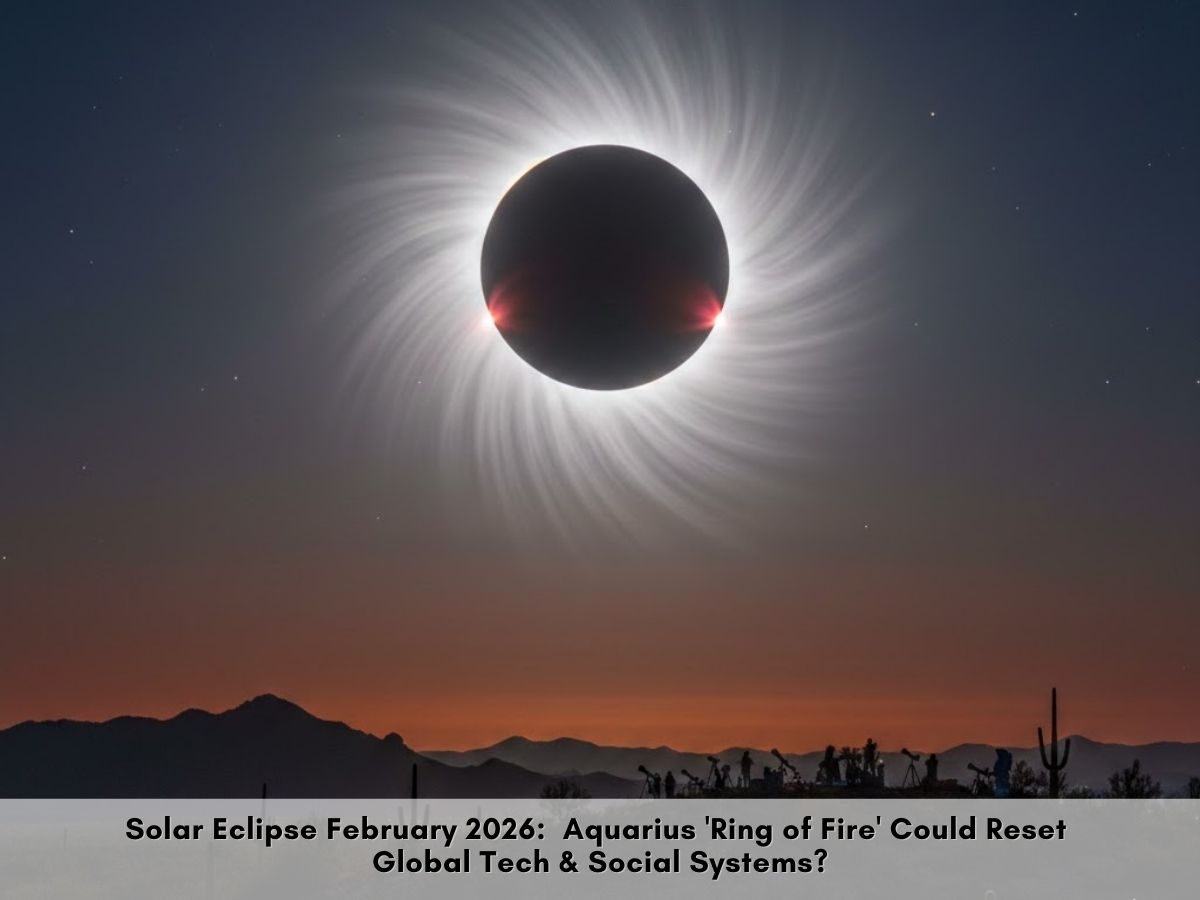
On February 17, 2026, a spectacular "ring of fire" annular solar eclipse will occur, primarily visible across the remote reaches of Antarctica and the Southern Ocean. While the full annularity is restricted to these southern latitudes, residents across southern South America will experience a significant partial eclipse throughout the afternoon.
The February 2026 solar eclipse represents one of the most unique astronomical events of the decade due to its path over the Earth’s most isolated continent. Unlike a total solar eclipse, where the moon completely obscures the sun, an annular eclipse occurs when the moon is near its apogee—the point in its orbit farthest from Earth. Because the moon appears slightly smaller in the sky than the sun, it leaves a brilliant outer ring of the solar disk visible, creating the iconic "ring of fire" effect. This phenomenon requires specific safety precautions and precise timing to witness safely and effectively.
The Mechanics of the February 17, 2026 Annular Eclipse
To understand the 2026 "ring of fire," one must look at the orbital mechanics involved. A solar eclipse occurs when the moon passes directly between the Earth and the sun. However, the moon's orbit is elliptical rather than perfectly circular. When the moon is at its furthest point from Earth, its apparent diameter is insufficient to cover the entire solar disk. During the maximum phase of the February 17 event, the moon will cover approximately 96% of the sun's center, leaving the remaining 4% to form the luminous ring.
This specific eclipse belongs to Saros series 121, a cycle of eclipses that repeats every 18 years and 11 days. The 2026 event is the 61st eclipse of the 71 events in this particular series. Because the sun is never completely blocked, the sky does not turn pitch black as it does during a total eclipse. Instead, the environment takes on a surreal, eerie twilight hue, temperatures may drop slightly, and shadows become incredibly sharp and crescent-shaped.
Path of Annularity: The Antarctic Traverse
The "path of annularity" is the narrow corridor where the moon is perfectly centered over the sun. For the 2026 eclipse, this path is exceptionally remote. The shadow of the moon first touches the Earth’s surface in the Southern Ocean, south of Africa, and proceeds to race across the Antarctic continent.
Most of the path traverses the icy wilderness of East Antarctica, passing near several research stations but remaining largely inaccessible to the general public. The maximum point of the eclipse—where the annularity lasts the longest—occurs at 12:12 UTC in the Southern Ocean, just off the coast of the Princess Elizabeth Land region of Antarctica. At this point, the ring of fire will persist for approximately 2 minutes and 9 seconds.
Because the path is so far south, the sun will be relatively low on the horizon for many observers. This provides a unique opportunity for photographers to capture the "ring" against the backdrop of icebergs or the Antarctic landscape, provided they are positioned on one of the few expedition vessels planned for the region this season.
Regional Visibility: Partial Phases in South America
While the true "ring of fire" is reserved for those in the far south, a partial solar eclipse will be visible across a massive portion of the Southern Hemisphere. This includes nearly all of Argentina, Chile, Uruguay, and parts of southern Brazil and Paraguay.
In these regions, the moon will appear to take a "bite" out of the sun. The further south the observer is located, the larger the bite will be. For example, in Ushuaia, Argentina—the world's southernmost city—the obscuration will be significant, with over 60% of the sun covered by the moon. In contrast, observers in Buenos Aires or Santiago will see a more modest partial eclipse.
Key Visibility Locations and Data
The following table outlines the expected timing and coverage for major locations during the February 17, 2026, event. Times are provided in Local Time for each region.
| Location | Eclipse Type | Start of Partial | Maximum Phase | End of Partial | Sun Obscuration |
|---|---|---|---|---|---|
| Antarctic Coast (Max) | Annular | 10:45 UTC | 12:12 UTC | 13:40 UTC | 96.0% |
| Ushuaia, Argentina | Partial | 08:32 ART | 09:40 ART | 10:55 ART | 64.2% |
| Punta Arenas, Chile | Partial | 08:28 CLT | 09:35 CLT | 10:50 CLT | 61.8% |
| Montevideo, Uruguay | Partial | 09:15 UYT | 10:10 UYT | 11:12 UYT | 28.5% |
| Buenos Aires, Argentina | Partial | 09:12 ART | 10:05 ART | 11:05 ART | 26.3% |
| Santiago, Chile | Partial | 08:45 CLT | 09:25 CLT | 10:10 CLT | 15.4% |
Essential Safety Protocols for Solar Observation
The most critical aspect of the 2026 ring of fire eclipse is safety. Unlike the brief "totality" of a total solar eclipse, an annular eclipse never offers a safe moment to look at the sun with the naked eye. Even when 96% of the sun is covered, the remaining 4% of the solar ring is powerful enough to cause permanent retinal damage, often referred to as "eclipse blindness" or solar retinopathy.
Certified Solar Filters
To view the eclipse directly, you must use solar viewing glasses or handheld solar viewers that meet the ISO 12312-2 international safety standard. These filters are thousands of times darker than standard sunglasses, which provide absolutely no protection against the sun’s intense infrared and ultraviolet radiation. Before use, always inspect your eclipse glasses for scratches, punctures, or tears. If the filter is damaged, discard it immediately.
Indirect Viewing Methods
If you do not have certified glasses, indirect viewing is a safe and effective alternative.
- Pinhole Projector: Poke a small hole in a piece of cardstock and allow the sunlight to pass through the hole onto a second piece of paper held a few feet away. You will see an inverted image of the eclipsed sun projected onto the surface.
- Natural Pinhole Effects: During the peak of the eclipse, look at the shadows cast by the leaves of trees. The small gaps between leaves act as natural pinholes, projecting hundreds of tiny "rings" or crescents onto the ground.
Protection for Optics
If you plan to use binoculars, a telescope, or a camera, you must use a dedicated solar filter on the front (the objective lens) of the device. Never look through an unfiltered optical device while wearing eclipse glasses; the concentrated light will melt the glasses and cause instant eye injury.
Photography Tips for the Ring of Fire
Capturing an annular eclipse requires specific gear and preparation. Because the "ring" is extremely bright, your camera's sensor needs the same protection as your eyes.
- Solar Filters for Lenses: Use a "white light" solar filter or a high-density ND filter (specifically ND100,000 or higher) designed for solar photography. This will allow you to capture the details of the solar disk without overexposing the shot or damaging your sensor.
- Focal Length: To fill the frame with the sun, a focal length of at least 400mm to 600mm is recommended. On a crop-sensor camera, a 300mm lens is often sufficient to see significant detail.
- Exposure Settings: Keep your ISO low (ISO 100 or 200) to minimize noise. Use a fast shutter speed, as the sun is remarkably bright even during annularity. Bracketing your exposures (taking a series of shots at different shutter speeds) is a wise strategy to ensure you get the perfect "ring" shot.
- Stability: A sturdy tripod is non-negotiable. At high focal lengths, even the slightest vibration from the wind or your hand will result in a blurry image.
Logistics and Expeditions for 2026
Given that the path of annularity is restricted to Antarctica, the 2026 event has spurred a niche market for eclipse-chasing cruises. Most expeditions depart from Ushuaia, Argentina, or Punta Arenas, Chile, heading south toward the South Shetland Islands and the Antarctic Peninsula.
Travelers considering these expeditions should be aware of the logistical challenges. February is late summer in the Southern Hemisphere, offering the best possible weather for Antarctic travel, but the Southern Ocean remains unpredictable. Ships must be equipped to handle "Drake Passage" conditions, and flexibility is key. Many captains will adjust the ship's position on eclipse day to find holes in the cloud cover, providing the best possible chance of witnessing the ring of fire.
For those staying on the South American mainland, the most favorable weather is typically found in the "rain shadow" regions of the Andes in Patagonia. Cities like Rio Gallegos or El Calafate in Argentina often have clearer skies than the more coastal or mountainous regions of Chile, making them prime spots for viewing the partial phases.
Why the 2026 Eclipse Matters
This eclipse serves as a bridge between major astronomical events. Following the high-profile eclipses of recent years, the 2026 annular eclipse reminds us of the sheer scale of the solar system. It is a technical challenge for photographers, a logistical hurdle for travelers, and a beautiful scientific display for researchers studying the solar corona and the Earth's ionosphere.
Frequently Asked Questions
Can I see the 2026 Ring of Fire from the United States or Europe?
No, the February 17, 2026, annular solar eclipse is entirely invisible from the Northern Hemisphere. The path of the moon's shadow remains confined to the southern latitudes, specifically Antarctica and the southern reaches of South America. Residents in the North will need to wait for the total solar eclipse in August 2026 (visible in Spain and Iceland) for their next major event.
How long does the "Ring of Fire" last?
The duration of annularity depends on your location within the path. At the point of greatest eclipse in the Southern Ocean, the ring will last for 2 minutes and 9 seconds. Near the edges of the path, the duration will be much shorter, lasting only a few seconds. The entire partial phase of the eclipse lasts roughly two to three hours.
Is it safe to take a photo of the eclipse with my smartphone?
You can take a photo, but you must protect the lens. Using a smartphone without a filter during an annular eclipse can damage the camera sensor over time and will likely result in a "blown-out" image where the sun looks like a giant white blob. Hold a pair of certified eclipse glasses over the smartphone lens to get a clear, safe image of the crescent or ring.
What happens if it is cloudy on February 17?
If there is 100% cloud cover, you will not be able to see the sun or the moon's silhouette. However, because this is an annular eclipse, you will still notice a significant "dimming" of the daylight during the maximum phase. The sky will take on a deep, gloomy grey color, and the temperature may drop noticeably, even if the sun itself is obscured by clouds.
Is this the same as the eclipse in August 2026?
No. There are two major solar eclipses in 2026. The February 17 event is an annular eclipse visible in the Southern Hemisphere (Antarctica/South America). The August 12 event is a total solar eclipse visible in the Northern Hemisphere (Greenland, Iceland, and Spain). They are separate events caused by different alignments of the moon's orbit.
Preparing for the Next Phase
To make the most of the 2026 ring of fire eclipse, begin your preparations by securing certified ISO 12312-2 eclipse glasses well in advance of February. If you are located in South America, identify a viewing spot with a clear view of the sun’s path in the morning and early afternoon. For those aiming for the path of annularity in Antarctica, ensure your travel arrangements and specialized solar photography equipment are finalized, as expedition slots for such rare celestial events are typically reserved months or even years in advance.