The 2024 NFL Draft rookie contracts are governed by the NFL’s Collective Bargaining Agreement (CBA), which utilizes a rigid "Rookie Wage Scale." This system predetermines contract lengths (four years), total values, and signing bonuses based on draft position, leaving almost no room for negotiation regarding the base salary or duration of the deal.
The Foundation of the NFL Rookie Wage Scale
The current landscape of NFL rookie compensation is a far cry from the era preceding the 2011 Collective Bargaining Agreement. Before these rules were implemented, top draft picks often commanded massive, unproven contracts that eclipsed those of established All-Pro veterans. The most famous example, Sam Bradford’s $78 million rookie deal in 2010, served as the catalyst for change. As of 2026, the league continues to operate under the refined version of the 2020 CBA, which further streamlined how the 2024 class was paid.
The "Rookie Wage Scale" was designed to funnel more money toward veteran players by capping the amount teams can spend on incoming talent. For the 2024 draft class, this meant that every player selected, from the first overall pick to the final "Mr. Irrelevant," entered the league with a contract value already largely calculated by the league's mathematical formulas. These formulas account for the league’s Total Salary Cap, which saw a historic jump to $255.4 million in 2024.
Because the total value is "slotted," the only real points of contention in negotiations for 2024 draftees involved the "offset language" and the timing of signing bonus payments. Offset language determines whether a team is relieved of its financial obligation if a player is cut and subsequently signs with another team. For the top picks in 2024, such as Caleb Williams and Jayden Daniels, these technicalities were the primary focus of their agents during the summer signing period.
Understanding the 2024 Total Rookie Pool and Year-One Cap Hits
Every NFL team is assigned a "Total Rookie Pool," which is the maximum amount the club can spend on its entire draft class in their first year. This is not a separate pot of money but rather a subset of the team's overall $255.4 million salary cap for 2024.
The Total Rookie Pool is divided into two parts: the "Year-One Rookie Allocation" and the total life-of-contract value. The year-one allocation is crucial because it limits the initial cap hit of the rookies. For example, even if a player receives a $25 million signing bonus, that bonus is prorated over the four years of the contract for cap purposes. This allows teams to fit their entire draft class into a relatively small sliver of the overall cap, typically ranging from $10 million to $15 million total for the first year, depending on the number and position of their picks.
The 2024 rookie pool was particularly significant because of the high concentration of quarterbacks taken early in the first round. Since the first overall pick's contract is significantly higher than the 32nd pick, teams like the Chicago Bears and Washington Commanders had to account for much larger rookie allocations than teams drafting later in the round.
The Mechanics of the 25% Rule and Bonus Structures
One of the more technical aspects of the 2024 NFL draft contract rules is the "25% Rule." This rule is designed to prevent teams from backloading rookie contracts with massive salary jumps in the final years to circumvent cap pressure.
According to this rule, the "Year 2" salary (base salary plus any roster bonuses, but excluding signing bonus proration) cannot increase by more than 25% of the "Year 1" total. This creates a steady, predictable climb in the player's cost over the four-year duration. For example, if a 2024 third-round pick had a year-one base salary of $795,000, his year-two base salary increase is strictly limited by this percentage of the original rookie cap hit.
Signing bonuses are the most vital component of the 2024 deals because they represent the only money that is typically "guaranteed at signing" for players drafted in the later rounds. In the first round, and increasingly in the second round, almost the entirety of the four-year deal is fully guaranteed. However, for players taken in rounds four through seven, the signing bonus might be the only guaranteed money they ever see if they fail to make the 53-man roster.
First-Round Specifics: The Fifth-Year Option and Fully Guaranteed Terms
Players selected in the first round of the 2024 NFL Draft receive a unique contract structure compared to those taken in rounds two through seven. The most notable difference is the Fifth-Year Option. This is a team-held option that must be exercised after the player's third season (for the 2024 class, this decision point will occur in the spring of 2027).
The 2020 CBA overhaul changed how these options are valued. Instead of being based strictly on draft slot, the fifth-year option is now tiered based on performance:
- Multiple Pro Bowls: The fifth-year salary equals the Franchise Tag amount for that position.
- One Pro Bowl: The salary equals the Transition Tag amount.
- Playtime Requirement: Players who meet specific snaps-played thresholds (75% in two of three years, or 50% average over three years) receive a salary based on the average of the top 3rd-to-20th highest salaries at their position.
- Basic: Players who do not meet these criteria receive a salary based on the average of the top 3rd-to-25th highest salaries.
Crucially, as of the 2020 CBA, once the fifth-year option is exercised, the salary becomes 100% fully guaranteed. For the 2024 class, this means that top-tier performers will see massive one-year paydays in 2028 that are locked in a year in advance.
2024 NFL Draft Contract Value Estimates by Slot
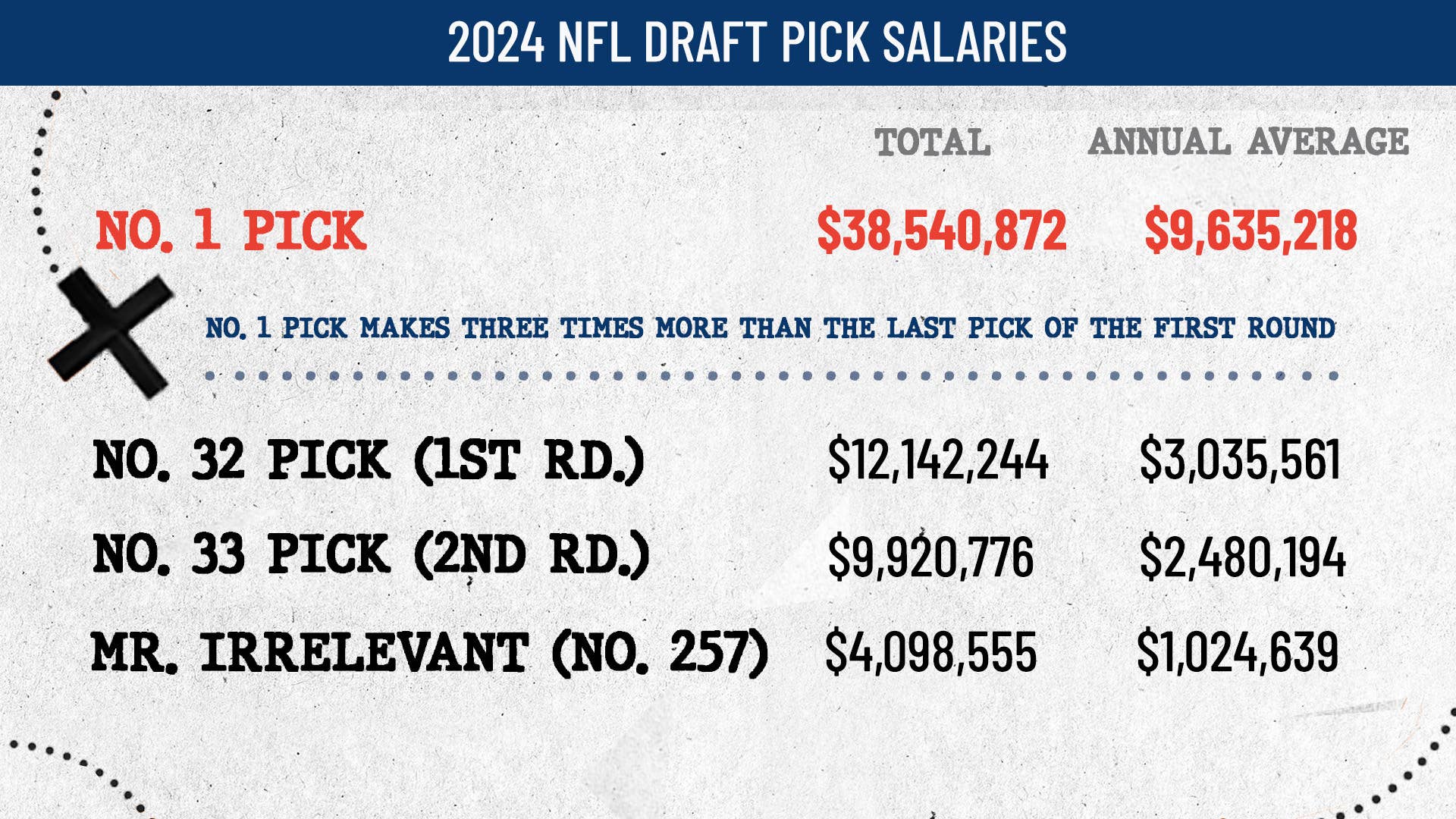
The following table outlines the approximate total contract values and signing bonuses for various positions in the 2024 NFL Draft. These figures are based on the $255.4 million salary cap established for the 2024 season.
| Draft Slot | Example Player (2024) | Approx. Total Value (4 Years) | Approx. Signing Bonus |
|---|---|---|---|
| Pick #1 | Caleb Williams (QB) | $39,486,057 | $25,537,132 |
| Pick #5 | Joe Alt (OT) | $33,161,212 | $20,937,244 |
| Pick #10 | J.J. McCarthy (QB) | $21,851,714 | $12,712,156 |
| Pick #20 | Troy Fautanu (OT) | $15,055,372 | $7,769,360 |
| Pick #32 | Xavier Legette (WR) | $12,357,644 | $5,807,376 |
| 2nd Round (#33) | Keon Coleman (WR) | $10,074,586 | $4,146,972 |
| 4th Round (#101) | Ja'Tavion Sanders (TE) | $4,856,128 | $836,128 |
| 7th Round (#257) | Jaylen Key (S) | $4,101,300 | $81,300 |
Note: All rookie contracts are for four years. First-round picks include a team option for a fifth year.
Differences Between Drafted Rounds and Undrafted Free Agents (UDFA)
The financial gap between being the last player drafted and the first player not drafted is significant. While "Mr. Irrelevant" (the 257th pick in 2024) received a four-year contract worth roughly $4.1 million with a modest signing bonus, Undrafted Free Agents (UDFAs) enter a different system entirely.
UDFAs sign three-year contracts rather than four-year deals. While they have the freedom to choose which team they sign with—often picking based on depth chart weakness—their signing bonuses are capped. For the 2024 cycle, each team had an "Undrafted Free Agent Signing Bonus Limit" of approximately $190,000 to $200,000 total. A team could give one elite UDFA a $30,000 bonus or split it among 15 players.
However, UDFAs often negotiate for "base salary guarantees." A team might offer a UDFA a $15,000 signing bonus but guarantee $150,000 of his first-year base salary to entice him to sign. This financial floor is the only leverage these players have before they hit Restricted Free Agency (RFA) after their third season.
Negotiation Leverage in the Modern Era
While the "Wage Scale" removed the ability to negotiate the total dollar amount, agents still fight over specific clauses that impact a player's long-term security. The two primary battlegrounds for the 2024 class were:
- Payment Schedule of the Signing Bonus: Top picks want their signing bonus paid upfront in a lump sum. Teams often prefer to defer payments into the following calendar year for cash-flow reasons. For a #1 overall pick, receiving $25 million in July vs. receiving it in installments over 12 months is a major point of contention due to the time value of money.
- Offset Language: As mentioned previously, this is the most common reason for rookie "holdouts" in the modern era. If a player is drafted #5 overall and is cut after three years, he is still owed his fourth-year guaranteed salary. If he signs with a new team for $2 million, "offset language" allows the original team to deduct that $2 million from what they owe him. Agents strive to remove these offsets so their clients can "double dip" if they are released.
By 2026, we have seen that most top-10 picks now successfully negotiate for most of their signing bonuses to be paid within the first few months of signing, while offset language remains a standard inclusion for most teams outside of the top three to five selections.
Frequently Asked Questions
Are 2024 NFL rookie contracts fully guaranteed?
For the first round of the 2024 draft, almost every contract is 100% fully guaranteed for all four years. As you move into the second round, the percentage of guaranteed money begins to drop. By the fourth round and beyond, typically only the signing bonus is guaranteed, meaning the player must make the roster to earn their base salary.
Can a rookie hold out for more money under the 2024 rules?
Technically, a rookie can refuse to sign, but they have zero leverage to increase the total value of the deal because of the slotted wage scale. A holdout in 2024 would generally be over technicalities like offset language or bonus payment timing, not the total contract amount. If a player does not sign by a specific deadline, they must wait until the following year's draft to be selected again.
How does the 25% rule impact a player's cap hit in 2025?
The 25% rule ensures that a player's 2025 cap hit (excluding proration) does not jump more than 25% of the 2024 figure. This creates a "smooth" salary cap transition, preventing teams from pushing all the financial "pain" of a contract into the final year of the deal.
What is the "Rookie Salary Cap" for each team?
Each team has a specific "Year-One Rookie Allocation." This is not an extra amount of money but a limit on how much of the team's total $255.4 million cap can be occupied by rookies. This ensures that teams with multiple first-round picks don't have an unfair advantage or disadvantage in managing their veteran roster.
How are signing bonuses taxed for rookies?
Signing bonuses are generally taxed based on the state where the team is located, though some "jock taxes" apply to game-day checks in other states. For the 2024 class, players drafted by teams in states with no income tax (like the Florida or Texas teams) saw a significantly higher "take-home" portion of their signing bonus compared to those drafted by the California or New York teams.
Final Financial Considerations for the 2024 Class
As the 2024 rookie class moves through their careers toward 2026 and beyond, their contracts serve as the baseline for their future earnings. Because these deals are capped and fixed, the most successful players will seek "extensions" as soon as they are eligible. Under NFL rules, drafted rookies cannot renegotiate or extend their contracts until after the completion of their third regular-season game of their third season. For the 2024 class, the "extension window" will officially open in early 2027.
For fans and analysts, understanding that these numbers are fixed helps clarify team-building strategies. A team with a "rookie-scale quarterback" like Caleb Williams has a massive competitive advantage because his $10 million average cap hit is significantly lower than the $50 million to $60 million commanded by veteran elite quarterbacks, allowing the team to spend heavily on other positions during this four-year window.