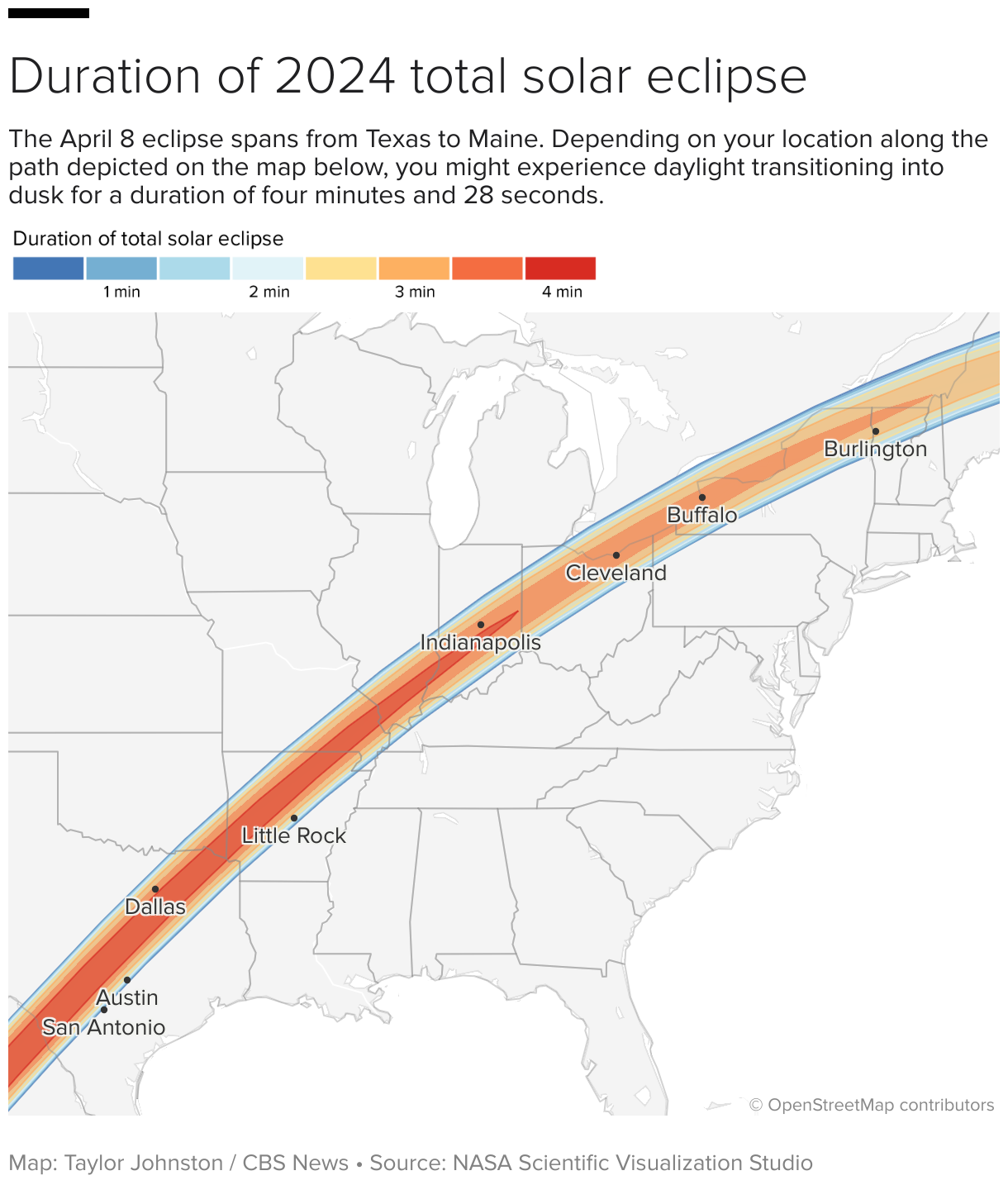
The total solar eclipse of April 8, 2024, was a seminal astronomical event characterized by a path of totality that spanned Mexico, the contiguous United States, and southeastern Canada. Occurring during a period of high solar activity, it offered a maximum totality duration of 4 minutes and 28 seconds, providing scientists and the public with an unprecedented view of the Sun’s active corona.
Chronology and the Path of Totality
The April 8, 2024, total solar eclipse was distinguished by its vast geographic reach and the high density of the population residing within its path. Unlike the 2017 "Great American Eclipse," the 2024 path was significantly wider—ranging from 108 to 122 miles—owing to the Moon’s closer proximity to Earth (perigee) during the event. This proximity resulted in a larger apparent lunar disk, which completely obscured the Sun for a longer duration and over a broader area.
The shadow first touched the Pacific coast of Mexico near Mazatlán at approximately 11:07 a.m. MST. It then traveled northeast through the Mexican states of Sinaloa, Durango, and Coahuila. Crossing the Rio Grande, the totality entered the United States through Texas and proceeded to traverse Oklahoma, Arkansas, Missouri, Illinois, Kentucky, Indiana, Ohio, Pennsylvania, New York, Vermont, New Hampshire, and Maine. Small portions of Tennessee and Michigan also experienced totality. In Canada, the path crossed Ontario, Quebec, New Brunswick, Prince Edward Island, and Newfoundland, eventually exiting the North American continent into the Atlantic Ocean.
The timing and duration varied significantly based on the observer's proximity to the center line of the path. While those on the edges experienced only a few seconds of totality, those near the center line in north-central Mexico and Texas enjoyed the maximum duration of nearly four and a half minutes. This duration was nearly double that of the 2017 eclipse, making it one of the most significant observational opportunities of the 21st century.
Totality Durations and Local Circumstances
The table below outlines key locations within the path of totality and the specific duration of the total phase experienced at those coordinates during the 2024 event.
| Location | Totality Start (Local Time) | Duration of Totality | Solar Altitude |
|---|---|---|---|
| Mazatlán, Sinaloa, Mexico | 11:07 a.m. MST | 4m 17s | 69° |
| Torreón, Coahuila, Mexico | 12:16 p.m. CST | 4m 28s | 70° |
| Eagle Pass, Texas, USA | 1:27 p.m. CDT | 4m 24s | 67° |
| Dallas, Texas, USA | 1:40 p.m. CDT | 3m 51s | 64° |
| Indianapolis, Indiana, USA | 3:06 p.m. EDT | 3m 47s | 53° |
| Cleveland, Ohio, USA | 3:13 p.m. EDT | 3m 48s | 49° |
| Buffalo, New York, USA | 3:18 p.m. EDT | 3m 45s | 45° |
| Montreal, Quebec, Canada | 3:26 p.m. EDT | 1m 27s | 40° |
| Gander, Newfoundland, Canada | 5:12 p.m. NDT | 2m 13s | 19° |
Solar Maximum and the Active Corona
One of the most scientifically significant aspects of the 2024 eclipse was its timing relative to the solar cycle. The Sun operates on an approximately 11-year cycle of magnetic activity, moving from solar minimum to solar maximum. The 2017 eclipse occurred near solar minimum, when the Sun’s magnetic field is relatively stable and the corona appears asymmetrical with streamers primarily extending from the solar equator.
In contrast, the 2024 eclipse occurred during or very near the Solar Maximum. This phase is characterized by a highly distorted and active magnetic field. Observers were treated to a "spiky" corona that extended in all directions, often appearing as a tangled web of plasma. Because of this heightened activity, several notable solar phenomena were visible to the naked eye during totality:
- Solar Prominences: These are massive loops of glowing plasma anchored in the photosphere and extending into the corona. During the 2024 event, many observers noted distinct ruby-red "dots" or loops along the limb of the Moon, which were actually prominences.
- Coronal Streamers: The corona appeared more voluminous and complex, with streamers visible across the entire solar disk rather than just the equatorial regions.
- Potential Coronal Mass Ejections (CMEs): Given the timing, there was a high statistical probability of a CME occurring during the eclipse. While a massive eruptive event was not captured in real-time by all ground observers, solar telescopes and professional instruments recorded significant plasma dynamics.
The National Solar Observatory (NSO) and other institutions utilized this event to study the "middle corona," a region that is difficult to observe even with space-based coronagraphs. By using the Moon as a natural occulting disk, researchers were able to measure the temperature and magnetic properties of the solar atmosphere with extreme precision.
Technological and Observational Advancements
The 2024 eclipse was likely the most-documented astronomical event in history, thanks to advancements in mobile technology and distributed scientific sensors. Beyond amateur photography, several high-level scientific missions were deployed to capture data that would be impossible to obtain under normal circumstances.
NASA’s Airborne Research
NASA deployed its WB-57 high-altitude research aircraft to chase the shadow of the Moon. Flying at altitudes above 50,000 feet, these jets were equipped with infrared and visible-light cameras. By flying along the path of totality, the aircraft were able to extend the duration of totality by several minutes and observe the Sun from above the majority of Earth's atmosphere, which often distorts or blocks specific wavelengths of light.
Citizen Science and the Eclipse Megamovie
Projects like the "Eclipse Megamovie" encouraged thousands of volunteers to use DSLR cameras to capture the eclipse. These images were then stitched together using algorithms to create a continuous, high-resolution view of the corona as it changed over the course of its journey across North America. This crowdsourced data provided a level of temporal resolution that a single observatory could not achieve.
Ionospheric Studies
The sudden cooling of the atmosphere and the removal of solar radiation during an eclipse create a "hole" in the ionosphere—the layer of Earth's atmosphere containing charged particles. Researchers used the 2024 eclipse to study how these changes affect radio communications and GPS signals. NASA’s Atmospheric Perturbations around Eclipse Path (APEP) mission launched three sounding rockets from Wallops Island, Virginia, before, during, and after the eclipse to measure these fluctuations in the upper atmosphere.
Economic Impact and Infrastructure Challenges
The 2024 eclipse was a significant "mega-event" for the North American economy, particularly for rural towns located within the path of totality. Estimates suggested that the eclipse generated billions of dollars in economic activity, driven primarily by travel, lodging, and dining.
However, the influx of millions of people into the narrow path of totality created significant logistical hurdles. Many small municipalities saw their populations triple or quadruple overnight. This led to:
- Traffic Congestion: In many areas, particularly in the "hill country" of Texas and the rural regions of Vermont and Maine, traffic remained at a standstill for hours after the eclipse concluded. This phenomenon, often called the "eclipse exit," is a known challenge where the arrival of visitors is spread over days, but the departure is simultaneous.
- Resource Depletion: Some smaller towns reported shortages of fuel and groceries. Local governments had to issue emergency declarations months in advance to ensure they had adequate emergency medical services and law enforcement.
- Grid Management: For the energy sector, the eclipse presented a unique challenge. Solar power generation plummeted as the shadow moved across the continent. Grid operators, such as ERCOT in Texas and PJM in the Northeast, had to prepare for a rapid ramp-down and subsequent ramp-up of solar energy, relying on natural gas and hydroelectric power to bridge the gap.
Safety Standards and Eye Protection Protocols
A critical component of the 2024 eclipse was the massive public health campaign regarding eye safety. Viewing the Sun directly, even when it is 99% obscured, can cause solar retinopathy, a permanent damage to the retina.
The gold standard for safety was the ISO 12312-2 international standard for solar filters. This standard dictates that filters must block more than 99.99% of visible light and nearly all ultraviolet and infrared radiation. During the 2024 event, the American Astronomical Society (AAS) worked extensively to identify and warn the public about counterfeit eclipse glasses that flooded online marketplaces.
The only time it was safe to view the eclipse without protection was during the brief period of totality—when the Moon completely covered the Sun's bright face (the photosphere). At that moment, the corona, which is only about as bright as a full moon, became visible. Understanding the transition from the "Diamond Ring" effect to totality was essential for observers to know when to remove and replace their glasses.
Future Total Solar Eclipses in North America
For many who witnessed the 2024 event, the experience sparked a lifelong interest in "eclipse chasing." While partial solar eclipses occur relatively frequently, total solar eclipses are rare at any specific geographic location.
The next total solar eclipse to touch the contiguous United States will not occur until August 23, 2044. This event will have a much smaller footprint, primarily affecting Montana, North Dakota, and parts of Canada. Shortly thereafter, on August 12, 2045, a "Great American Eclipse" will cross the United States from California to Florida, featuring a path of totality and durations exceeding six minutes in some areas.
Internationally, those seeking totality sooner will look to the eclipse of August 12, 2026, which will pass over Greenland, Iceland, and Spain. This 2026 event is currently the primary focus for the global astronomical community, as it offers a totality path through highly accessible regions of Europe.
FAQ: Common Questions About the 2024 Eclipse
Why was the 2024 eclipse longer than the 2017 eclipse?
The 2024 eclipse was longer because the Moon was closer to the Earth in its elliptical orbit. When the Moon is at its "perigee" (closest point), it appears larger in the sky, casting a wider shadow and taking more time to move across the solar disk. Additionally, the Earth was farther from the Sun in April than it was during the August 2017 eclipse, making the Sun appear slightly smaller.
Did the 2024 eclipse cause any permanent damage to the power grid?
No permanent damage was reported. While there was a significant drop in solar power production—Texas alone lost several gigawatts of capacity during the peak—grid operators successfully compensated by using reserve power sources. The event served as a successful "stress test" for modern renewable-heavy energy grids.
What were "Baily's Beads" and the "Diamond Ring" seen during the event?
Baily's Beads are bright spots of sunlight that appear just before and after totality as the Sun's light passes through the valleys and craters on the Moon's rugged limb. The Diamond Ring occurs when only one "bead" remains, creating a brilliant flare of light set against the thin circle of the inner corona, resembling a ring with a large diamond.
How did animals react during the 2024 totality?
Researchers and citizen scientists noted significant behavioral changes in both domestic and wild animals. Many birds returned to their nests thinking it was nightfall, while nocturnal insects like crickets began to chirp. Some zoo animals, such as giraffes and tortoises, displayed signs of anxiety or retreated to their evening enclosures as the temperature dropped and the sky darkened.
Where can I find the most accurate historical data for the 2024 eclipse path?
The most authoritative data is maintained by the NASA Eclipse Web Site and the AAS Solar Eclipse Task Force. These archives include high-resolution umbral maps, contact timings, and local circumstances for every city within the path.
Strategic Recommendations for Future Eclipse Planning
For those planning to witness future totalities, such as the 2026 European eclipse or the 2044/2045 U.S. events, several lessons from 2024 are paramount. First, mobility is key. Cloud cover is the primary antagonist of an eclipse observer; having the ability to drive 100 miles in any direction based on short-term weather forecasts is essential.
Second, early procurement of safety gear is necessary to avoid the influx of fraudulent products that appear in the months leading up to the event. Finally, observers should prioritize the "experience" over photography. The 2024 eclipse proved that while professional equipment can capture the corona, the atmospheric changes—the 10-degree temperature drop, the eerie 360-degree sunset, and the sudden silence—are best experienced away from the viewfinder.