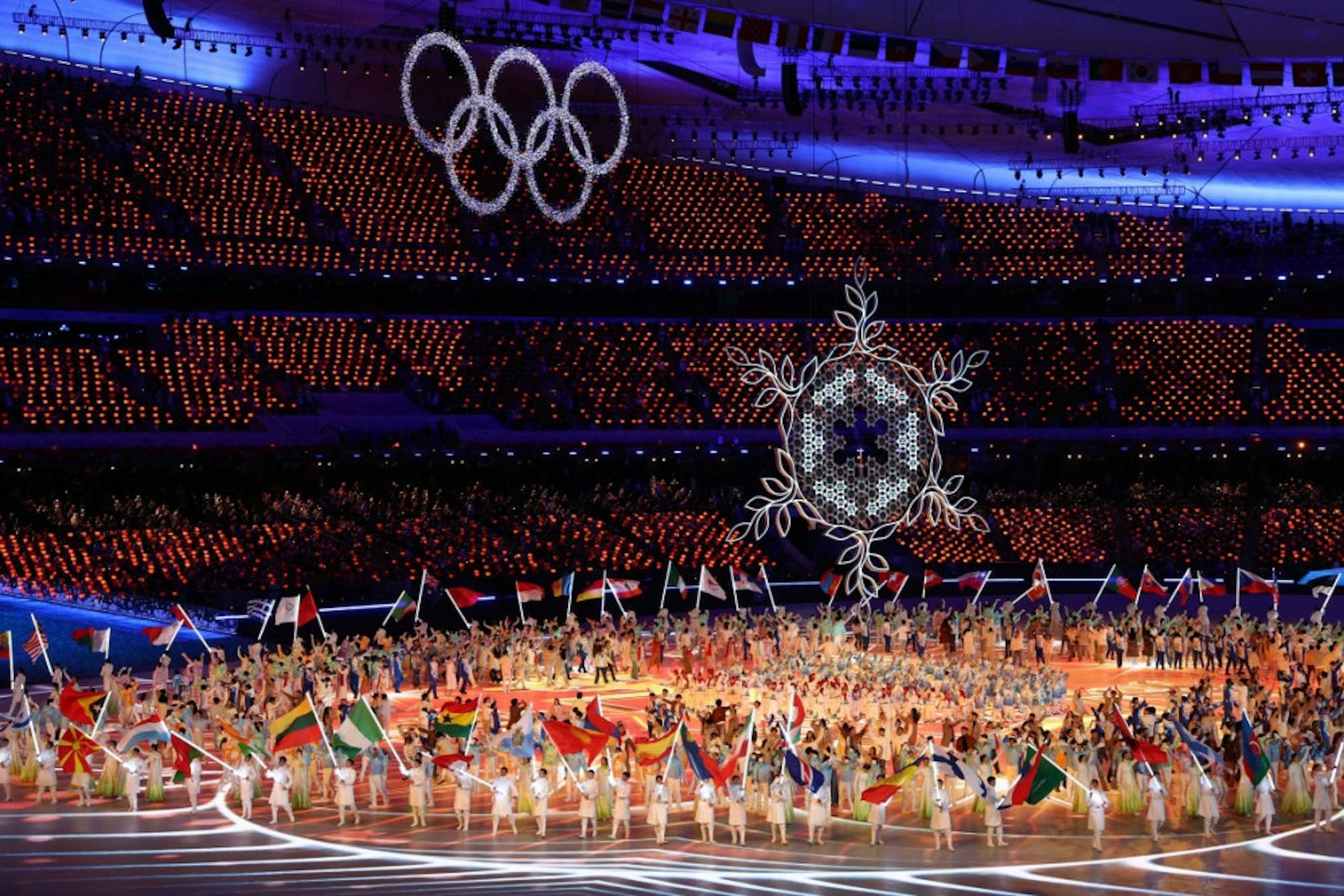
The 2022 Winter Olympics, officially the XXIV Olympic Winter Games, were held from February 4 to February 20, 2022, in Beijing, China. This landmark event established Beijing as the first city to host both the Summer and Winter Games, emphasizing sustainable venue reuse, pioneering carbon-neutral technologies, and a rigorous "closed-loop" management system.
Beijing’s Historic "Dual-Olympic" Status
The 2022 Winter Olympics were defined by the strategic reuse of infrastructure from the 2008 Summer Games. This "Dual-Olympic" approach was a central pillar of the International Olympic Committee’s (IOC) "Olympic Agenda 2020," which advocates for the use of existing facilities to reduce costs and environmental impact. The most iconic transformation was the conversion of the National Aquatics Center, known as the "Water Cube," into the "Ice Cube." By installing a removable ice-making structure over the swimming pool, organizers created a world-class curling venue that could revert to a swimming facility post-Games.
Similarly, the National Stadium, famously known as the "Bird's Nest," hosted the opening and closing ceremonies, just as it had in 2008. The reuse of these venues served as a global case study for urban sports sustainability. As of 2026, these facilities continue to serve as multifunctional hubs for both elite training and public recreation, proving that the high costs of Olympic infrastructure can yield long-term social value if managed with a "lifecycle" perspective.
Beyond the urban center, the Games expanded into the Yanqing and Zhangjiakou regions. This regional development plan was designed to jumpstart China’s domestic winter sports industry. The integration of these three clusters was made possible by the construction of the Beijing-Zhangjiakou high-speed railway, which reduced travel time from several hours to just 50 minutes, effectively creating a unified sports corridor.
The Three Competitive Clusters: Architecture and Infrastructure
The competition was organized into three distinct geographical zones, each tailored to specific disciplines and technical requirements.
The Beijing Cluster
Primarily utilized for ice sports, this cluster relied heavily on 2008 legacy venues. However, it also featured the only new permanent venue in the city: the National Speed Skating Oval, commonly referred to as the "Ice Ribbon." The facility features a sleek exterior comprised of 22 glass ribbons. Technically, it was the first Olympic venue to use carbon dioxide transcritical direct refrigeration for ice making, a technology that significantly reduces energy consumption and greenhouse gas emissions compared to traditional hydrofluorocarbons.
The Yanqing Cluster
Located 75 kilometers northwest of central Beijing, Yanqing hosted the alpine skiing and sliding events (bobsleigh, luge, and skeleton). The National Sliding Center, known as the "Flying Snow Dragon," features a 1,975-meter track with 16 curves, including a unique 360-degree turn. Its design incorporated a wooden roof structure to provide shade, reducing the energy required to keep the track frozen.
The Zhangjiakou Cluster
Situated 180 kilometers from Beijing, Zhangjiakou was the hub for Nordic skiing, ski jumping, biathlon, and snowboarding. The National Ski Jumping Center, nicknamed "Snow Ruyi" due to its resemblance to a traditional Chinese ornamental scepter, was a centerpiece of architectural innovation. The venue was designed to integrate into the natural mountain landscape while providing state-of-the-art wind protection for athletes.
New Events and Athletic Milestones
The 2022 Games introduced seven new events to the Olympic program, reflecting a push for gender equality and youthful appeal. These additions brought the total number of events to 109 across 15 disciplines.
- Women’s Monobob: A solo bobsleigh event that focuses on the skill of the individual pilot, as all sleds are standardized.
- Freestyle Skiing Big Air (Men and Women): Held at the Shougang Park, an unconventional urban site built on a repurposed steel mill.
- Mixed Team Competitions: New team events were added in short-track speed skating, ski jumping, freestyle skiing aerials, and snowboard cross.
Athletically, the Games were marked by historic performances. Eileen Gu became a global sensation, winning three medals (two gold, one silver) in freestyle skiing for China, the first athlete to do so in three different freestyle disciplines at a single Games. In figure skating, Nathan Chen of the United States secured gold with a world-record short program score, while Nils van der Poel of Sweden dominated long-distance speed skating, breaking both Olympic and world records.
However, the Games were not without controversy. The figure skating world was rocked by a doping case involving Russian skater Kamila Valieva, which led to a protracted legal battle and delayed the medal ceremony for the team event—a situation that remained a point of discussion in sports law and ethics well into 2024 and 2025.
Technological Advancements: Artificial Snow and 5G Integration
The 2022 Winter Olympics were the first to rely almost 100% on artificial snow. Because the regions of Yanqing and Zhangjiakou are characterized by an arid climate, organizers deployed over 350 snow-making fans and guns supplied by the Italian company TechnoAlpin.
- Water Management: To address environmental concerns, organizers built a series of reservoirs and pumping stations to collect and recycle meltwater and rainwater.
- Precision Snowmaking: The "Smart Snowmaking" system utilized real-time weather data to optimize the density and temperature of the snow, ensuring consistent conditions for athletes across all heats, which is critical for safety and fair competition.
Technologically, the Games served as a massive testbed for 5G connectivity. The high-speed rail line connecting the clusters was the first in the world to offer stable 5G signals at speeds of 350 km/h. This allowed for high-definition "cloud broadcasting," where media outlets could edit and transmit 8K footage in real-time from the mountains back to international broadcast centers. In the Olympic Village, automation took center stage; robotic kitchens prepared and delivered meals via ceiling-mounted tracks, minimizing human contact during the pandemic.
Environmental Stewardship and Carbon Neutrality Goals
Beijing 2022 pledged to be the first carbon-neutral Olympics. This goal was pursued through four primary avenues:
- Renewable Energy: All venues were powered by 100% renewable energy, much of it generated by wind and solar farms in the Zhangjiakou region.
- Low-Carbon Transport: Over 80% of the vehicles used within the Games’ transport system were energy-efficient, utilizing hydrogen fuel cells or electric batteries.
- Ice Making: As mentioned, the use of CO2 refrigeration in four rinks reduced the ozone-depleting potential to zero and lowered energy usage by approximately 30% compared to conventional methods.
- Forestry Offsets: To compensate for unavoidable emissions, millions of trees were planted in the host regions, creating new green belts that now, in 2026, serve as significant carbon sinks.
The sustainability efforts were audited by third-party organizations, providing a transparent framework for future host cities like Milano Cortina (2026) and the French Alps (2030) to follow.
Statistical Performance: The 2022 Medal Tally
The 2022 Winter Olympics saw Norway continue its historical dominance in winter sports, while the host nation, China, achieved its best-ever performance in a Winter Games.
| Rank | NOC (Nation) | Gold | Silver | Bronze | Total |
|---|---|---|---|---|---|
| 1 | Norway | 16 | 8 | 13 | 37 |
| 2 | Germany | 12 | 10 | 5 | 27 |
| 3 | China | 9 | 4 | 2 | 15 |
| 4 | USA | 8 | 10 | 7 | 25 |
| 5 | Sweden | 8 | 5 | 5 | 18 |
| 6 | Netherlands | 8 | 5 | 4 | 17 |
| 7 | Austria | 7 | 7 | 4 | 18 |
| 8 | Switzerland | 7 | 2 | 5 | 14 |
| 9 | ROC (Russian Olympic Committee) | 6 | 12 | 14 | 32 |
| 10 | France | 5 | 7 | 2 | 14 |
Note: The ROC competed under a neutral flag due to ongoing sanctions related to previous anti-doping violations.
The "Closed-Loop" Management System
Perhaps the most unique aspect of the 2022 Games was the Closed-Loop Management System. To prevent the spread of COVID-19, all participants—including athletes, officials, media, and support staff—were confined to a strictly separated "bubble." This bubble encompassed the competition venues, designated hotels, and dedicated transportation lanes.
Participants were required to undergo daily PCR testing and were not permitted to interact with the general public. This logistical feat involved thousands of workers and a high degree of digital tracking via the "My2022" app. While these measures were criticized for their impact on the atmosphere and athlete mental health, they were remarkably effective from a public health perspective; the infection rate within the loop remained exceptionally low, allowing the Games to proceed to completion without major schedule disruptions.
Post-Games Utilization: The Status of Venues in 2026
As of 2026, the legacy of Beijing 2022 is visible in the transformation of its host regions. The Shougang Big Air site has become a global icon of urban regeneration, serving as a permanent sports park and tourism destination within a former industrial wasteland. In Zhangjiakou, the "Snow Ruyi" and surrounding facilities have matured into a premier training base for international winter sports teams, hosting multiple World Cup events since 2022.
The investment in the high-speed rail link has fostered a "winter sports belt" that has encouraged over 300 million Chinese citizens to participate in winter activities, according to official data verified by the International Olympic Committee. This massive increase in participation has shifted the global winter sports market, with significant growth in domestic equipment manufacturing and alpine tourism.
Essential Frequently Asked Questions
Who was the mascot for the 2022 Winter Olympics?
The official mascot was Bing Dwen Dwen, a panda encased in a "shell" of ice that resembled an astronaut suit. The name "Bing" means ice in Mandarin, symbolizing purity and strength, while "Dwen Dwen" suggests robustness and liveliness. The mascot became a massive commercial success, frequently selling out at retail locations worldwide.
How many sports were in the 2022 Winter Olympics?
The Games featured 7 sports encompassing 15 disciplines. These included alpine skiing, biathlon, bobsleigh, cross-country skiing, curling, figure skating, freestyle skiing, ice hockey, luge, Nordic combined, short track speed skating, skeleton, ski jumping, snowboarding, and speed skating.
Where did the opening and closing ceremonies take place?
Both ceremonies were held at the National Stadium (Bird's Nest) in Beijing. Directed by Zhang Yimou, who also directed the 2008 ceremonies, the events utilized advanced LED flooring technology and emphasized themes of global unity and the arrival of spring.
What happened to the Russian athletes in 2022?
Due to a ruling by the World Anti-Doping Agency (WADA) and the Court of Arbitration for Sport (CAS), Russian athletes competed under the name and flag of the Russian Olympic Committee (ROC). They were not permitted to use the Russian national anthem or display the Russian flag during medal ceremonies.
How was the "Ice Cube" created?
The transformation of the Water Cube into the Ice Cube involved a "water-to-ice conversion" technology. A steel support structure was installed in the pool to support a floor, upon which ice-making pipes were laid. This allowed the venue to switch between a swimming pool and a curling rink in approximately 20 days.
Transitioning to Milano Cortina 2026
The conclusion of the 2022 Games marked the beginning of a new Olympic cycle focused on decentralization and cultural heritage in Italy. For those looking to understand the evolution of the Winter Games, studying the transition from the high-tech, centralized model of Beijing 2022 to the multi-city, mountain-focused approach of Milano Cortina 2026 is essential.
Athletes and fans should monitor official Olympic updates for qualification standards and ticket information for future events. The data and sustainability practices established in Beijing remain the benchmark for evaluating the success of future winter sports hosting models, ensuring that the Olympic movement continues to balance elite performance with environmental and social responsibility.