The 2022 FIFA World Cup was the 22nd edition of the prestigious international football tournament, held in Qatar from November 20 to December 18, 2022. It concluded with Argentina winning their third title after defeating France on penalties in what is widely considered one of the greatest finals in sporting history.
Tournament Overview and Cultural Significance
The 2022 FIFA World Cup marked several historic firsts for the sport. It was the first World Cup ever hosted in the Arab world and the second held entirely in Asia, following the 2002 tournament in South Korea and Japan. Due to Qatar's intense summer heat, the event was shifted from its traditional June-July window to November and December, making it the first "winter" World Cup for the Northern Hemisphere. This scheduling shift required a major restructuring of the European club football calendar, creating a unique mid-season break that many analysts feared would lead to player fatigue, but instead resulted in high-intensity performances.
Hosting the tournament in Qatar brought significant scrutiny and debate regarding the nation’s size, human rights record, and the logistical challenges of hosting millions of fans in a compact geographic area. However, the compact nature of the tournament also provided a unique experience for spectators, who were able to attend multiple matches in a single day due to the short distances between stadiums. This "Olympic-style" layout differed vastly from the sprawling geography of the 2018 tournament in Russia or the upcoming 2026 expansion across North America.
Culturally, the tournament served as a bridge between the Middle East and the global football community. The opening ceremony at Al Bayt Stadium emphasized themes of inclusion and humanity, featuring appearances by Morgan Freeman and BTS member Jungkook. Despite the geopolitical tensions and pre-tournament controversies, the event focused heavily on the "Last Dance" narratives of legendary figures like Lionel Messi and Cristiano Ronaldo, which dominated global media coverage throughout the month-long competition.
Infrastructure and the Eight Architectural Marvels
Qatar constructed or heavily renovated eight stadiums to host the 64 matches of the tournament. Each venue was designed to reflect an aspect of Qatari culture while incorporating state-of-the-art cooling technology to ensure player and fan comfort. These venues were situated within a 35-mile radius of Doha, connected by a brand-new, high-tech metro system that handled the majority of fan transportation.
- Lusail Iconic Stadium (88,966 capacity): The centerpiece of the tournament, this stadium hosted the final. Its design was inspired by the "fanar" lantern and traditional bowls used in the Arab world.
- Al Bayt Stadium (68,895 capacity): Modeled after the "bayt al sha’ar" tents used by nomadic peoples, it hosted the opening match. It featured a retractable roof and served as a symbol of hospitality.
- Stadium 974 (44,089 capacity): Perhaps the most innovative venue, it was built entirely from 974 recycled shipping containers. It was the first fully demountable stadium in World Cup history, designed to be dismantled after the event to reduce the "white elephant" syndrome often seen in host cities.
- Al Thumama Stadium (44,400 capacity): Designed to resemble the "gahfiya," a traditional woven cap worn by men across the Middle East.
- Khalifa International Stadium (45,857 capacity): Qatar’s most historic venue, renovated with a new facade and advanced cooling systems.
- Education City Stadium (44,667 capacity): Nicknamed the "Diamond in the Desert," its facade features triangles that form complex, diamond-like geometrical patterns that appear to change color as the sun moves.
- Ahmad bin Ali Stadium (45,032 capacity): Located on the edge of the desert, its design incorporates symbols of Qatari culture and the surrounding landscape.
- Al Janoub Stadium (44,325 capacity): Designed by the late Zaha Hadid, its flowing lines were inspired by the sails of traditional dhow boats.
The logistical success of the tournament relied on the "Hayya Card," a mandatory digital ID for fans that acted as an entry permit to the country, stadium access, and a free pass for public transportation. This integrated digital approach set a new standard for major sporting event management.
Technological Advancements and Innovations
The 2022 FIFA World Cup was a milestone for technological integration in football. FIFA introduced several systems designed to increase the accuracy of officiating and provide more data-driven insights for fans and broadcasters.
The most significant advancement was Semi-Automated Offside Technology (SAOT). This system utilized 12 dedicated tracking cameras mounted under the roof of each stadium to track the ball and 29 data points on each individual player, 50 times per second. By calculating the players' exact positions on the pitch, the system could provide an automated offside alert to video match officials. This drastically reduced the time taken for VAR (Video Assistant Referee) checks, which had been a point of contention in previous years.
Inside the official match ball, the "Al Rihla" by Adidas, was a Connected Ball Technology. A motion sensor (Inertial Measurement Unit) was placed at the center of the ball, sending data to the Video Operation Room 500 times per second. This allowed for precise detection of the "kick point," which was essential for determining offsides and touches in congested areas.
Furthermore, FIFA launched the FIFA Player App, which allowed every player to access their individual performance data shortly after each match. This included physical metrics (distance covered, top speed) and enhanced football data such as line-breaking passes and pressure applied. This level of data transparency had never been seen before at a World Cup level.
The Road to the Final: Results and Major Upsets
The group stage of Qatar 2022 was defined by high drama and unexpected results, signaling a narrowing gap between traditional football powerhouses and emerging nations. One of the biggest shocks in tournament history occurred early on when Saudi Arabia defeated eventual champions Argentina 2-1 in their opening match. This result briefly put Argentina's progression in jeopardy and set the tone for a tournament of surprises.
Japan also made headlines by winning a group that included both Germany and Spain, defeating both former world champions with disciplined tactical play. Morocco became the ultimate underdog story, topping a group with Croatia and Belgium before embarking on a historic run. They defeated Spain in the Round of 16 and Portugal in the Quarter-finals, becoming the first African and Arab nation to reach a World Cup Semi-final.
The knockout rounds saw a mix of dominant performances and tactical battles. France, the defending champions, looked formidable as Kylian Mbappé led their attack, while Argentina steadily improved after their initial setback against Saudi Arabia. The Quarter-finals were particularly intense, with Croatia knocking out tournament favorites Brazil on penalties and Argentina surviving a heated battle against the Netherlands that saw a record-breaking 18 yellow cards.
| Stage | Matchup | Result | Key Highlight |
|---|---|---|---|
| Group Stage | Saudi Arabia vs. Argentina | 2-1 | One of the greatest upsets in WC history. |
| Group Stage | Japan vs. Germany | 2-1 | Japan's second-half comeback stunned the 2014 winners. |
| Round of 16 | Morocco vs. Spain | 0-0 (3-0 PK) | Morocco's defense held firm for 120 minutes. |
| Quarter-final | Croatia vs. Brazil | 1-1 (4-2 PK) | Livaković's heroics sent the favorites home. |
| Quarter-final | Argentina vs. Netherlands | 2-2 (4-3 PK) | A feisty encounter with late drama. |
| Semi-final | France vs. Morocco | 2-0 | France ended Morocco's historic run. |
| Final | Argentina vs. France | 3-3 (4-2 PK) | Messi vs. Mbappé in a historic duel. |
The Lusail Iconic Final: Argentina vs. France
The final on December 18, 2022, is widely regarded as the most thrilling championship match in the history of the FIFA World Cup. Argentina dominated the first 70 minutes, leading 2-0 through a Lionel Messi penalty and a stunning team goal finished by Angel Di Maria. However, the momentum shifted dramatically when Kylian Mbappé scored twice in 97 seconds late in the second half, forcing extra time.
In extra time, Messi scored again to give Argentina the lead, only for Mbappé to complete his hat-trick with another penalty, making him the first player to score three goals in a final since Sir Geoff Hurst in 1966. The match ended 3-3 after 120 minutes, leading to a penalty shootout.
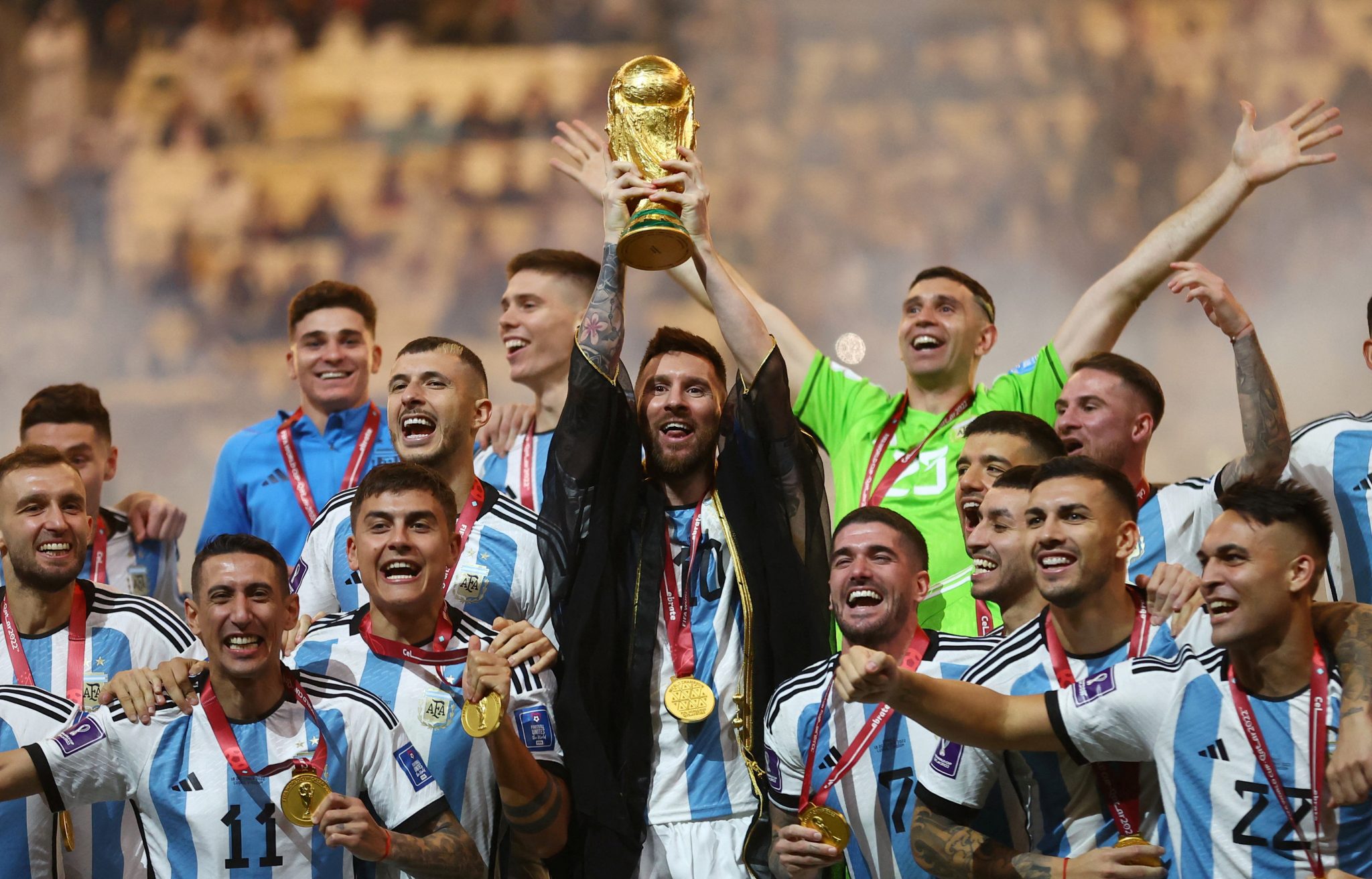
Argentina's goalkeeper, Emiliano Martínez, who had already become a hero in earlier rounds, saved Kingsley Coman’s penalty, while Aurelien Tchouameni shot wide for France. Argentina's takers were clinical, and Gonzalo Montiel scored the deciding penalty to secure the trophy. The image of Lionel Messi being draped in a "Bisht" (a traditional Arab cloak) by the Emir of Qatar before lifting the trophy became the defining image of the tournament, symbolizing his ascent to the pinnacle of football history.
Awards, Statistics, and Individual Performances
The tournament served as a platform for both established stars and emerging talents. Lionel Messi was awarded the Golden Ball as the best player of the tournament, becoming the first person to win the award twice (previously in 2014). Kylian Mbappé took home the Golden Boot with 8 goals, narrowly beating Messi’s 7.
- Golden Glove: Emiliano Martínez (Argentina) was recognized as the best goalkeeper for his crucial saves and shootout dominance.
- Best Young Player: Enzo Fernández (Argentina), whose breakout performance in the midfield provided the balance Argentina needed after their opening loss.
- Total Goals Scored: 172 goals were scored throughout the tournament, a new record for a 32-team World Cup, surpassing the 171 goals scored in 1998 and 2014.
- Clean Sheets: Jordan Pickford (England) and Yassine Bounou (Morocco) were among the leaders in shutouts, reflecting the high defensive standards of the tournament.
The 2022 edition also saw the rise of new tactical trends. There was a significant emphasis on "mid-block" defending and quick transitions rather than the high-pressing styles that had dominated European club football in the years prior. This change was partly due to the heat and the necessity of conserving energy over a condensed seven-game schedule.
Global Impact and Long-term Legacy
Looking back from 2026, the legacy of the 2022 World Cup is multifaceted. Economically, Qatar reported that the tournament contributed significantly to its "National Vision 2030," accelerating infrastructure projects that would have otherwise taken decades. The "Stadium 974" concept proved that temporary infrastructure is a viable solution for future hosts, influencing the planning for the 2026 and 2030 tournaments.
In terms of football development, Morocco’s success catalyzed increased investment in African and Arab football academies. It proved that tactical discipline and collective spirit could overcome the talent gap previously held by European and South American giants. This has led to a more competitive global landscape as we move into the 48-team era.
However, the tournament also left a legacy of debate regarding sportswashing and the ethical responsibilities of international sporting bodies. The discussions surrounding labor laws in Qatar led to some reforms in the "Kafala" system, though human rights organizations continue to monitor the long-term efficacy of these changes. In the world of sports media, the 2022 World Cup was the most-watched event in history at that time, with the final alone drawing an estimated 1.5 billion viewers globally, cementing football's status as the world's primary cultural export.
Frequently Asked Questions
Who won the 2022 FIFA World Cup?
Argentina won the 2022 FIFA World Cup after defeating France in the final. The match ended 3-3 after extra time, and Argentina won 4-2 in a penalty shootout. This was Argentina's third World Cup title (1978, 1986, 2022) and the first for Lionel Messi, which many fans believe solidified his status as the greatest player of all time.
Why was the 2022 World Cup held in November and December?
The tournament was moved to the winter months to avoid the extreme summer temperatures in Qatar, which can exceed 50°C (122°F). By playing in November and December, temperatures were a more manageable 20°C to 30°C, ensuring the safety of players and fans. This was the first time in history a World Cup was not held in the May-July window.
Which player scored the most goals in the 2022 World Cup?
Kylian Mbappé of France won the Golden Boot by scoring 8 goals. This included a historic hat-trick in the final against Argentina. Lionel Messi finished as the second-highest scorer with 7 goals, while Olivier Giroud (France) and Julian Alvarez (Argentina) each scored 4.
What happened to the stadiums after the tournament?
Qatar planned for a "modular" legacy for most venues. Stadium 974 was completely dismantled. Other stadiums, such as Al Janoub and Education City, had their capacities reduced by half, with the removed seats donated to developing nations to help build their sports infrastructure. Some venues were repurposed to include hospitals, shopping malls, and community centers.
How many teams participated in the 2022 World Cup?
There were 32 teams participating in the 2022 World Cup. This was the final time this format was used; starting with the 2026 World Cup in North America, the tournament expanded to 48 teams to allow for more representation from various global confederations.
Accessing Historical Match Data and Replays
For researchers or fans looking to revisit the technical details of the 2022 tournament, FIFA maintains an extensive digital archive. The FIFA Training Centre website provides deep-dive tactical reports for every match, while the FIFA+ streaming platform offers full match replays and highlights. These resources are essential for understanding the tactical shifts that occurred during the Qatar tournament and remain the primary official source for verified match statistics and official reports.