The 2021 season refers primarily to the 72nd FIA Formula 1 World Championship, a landmark year defined by the intense rivalry between Max Verstappen and Lewis Hamilton. It concluded with Verstappen’s first title following a controversial final lap in Abu Dhabi, marking the end of the Mercedes-dominated era and the introduction of the sport's first cost cap.
While the "2021 season" can describe various sporting calendars—including the first 17-game NFL schedule or the post-pandemic recovery of Broadway—in the context of global sporting impact and technical shifts, it is synonymous with the 2021 Formula 1 World Championship. This season represented a transitional bridge between the established turbo-hybrid era and the ground-effect revolution of 2022. It was a year where technical ingenuity, high-stakes litigation over regulations, and pure on-track aggression collided to produce one of the most-watched spectacles in modern sporting history.
The Technical Foundation: Regulations and the "Low Rake" Dilemma
Entering the 2021 season, the FIA introduced specific aerodynamic changes intended to reduce downforce by approximately 10%. These changes were a safety measure to prevent the existing tires from failing under the ever-increasing loads generated by the fastest cars in history. The primary modification involved clipping the rear floor of the car and banning certain slots and winglets in the "coke bottle" region near the rear wheels.
This seemingly minor adjustment had a disproportionate impact on car philosophies. Formula 1 cars generally fall into two categories: high rake (where the rear of the car is significantly higher than the front, favored by Red Bull) and low rake (where the car runs flatter to the ground, favored by Mercedes and Aston Martin). The 2021 floor cuts stripped away more performance from the low-rake designs, effectively erasing the comfortable margin Mercedes had enjoyed in 2020. This technical parity was the "X-factor" that allowed Red Bull Racing and Honda to challenge for the title from the opening race in Bahrain.
Furthermore, 2021 marked the debut of the Financial Regulations, commonly known as the Budget Cap. Set at a baseline of $145 million, this forced "Big Three" teams (Mercedes, Red Bull, and Ferrari) to drastically restructure their operations. For the first time, performance was not just a matter of who could spend the most, but who could develop the most efficiently within a fixed ceiling.
The Verstappen-Hamilton Rivalry: A Chronology of Conflict
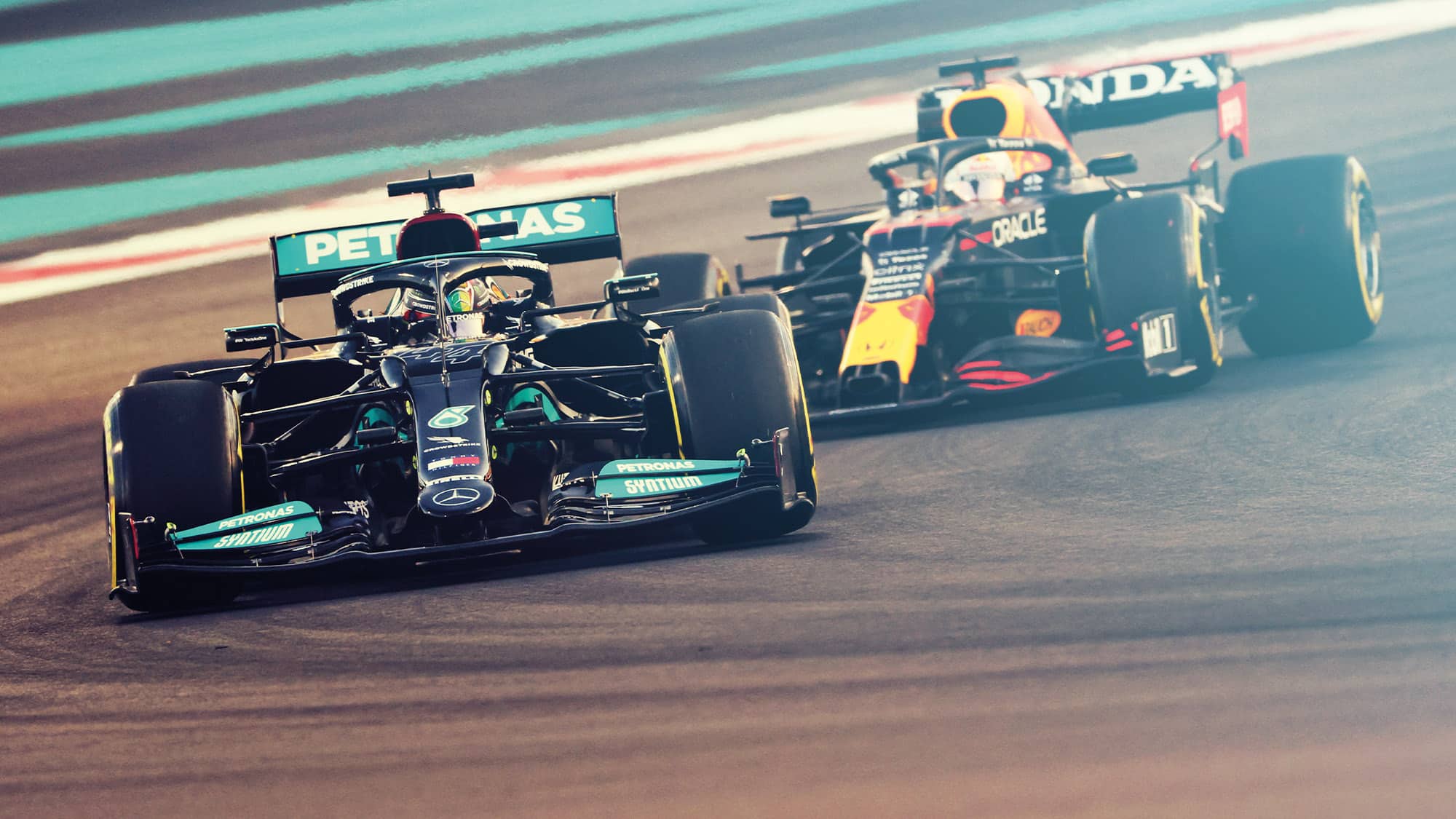
The 2021 season is best remembered for the escalating tension between seven-time champion Lewis Hamilton and the young challenger Max Verstappen. Their battle was not merely a sporting contest but a clash of generations and mentalities.
The Opening Volleys (Bahrain to Spain)
The season began with a statement of intent from Red Bull in Bahrain. While Hamilton won the opening race through superior strategy and "track limits" controversy, it was clear that Verstappen had the faster car in qualifying. This set a pattern for the first quarter of the season: Verstappen would often hold the raw pace, while Hamilton and Mercedes relied on veteran experience and tactical execution to stay within reach.
The Flashpoints: Silverstone and Monza
By mid-season, the professional respect between the two drivers began to fray. At the British Grand Prix (Silverstone), the two collided at Copse corner—one of the fastest turns on the calendar. Verstappen suffered a 51G impact, while Hamilton went on to win the race despite a penalty. This event shifted the narrative from a sporting rivalry to a personal feud.
The tension peaked again at the Italian Grand Prix in Monza. As the two fought for position into the first chicane, their cars collided, with Verstappen’s Red Bull ending up perched on top of Hamilton’s Mercedes. Both were forced to retire, and the images of the "stacked" cars became the defining visual of the 2021 season's intensity.
Midfield Dynamics and the Rise of McLaren and Alpine
While the title fight dominated headlines, the 2021 season was also remarkable for the resurgence of the midfield. With the top two teams pouring every resource into their title protagonists, opportunities opened up for others to claim glory.
- McLaren’s 1-2 at Monza: Daniel Ricciardo led teammate Lando Norris to a dominant victory in Italy, the team's first win since 2012. It remains a high-water mark for the Woking-based team in the 2020s.
- Esteban Ocon’s Maiden Win: In a chaotic, rain-affected Hungarian Grand Prix, Esteban Ocon took a shock victory for Alpine, aided by a masterclass in defensive driving from his teammate, Fernando Alonso, who held off a charging Hamilton for several laps.
- George Russell’s "Mr. Saturday" Heroics: Driving a struggling Williams, George Russell produced a stunning qualifying lap in the rain at Spa-Francorchamps to secure second on the grid. He was awarded his first podium when the race was called off after two laps behind the Safety Car due to torrential rain.
2021 Season Performance Data and Standings
The following table summarizes the final standings and key metrics for the top five drivers of the 2021 season, illustrating the razor-thin margins that defined the year.
| Driver | Team | Points | Wins | Podiums | Poles |
|---|---|---|---|---|---|
| Max Verstappen | Red Bull Racing | 395.5 | 10 | 18 | 10 |
| Lewis Hamilton | Mercedes | 387.5 | 8 | 17 | 5 |
| Valtteri Bottas | Mercedes | 226 | 1 | 11 | 4 |
| Sergio Perez | Red Bull Racing | 190 | 1 | 5 | 0 |
| Carlos Sainz | Ferrari | 164.5 | 0 | 4 | 0 |
Note: The "0.5" points resulted from the shortened Belgian Grand Prix, where only half-points were awarded.
The Abu Dhabi Finale: Controversy and Legacy
The 2021 season concluded in a manner that remains a point of debate in 2026. Heading into the final race at the Yas Marina Circuit in Abu Dhabi, Verstappen and Hamilton were tied on points—a scenario that had only occurred once before in F1 history (1974).
The race was controlled by Hamilton for 57 of the 58 laps. However, a late crash by Nicholas Latifi triggered a Safety Car period. The controversy stemmed from Race Director Michael Masi’s decision to allow only the five lapped cars between Hamilton and Verstappen to unlap themselves, and to restart the race for a single final lap of green-flag racing. On fresher tires, Verstappen overtook Hamilton to secure the World Championship.
The Institutional Fallout
The immediate aftermath of the 2021 season led to a significant overhaul of FIA race management. By 2022, the role of Race Director was split, and a "Virtual Race Control Room" (similar to VAR in football) was established to assist officials. The rules regarding Safety Car restarts were also codified with greater precision to prevent a repeat of the subjective interpretation seen in Abu Dhabi.
Logistics and the Post-Pandemic Calendar
The 2021 season was also a logistical triumph. As the world continued to navigate the tail end of global travel restrictions, Formula 1 managed to execute a 22-race calendar. This required the introduction of "triple-headers" (three races in three weekends) and the return of historic venues like Zandvoort, which hosted the first Dutch Grand Prix since 1985.
The season also saw the debut of the Qatar Grand Prix and the Saudi Arabian Grand Prix, reflecting a pivot in the sport's commercial strategy toward the Middle East. These high-speed street circuits provided the backdrop for the penultimate rounds of the championship, where the wheel-to-wheel combat between the leaders reached its most desperate levels.
The "Sprint" Experiment
2021 was the year Formula 1 introduced the "Sprint" format at three events: Silverstone, Monza, and Interlagos. This shorter Saturday race determined the grid for Sunday and offered championship points. While divisive among purists, the format succeeded in increasing television viewership on Fridays and Saturdays, leading to the expanded Sprint schedule seen in subsequent years.
FAQ: Key Questions About the 2021 Season
Who won the 2021 Formula 1 Constructors' Championship?
Mercedes-AMG Petronas won the Constructors' Championship with 613.5 points. Despite Max Verstappen winning the Drivers' title, the consistent scoring of Lewis Hamilton and Valtteri Bottas secured Mercedes their eighth consecutive team title, a record that remains unsurpassed.
Why was the 2021 Belgian Grand Prix controversial?
The race was held under extreme rain conditions. After hours of delays, the cars completed only two laps behind the Safety Car to satisfy the minimum requirements for a "race" to be official. Half-points were awarded, and fans were left without seeing any competitive racing, leading to major changes in how rain-shortened events are handled.
What happened to Michael Masi after the 2021 season?
Following an internal FIA investigation into the Abu Dhabi GP procedures, Michael Masi was removed from the role of Race Director ahead of the 2022 season. The FIA concluded that "human error" was a factor in the unlapping process but maintained that the results of the championship were final and valid.
How did the 2021 cost cap affect the teams?
The $145 million limit forced teams to prioritize efficiency. In 2022, it was revealed that Red Bull Racing had committed a "minor overspend" breach during the 2021 season, resulting in a $7 million fine and a 10% reduction in their aerodynamic testing time for the following year.
Which drivers retired or moved after the 2021 season?
The most notable departure was 2007 World Champion Kimi Räikkönen, who retired from Formula 1 after a storied 20-year career. Additionally, Valtteri Bottas moved from Mercedes to Alfa Romeo, George Russell was promoted to Mercedes, and Alex Albon returned to the grid with Williams for 2022.
How to Review and Analyze 2021 Season Data
For those researching the 2021 season for historical or statistical purposes, it is essential to look beyond the final point standings. To understand the true performance delta between teams, one should analyze "super-times" (the fastest lap of each car during a weekend expressed as a percentage of the fastest overall lap).
If you are looking to revisit the season's most critical moments, the official Formula 1 YouTube channel provides comprehensive race highlights. For deep-dive technical analysis of the floor regulation changes that defined the year, the FIA Technical Department's archives offer the original regulatory texts and bulletins issued throughout 2021. Understanding these technical nuances is the best way to grasp why the 2021 season was the most competitive of the turbo-hybrid era.