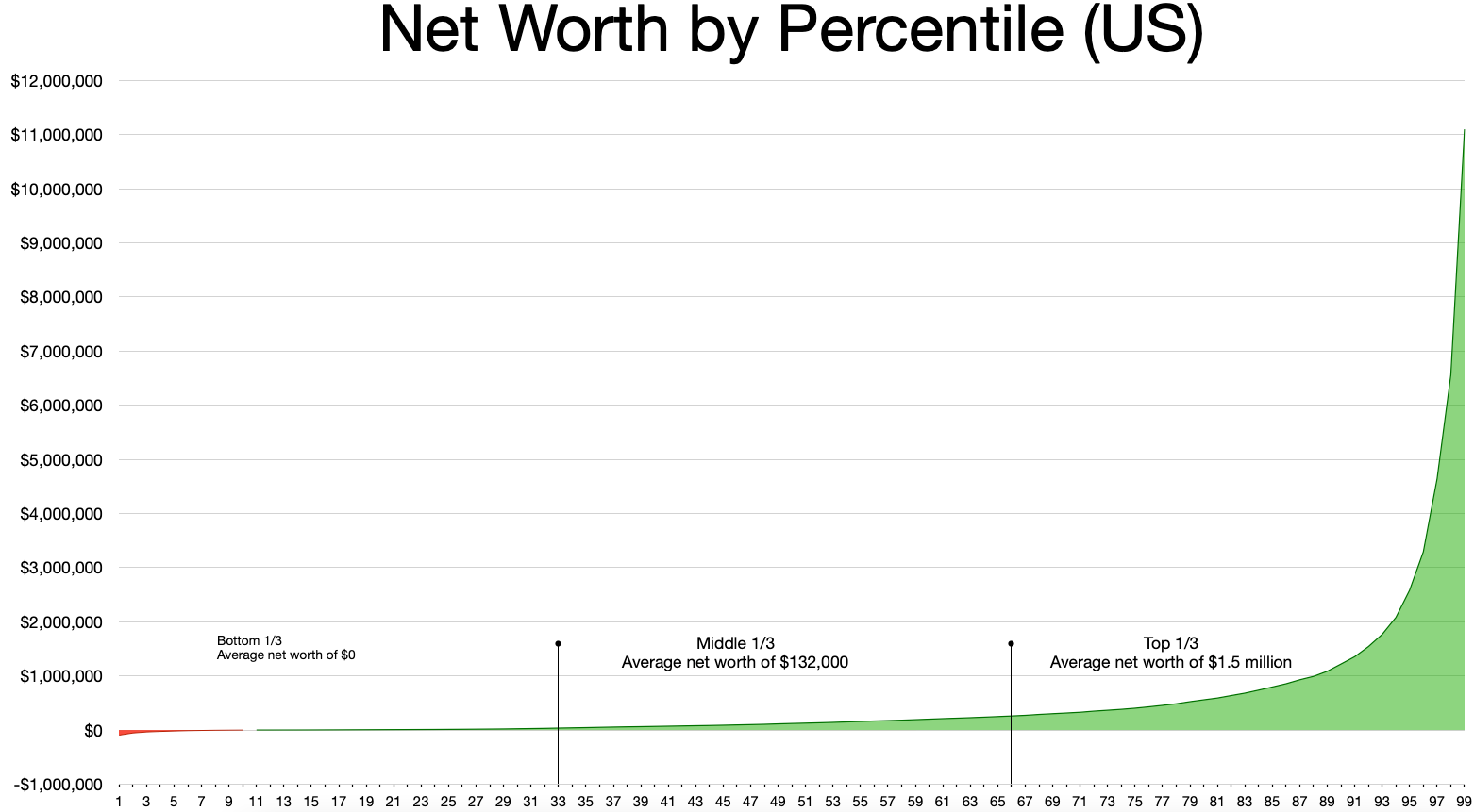
In 2017, entering the top 5% of American households (the 95th percentile) required a minimum net worth of approximately $2,370,000. To join the top 1% (the 99th percentile), that threshold rose significantly to roughly $10,375,000. These figures, derived from the Federal Reserve’s Survey of Consumer Finances, reflect the combined value of all assets minus total liabilities.
Understanding the 2017 Wealth Landscape
To analyze the "wealth elite" of 2017, one must first define net worth in the context of economic stratification. Net worth is the most accurate measure of financial health because it accounts for debt. In 2017, the United States was in the midst of one of the longest economic expansions in history. Following the 2008 financial crisis, asset prices—specifically equities and real estate—saw a sustained recovery that disproportionately benefited those already holding significant capital.
The 95th percentile represents a specific tier often referred to as the "mass affluent" or the lower rung of the "wealth elite." By 2017, this group was characterized not just by high income, but by significant equity in primary residences and robust retirement accounts. Unlike the median household, which held a net worth of roughly $97,300 at the time, the 95th percentile had crossed the million-dollar threshold several times over, providing a "safety cushion" that allowed for more aggressive investment strategies.
The data for 2017 is primarily rooted in the 2016 Survey of Consumer Finances (SCF), which is released triennially. Because the 2016 data was the most current available during the 2017–2018 period, it serves as the definitive benchmark for that era’s wealth distribution.
Breaking Down the Percentiles: From Top 10% to the 1%
Wealth distribution is not linear; it is exponential. The gap between the 50th percentile (median) and the 90th percentile is substantial, but the gap between the 95th and the 99th is a canyon. In 2017, the "entry-level" elite status began at the 90th percentile, but "joining the wealth elite" generally refers to the top 5% and above.
| Wealth Percentile | 2017 Estimated Net Worth Threshold | Primary Asset Drivers |
|---|---|---|
| 90th Percentile | $1,180,000 | Primary residence, 401(k), modest brokerage accounts. |
| 95th Percentile | $2,370,000 | Paid-off real estate, diversified portfolios, some business equity. |
| 98th Percentile | $5,050,000 | Multiple real estate holdings, private equity, significant liquid assets. |
| 99th Percentile | $10,375,000 | Business ownership, venture capital, sophisticated tax structures. |
| 99.9th Percentile | $43,000,000+ | Controlling interests in companies, family offices, global diversified assets. |
The move from the 95th to the 99th percentile is the most difficult transition in personal finance. While the 95th percentile often consists of highly paid professionals (surgeons, corporate executives, successful small business owners), the 99th percentile is dominated by individuals whose wealth is decoupled from their time. Their income is generated by capital, not labor.
The Composition of Elite Wealth in 2017
Understanding how the top 5% held their wealth in 2017 provides a roadmap for those looking to replicate that success. The "wealth elite" do not keep their money in savings accounts; they deploy it into appreciating assets.
Residential and Commercial Real Estate
For the 95th percentile, the primary residence accounted for a significant portion of their net worth, but as you moved toward the 99th, real estate became an investment vehicle rather than just a place to live. In 2017, the low-interest-rate environment allowed the elite to use "cheap" debt to leverage property acquisitions, effectively using the bank's money to capture equity growth.
Business Equity and Private Holdings
This is the single largest differentiator for the top 1%. While the bottom 90% of households hold the majority of their wealth in their homes and retirement accounts, the top 1% hold the majority of their wealth in business equity (both public and private). In 2017, the "Wealth Elite" were largely founders, partners in law or medical firms, or early-stage investors in successful startups.
Equities and Fixed Income
The 2017 bull market was a massive tailwind for the 95th percentile. Those with heavy exposure to the S&P 500 or the Nasdaq saw their net worths climb significantly without any increase in labor. The elite also utilized sophisticated tax-loss harvesting and dividend reinvestment plans (DRIPs) to compound wealth while minimizing the "tax drag" that slows down the average investor.
Strategies to Ascend the Wealth Ladder
Joining the wealth elite is rarely an accident of savings; it is usually the result of a deliberate shift in how one interacts with the economy. To move from the median to the 95th or 99th percentile, three primary levers must be pulled.
1. Scaling Through Equity, Not Salary
Earned income (W-2) is the most heavily taxed form of income and is limited by the number of hours in a day. To reach a net worth of $2.4M (the 2017 95th percentile), one typically needs equity. This can be achieved through:
- Intrapreneurship: Negotiating for stock options or restricted stock units (RSUs) in a high-growth company.
- Entrepreneurship: Building a scalable business where the value is based on a multiple of earnings, not hourly work.
- Real Estate Syndication: Pooling capital to buy large-scale assets that offer both cash flow and massive appreciation.
2. Aggressive Capital Allocation
The wealth elite in 2017 focused on "velocity of money." They did not let cash sit idle. By 2017 standards, an aggressive portfolio might have allocated 70-80% to equities and 20% to alternative investments (private equity, collectibles, or hedge funds). The goal was to outpace inflation and the standard 7% market return by identifying undervalued sectors or using leverage responsibly.
3. Tax Optimization and Legal Shielding
As net worth increases, the government becomes a larger "partner" in your wealth. The 2017 elite used legal structures to protect their assets. This included:
- Irrevocable Trusts: Removing assets from the taxable estate.
- Donor-Advised Funds (DAFs): Managing charitable giving while receiving immediate tax breaks.
- Defined Benefit Plans: Allowing high earners to shield significantly more income than a standard 401(k).
The Role of Debt in Building Elite Wealth
A common misconception is that the wealth elite are debt-free. In reality, the top 5% in 2017 used debt as a tool rather than a burden. There is a fundamental difference between "consumer debt" (high-interest credit cards) and "investment debt" (low-interest mortgages or lines of credit secured by securities).
By using a Securities-Backed Line of Credit (SBLOC), an individual in the 95th percentile could access cash for new investments without selling their stocks and triggering a capital gains tax. This strategy, often called "Buy, Borrow, Die," is a staple of the wealth elite. In 2017, with the Federal Funds Rate still relatively low, this strategy was highly effective in inflating net worth by keeping assets invested while funding new ventures with borrowed capital.
The Mental Shift: From Consumer to Capitalist
Joining the top 5% requires a psychological transition. Most people view $100,000 as a sum to be spent on a car or a renovation. The wealth elite view $100,000 as a "soldier" that can be sent out to capture more money.
In 2017, the cost of living in major hubs like New York or San Francisco could easily swallow a $250,000 salary. Those who reached the 95th percentile often practiced "geographic arbitrage" or maintained a lifestyle significantly below their means during their wealth-accumulation phase. They prioritized the purchase of income-producing assets over status-signaling luxury goods, understanding that the real status is the freedom provided by a multi-million dollar net worth.
Frequently Asked Questions
What was the difference between "High Net Worth" and the 95th percentile in 2017?
High Net Worth (HNW) is typically defined by financial institutions as individuals with at least $1 million in liquid investable assets. In 2017, a person could be in the 90th percentile of net worth (approximately $1.18M) but not be considered HNW if most of that wealth was tied up in their primary residence. The 95th percentile ($2.37M) almost always qualified as HNW, as they usually held over $1M in liquid assets alongside their home equity.
Did the 2017 net worth thresholds include home equity?
Yes, the standard net worth calculations provided by the Federal Reserve include all assets, including the market value of a primary residence, minus all debts like mortgages. However, many financial planners prefer to look at "Net Investable Assets," which excludes the primary home, as you cannot easily spend your house without living elsewhere.
How much did the 2017 wealth elite earn annually?
While net worth is a measure of accumulated wealth, the income for the top 5% in 2017 typically started around $250,000 to $300,000 per year. For the top 1%, the annual household income was approximately $480,000 or higher. It is important to note that many in the 1% had lower "taxable" incomes due to their earnings coming from capital gains rather than traditional salaries.
Was 2017 a good year for building wealth compared to previous years?
2017 was an exceptional year for wealth building. The S&P 500 returned over 19%, and the Tax Cuts and Jobs Act of 2017 was signed into law late in the year, which lowered corporate tax rates and created new incentives for business owners and investors, setting the stage for further net worth growth in the following years.
What is the fastest way to move from the 50th to the 95th percentile?
Historically, the fastest non-inheritance routes are specialized high-income professions (medicine, law, tech) combined with a high savings rate, or successful entrepreneurship. In 2017, the "tech boom" allowed many employees at mid-stage startups to leapfrog from the median to the 95th percentile via equity refreshes and IPOs.
Practical Steps to Target the Top 5%
If you aim to reach the wealth benchmarks established by the 2017 elite, your focus must shift from saving to compounding. Start by auditing your current asset allocation. If more than 50% of your net worth is tied up in your primary residence, you are "house rich" but "investment poor." True entry into the wealth elite requires diversifying into assets that grow independent of your physical location.
Secondly, maximize every tax-advantaged vehicle available. In 2017, the difference between a self-employed person using a standard IRA versus a Solo 401(k) could mean tens of thousands of dollars in annual tax savings. Finally, seek "asymmetric risk"—opportunities where the downside is limited but the upside is 10x or 100x. This is how the 99th percentile is formed; they don't just win often, they win big when they do win.