The year 1999 stands as a monumental turning point in horror cinema, characterized by a radical shift from slick, self-referential post-slasher tropes toward raw psychological dread, found-footage realism, and high-concept international chillers. This transitional epoch redefined how fear was produced, marketed, and consumed on screen, leaving a permanent legacy on the genre.
The Paradigm Shift: Moving Beyond the Post-Slasher Wave
By the late 1990s, the horror genre was heavily saturated by the ironical, meta-textual formula popularized by Scream (1996). Studios churned out slick, youth-oriented slashers featuring masked killers, sarcastic teenagers, and self-aware pop-culture dialogue. However, audience fatigue set in by the tail end of the decade, creating an urgent creative vacuum. Filmmakers and studios recognized that shock value and witty banter had lost their edge, prompting a desperate search for fresh avenues of terror.
This fatigue opened the door for riskier, atmosphere-driven projects that relied on mood, ambiguity, and existential dread rather than body counts and jump scares. The cinematic landscape of 1999 capitalized on this weariness by pivoting sharply toward the unseen, the psychological, and the uncomfortably plausible. Instead of inviting audiences to laugh along with the characters at the absurdity of horror tropes, the masterminds of 1999 horror forced viewers back into isolated, helpless vulnerability.
Found-Footage Realism and The Blair Witch Project
No discussion of 1999 horror is complete without examining the seismic cultural impact of The Blair Witch Project. Written, directed, and edited by Daniel Myrick and Eduardo Sánchez, the film revolutionized independent filmmaking and marketing. Operating on a micro-budget of roughly $60,000, the production utilized hand-held 16mm and Hi8 cameras, allowing the actors to improvise their dialogue while navigating the dense, disorienting woods of Maryland.
The true genius of The Blair Witch Project, however, lay in its pioneering use of the internet as a viral marketing tool. Long before social media algorithms dictated box office success, the filmmakers constructed elaborate fictional backstories, missing-person posters, and faux police reports online. Many early viewers genuinely believed the recovered footage belonged to three student filmmakers who had vanished under mysterious circumstances. By blurring the line between fiction and documentary reality, the film bypassed traditional suspension of disbelief, proving that imagination remains far more terrifying than any high-budget practical monster.
Psychological Dread and Domestic Terror in The Sixth Sense
While The Blair Witch Project revolutionized independent aesthetics, M. Night Shyamalan’s The Sixth Sense redefined mainstream psychological horror and supernatural drama. Released by Hollywood Pictures, the film centers on a child psychologist, played by Bruce Willis, trying to help a young boy (Haley Joel Osment) who claims to see dead people. Rather than relying on graphic violence or aggressive gore, Shyamalan crafted a patient, atmospheric narrative anchored by profound grief, isolation, and domestic melancholy.
The film's triumph demonstrated that mainstream audiences hungered for intelligent, emotionally resonant horror. The chilling atmosphere was driven entirely by muted color palettes, lingering camera angles, and a pervasive sense of architectural claustrophobia, even within sunlit suburban homes. The Sixth Sense proved that a horror film could achieve massive commercial and critical acclaim—including multiple Academy Award nominations—by prioritizing character depth and narrative misdirection over conventional shocks.
International Horizons: Audition and Japanese Horror Expansion
Beyond North American borders, 1999 marked the emergence of J-horror onto the global stage, spearheaded by Takashi Miike’s disturbing masterpiece Audition (Ōdishon). Adapted from Ryu Murakami’s novel, the film begins deceptively as a gentle, melancholic drama about a widower holding mock auditions to find a new wife, before descending into a harrowing exploration of trauma, obsession, and anatomical torture.
| Film | Primary Subgenre | Defining Technical Style | Core Psychological Theme |
|---|---|---|---|
| The Blair Witch Project | Found-Footage / Folk | Handheld 16mm/Hi8, natural lighting | Paranoia, isolation, loss of direction |
| The Sixth Sense | Supernatural / Mystery | Controlled framing, subdued tones | Grief, trauma, alienation |
| Audition | Psychological / Torture | Slow-burn domestic setup to visceral shock | Obsession, vengeance, hidden identity |
| House on Haunted Hill | Supernatural / Slasher | Rapid editing, theatrical lighting, CGI | Greed, entrapment, institutional evil |
Audition exemplified a growing international appetite for transgressive, slow-burn narratives that weaponized polite societal expectations against the protagonists. The film's meticulous pacing lulls the viewer into a false sense of security before delivering one of the most infamous climaxes in horror history. This global cross-pollination laid the groundwork for the massive influx of Japanese horror remakes and independent international imports that dominated the subsequent decade.
Mainstream Reinvention: House on Haunted Hill and Sleepy Hollow
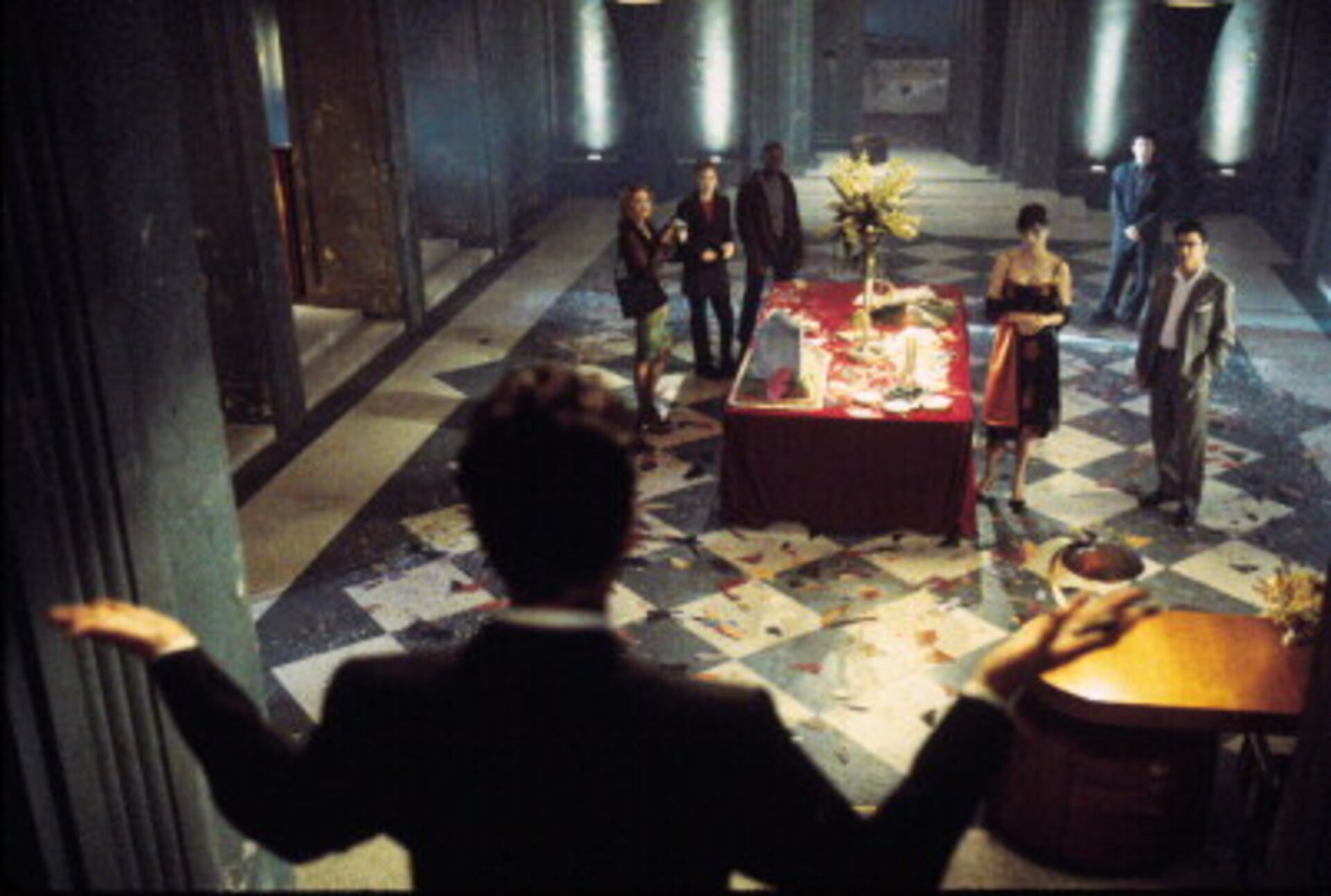
Even traditional studio horror underwent a high-concept revitalization in 1999. William Malone’s House on Haunted Hill, a remake of the 1959 William Castle classic, leaned into an aggressive, MTV-styled aesthetic characterized by rapid-fire editing, industrial soundscapes, and digital effects. Produced by Dark Castle Entertainment, the film aimed to revive the funhouse thrills of classic creature features while updating them for a hyper-stimulated millennial audience.
Simultaneously, Tim Burton delivered Sleepy Hollow, a lavish, atmospheric blending of gothic romance, historical fantasy, and graphic slasher tropes. Featuring Emmanuel Lubezki’s striking, desaturated cinematography and production design that evoked classic Hammer Horror films, Sleepy Hollow demonstrated how studio capital could successfully resurrect classic literary monsters. These films proved that the year's cinematic output was not monolithic; it successfully accommodated both ultra-low-budget indie experiments and lavish studio productions.
The Enduring Legacy of 1999 on Modern Genre Filmmaking
The shockwaves generated by the horror landscape of 1999 continue to resonate throughout contemporary cinema. The democratization of filmmaking tools and the rise of digital distribution trace their lineage directly back to the guerrilla marketing and production strategies of The Blair Witch Project. Furthermore, the modern critical appreciation for elevated horror—films that utilize genre mechanics to explore trauma, grief, and societal decay—owes a massive debt to the mature tonal shifts established by The Sixth Sense and Audition.
Frequently Asked Questions
Why is 1999 considered such an important year for horror movies?
1999 marked a crucial turning point away from the self-aware, ironic post-slasher trend toward atmospheric psychological dread, innovative marketing, and found-footage realism. It introduced groundbreaking independent and international films that permanently expanded the boundaries of the genre.
How did The Blair Witch Project change horror marketing?
The film pioneered viral internet marketing by presenting fictionalized backstories, missing persons reports, and fake police archives as genuine historical facts. This strategy convinced many early viewers that the events depicted in the movie were real before they stepped into the theater.
Was The Sixth Sense commercially and critically successful?
Yes, The Sixth Sense was a massive box office phenomenon and received six Academy Award nominations, including Best Picture and Best Director. It proved that supernatural horror could achieve mainstream prestige through strong character development and atmospheric storytelling.
What role did international cinema play in 1999 horror?
International cinema expanded its global footprint significantly in 1999, most notably through Takashi Miike’s Audition. This film helped lay the foundation for the international J-horror wave that influenced global genre trends throughout the 2000s.
How do 1999 horror films compare to mid-1990s slashers?
While mid-1990s slashers relied heavily on meta-commentary, pop-culture jokes, and masked killers targeting self-aware teenagers, 1999 horror favored vulnerability, existential isolation, slow-burn pacing, and documentary-style realism to evoke genuine fear.
Next Steps for Exploring Late-90s Cinema
To fully appreciate the scope of this cinematic epoch, film enthusiasts should explore contemporary film archives, original theatrical trailers, and retrospective analyses of late-90s independent distribution models. Examining the production notes of micro-budget indies alongside studio blockbusters from that year reveals a fascinating industry-wide struggle to capture an increasingly cynical audience's imagination.