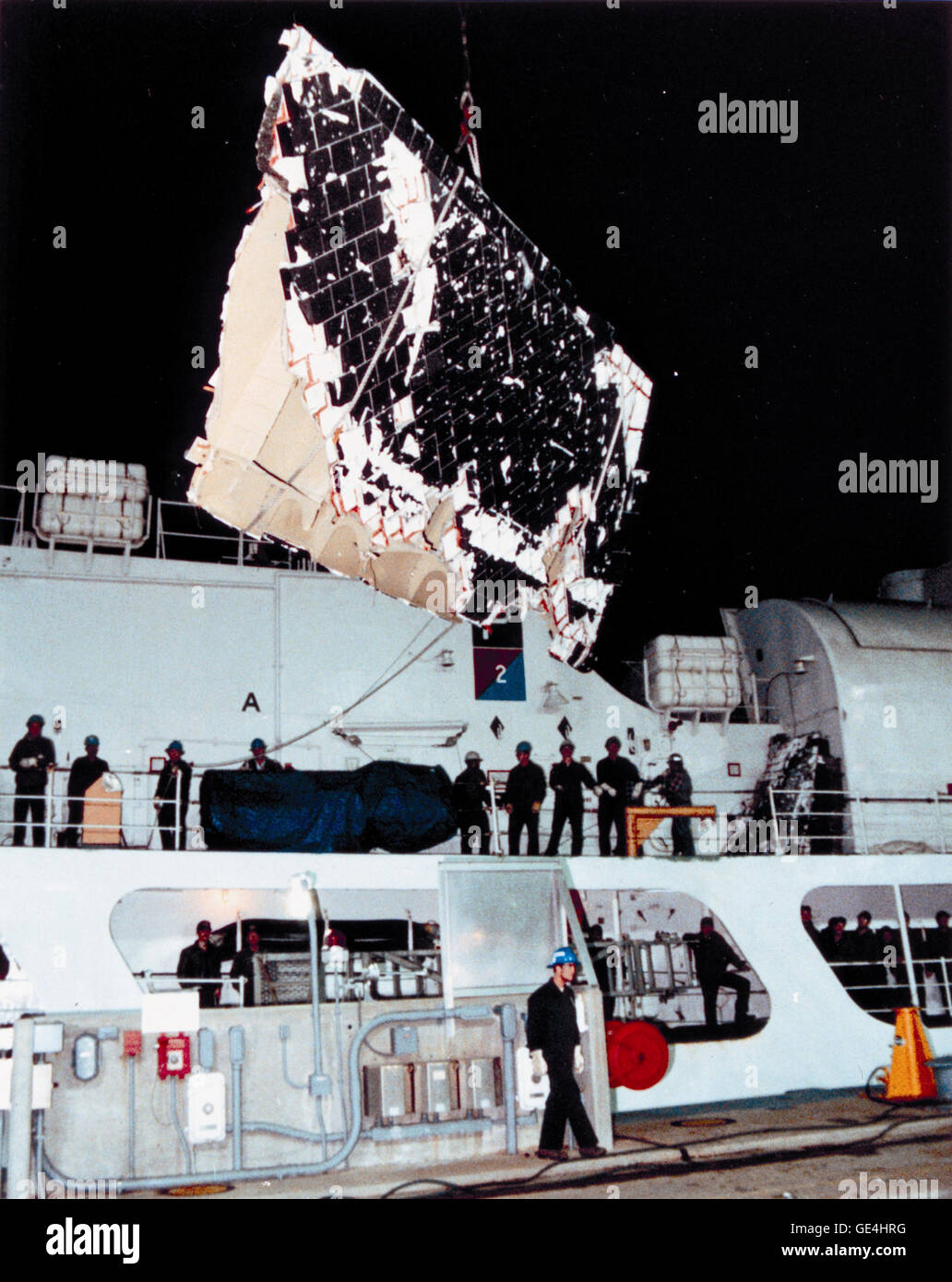
The investigations launched in 1986 transformed modern forensic inquiry, disaster response, government accountability, and financial regulation worldwide. Landmark probes into the Space Shuttle Challenger explosion, the Chernobyl nuclear disaster, the Iran-Contra affair, and Wall Street insider trading established lasting standards for root-cause analysis, regulatory enforcement, and institutional transparency.
The Rogers Commission: Root-Cause Analysis of the Space Shuttle Challenger Explosion
On January 28, 1986, the Space Shuttle Challenger exploded 73 seconds into flight, killing all seven crew members. Five days later, President Ronald Reagan established the Presidential Commission on the Space Shuttle Challenger Accident, chaired by former Secretary of State William P. Rogers. The commission's roster included prominent engineers, scientists, astronauts, and military figures, notably Vice Chairman Neil Armstrong, physicist Richard Feynman, astronaut Sally Ride, and test pilot Chuck Yeager.
CHALLENGER FAILURE CAUSAL CHAIN
- Ambient Cold Temp (<36°F): O-Ring Stiffening / Loss of Resiliency
- Launch Ignition: Primary O-Ring Fails to Seal Field Joint
- Hot Gas Blow-by Burns Secondary O-Ring & Erodes Insulation
- Flame Plume Breaches External Fuel Tank Structure: Destruction
The investigation focused on the technical mechanisms of the failure alongside systemic organizational breakdown. The immediate physical cause was traced to the failure of two rubber O-rings sealing the aft field joint of the Solid Rocket Booster (SRB). Unusually cold temperatures at Cape Canaveral on the morning of the launch—reaching 36°F (2°C), well below the tested operating envelope—compromised the elasticity of the Viton rubber O-rings. During launch, the primary O-ring failed to create a gas-tight seal, allowing superheated exhaust gases to erode the secondary seal and burn through the adjacent External Tank containing liquid hydrogen and liquid oxygen.
Physicist Richard Feynman famously demonstrated this material vulnerability during a televised public hearing by submersing a sample O-ring material in a glass of ice water, proving that cold temperature severely degraded the polymer's resilience.
Beyond the hardware failure, the Rogers Commission uncovered severe flaws in NASA's communication channels and safety culture:
- Suppression of Engineering Warnings: Engineers from contractor Morton Thiokol, including Roger Boisjoly and Bob Ebeling, had explicitly warned NASA management the night before the launch that low temperatures posed an unquantified risk to O-ring sealing capacity.
- Normalized Deviance: NASA managers had observed evidence of O-ring erosion on previous warmer-weather flights but reclassified the defect as an "acceptable risk" rather than halting launches to fix the joint design.
- Flawed Risk Communication: Information regarding critical safety concerns was filtered out before reaching top launch decision-makers.
The Commission's final report, published on June 9, 1986, mandated extensive structural redesigns of the solid rocket motor joints, created an independent NASA Office of Safety, Reliability, and Quality Assurance, and suspended the Space Shuttle program for nearly 32 months until rigorous redesigns were completed.
Chernobyl Nuclear Disaster Inquiries: Evaluating Systemic Engineering and Human Errors
The explosion of Reactor No. 4 at the Chernobyl Nuclear Power Plant in Prypiat, Ukrainian SSR, on April 26, 1986, triggered the most complex international nuclear safety investigation in history. Initial Soviet efforts focused on containment and secrecy, but the global detection of radioactive isotopes forced a public technical accounting.
CHERNOBYL ACCIDENT SEQUENCE (1986)
- Low-Power Turbine Test Initiated (Safety Interlocks Disabled)
- Xenon Poisoning + Water Cavitation: Thermal Power Instability
- AZ-5 Emergency Shutdown Pressed: Graphite Control Rod Tips Insert
- Positive Scram Effect (Positive Void Coefficient): Power Spike
- Steam Explosion & Zirconium-Water Reaction Breaches Reactor Core
The Soviet State Commission, led by academician Valery Legasov and Deputy Chairman Boris Shcherbina, conducted the primary on-site technical inquiry. In August 1986, a Soviet delegation presented its findings to the International Atomic Energy Agency (IAEA) at a specialized conference in Vienna. This presentation formed the basis of the IAEA’s initial report, known as INSAG-1.
The 1986 investigations evaluated two main factors:
Operator Conduct and Test Protocol Deviations
Operators were conducting an electrical engineering test to determine whether the coasting turbine generator could provide emergency power to main coolant pumps during a station blackout. To execute the test at low power, operators bypassed automatic emergency core cooling systems (ECCS) and disabled key automated shutdown interlocks. The reactor became severely unstable due to thermal-hydraulic imbalance and xenon poisoning.
Fundamental RBMK-1000 Reactor Design Vulnerabilities
While early Soviet reports placed primary blame on operator error, technical analysis revealed severe design flaws inherent to the RBMK-1000 graphite-moderated reactor:
- Positive Void Coefficient: At low power levels, an increase in steam bubbles ("voids") in the cooling water accelerated nuclear reactivity rather than dampening it.
- Control Rod Displacer Design: The control rods possessed graphite displacer tips. When emergency shutdown button AZ-5 was pressed, the initial insertion of the control rods briefly introduced graphite into the core, displacing neutron-absorbing water and causing an immediate power spike (the "positive scram effect").
The thermal spike caused instantaneous vaporization of cooling water, resulting in a steam explosion that blew off the 2,000-ton reactor lid, followed by a secondary explosion driven by hydrogen accumulation. The 1986 investigation prompted immediate modifications across all operating RBMK reactors, including reduction of the positive void coefficient, redesign of control rod tips, and enrichment adjustments to reactor fuel.
The Iran-Contra Affair: Constitutional and Executive Oversight Probes
In late 1986, a series of media revelations exposed a covert U.S. government operation involving the secret sale of weapons to Iran and the redirection of proceeds to fund anti-communist Contra rebels in Nicaragua. This operation directly contradicted stated U.S. foreign policy and circumvented congressional restrictions.
IRAN-CONTRA COVER-TO-FUNDING FLOW CHART
- Covert Arms Transfers: U.S. Weapons Sold to Iranian Intermediaries
- Inflated Payment Revenues Diverted to Swiss Bank Accounts
- Funds Used to Purchase Supplies / Arms for Nicaraguan Contras (Bypassing Congressional Boland Amendment Mandates)
The operational thread unraveled in October and November 1986:
- October 5, 1986: A cargo plane carrying weapons to Nicaraguan rebels was shot down over Nicaragua, leading to the capture of American operative Eugene Hasenfus.
- November 3, 1986: The Lebanese magazine Al-Shiraa published an expose disclosing secret U.S. arms sales to Iran in exchange for assistance in securing the release of American hostages held in Lebanon.
- November 25, 1986: U.S. Attorney General Edwin Meese announced that funds from the Iranian arms sales had been diverted to the Nicaraguan Contras.
Three separate investigative bodies were established to examine potential statutory breaches, executive overreach, and constitutional violations:
The Tower Commission (Appointed November 26, 1986)
President Reagan appointed a Special Review Board chaired by former Senator John Tower, alongside former National Security Advisor Brent Scowcroft and former Secretary of State Edmund Muskie. The Tower Commission examined the structure and operational conduct of the National Security Council (NSC). Its investigation concluded that while President Reagan had not been fully aware of the extent of the diversion, his relaxed management style allowed National Security Council aides, including Lieutenant Colonel Oliver North and Vice Admiral John Poindexter, to run an unauthorized shadow foreign policy.
Independent Counsel Investigation (Appointed December 19, 1986)
Pursuant to the Ethics in Government Act, a panel of federal judges appointed Lawrence E. Walsh as Independent Counsel to investigate potential criminal violations by executive branch officials. Walsh’s multi-year investigation focused on conspiracy, obstruction of justice, destruction of public documents, and illegal diversion of funds in violation of the Boland Amendment.
Joint Congressional Committees
In December 1986, the House and Senate created select committees to investigate the affair jointly. These televised hearings in 1987 probed executive transparency, intelligence oversight, and the limits of Presidential authority.
Regulatory and Forensic Breakthroughs in Securities and Homicide Inquiries
Beyond aerospace, nuclear, and geopolitical crises, 1986 served as a pivotal turning point in financial market regulation and international criminal investigations.
Wall Street Insider Trading Probes
In 1986, the U.S. Securities and Exchange Commission (SEC), led by Enforcement Director Gary Lynch, and the U.S. Attorney's Office for the Southern District of New York launched historic insider trading enforcement actions.
1986 SEC FINANCIAL ENFORCEMENT CHAIN
- May 1986: SEC Arrests Investment Banker Dennis Levine
- Levine Cooperates: Implicates Arbitrageur Ivan Boesky
- Nov 1986: Boesky Agrees to $100M Fine & Civil/Criminal Sanctions
- Subpoenas Issued to Drexel Burnham Lambert / Michael Milken
- Dennis Levine (May 1986): Investment banker Dennis Levine was charged with generating over $12 million in illicit profits by trading on non-public merger and acquisition information. Levine’s cooperation provided evidence against a wider network of market participants.
- Ivan Boesky (November 1986): Prominent Wall Street arbitrageur Ivan Boesky agreed to a settlement with the SEC that included a $100 million civil penalty and restitution—the largest securities enforcement penalty in history at that time—and a permanent ban from the securities industry. Boesky pled guilty to criminal charges and agreed to covertly record conversations with co-conspirators.
The 1986 insider trading inquiries established early methodologies for analyzing electronic trade settlement records and tracing cross-border capital flows through offshore bank accounts, eventually leading to structural changes in the Insider Trading and Securities Fraud Enforcement Act.
The Olof Palme Assassination Investigation
On February 28, 1986, Swedish Prime Minister Olof Palme was assassinated on a street corner in central Stockholm while walking home from a movie theater with his wife. The initial homicide investigation became an internationally recognized case study in forensic and procedural errors.
The initial inquiry, led by Stockholm Police Commissioner Hans Holmér, faced several critical breakdowns:
- Failure to secure the crime scene promptly, leading to contamination of ballistic and forensic evidence.
- Failure to institute immediate cordons around central Stockholm or close transportation hubs.
- Unwarranted focus on speculative political theories, such as allegations against the Kurdistan Workers' Party (PKK), while overlooking basic crime scene forensics.
The procedural errors in the 1986 Palme investigation forced European law enforcement agencies to overhaul major crime scene management protocols, chain-of-custody policies, and central command structures during high-profile political investigations.
Comparative Matrix of Major 1986 Investigations
The following matrix compares the governing bodies, central findings, and policy outcomes of the key investigations initiated or conducted in 1986:
| Investigation Scope | Primary Investigating Authority | Central Technical / Legal Finding | Long-Term Regulatory & Industry Impact |
|---|---|---|---|
| Space Shuttle Challenger | Rogers Commission (Presidential Commission) | O-ring seal failure caused by cold temperatures; systemic communication breakdown at NASA | Complete joint redesign, launch temperature limits, creation of independent NASA Safety Office |
| Chernobyl Nuclear Disaster | Soviet State Commission / IAEA (INSAG) | Combination of unauthorized operator test procedures and RBMK positive void coefficient design defects | Global RBMK safety overhauls, creation of WANO (World Association of Nuclear Operators), mandatory incident reporting |
| Iran-Contra Affair | Tower Commission / Independent Counsel Lawrence Walsh | Covert sale of arms to Iran and illegal diversion of funds to Nicaraguan Contras, violating congressional mandates | Stricter congressional oversight of covert operations, revised National Security Council operational limits |
| Wall Street Insider Trading | SEC Enforcement Division / US Attorney SDNY | Systematic trading on material non-public information across investment banks and arbitrage funds | Increased SEC subpoena authority, enhanced trade monitoring, passing of ITSFEA legislation |
| Olof Palme Assassination | Swedish National Police / Special Investigative Commissions | Immediate failure of scene preservation, delayed grid searches, structural command errors | Reform of European major-incident command structures, standardized forensic scene containment |
Modern Investigative Methodologies Shaped by 1986 Events
The investigative frameworks refined in 1986 established enduring methodologies still relied upon by modern forensic analysts, regulatory bodies, and safety boards:
EVOLUTION OF MODERN INVESTIGATIVE PROTOCOLS
Root-Cause Analysis (RCA): Human Factor vs. Hardware Separation
Whistleblowing Frameworks: Protecting Safety & Compliance Voices
Independent External Commissions: Elimination of Self-Policing
Cross-Border Financial Forensics: Tracing Offshore Accounts
Formalized Root-Cause Analysis (RCA): The Rogers Commission and post-Chernobyl technical reviews shifted investigative focus away from assigning simple human error toward identifying systemic organizational vulnerabilities, material science limits, and design oversights.
Whistleblower Protection and Alternate Escalation Channels: The suppression of warnings from Morton Thiokol engineers directly influenced modern safety protocols, mandating confidential reporting mechanisms in aerospace, nuclear power, and hazardous industries.
Independent Oversight Mandates: The investigations of 1986 demonstrated the inherent conflict of interest when institutions investigate their own operational failures. Modern regulatory frameworks require independent external commissions for critical transportation, energy, and government incidents.
Cross-Border Financial Forensics: Financial enforcement in 1986 established modern techniques for matching trade timing with non-public news disclosures and subpoenaing foreign bank records to unveil beneficiary owners of shell accounts.
Frequently Asked Questions
What was the main conclusion of the 1986 Rogers Commission report?
The Rogers Commission concluded that the Space Shuttle Challenger accident was physically caused by a failure of the rubber O-rings in the right Solid Rocket Booster joint due to cold launch temperatures. It also identified severe organizational failures within NASA, including the suppression of safety concerns raised by contractor engineers and a history of accepting incremental technical risks without adequate testing.
How did Soviet investigations into the Chernobyl disaster change over time?
Initial Soviet reports presented to the IAEA in August 1986 placed primary responsibility on plant operators for disabling safety systems during an unauthorized test. Subsequent investigations and the updated IAEA report (INSAG-7) recognized that fundamental design flaws in the RBMK-1000 reactor—specifically the positive void coefficient and graphite-tipped control rods—were primary technical causes of the explosion.
Who led the independent legal investigations into the Iran-Contra affair?
President Ronald Reagan appointed the Tower Commission (led by former Senator John Tower) in November 1986 to conduct an executive review of the National Security Council. Independently, federal judges appointed former federal judge Lawrence E. Walsh as Independent Counsel in December 1986 to conduct a criminal investigation into potential illegal acts by government officials.
Why was the 1986 Wall Street insider trading investigation significant?
The 1986 SEC investigations exposed widespread, systematic trading on illicit non-public information among major financial firms. High-profile enforcement actions against Dennis Levine and Ivan Boesky led to unprecedented financial penalties, criminal convictions, and statutory changes that expanded regulatory authority over capital markets.
What errors compromised the initial 1986 Olof Palme assassination investigation?
The initial investigation suffered from delayed crime scene containment, improper handling of physical evidence, failure to seal transport routes out of Stockholm, and an overemphasis on unverified political conspiracy theories at the expense of basic forensic homicide procedures.
Accessing Historical Investigative Records
Researchers, legal analysts, and forensic safety specialists seeking primary documentation from 1986 investigations should consult official archival repositories:
- Space Shuttle Challenger Investigation Records: The full multi-volume Report of the Presidential Commission on the Space Shuttle Challenger Accident is preserved by the National Aeronautics and Space Administration (NASA) Historical Office and the National Archives and Records Administration (NARA).
- Chernobyl Technical Documentation: Technical proceedings, INSAG reports, and international nuclear safety reviews are maintained in the digital archives of the International Atomic Energy Agency (IAEA).
- Iran-Contra Records: The multi-volume Final Report of the Independent Counsel for Iran/Contra Matters (Lawrence E. Walsh) and official records of the Special Review Board (Tower Commission) are hosted by the United States Government Publishing Office (GPO) and the Ronald Reagan Presidential Library archives.
- SEC Enforcement Records: Civil litigation releases, administrative proceedings, and court filings related to the 1986 market enforcement actions are accessible via the U.S. Securities and Exchange Commission historical archives and federal court record repositories.