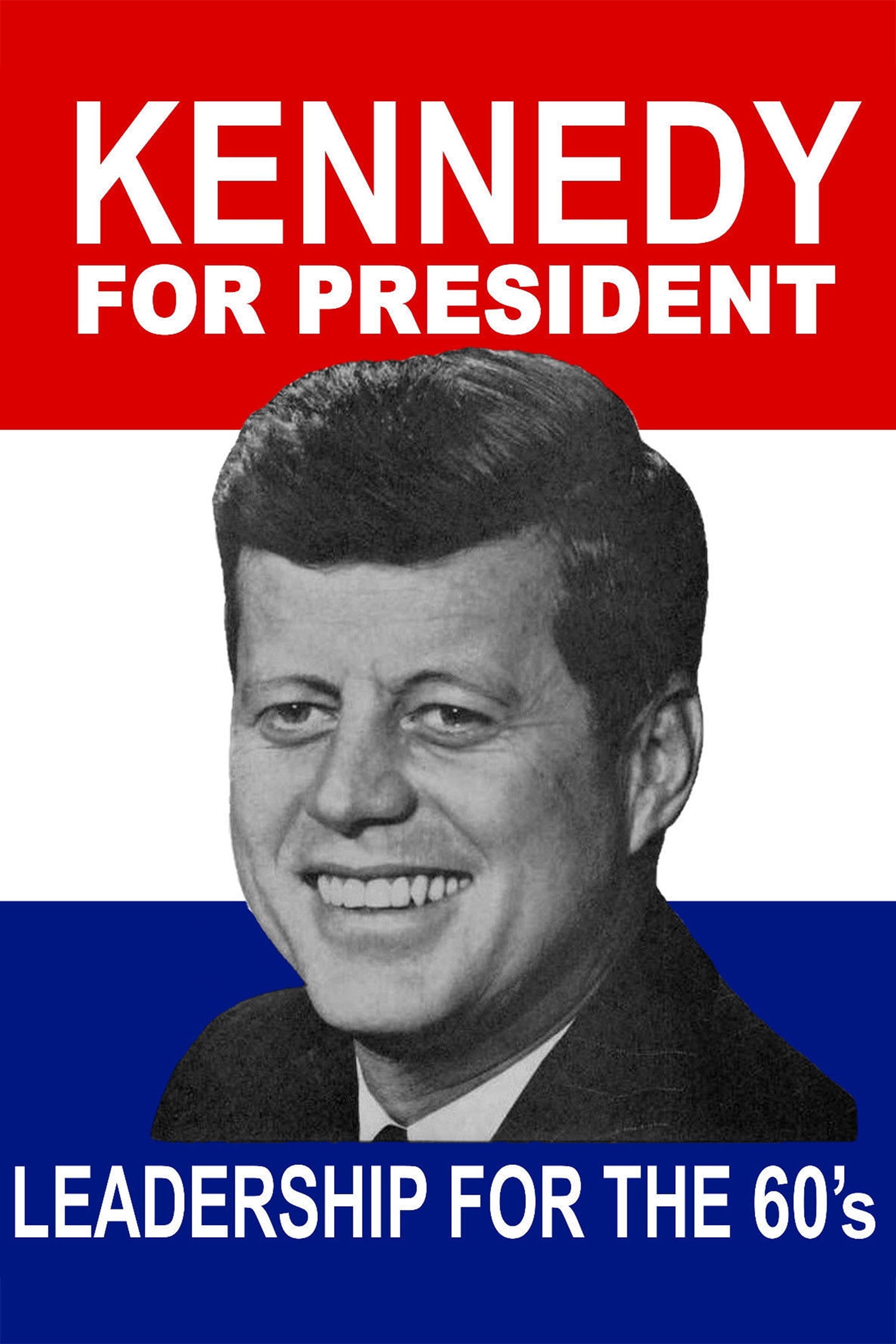
The 1960 United States presidential election was one of the closest and most consequential contests in modern political history. Democrat John F. Kennedy narrowly defeated Republican Richard M. Nixon, fundamentally transforming how campaigns were conducted, introducing the era of televised debates, and highlighting shifting demographic and regional alliances across the nation.
Historical Context and the Political Landscape of 1960
As the 1960 presidential election approached, the United States stood at a crossroads domestically and internationally. Dwight D. Eisenhower, a popular two-term Republican, was constitutionally barred from running for a third term under the newly ratified Twenty-second Amendment. The post-World War II economic boom was slowing down slightly, giving rise to concerns about a potential recession and sluggish economic growth. Simultaneously, the Cold War intensified. Events such as the 1957 launch of Sputnik by the Soviet Union, the 1959 Cuban Revolution led by Fidel Castro, and the 1960 U-2 spy plane incident heightened national anxieties regarding American technological and military superiority.
Domestically, the civil rights movement was gaining significant momentum. Sit-ins, protests, and demands for desegregation challenged the entrenched racial status quo, particularly across the American South. Both major political parties recognized that the upcoming election would hinge on how candidates addressed these deep-seated anxieties. Voters were looking for energetic leadership capable of guiding the country through a precarious geopolitical landscape while managing domestic pressures for social change.
The Democratic Nomination and the Rise of John F. Kennedy
Securing the Democratic nomination in 1960 required navigating a crowded and competitive field of party heavyweights. Senator John F. Kennedy of Massachusetts entered the race early, recognizing that he needed to prove his viability across various primaries to overcome two major perceived liabilities: his relative youth at age 43 and his Roman Catholic faith, which had not been held by any major-party president in United States history.
Kennedy systematically entered and won several key primary elections, including a pivotal victory in West Virginia that demonstrated a Catholic candidate could successfully win over heavily Protestant, working-class voters. At the Democratic National Convention in Los Angeles, California, Kennedy secured the nomination on the first ballot. In a move designed to balance the national ticket and secure vital Southern support, Kennedy selected Senator Lyndon B. Johnson of Texas as his running mate. This pairing brought together Northern liberal reform elements and powerful Southern conservative party machinery, creating a formidable coalition for the general election.
The Republican Nomination and the Campaign of Richard M. Nixon
The Republican Party converged around Vice President Richard M. Nixon, who faced virtually no serious opposition for the nomination. Backed by the prestige of the Eisenhower administration and boasting extensive foreign policy experience, Nixon was widely viewed as a seasoned and formidable candidate. At the Republican National Convention in Chicago, Illinois, Nixon secured the nomination unanimously and chose former UN Ambassador Henry Cabot Lodge Jr. of Massachusetts as his vice-presidential running mate.
Nixon’s campaign strategy initially emphasized his executive experience and continuity with the popular Eisenhower administration. He pledged a vigorous campaign across all fifty states, promising to visit every single one before election day. However, this commitment placed an immense physical toll on Nixon. In late August, he injured his knee, leading to a severe infection that hospitalized him for two weeks and halted his campaign momentum at a critical juncture in the race.
The 1960 Debates: Television Transforms American Politics
The defining innovation of the 1960 presidential election was the series of four televised debates between Kennedy and Nixon, the first general-election presidential debates in United States history. Sponsored by the major television networks, these encounters drew massive audiences, with an estimated 70 million Americans tuning into the first debate alone.
| Candidate | Visual Presentation Style | Strategic Focus | Perceived Impact |
|---|---|---|---|
| John F. Kennedy | Calm, composed, tanned, and direct-to-camera | Poise, energy, and the need for new national direction | Won over television viewers who noted his confident demeanor |
| Richard M. Nixon | Pale, recovering from illness, wearing ill-fitting suit | Policy detail, defense of the Eisenhower record, expertise | Won over radio listeners who focused primarily on substantive policy arguments |
The medium of television profoundly influenced public perception. Nixon, who had recently been hospitalized, appeared pale, thin, and visibly fatigued. He declined heavy makeup, and his gray suit blended into the studio background. Kennedy, by contrast, appeared rested, tanned, and completely at ease in front of the cameras. Millions of television viewers concluded that Kennedy won the encounter based on his commanding visual presence. Conversely, radio listeners frequently judged that Nixon had won or that the debate was a draw, noting his detailed command of domestic and foreign policy. The debates established visual media as a central battleground in modern political campaigns.
Election Day Results and Electoral Controversy
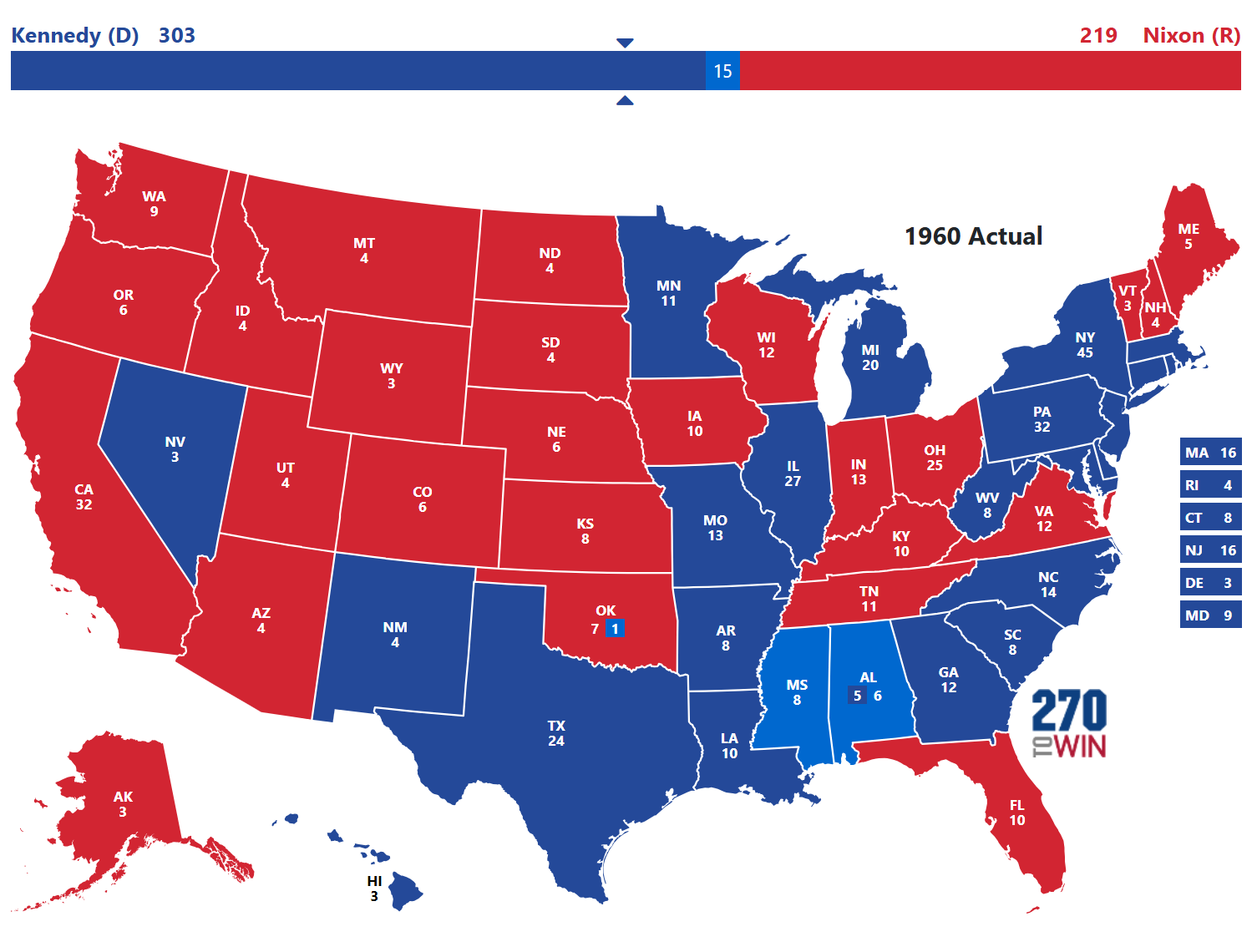
The election held on November 8, 1960, produced one of the closest popular vote margins in American history. Out of nearly 69 million votes cast, Kennedy defeated Nixon by a razor-thin margin of roughly 112,000 votes, capturing 49.7 percent of the popular vote to Nixon's 49.5 percent. In the Electoral College, Kennedy secured a more comfortable victory with 303 votes to Nixon's 219, while Senator Harry F. Byrd of Virginia captured 15 unpledged electors.
| State / Category | John F. Kennedy (Democrat) | Richard M. Nixon (Republican) | Margin / Result |
|---|---|---|---|
| Popular Vote | 34,220,984 (49.7%) | 34,108,157 (49.5%) | ~112,000 votes |
| Electoral College | 303 | 219 | Kennedy wins majority |
| Illinois (Key State) | 2,377,846 (50.0%) | 2,357,988 (49.6%) | Kennedy won by ~9,000 votes |
| Texas (Key State) | 1,167,932 (51.1%) | 1,121,140 (49.0%) | Kennedy won by ~46,000 votes |
The extreme closeness of the tally triggered immediate allegations of voter fraud and irregularities, particularly in pivotal states like Illinois and Texas. In Illinois, strong Democratic machine politics in Cook County, directed by Mayor Richard J. Daley, delivered Chicago for Kennedy and carried the state by fewer than 9,000 votes. In Texas, Vice President Johnson’s home state, allegations of ballot box manipulation also surfaced. Despite intense pressure from Republican operatives and party leaders to challenge the results in court, Nixon ultimately decided against pursuing formal nationwide recounts. He publicly cited the destabilizing effect a protracted constitutional crisis would have on the nation during the height of the Cold War, allowing the certification of Kennedy's victory to proceed smoothly.
Long-Term Significance and Legacy
The 1960 election left a lasting imprint on American political culture, institutions, and campaign strategy. Most prominently, it proved that a Roman Catholic could successfully ascend to the presidency, permanently dismantling a major religious barrier in American electoral politics. Furthermore, the contest cemented the supremacy of television as the primary medium for political communication, altering how candidates project credibility, charisma, and leadership.
The narrow outcome also underscored the deep regional and demographic divisions within the United States electorate. Kennedy's victory relied on a coalition of urban industrial centers, organized labor, Catholic voters, and traditional Southern Democrats. The strategies, polling techniques, and media-management practices pioneered during the 1960 campaign became standard templates for future presidential cycles, shaping the modern architecture of American democracy.
Assessing Historical Interpretations of the 1960 Contest
Evaluating the 1960 election requires understanding how historians view the interplay between media, political machinery, and policy issues. While contemporary accounts frequently emphasized the visual impact of the televised debates, modern political scientists point out that underlying economic conditions, demographic shifts, and party identification played equally decisive roles in shaping voter choices. The election remains a benchmark for studying political communication, electoral strategy, and the mechanics of a closely contested democratic transition.