In Taylor Sheridan’s prequel series 1883, John Dutton is introduced as John Dutton I, a five-year-old boy traveling west alongside his parents, James and Margaret Dutton, and his older sister Elsa. The series chronicles the family's perilous migration from Fort Worth, Texas, to Montana, establishing the historical foundation, ancestral sacrifices, and territorial pacts that birthed the modern Yellowstone Dutton Ranch.
Disambiguating John Dutton in 1883
To understand the historical and narrative framework of the Yellowstone universe, viewers must distinguish between the multiple generations of men named John Dutton. In the original series Yellowstone, the central patriarch played by Kevin Costner is John Dutton III. In 1883, the character named John Dutton is his grandfather, John Dutton I, portrayed as a young child by actor Audie Rick.
John Dutton I represents the bridge between the pioneering generation that conquered the trail and the entrenched landed gentry that built the ranch empire. Born in Texas in the late 1870s, young John experiences the brutal reality of the American frontier long before he ever holds power in Montana.
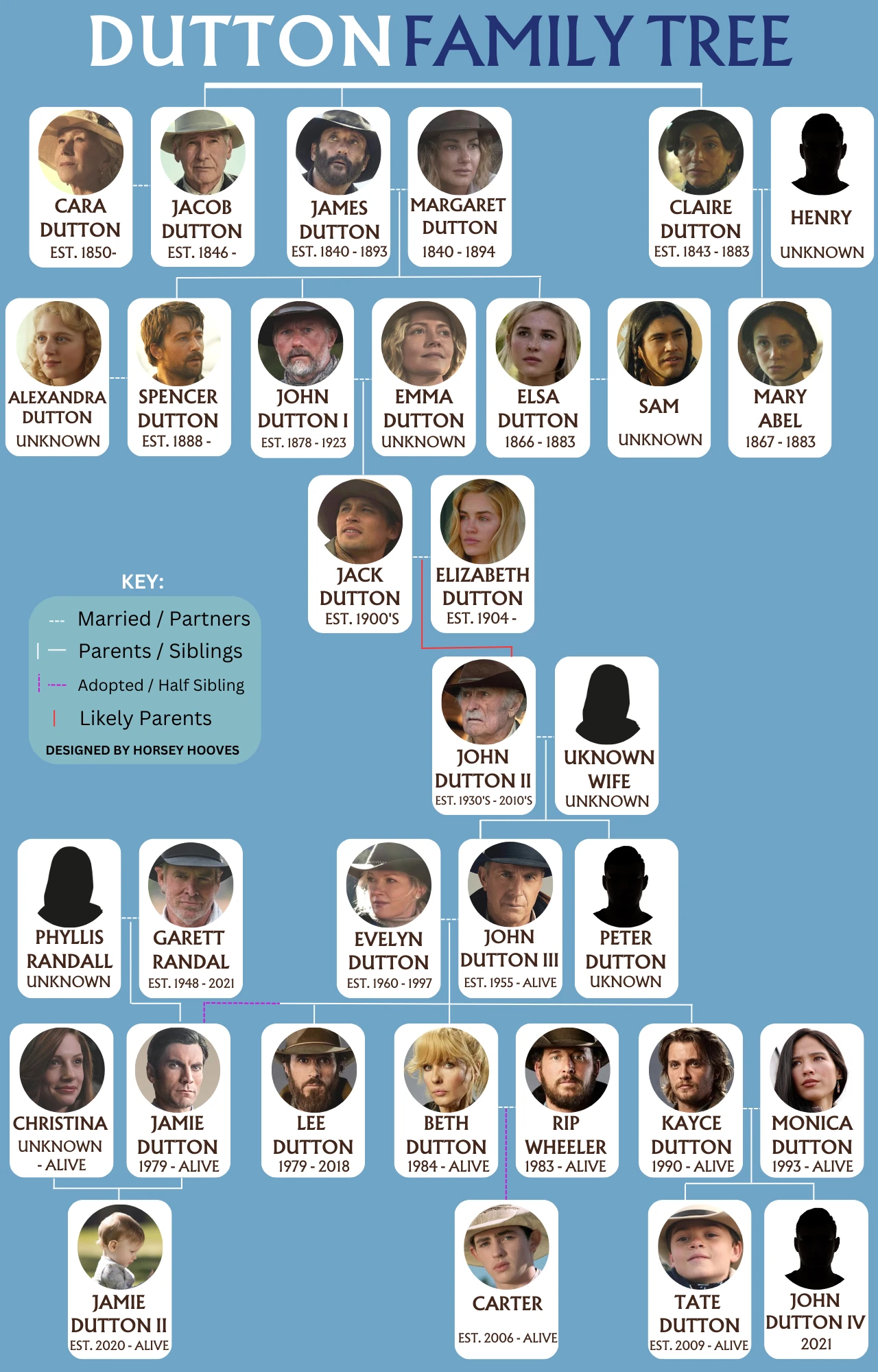
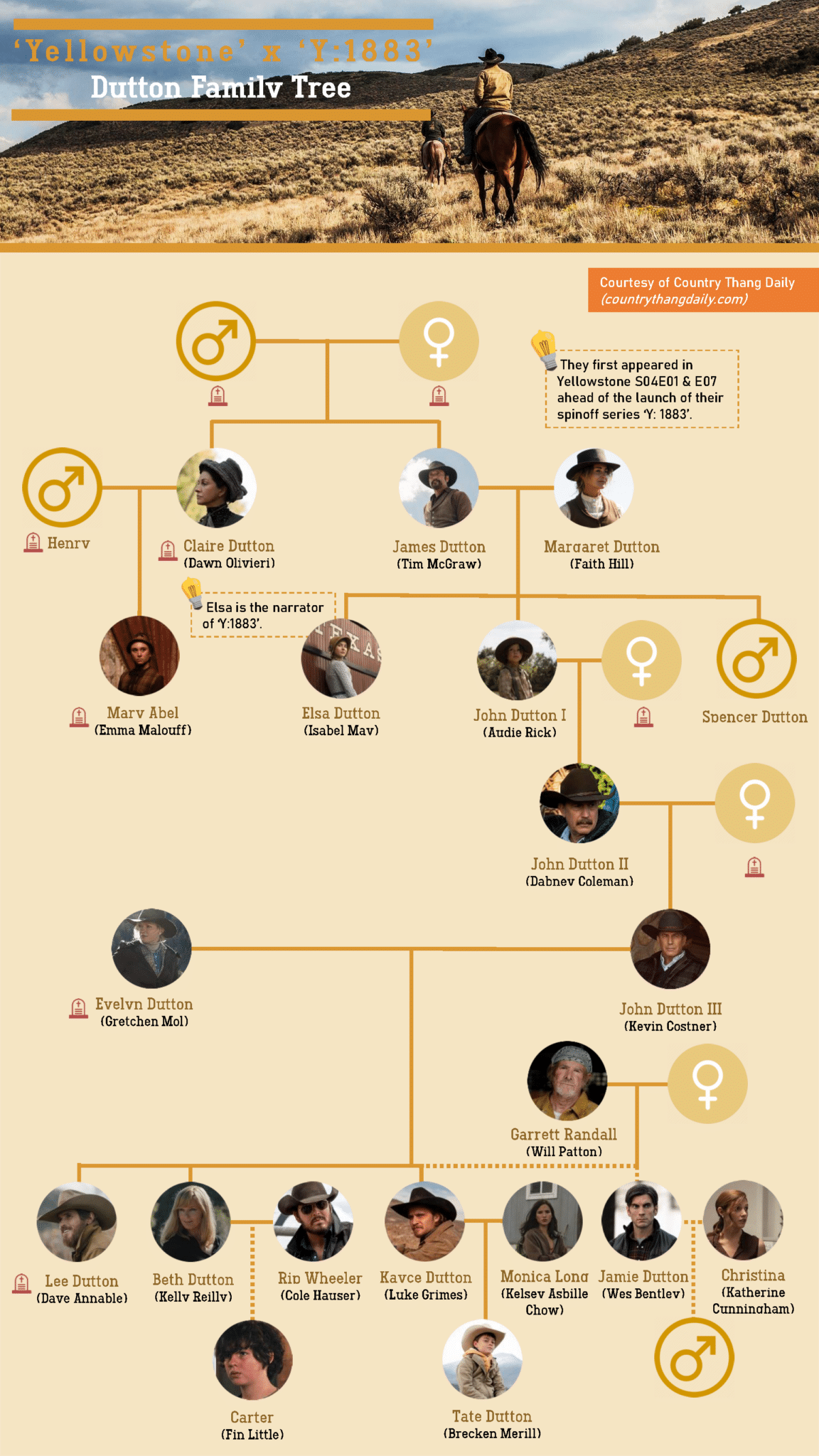
- James Dutton & Margaret Dutton (Pioneers of 1883)
- Elsa Dutton (Died 1883 in Montana)
- John Dutton I (Child in 1883 to Adult in 1923)
- John Dutton II (Patriarch shown in flashbacks)
- John Dutton III (Patriarch in Yellowstone)
- John Dutton II (Patriarch shown in flashbacks)
- Spencer Dutton (Born post-1883, key figure in 1923)
As depicted in 1883, John I is largely an observer of the sacrifices made by his parents, James (Tim McGraw) and Margaret (Faith Hill), as well as the tragic journey of his sister, Elsa (Isabel May). His survival through starvation, disease, and violence ensures the continuation of the family surname and sets up the ranch's eventual expansion during the early 20th century.
The Migration Route: From Fort Worth to Paradise Valley
The narrative of 1883 follows a classic yet grim westward migration corridor. The Dutton family leaves Tennessee following the economic disruption of the Reconstruction Era, re-assembling in Fort Worth, Texas—a major staging ground known historically as "Hell's Half Acre." From Fort Worth, James Dutton joins a wagon train led by Pinkerton agents Shea Brennan (Sam Elliott) and Thomas (LaMonica Garrett).
Stages of the Dutton Journey
- Fort Worth to the Red River: The journey begins by pushing northward through northern Texas into Indian Territory (modern-day Oklahoma). Crossing the Red River represents the first major tactical obstacle, testing the wagon train's equipment and livestock management.
- The Great Plains and Kansas: Moving through Central Kansas, the expedition encounters deadly outbreaks of cholera, rattlesnake bites, and severe river crossings across the Brazos and Kansas Rivers.
- Nebraska and Wyoming: Heading northwest along branches of the Oregon and Bozeman Trails, the group faces declining provisions, internal dissent among European immigrants, and direct conflict with bandit bands.
- Montana Territory: The ultimate destination was originally Oregon, but the journey shifts dramatically when Elsa Dutton is fatally wounded by a poisoned arrow during an encounter with a Lakota war party driven by a tragic misunderstanding.
Elsa’s imminent death alters the family's destiny. James Dutton seeks a place where his daughter can spend her final moments and be buried, knowing that wherever her body rests, the family will settle forever. A Crow elder named Spotted Eagle directs James to Paradise Valley in the Montana Territory, establishing the site that would become the Yellowstone Ranch.
Real-World Historical Context of the 1883 Frontier
While 1883 is a fictional narrative, its events are rooted in the socio-economic realities of late 19th-century America. The year 1883 fell within the tail end of the American Gilded Age and the height of the Westward Expansion era, a period defined by massive immigration, Indian Appropriations Acts, and the expansion of transnational rail lines.
Post-Civil War Displacement
James Dutton's background as a former Confederate captain (having fought at the Battle of Antietam) reflects the historical movement of displaced veterans moving west after the American Civil War. With Southern agricultural economies devastated by the war and Reconstruction policies altering land ownership, thousands of former soldiers migrated west to claim land under the Homestead Act of 1862.
The Role of Pinkerton Agents and Immigrant Caravans
The inclusion of Shea Brennan and Thomas highlights the role of private protection agencies during the era. With federal marshals scarce across vast stretches of unorganized territory, private guards were routinely hired to protect valuable cargo, cattle herds, and immigrant groups.
The wagon train in 1883 consists heavily of German and Roma immigrants who spoke little English and lacked frontier survival skills. This reflects historical trends of late 19th-century immigration, where European arrivals frequently purchased Western land sight-unseen from railroad companies, only to find themselves ill-prepared for the brutal conditions of the Great Plains.
Indigenous Sovereignty and Territorial Conflict
The late 19th century was marked by intense conflict between Western settlers and Native American tribes. By 1883, the Great Sioux War of 1876 had concluded, and the federal government was aggressively pushing indigenous populations onto restricted reservations. The depiction of Comanche, Lakota, and Crow nations in 1883 captures a period of profound transition, where native groups fought to protect their remaining territories while dealing with broken federal treaties and decimated bison herds.
The Dutton Family Lineage Across Generations
The events of 1883 serve as the foundation for the complex family tree that spans multiple series across the television franchise. Understanding the exact lineage clarifies how land rights, historical grievances, and personal obligations carry down to modern times.
| Era / Series | Family Patriarch | Key Family Members | Historical Setting & External Pressures | Status of Paradise Valley Land |
|---|---|---|---|---|
| 1883 | James Dutton | Margaret, Elsa, John I | Post-Civil War, Westward Trail, Indian Wars era | Claimed upon Elsa's death; unplotted frontier land |
| 1923 | Jacob Dutton (Brother of James) | Cara, John I (Adult), Spencer, Alexandra | Post-WWI, Prohibition, Great Depression in the West | Established cattle operation facing range wars and drought |
| Yellowstone (Present Era) | John Dutton III | Beth, Kayce, Jamie, Rip Wheeler, Tate | Corporate expansion, federal environmental policy, casino development | Massive private landholding under constant legal and physical attack |
Following James Dutton’s death in the early 1890s (shown in flashbacks during Yellowstone Season 4), his brother Jacob Dutton (Harrison Ford in 1923) moves to Montana to help Margaret run the ranch and raise John I and his younger brother Spencer. John Dutton I eventually marries Emma and fathers John Dutton II, who in turn fathers John Dutton III (Kevin Costner).
The Seven-Generation Pact: Narrative Implications
One of the most critical elements introduced in 1883 is the conversation between James Dutton and the Crow leader, Spotted Eagle. When James asks where he can take his dying daughter, Spotted Eagle points him toward Paradise Valley, but warns him of the long-term cost.
"In seven generations, my people will rise up and take it back from you." — Spotted Eagle
"In seven generations, you can have it." — James Dutton
This exchange creates an overarching thematic arc for the entire Yellowstone saga. Counting generations from James Dutton:
- Generation 1: James Dutton (Settler)
- Generation 2: John Dutton I / Spencer Dutton
- Generation 3: John Dutton II
- Generation 4: John Dutton III (Kevin Costner)
- Generation 5: Kayce Dutton / Beth Dutton / Jamie Dutton
- Generation 6: Tate Dutton (Son of Kayce Dutton and Monica Long)
- Generation 7: Future offspring of Tate Dutton's line
Tate Dutton holds a unique position in this generational counting. As the son of Kayce Dutton (white/settler heritage) and Monica Long (Indigenous/Broken Rock Reservation heritage), Tate embodies both sides of the original agreement. His existence conceptually resolves the prophecy by returning ownership of the land to Native bloodlines through natural inheritance rather than military or legal seizure.
Key Historical Realities vs. Dramatic Fiction in 1883
While 1883 is celebrated for its gritty, unvarnished depiction of frontier life, viewers should distinguish historical facts from narrative dramatization.
Verified Historical Accuracies
- Hazard Rates on the Trail: Mortality rates on westward wagon trails were exceptionally high. Disease (such as cholera and dysentery), drowning during river crossings, and accidental firearm discharges accounted for the majority of deaths, rather than combat.
- Cattle Driving Mechanics: The practice of gathering Texas Longhorns and driving them north to railheads or northern pastures was at its absolute peak in the late 1870s and early 1880s before barbed wire fenced off the open range.
- Texan Cultural Conditions: Fort Worth in 1883 was indeed a lawless hub dominated by cattle drives, saloons, and violent crime, earning its historical nickname "Hell's Half Acre."
Dramatic Interpretations
- Solo Family Migration: Most settlers traveled in large, formal wagon companies bound together by written charters and strict rules. James Dutton’s aggressive independence, while compelling for television, would have made survival significantly harder in real life.
- Pinkerton Functionality: Pinkerton agents were primarily private investigators, railroad guards, and strikebreakers. While former agents did work as trail guides, they rarely operated as independent contractors taking small groups of untrained European immigrants across uncharted territory without extensive supply trains.
Frequently Asked Questions
Who plays young John Dutton in 1883?
Young John Dutton I is played by child actor Audie Rick in 1883. The character appears as a five-year-old boy experiencing the trek from Texas to Montana alongside his sister Elsa and parents James and Margaret.
How is John Dutton from 1883 related to Kevin Costner's character?
John Dutton I (the child in 1883) is the grandfather of John Dutton III (Kevin Costner in Yellowstone). John I grows up to appear as an adult in 1923, where he has a son named John Dutton II, who later fathers John III.
Is the story of 1883 based on a true historical family?
No. The Dutton family and the specific events of 1883 are fictional creations of showrunner Taylor Sheridan. However, the series uses real historical settings, authentic trail conditions, and genuine historical context from the late 19th-century American West.
Why did the Dutton family stop in Montana instead of continuing to Oregon?
The family originally intended to settle in Oregon. However, after their daughter Elsa was fatally shot with a poisoned arrow in Wyoming, James Dutton rode north looking for a place to settle before she died. He agreed to settle wherever she breathed her last breath, which led them to Paradise Valley, Montana.
What is the historical significance of the Bozeman Trail in 1883?
The Bozeman Trail was an overland route connecting the Oregon Trail to the gold fields of Montana. Though officially closed following Red Cloud's War and the Fort Laramie Treaty of 1868, segments of the route were still utilized by ranchers, homesteaders, and cattle drives in the 1880s to access northern grazing lands.
Tracking the Dutton Saga Chronologically
To fully appreciate how 1883 informs the modern Yellowstone story line, viewers should engage with the narrative universe in chronological order rather than release order:
- 1883 (Limited Series): Establishes the founding of the ranch, the burial of Elsa Dutton, and the original pact with the Crow Nation.
- 1893 Flashbacks (Featured in Yellowstone Season 4): Shows James Dutton establishing the ranch boundaries while dealing with early Montana law enforcement and Native relations.
- 1923 (Prequel Series): Explores John Dutton I as an adult alongside his uncle Jacob Dutton during the Western Great Depression, early range wars, and Prohibition.
- Yellowstone (Main Series): Follows John Dutton III as he attempts to keep the massive property intact against modern real estate developers, tribal leaders, and government intervention.
By understanding 1883, viewers gain a clear perspective on why the modern Dutton family guards their land with intense, almost fanatical devotion: every acre of Paradise Valley was paid for with the blood, starvation, and lives of their ancestors.