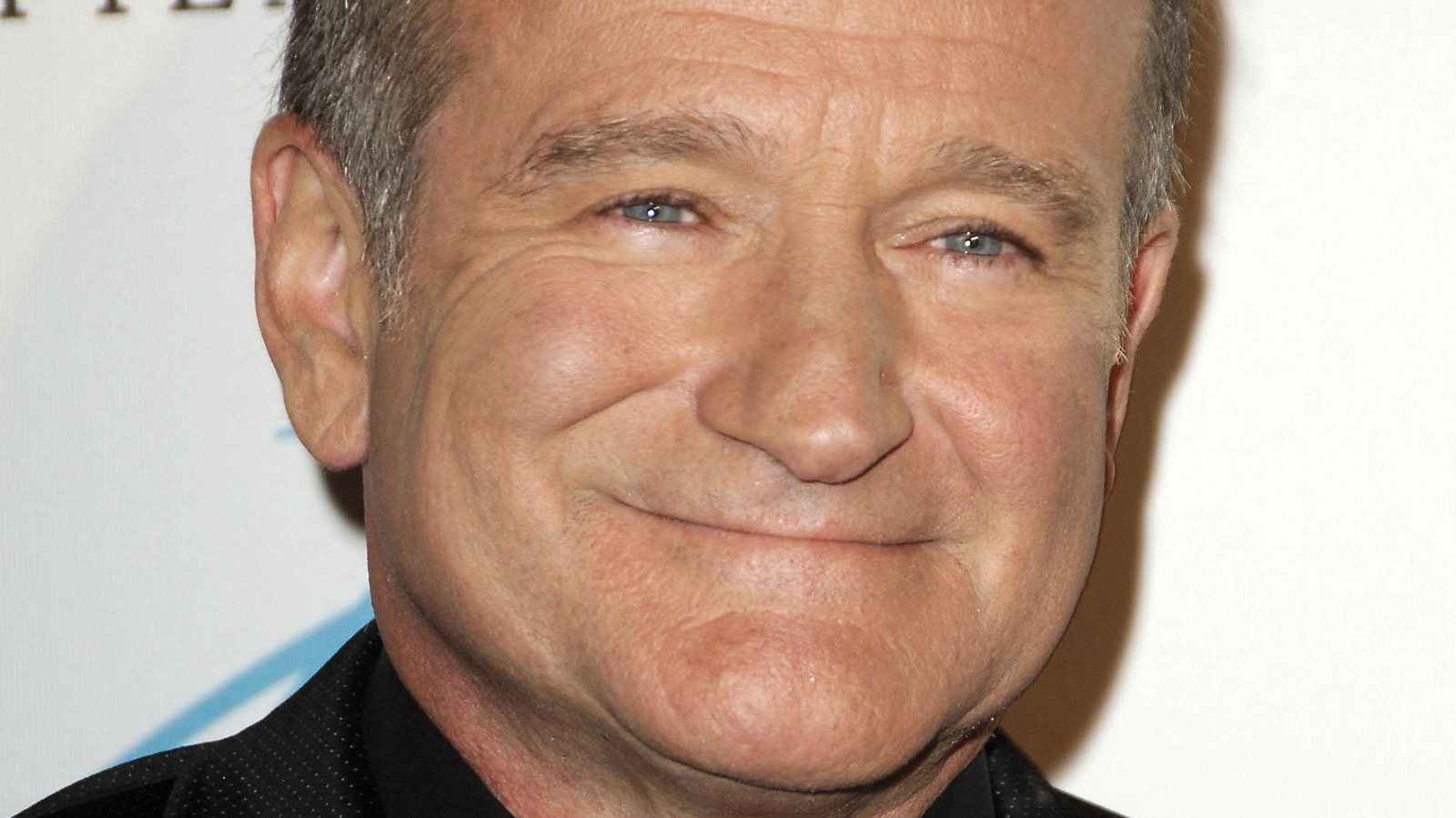
Robin Williams remains one of the most beloved figures in entertainment history, known for his lightning-fast improvisational skills and profound dramatic depth. Beyond the iconic roles and high-energy stand-up, his life was marked by quiet humanitarianism, unexpected intellectual passions, and enduring friendships that shaped the landscape of Hollywood for decades.
The Formative Years and Unexpected Beginnings
Robin Williams’ journey to becoming a global icon was not a linear path of early success. In fact, many of his most defining traits were forged in the quiet moments of his youth and his rigorous classical training.
1. Voted "Least Likely to Succeed"
In a twist of historical irony, his high school classmates at Redwood High School in California once voted him the "Least Likely to Succeed." At the time, Williams was relatively quiet and had not yet unleashed the manic, extroverted energy that would later define his career. This early dismissal by his peers underscores a common theme in his life: the vast difference between his private, introspective self and his public persona. By 2026, this anecdote remains a powerful reminder that early academic or social labels rarely dictate a person’s ultimate potential.
2. The Juilliard Pact with Christopher Reeve
Williams was one of only two students accepted into the Advanced Program at Juilliard in 1973; the other was Christopher Reeve. The two became roommates and lifelong friends. They famously made a "pact" that whoever became successful first would support the other. While they both achieved stardom relatively quickly, their bond deepened after Reeve’s tragic horse-riding accident in 1995. Williams was the first person to make Reeve laugh in the hospital, entering the room dressed as a surgeon and speaking in a Russian accent, claiming he was there to perform a "proctology exam."
3. Studying Under John Houseman
While at Juilliard, Williams studied under the legendary John Houseman. Houseman eventually told Williams that he was wasting his time at the prestigious school because there was nothing more they could teach him regarding his natural comedic and improvisational abilities. Houseman encouraged him to leave Juilliard and pursue his career professionally, a rare admission from an institution that emphasized classical, rigorous training over spontaneous performance.
Revolutionizing the Screen and the Stage
Robin Williams didn't just perform; he altered the medium he worked in. Whether it was television, animation, or live-action film, his presence often forced creators to rewrite the rules.
4. The Audition That Changed Television
When Williams auditioned for the role of Mork the alien in Mork & Mindy, producer Garry Marshall asked him to take a seat. Williams immediately sat on his head, resting his feet on the back of the chair. Marshall later remarked that he hired Williams because he was the "only alien who auditioned." This moment of pure spontaneity launched his career and established his reputation as a performer who could find humor in the physical space of a room instantly.
5. Improvised Dialogue in Aladdin
Disney’s Aladdin (1992) is often cited as the film that changed how major stars approached voice acting. Williams recorded approximately 16 hours of improvised material for the role of the Genie. He riffed so much that the script became a mere suggestion. Because so much of his dialogue was improvised, the film was actually rejected for a "Best Adapted Screenplay" Academy Award nomination. The Academy felt the heavy reliance on Williams’ ad-libs meant the screenplay didn't meet the criteria for a pre-written work.
6. The Golden Globe Controversy
While the Academy snubbed the screenplay, the Golden Globes took a different approach. They were so impressed by his performance that they created a special "Special Achievement Award" for him in 1993. This was because the Genie didn't fit into the traditional "Best Actor" categories for a musical or comedy at the time, yet his impact on the film's success was undeniable.
The Humanitarian and the Intellectual
Beneath the laughter, Williams was deeply committed to social causes and possessed a range of hobbies that showcased a complex, curious mind.
7. The Homelessness Rider
One of the most heartwarming facts about Williams was his "requirement" for movie studios. He frequently included a rider in his contracts requiring the production company to hire a certain number of homeless people to work on the set. According to Brian Lord, a talent agent who once saw one of Williams’ riders, this wasn't just a suggestion; it was a way for Williams to use his leverage to provide immediate employment and dignity to those in need.
8. Cheering Up Steven Spielberg
During the grueling filming of Schindler's List, director Steven Spielberg fell into a deep depression due to the harrowing nature of the subject matter. To help his friend, Williams would call Spielberg once a week on a speakerphone. He would perform 15 minutes of stand-up comedy for the cast and crew, never telling them he was calling—he would just start his routine to lift their spirits. Spielberg later noted that these calls were essential to his mental well-being during the production.
9. A Passion for Video Games and Zelda
Williams was a massive fan of video games, a hobby he shared openly. His love for the Nintendo series The Legend of Zelda was so great that he named his daughter Zelda Williams. He even appeared in several commercials for the franchise. His interests also extended to PC gaming and tabletop wargaming, including Warhammer 40,000, proving that his intellectual curiosity spanned multiple subcultures.
| Achievement/Attribute | Detail | Impact |
|---|---|---|
| Education | Juilliard School | Classical training that grounded his erratic energy. |
| Philanthropy | Comic Relief USA | Co-founded with Billy Crystal and Whoopi Goldberg; raised millions. |
| Top Award | Academy Award (1998) | Won Best Supporting Actor for Good Will Hunting. |
| Social Requirement | Homeless Hire Rider | Leveraged star power to provide jobs for the unhoused. |
| Scientific Legacy | Lewy Body Dementia | His diagnosis brought global awareness to the neurological condition. |
Hidden Talents and Physical Feats
While his voice and face were his primary tools, Williams’ life was marked by physical disciplines and unexpected early jobs.
10. A Professional Mime in Central Park
Before the fame of Happy Days and Mork & Mindy, Williams earned money as a street performer. He worked as a mime in front of the Metropolitan Museum of Art in New York City. This period allowed him to hone his physical comedy and observe human behavior, which he would later use to create his many "characters" on stage.
11. An Avid Cyclist
Williams was a devoted cyclist and often claimed that cycling was the closest thing to "meditation" he could achieve. He owned a massive collection of high-end bicycles and was a frequent spectator at the Tour de France. He was close friends with several professional cyclists and used the sport as a way to manage his boundless physical energy and maintain his cardiovascular health.
12. Connection with Koko the Gorilla
In 2001, Williams visited Koko the Gorilla, the famous primate who learned American Sign Language. Koko had not smiled for six months following the death of her companion, Michael. Within minutes of meeting Williams, she was laughing and engaging in play. The two formed a genuine bond, and when Williams passed away in 2014, the Gorilla Foundation reported that Koko became visibly somber and signed the word for "cry" when told of his death.
The Medical Reality and Final Acts
The end of Robin Williams’ life was shrouded in mystery until medical reports clarified the struggle he was facing privately.
13. Misdiagnosis of Parkinson’s
For a period leading up to his death, Williams was diagnosed with Parkinson’s Disease. However, an autopsy later revealed that he actually suffered from Lewy Body Dementia (LBD). This is a progressive brain disorder that causes a decline in mental abilities, hallucinations, and physical tremors. His widow, Susan Schneider Williams, has since become a prominent advocate for LBD awareness, describing the disease as "the terrorist inside my husband's brain."
14. The "Good Will Hunting" Bench
The bench in the Boston Public Garden where Williams filmed the famous "Your move, chief" scene with Matt Damon became an unofficial memorial after his death. Fans covered it in flowers, chalk drawings, and quotes. By 2026, it remains a site of pilgrimage for those who found solace in his performance as Dr. Sean Maguire, a role that finally earned him his elusive Oscar.
15. Supporting the Arts for Others
Williams didn't just graduate from Juilliard (or rather, leave early); he also funded a scholarship there. For years, he quietly paid for the tuition of several students, including actor Jessica Chastain. Chastain has publicly stated that she would not have been able to attend the school without the scholarship provided by Williams, highlighting his commitment to fostering the next generation of talent without seeking public credit.
Frequently Asked Questions
Did Robin Williams really improvise his lines in Mrs. Doubtfire?
Yes, Williams improvised extensively during the filming of Mrs. Doubtfire. Director Chris Columbus used multiple cameras to capture Williams’ ad-libs because he never knew exactly what the actor would do or say next. This resulted in several different versions of scenes, ranging from PG to R-rated, though the film was ultimately edited for a family-friendly rating.
What was the cause of Robin Williams' death?
While his death was a suicide, the underlying medical cause was Lewy Body Dementia. This condition is often misdiagnosed as Parkinson's or Alzheimer's. The severe neurological decay caused by LBD led to intense anxiety, paranoia, and memory loss, which contributed significantly to his mental state in his final months.
How many Academy Awards did Robin Williams win?
Robin Williams won one Academy Award. He received the Oscar for Best Supporting Actor for his role in Good Will Hunting (1997). He was nominated three other times for Best Actor in Good Morning, Vietnam, Dead Poets Society, and The Fisher King.
Was Robin Williams a classically trained actor?
Yes, he was highly trained. Despite his reputation for wild comedy, he attended the Juilliard School’s drama division. This classical foundation gave him the technical range to transition seamlessly between manic stand-up comedy and heavy dramatic roles, such as those in One Hour Photo or Insomnia.
What was his first major role?
His breakout role was playing Mork from Ork, an alien who first appeared in an episode of Happy Days in 1978. The character was so popular that it led to the spin-off series Mork & Mindy, which ran for four seasons and turned Williams into a household name.
Honoring the Legacy of a Comic Genius
To truly honor Robin Williams’ legacy, one should look beyond the highlights of his filmography and toward his impact on the people around him. Whether it was through his support of the homeless, his dedication to his friends, or his battle with a devastating neurological disease, Williams lived a life of profound empathy.
For those looking to explore his work further, consider revisiting his lesser-known dramatic turns, which often reveal more about the man than his blockbusters. Supporting organizations like the Lewy Body Dementia Association (LBDA) or Comic Relief US are practical ways to continue the work he championed. His life reminds us that even in the face of internal struggles, the act of giving—whether it be a laugh, a job, or a moment of kindness—is the most enduring legacy one can leave behind.