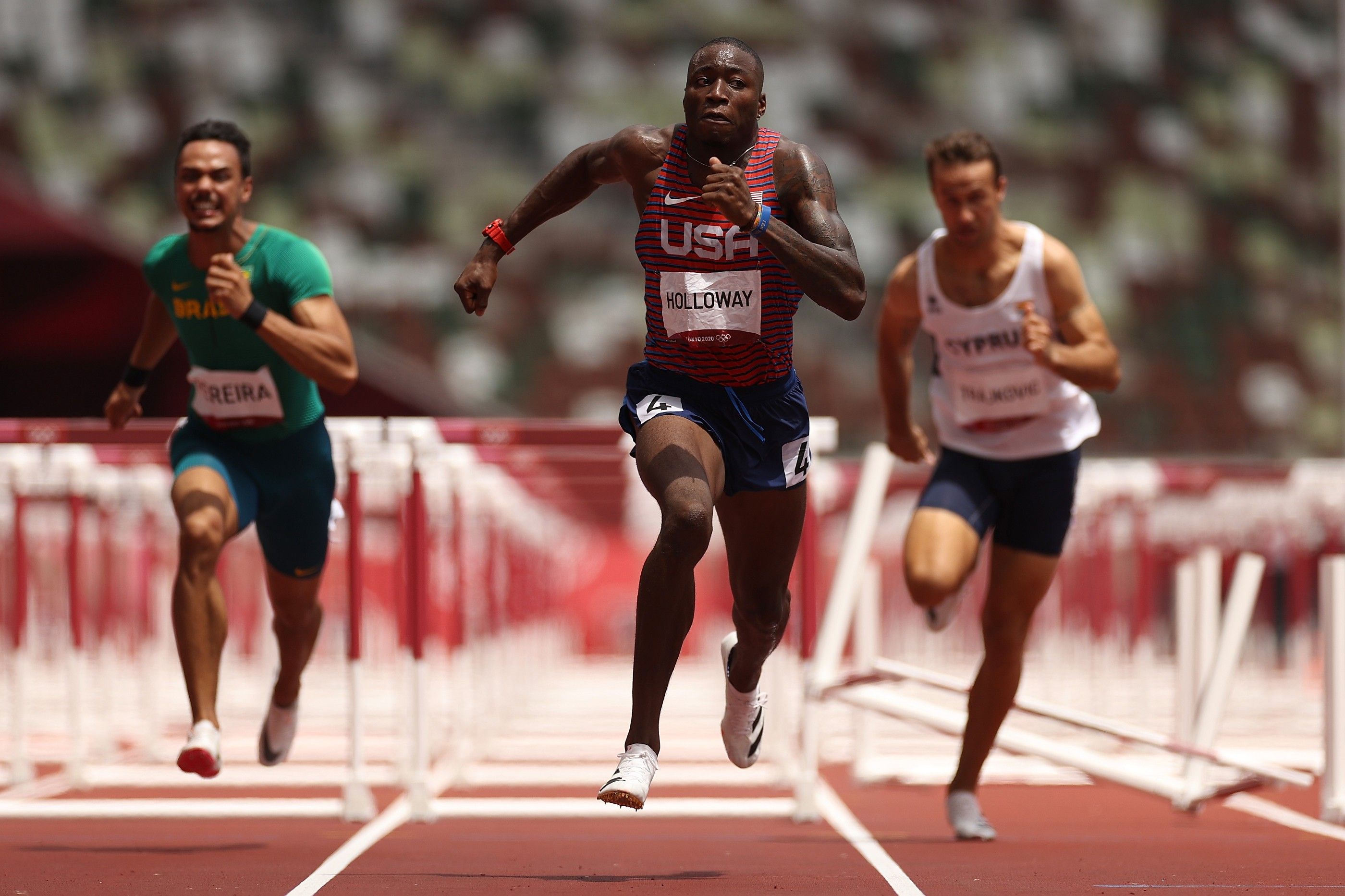
The 110m hurdles at the Olympic Games represents one of the most technical and demanding events in athletics, requiring a synthesis of explosive sprinting speed, rhythmic precision, and fluid clearing technique. Since its introduction to the modern Olympic program in 1896, the event has evolved from a test of raw endurance to a highly specialized discipline where margins of victory are often measured in hundredths of a second.
Technical Specifications and Competition Rules
The 110m hurdles is a men’s event contested on a straight track. The race requires athletes to navigate 10 hurdles, each measuring 1.067 meters (3 feet, 6 inches) in height. The placement of these obstacles is strictly regulated: the distance from the starting line to the first hurdle is 13.72 meters, the distance between each of the 10 hurdles is 9.14 meters, and the run-in from the final hurdle to the finish line is 14.02 meters.
World Athletics, the international governing body for track and field, enforces stringent rules regarding competition conduct. An athlete may be disqualified for intentionally knocking down hurdles with their hands or trailing leg, or if their lead leg passes outside or below the hurdle plane. Additionally, false starts are penalized with immediate disqualification. Because the event is a sprint, the starting block reaction time is critical; any movement before the gun fires, detected by sensitive pressure-plate sensors in the blocks, results in an exit from the race.
Historical Evolution of the Event
The 110m hurdles has been a fixture of the modern Olympic Games since their inception in Athens in 1896. Initially, the race was run on grass or cinder tracks with heavy, stationary wooden hurdles that were essentially L-shaped obstacles. These hurdles were prone to tipping, and the technique required to clear them was vastly different from today; early hurdlers often leaped over the barriers with a hitching motion rather than sprinting through them.
The introduction of the L-shaped "self-tipping" hurdle in 1935 significantly altered the physics of the race. By allowing the hurdle to move forward upon contact, the risk of injury and disqualification was reduced, enabling athletes to maintain a more aggressive, lower trajectory. This innovation allowed for the development of the modern "step-over" technique, where the athlete maintains a sprinting stride pattern rather than jumping. As track surfaces transitioned from cinder to synthetic polyurethane materials in the late 1960s, the speed and efficiency of the event increased exponentially, leading to the rapid progression of world records observed throughout the late 20th and early 21st centuries.
Anatomy of the Elite Hurdling Technique
Success in the 110m hurdles is predicated on the "three-step rhythm." Elite performers take exactly three steps between each hurdle. This requires impeccable stride length management; if an athlete takes too long a stride, they risk hitting the hurdle; too short, and they lose momentum. The lead leg must be brought over the hurdle with a rapid, snapping motion, while the trail leg remains tucked tight to the body to minimize time spent in the air.
The "lead arm" action is equally critical, as it acts as a counterbalance to the explosive movement of the lower body. Athletes must keep their shoulders square to the finish line to prevent lateral drift. Any wasted movement during the flight phase translates into a loss of velocity, which is impossible to recover during the short 14.02-meter dash to the finish.
Comparison of Olympic Hurdling Eras
| Era | Hurdle Construction | Track Surface | Average Winning Technique |
|---|---|---|---|
| 1896–1932 | Solid/Fixed Wood | Cinder/Grass | High-jump/Hitching |
| 1936–1964 | L-Shaped (Weighted) | Cinder | Early Sprint-clearing |
| 1968–1996 | L-Shaped (Counterweighted) | Synthetic | Technical 3-step rhythm |
| 2000–Present | Modern Plastic/Metal | High-Tech Synthetic | Power-sprint/Minimal air-time |
Notable Elite Performers
The history of the 110m hurdles is defined by legendary figures who redefined the limits of human speed. The American dominance in the event was established early, but it has since become a global competition.
- Harrison Dillard: A standout of the 1948 and 1952 Olympics, Dillard was the first to bridge the gap between pure sprinting and hurdling. His ability to maintain top-end speed between the barriers set a new standard for his era.
- Renaldo Nehemiah: In the late 1970s and early 1980s, Nehemiah was the first to break the 13-second barrier, proving that the event could be run with pure, raw speed.
- Liu Xiang: Representing China, Liu Xiang’s gold medal performance at the 2004 Athens Olympics was a watershed moment, as he equaled the world record and became a global icon, proving the viability of Asian athletes in the power-based sprint hurdles.
- Aries Merritt: Holding the current world record, Merritt’s 2012 performance in Brussels solidified the modern technical approach, combining near-perfect form with unprecedented frequency.
Challenges and Common Mistakes
Even at the highest levels, the 110m hurdles remains a high-risk event. The most common error is "clipping" the hurdle with the lead leg, which causes a loss of balance. Because the athlete is traveling at high velocity, even a minor change in the center of gravity can cause a stumble or a total fall.
Another frequent technical failure is "hovering"—spending too much time in the air. This often happens when an athlete gets "too close" to the hurdle at takeoff. Ideally, the athlete should take off approximately 2 meters before the hurdle and land 1.2 to 1.5 meters past it. If these distances are not maintained, the athlete loses their rhythmic 3-step cadence, forcing a "chopping" of steps that effectively kills their momentum. Troubleshooting this issue usually involves extensive work on approach drills and blocks-to-first-hurdle acceleration.
Frequently Asked Questions
Why is the 110m hurdles restricted to men in the Olympics?
The 110m distance is specific to the men’s Olympic program. Women compete in the 100m hurdles, which features lower hurdles and different spacing. This is not a matter of exclusion but rather a historical distinction in event programming standardized by World Athletics to account for biological and physiological differences in stride length and speed.
Can an athlete continue if they knock over a hurdle?
Yes. Under current World Athletics rules, knocking over a hurdle is permitted, provided the athlete does not do so deliberately and does not interfere with the lane of another competitor. However, hitting a hurdle almost always results in a loss of time and balance, making it a severe disadvantage.
What is the purpose of the 14.02-meter run-in?
The run-in from the final hurdle to the finish line is designed to test an athlete’s ability to transition from the technical hurdle rhythm back to a pure flat-out sprint. It serves as a final physical and mental test after the athlete has already exerted significant energy navigating the 10 barriers.
How are hurdles adjusted for different heights?
In Olympic-level competition, hurdles are fixed at the official height of 1.067 meters. They are never adjusted during the race. If an athlete fails to clear the height, they typically strike the top bar, which is counterweighted to fall forward safely to prevent serious injury.
What is the most important part of the race?
The approach to the first hurdle and the clearance of the final hurdle are often cited as the most critical segments. A fast start is necessary to establish the 3-step rhythm, while the finish is where athletes often lose or gain their medals based on their ability to maintain form under extreme physical fatigue.
Improving Your Hurdling Performance
For those seeking to improve their proficiency in the 110m hurdles, the primary recommendation is to prioritize "rhythm over speed" in the early stages of training. Novice athletes often attempt to sprint through the hurdles before mastering the lead-leg snap and trail-leg drive. Focus your training on hurdle mobility drills, such as walking over hurdles to emphasize the lead-leg path and trail-leg whip, before attempting to incorporate them into a full-speed block start. Consistency in the 3-step rhythm is the foundation of elite performance; once the rhythm is locked in, speed will naturally follow as your technical efficiency improves.