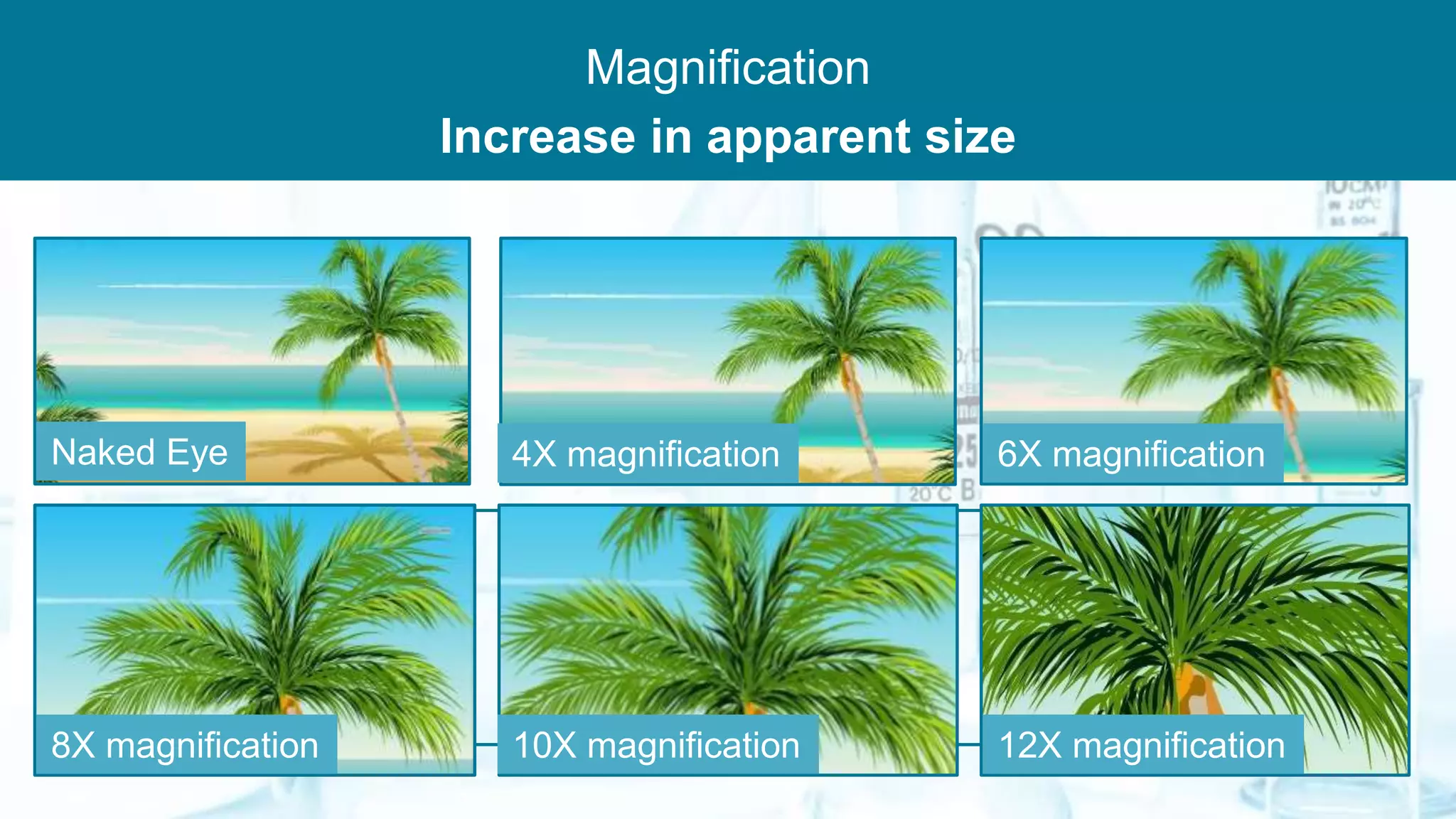
10x magnification is an optical measurement indicating that an object viewed through a lens or system appears ten times larger than it does to the naked eye. This specification is the industry standard for binoculars, monoculars, and certain microscope objectives, balancing image enlargement with field of view, light transmission, and stability for handheld use.
The Physics of 10x Magnification
At its core, magnification is the ratio between the apparent size of an object as viewed through an optical instrument and its size as seen by the unaided eye. A 10x system takes incoming light and alters the convergence angle, effectively projecting a larger image onto the retina of the user.
In practical optical design, this is achieved through a combination of objective lenses (the front lenses that collect light) and ocular lenses (the eyepieces). The magnification power is determined by the focal length of the objective lens divided by the focal length of the eyepiece. In a pair of 10x42 binoculars, for example, the "10x" refers to this power, while the "42" indicates the objective lens diameter in millimeters.
Why 10x is Considered the "Goldilocks" Standard
For outdoor enthusiasts, birdwatchers, and hunters, 10x magnification is frequently cited as the ideal balance between power and portability. Lower magnification—such as 8x—offers a wider field of view and is generally easier to hold steady, but it provides less detail at long distances. Conversely, 12x or 15x magnification pulls distant subjects significantly closer but presents two major challenges: increased image shake and diminished light-gathering capability.
The 10x threshold represents the maximum power most users can stabilize without the assistance of a tripod or monopod. Because any slight tremor of the human hand is also magnified by the same factor, a 10x system pushes the limits of handheld comfort. Beyond 10x, the perceived "wobble" often offsets the benefit of higher resolution, leading to eye strain and reduced image clarity during prolonged observation.
Technical Performance and Limitations
When evaluating a 10x device, users must consider the exit pupil—a calculation derived by dividing the objective lens diameter by the magnification power. For a 10x42 optic, the exit pupil is 4.2mm. This measurement dictates how much light reaches the eye. In low-light conditions, such as at dawn or dusk, an exit pupil of 4mm or higher is generally required to keep the image bright.
A common misconception is that higher magnification always equates to better performance. In reality, as magnification increases, the field of view narrows and the depth of field—the distance over which the image remains in focus—decreases. Consequently, a user with 10x binoculars will have to adjust the focus wheel more frequently when tracking a subject moving toward or away from them compared to a user with 8x magnification.
Comparative Analysis of Standard Magnification Levels
| Feature | 8x Magnification | 10x Magnification | 12x+ Magnification |
|---|---|---|---|
| Field of View | Widest | Moderate | Narrow |
| Stability | Excellent (Handheld) | Good (Handheld) | Poor (Requires Tripod) |
| Brightness | High | Balanced | Lower |
| Best Use | Forests/Dense Cover | General Purpose | Long-Range Scouting |
| Focusing Effort | Low | Moderate | High |
Essential Considerations for Choosing 10x Equipment
Before investing in 10x optics, assess the primary environment in which the device will be used. If your activities involve high-movement tracking, such as following wildlife in motion or rapid scanning of terrain, the slightly reduced field of view at 10x requires more disciplined scanning techniques.
- Weight and Ergonomics: A 10x42 unit is heavier than a 10x25 compact model. If the weight is too great, it will cause fatigue, which exacerbates hand shake.
- Coating Quality: Because 10x systems can feel "darker" than lower-power alternatives due to the smaller exit pupil, ensure the lenses feature fully multi-coated glass to maximize light transmission.
- Eye Relief: If you wear eyeglasses, you must ensure your 10x optic provides at least 16mm of eye relief. Without this, you will be unable to see the full field of view, effectively losing the benefits of the 10x design.
Troubleshooting and Best Practices
The most frequent issue encountered with 10x magnification is the perception of a "shaky" or "jittery" image. This is rarely a fault of the instrument, but rather a reflection of the user's natural physiology. To mitigate this, practice proper holding techniques:
- Brace your elbows: Hold your elbows close to your ribcage rather than splaying them outward.
- Lean for support: Whenever possible, lean your shoulders or elbows against a tree, fence post, or vehicle to create a stable anchor point.
- The "Three-Point" Method: Ensure both hands are gripping the barrel of the binoculars while your forehead or eyecups are pressed firmly against your brow.
If you find that 10x is consistently too difficult to stabilize, it does not necessarily mean your vision is poor or the device is defective. It is a physical limit of the 10x platform. In such cases, moving to an 8x platform will provide an instantly more stable and enjoyable viewing experience for most users.
Frequently Asked Questions
Is 10x magnification enough to see craters on the moon?
Yes, 10x magnification is sufficient to clearly see the lunar craters and the contrast between the moon's maria (dark plains) and highlands. While you will not see them in high-definition detail, the major features are easily discernible with stable 10x optics.
Does 10x magnification make the image blurry?
No, 10x magnification itself does not cause blurriness. Blur is usually caused by an out-of-focus image, poor lens quality, or excessive hand shake. If the image is clear in the center but blurry at the edges, this is a result of optical aberrations, which are common in budget-tier 10x equipment.
Why do some 10x binoculars cost more than others?
The price of 10x optics is primarily determined by glass quality (such as Extra-low Dispersion or ED glass), coating types, and mechanical build. High-end 10x binoculars use specialized glass to eliminate chromatic aberration—the purple fringing seen around high-contrast objects—which is expensive to manufacture and refine.
Can I use 10x magnification for close-up work?
Standard 10x binoculars are designed for distance viewing and typically have a minimum focus distance of 6 to 15 feet. If you require 10x magnification for close-up inspection of small objects like insects or circuit boards, you should look for a "macro" binocular or a specialized 10x magnifying loupe instead.
Is a 10x42 better than a 10x50?
A 10x50 binocular will provide a brighter image than a 10x42 because the larger 50mm objective lens gathers more light. However, 10x50s are larger and heavier, which may make them less practical for all-day use. Choose 10x42 for portability and 10x50 for maximum performance in low-light environments.
Achieving Optimal Results
To maximize the utility of your 10x magnification equipment, commit to a consistent adjustment routine. Always adjust the diopter—the small ring usually found on one eyepiece—to match the vision difference between your left and right eyes. By focusing the central image first and then fine-tuning the diopter for your weaker eye, you ensure the image is as sharp as possible, allowing your brain to process the 10x enlargement without the added strain of fighting a slight focus mismatch.