A net worth of $1.27 million places an individual or household in approximately the top 11% to 13% of all United States households as of 2026. On a global scale, this amount is even more significant, comfortably positioning you within the top 1% of the world’s wealthiest adults.
While being a "millionaire" remains a significant psychological and financial milestone, your specific percentile ranking depends heavily on variables such as age, geographic location, and whether you include equity in your primary residence. In 2026, a $1.27 million net worth represents the "mass-affluent" tier—a demographic that enjoys significant financial security but often still relies on some form of active income or careful retirement planning to maintain their lifestyle.
Defining Net Worth in the 2026 Economy
To accurately determine your percentile, you must first ensure your calculation of "net worth" aligns with the standards used by organizations like the Federal Reserve. Net worth is the total market value of all assets minus all outstanding liabilities.
Assets Included in the Calculation
- Liquid Assets: Cash, savings accounts, and money market funds.
- Investments: Taxable brokerage accounts, retirement accounts (401k, IRA, 403b), and cryptocurrency holdings.
- Real Estate: The current market value of your primary residence, secondary homes, and investment properties.
- Business Equity: The valuation of any privately owned businesses or partnerships.
- Personal Property: Highly liquid or high-value items such as vehicles, jewelry, or art (though these are often excluded in conservative "investable asset" calculations).
Liabilities to Subtract
- Mortgage Debt: The remaining balance on all real estate loans.
- Consumer Debt: Credit card balances, personal loans, and student loans.
- Business Debt: Any personal liabilities tied to business ventures.
In 2026, the distinction between total net worth and net worth excluding primary residence (frequently referred to as investable assets) has become more pronounced due to the continued appreciation of real estate in many urban hubs. If much of your $1.27 million is tied up in home equity, your lifestyle and liquid financial flexibility may differ significantly from someone with the same net worth in liquid stocks.
US Household Percentile Rankings: Where $1.27 Million Sits
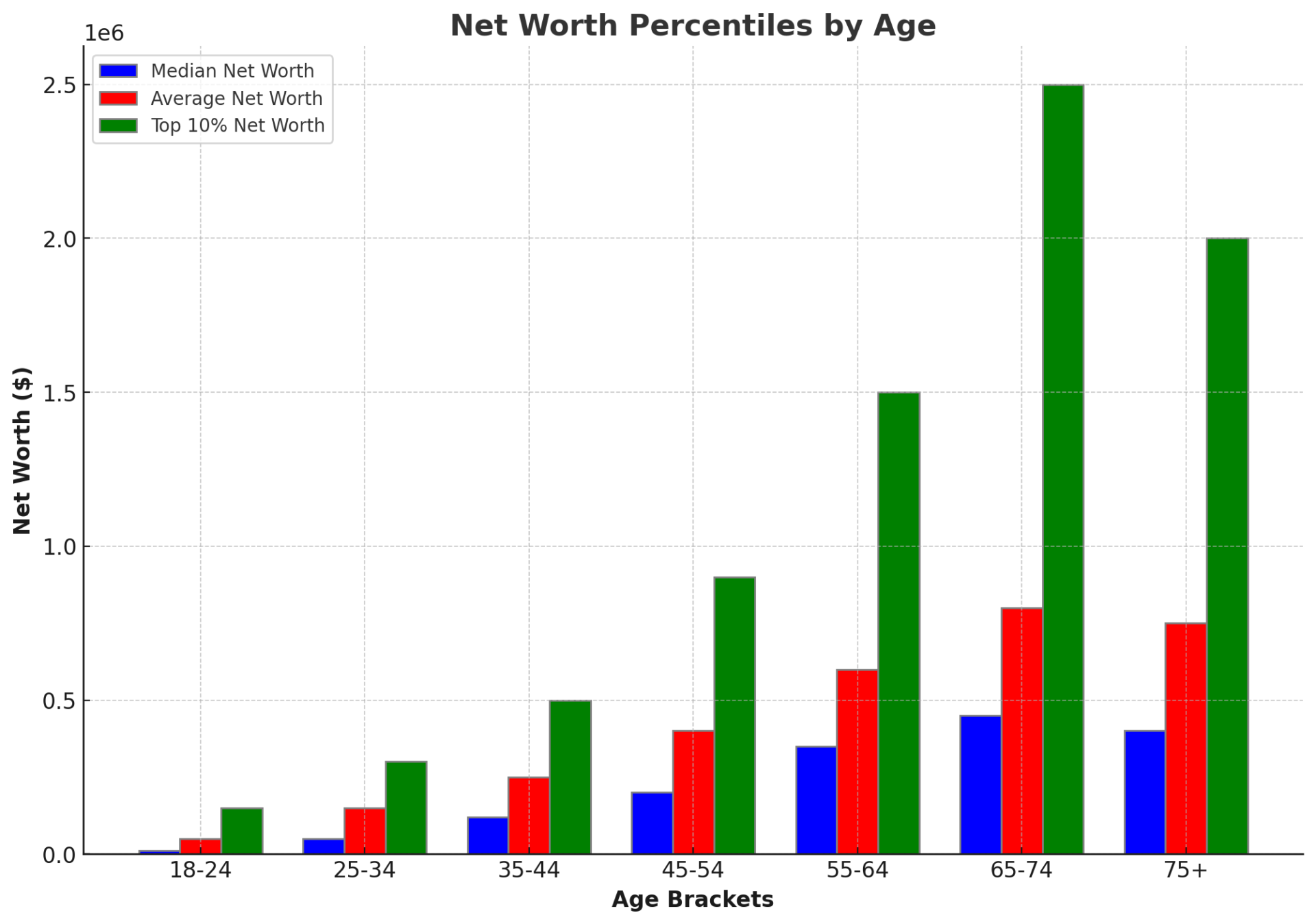
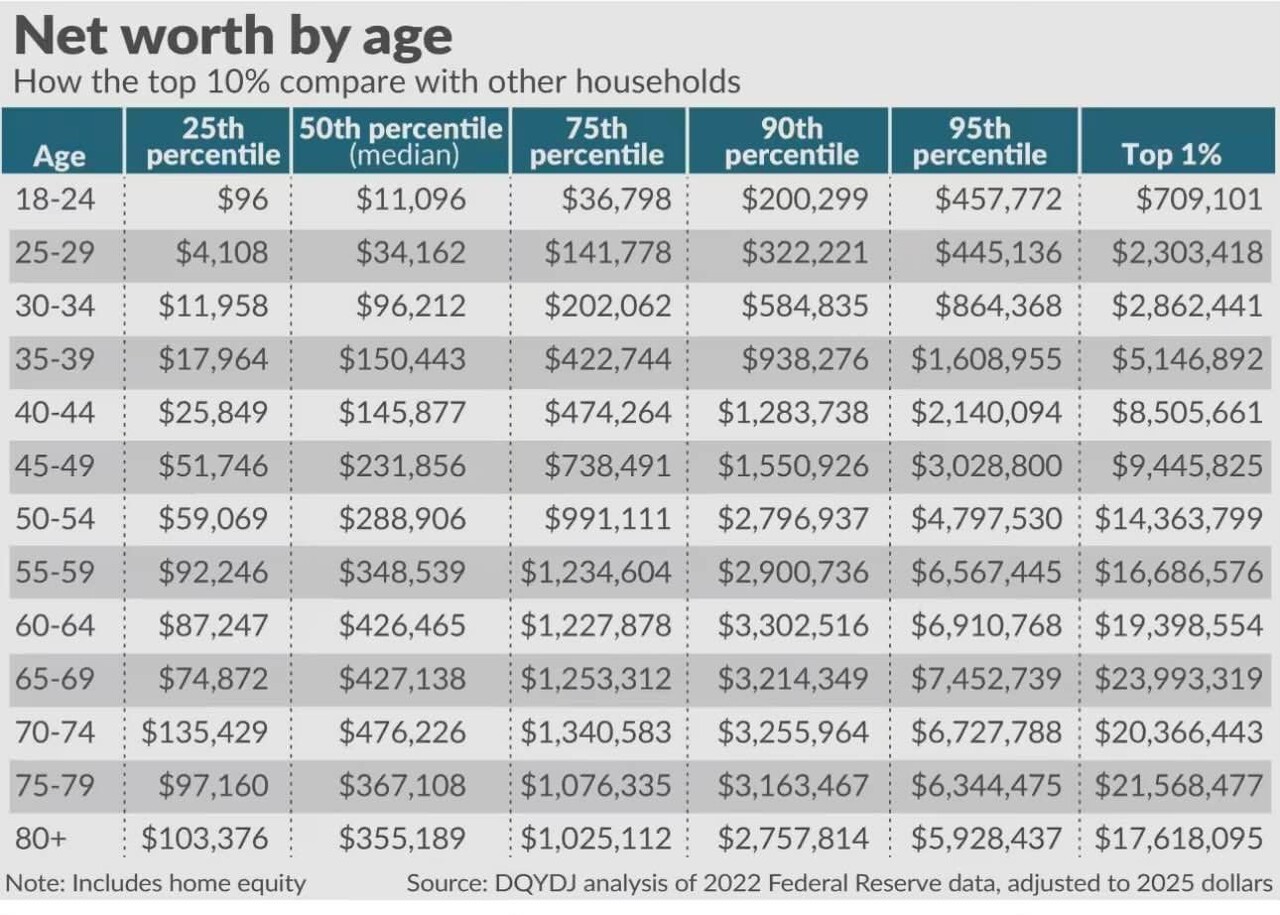
According to data trends derived from the Federal Reserve’s Survey of Consumer Finances and adjusted for 2026 economic conditions, the distribution of wealth remains highly skewed. While the median household net worth (the 50th percentile) is roughly $220,000 to $250,000, the jumps between percentiles become much larger as you approach the top of the pyramid.
The Top 10% vs. The Top 1%
To reach the top 10% of American households in 2026, the threshold is approximately $1.9 million to $2.1 million. At $1.27 million, you are within striking distance of the top decile but still reside firmly in the top 15% range. For comparison, entering the top 1% now requires a net worth exceeding $13.5 million, a figure that has risen steadily over the last decade due to equity market performance and asset inflation.
Age-Based Percentiles: A Critical Context
Wealth is cumulative. Comparing a 30-year-old to a 70-year-old using the same $1.27 million benchmark provides an incomplete picture. In 2026, $1.27 million is a much rarer achievement for younger cohorts.
| Age Group | Percentile Rank with $1.27M (Estimated 2026) |
|---|---|
| Under 35 | Top 1% - 2% |
| 35–44 | Top 4% - 6% |
| 45–54 | Top 8% - 10% |
| 55–64 | Top 12% - 15% |
| 65–74 | Top 14% - 17% |
| 75+ | Top 15% - 18% |
For a household headed by someone under 35, $1.27 million is an elite status, often indicating early career success, an inheritance, or a successful entrepreneurial exit. For those nearing retirement age (60s), this amount is closer to the "upper-middle class" standard required for a comfortable, self-funded retirement.
The Global Perspective: Being the Global 1%
While $1.27 million might feel like "upper-middle class" in high-cost-of-living cities like New York, San Francisco, or London, it is an extraordinary sum on the global stage.
Data from the UBS Global Wealth Report (formerly Credit Suisse) consistently shows that the threshold for the global top 1% is surprisingly accessible for many Western professionals. In 2026, the threshold to be in the top 1% of the world’s wealthiest adults is roughly $1.2 million.
With a net worth of $1.27 million, you are officially wealthier than 99% of the human population. This disparity highlights the immense concentration of wealth in developed nations and the strength of the U.S. dollar and domestic asset markets relative to the rest of the world.
Impact of Geographic Location on Wealth Perception
In 2026, the "purchasing power" of $1.27 million varies wildly depending on where you reside. Financial experts often distinguish between "nominal wealth" (the number on paper) and "real wealth" (what that money buys in your local economy).
- High-Cost Areas (Tier 1 Cities): In cities like San Jose, Seattle, or Boston, a $1.27 million net worth might only cover a modest three-bedroom home and a small retirement fund. In these regions, you may feel "middle class" because your neighbors and peers have similar or higher valuations.
- Moderate-Cost Areas: In states like Ohio, Texas, or Georgia, $1.27 million allows for a much more expansive lifestyle, including a premium property and significant discretionary spending power.
- Low-Cost Areas: In many rural parts of the U.S. or in popular expat destinations (Portugal, Mexico, Southeast Asia), this net worth is sufficient to live a life of high luxury or retire decades earlier than planned.
Financial Security and the "Millionaire" Milestone in 2026
Being a millionaire in 2026 does not carry the same weight it did in 1996 or even 2016. Due to cumulative inflation, $1.27 million in 2026 has the purchasing power that approximately $850,000 had a decade prior.
The 4% Rule and Income Generation
A common way to view a $1.27 million net worth is through the lens of income generation. Using the traditional 4% Rule for sustainable withdrawals, a $1.27 million portfolio (assuming it is all invested) would generate roughly $50,800 per year in pre-tax income.
- If your $1.27 million includes $500,000 in home equity, your invested assets drop to $770,000, generating only $30,800 per year.
- This illustrates why a $1.27 million net worth is often viewed as a "foundation" rather than "financial independence" for many households.
The Role of Tax-Advantaged Accounts
In 2026, the composition of your wealth matters as much as the amount. A $1.27 million net worth held entirely in a Traditional 401k is worth less than the same amount in a Roth IRA, because the former carries a significant deferred tax liability. As tax rates and brackets have shifted, the "net-of-tax" percentile would actually place Roth-heavy households in a higher effective wealth tier than those with taxable or tax-deferred assets.
Common Mistakes When Calculating Wealth Percentiles
To get an accurate read on your standing, avoid these common pitfalls that can skew your data:
- Ignoring the "Mass Affluent" Gap: Many people assume that if they aren't in the top 1%, they aren't "rich." However, the gap between the 50th percentile ($250k) and the 88th percentile ($1.27M) is a massive sociological and financial chasm.
- Overvaluing Illiquid Assets: Including the estimated value of a business that hasn't been audited or "lifestyle" assets like luxury cars can artificially inflate your percentile.
- Forgetting Inflation: When looking at historical charts from 2020 or 2023, you must adjust the "thresholds" upward to account for the 2026 reality. A 90th percentile rank that required $1.6 million in 2023 likely requires nearly $2 million today.
Frequently Asked Questions
Does home equity count toward my net worth percentile?
Yes, most standard wealth reports, including those from the Federal Reserve, include primary residence equity in household net worth. However, many financial planners prefer to track "Net Investable Assets" (NIA) separately, as you cannot easily spend your home’s roof to pay for groceries. If you exclude your home, your percentile rank will likely drop significantly, as home equity is the primary asset for the American middle class.
Is $1.27 million enough to be considered "high net worth" (HNW)?
In the financial services industry, the traditional definition of a High Net Worth Individual (HNWI) is someone with at least $1 million in investable assets, excluding their primary residence. If your $1.27 million is entirely in stocks and cash, you meet this criteria. If a significant portion is in home equity, you are classified as "Mass Affluent."
How many households in the US have a net worth of at least $1.27 million?
As of 2026, approximately 16 to 18 million U.S. households have a net worth exceeding $1 million. The specific group at the $1.27 million mark is part of the largest growth segment in wealth demographics—the upper-middle class that has benefited from long-term 401k contributions and real estate appreciation.
What is the 99th percentile net worth in 2026?
To be in the top 1% (99th percentile) in the United States in 2026, a household typically needs a net worth of approximately $13.5 million to $14 million. The jump from the top 10% ($2 million) to the top 1% is much larger than the jump from the bottom 10% to the top 10%.
How does inflation affect my $1.27 million percentile ranking over time?
If your net worth stays stagnant at $1.27 million while the economy grows and inflation continues, your percentile rank will slowly decrease. This is because the "median" and "top 10%" thresholds move upward as wages rise and assets appreciate. To maintain your percentile, your wealth must generally grow at a rate that meets or exceeds the national average for asset appreciation.
Next Steps: Optimizing Your Wealth Tier
Regardless of your exact percentile, a $1.27 million net worth is a position of strength that requires active management to preserve.
- Analyze Your Asset Allocation: Ensure you aren't "house poor." If more than 50% of your net worth is tied up in your primary residence, consider whether downsizing or relocating could unlock capital for income-generating investments.
- Focus on Tax Efficiency: At this wealth level, taxes become one of your largest "expenses." Utilize tax-loss harvesting, maximize HSA contributions, and consider the timing of Roth conversions to protect your wealth from future tax hikes.
- Review Estate Planning: Once you surpass the $1 million mark, having a basic will is often insufficient. Consider a revocable living trust to ensure your $1.27 million is protected from probate and distributed according to your wishes.
- Benchmark Against Your Peers: Use age-specific calculators to see how you compare to your own demographic. Being in the top 12% of the country is impressive, but being in the top 2% of your age group suggests you may have the opportunity for early retirement or significant philanthropic impact.