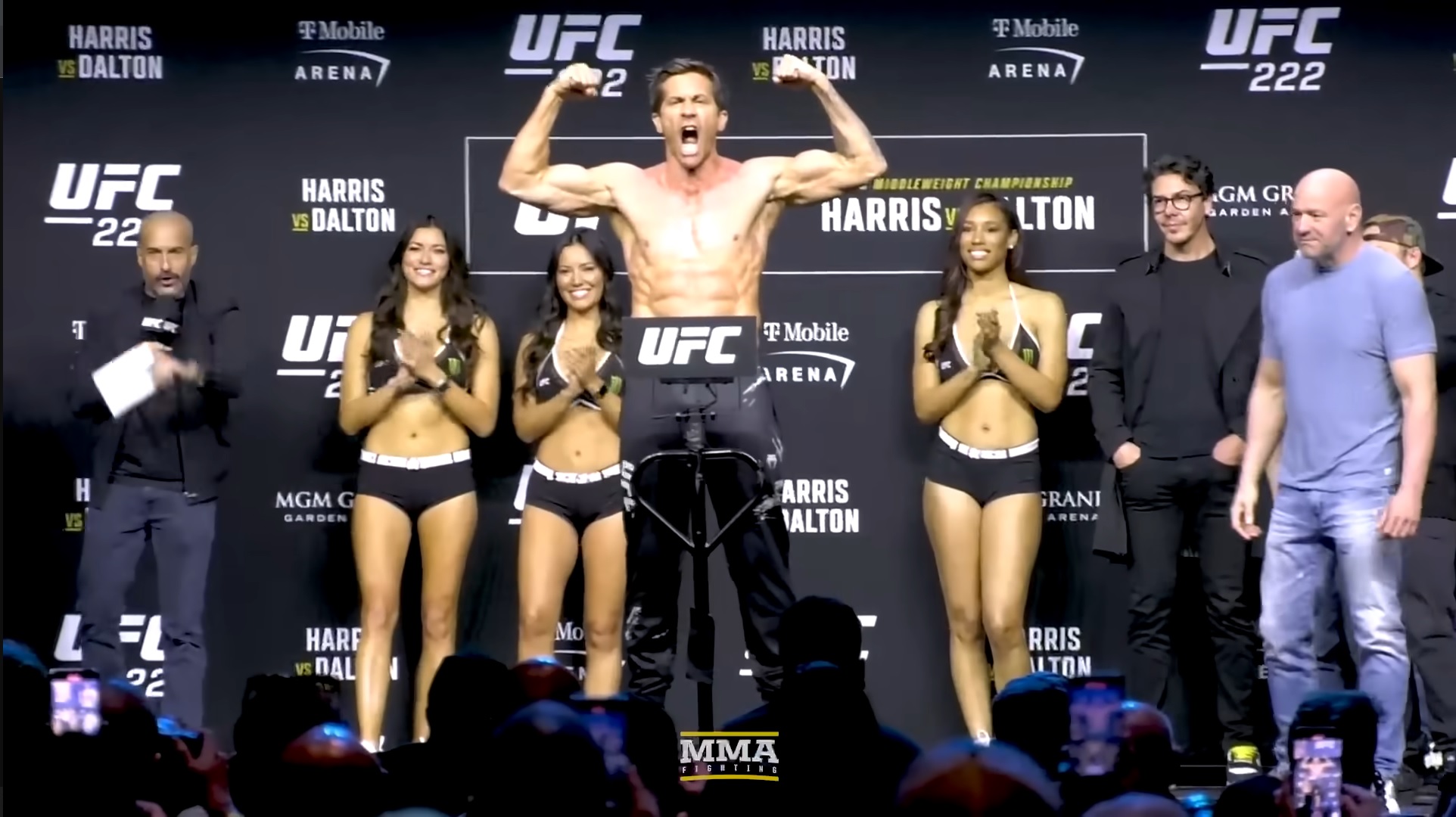
Jake Gyllenhaal’s involvement with UFC 222 serves as a pivotal bridge between professional mixed martial arts and the high-production world of Hollywood filmmaking. While the event itself—headlined by Cris Cyborg versus Yana Kunitskaya—took place on March 3, 2018, at the T-Mobile Arena in Las Vegas, Gyllenhaal’s physical presence inside the Octagon during the proceedings was part of a meticulously planned production sequence for the 2024 film Road House. By utilizing a live UFC event as a backdrop, the film production team achieved a level of visual authenticity that is rarely possible through traditional set design or digital compositing.
Understanding the Context of the Production
The primary point of confusion for many viewers stems from the timeline. UFC 222 was a legitimate pay-per-view card sanctioned by the Ultimate Fighting Championship in 2018. However, scenes featuring Jake Gyllenhaal as the character Elwood Dalton—a former UFC fighter turned bouncer—were filmed at subsequent UFC events, most notably during the ceremonial weigh-ins and live action at UFC 285 in March 2023. The confusion often arises because fans recall seeing Gyllenhaal in a UFC environment, but the actual filming occurred years after UFC 222.
The choice to film at a live event serves a distinct purpose: integrating the actor into the professional atmosphere of a real fight card. This environment provides the ambient noise, the specific lighting of the T-Mobile Arena, and the authentic reaction of a genuine MMA audience. For the production, this meant placing Gyllenhaal into the cage under the supervision of real officials and with the cooperation of UFC leadership to capture footage that felt indistinguishable from a standard UFC broadcast.
The Role of Authentic Environments in Sports Filmmaking
Modern sports cinema increasingly relies on the "live-shot" technique to maintain audience immersion. When an actor performs in front of a capacity crowd that believes they are watching a real fighter, the stakes of the performance are elevated. Gyllenhaal’s physical transformation for the role involved months of specialized training to ensure that his movements, stance, and reaction time mirrored that of a seasoned middleweight fighter.
The collaboration between the film studio and the UFC allowed the production to leverage the existing infrastructure of a fight night. This included:
- The Octagon Infrastructure: Utilizing the exact cage, lighting rigs, and sound systems used for professional bouts.
- Production Personnel: Employing standard UFC camera crews to shoot the scenes, ensuring the visual language of the film matched the aesthetic of the UFC broadcasts.
- Audience Integration: Filming during actual live events meant that the crowd's energy was genuine, providing a visceral reaction to the performance that could not be manufactured with extras.
Technical Challenges of Filming at Live UFC Events
Filming a feature film during a live, broadcasted sporting event presents significant technical and logistical hurdles. The primary challenge is the preservation of the broadcast integrity; the film production cannot interfere with the live, high-stakes competition occurring between professional athletes.
The integration required a "show within a show" approach. For the scenes involving Gyllenhaal, the production team had to work within tight time constraints, often operating during the gaps between preliminary and main card bouts. The lighting, which is optimized for television broadcast, had to be carefully balanced to ensure that the film footage captured the necessary depth of field while remaining consistent with the event's overall aesthetic. Furthermore, the audio department faced the challenge of isolating the actors' dialogue while filtering out the overwhelming ambient noise of an arena holding nearly 20,000 spectators.
Comparison of Production Techniques
To distinguish between reality and cinematic recreation, it is helpful to look at how sports media events are handled for entertainment purposes versus professional competition.
| Feature | UFC 222 (2018) | Road House Filming (2023) |
|---|---|---|
| Primary Intent | Professional athletic competition | Cinematic narrative production |
| Participant Status | Licensed professional fighters | Actors in costume and makeup |
| Broadcast Goal | Sporting results and rankings | Narrative continuity and visual fidelity |
| Venue Usage | Full-scale event operations | Targeted "take" sequences |
| In-Arena Crowd | Spectators of the fight card | Spectators of the fight card (unaware) |
This table illustrates the necessity of professional separation. While the audience sees both as part of the "UFC experience," the regulatory and operational frameworks are entirely distinct. The filming was effectively a guest production housed within the larger framework of a UFC event, requiring a high degree of synchronization between the sports organization and the film studio.
Safety and Regulatory Requirements
Operating inside an active fighting cage is inherently dangerous, even when the combatants are performing a scripted sequence. Strict safety protocols were implemented to protect both the actors and the surrounding crew. Because Gyllenhaal performed his own sequences, he was required to undergo rigorous conditioning and training with combat sports experts.
From a regulatory standpoint, the commission overseeing the event had to authorize the presence of non-professional fighters inside the cage. This involved legal clearances, liability waivers, and the presence of professional medical staff at ringside, just as they would be for a standard sanctioned bout. The "fight" being recorded was essentially a choreographed performance, yet it followed the physical intensity of actual combat to ensure the final product met the standards of the genre.
The Impact on Modern Sports Media
The strategy of embedding actors into live sporting events reflects a broader shift in how media is consumed. By blurring the lines between a real sporting event and a fictionalized account, filmmakers aim to satisfy the high expectations of audiences who are increasingly savvy about technical film production. When a viewer sees Jake Gyllenhaal stepping into the Octagon at a recognizable venue, the psychological connection to the authenticity of the movie increases.
This approach also benefits the UFC by keeping the brand relevant in mainstream media and expanding its reach beyond the core combat sports demographic. It is a symbiotic relationship where the film gains the cachet of a legitimate sports brand, and the sports organization gains exposure within the cinematic landscape, effectively turning the arena into a hybrid media studio.
Frequently Asked Questions
Did Jake Gyllenhaal actually fight at UFC 222?
No, Jake Gyllenhaal did not fight at UFC 222. The event was held in 2018, while the filming for the scenes in question took place in 2023 at subsequent events. Any footage showing him in the Octagon is a scripted performance for a film project rather than a competitive professional bout.
How were the fight scenes captured so authentically?
The film production utilized actual UFC events to record scenes, employing the organization's professional camera crews, lighting setups, and real-time environments. By filming amidst a live audience, the production captured the authentic atmosphere of a professional fight night, which helps maintain immersion for the viewer.
Why is there confusion regarding UFC 222 and the film?
The confusion stems from the fact that the movie production heavily utilized the brand and the aesthetic of the UFC. Because the film features real-world UFC locations and, in some instances, real UFC officials, audiences often associate the visual language of the film with the brand's history, even if the specific event mentioned did not feature the actor.
Were the crowd reactions at the filming real?
Yes, the crowds present during the filming sequences were real spectators who had purchased tickets for the UFC event. While they were watching the filming of a sequence, their reactions to the spectacle of a cage fight occurring in their presence were authentic, providing the necessary energy for the film.
Is it dangerous for an actor to perform in an active cage?
Yes, it is high-risk. While the fighting is choreographed, the physical demands of simulating a professional bout at a high speed require extensive, sustained training. Actors involved in such productions are supported by professional stunt coordinators and safety medical teams to minimize the risk of injury during the filming process.
Next Steps for Fans of Sports Cinema
If you are interested in the production of sports-based films, the most effective way to understand the process is to contrast the finished product with "behind-the-scenes" content provided by the studios. Many production companies release featurettes detailing the training regimens and location logistics used to create these sequences. By comparing these materials against official UFC event logs from 2023, you can see the precise coordination required to host a movie production within a professional sports environment. If you seek further information on the legalities of such productions, you may consult the records of the athletic commissions that oversee these events, as they often detail the requirements for any non-competitive activities held within their sanctioned arenas.