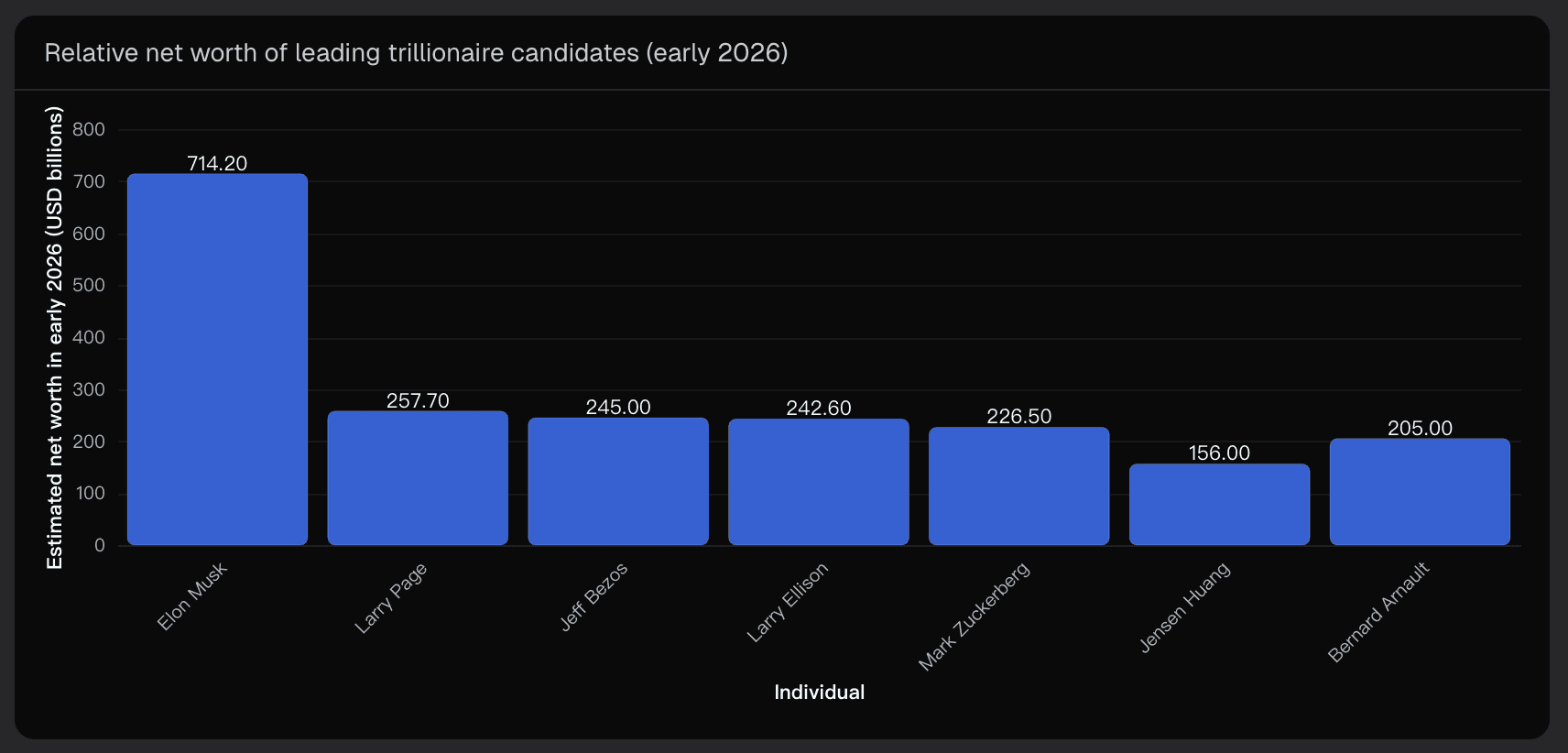
As of early 2026, there are no individuals who have been officially verified as trillionaires by major financial tracking institutions such as Forbes or the Bloomberg Billionaires Index. While several ultra-high-net-worth individuals, including Elon Musk and Jensen Huang, are approaching this historic milestone with net worths exceeding $400 billion, the "trillionaire" designation currently applies only to a select group of multinational corporations and sovereign entities.
The Quest for the First Individual Trillionaire: 2026 Rankings
The transition from billionaire to trillionaire is a mathematical leap that requires not just wealth, but an unprecedented dominance over a transformative sector of the global economy. In 2026, the financial world is closely monitoring a small group of "centi-billionaires" whose trajectories suggest the first $1 trillion personal net worth may be realized before the decade concludes.
Elon Musk: The Frontrunner
Elon Musk remains the most likely candidate to become the world's first trillionaire. His wealth is fundamentally tied to the valuations of Tesla, SpaceX, and his artificial intelligence venture, xAI. By 2026, Tesla’s evolution into a robotics and energy storage powerhouse, combined with the successful deployment of the Starship launch system, has kept Musk’s net worth in the $350 billion to $550 billion range, depending on market volatility. Analysts from organizations like Oxfam International have noted that if his wealth continues to grow at its historical average of over 100% annually, he could cross the trillion-dollar threshold by 2027.
Jensen Huang and the AI Supercycle
The most rapid ascent in the 2020s has belonged to Jensen Huang, CEO of NVIDIA. Due to the relentless demand for AI infrastructure, NVIDIA’s market capitalization has repeatedly broken records, pushing Huang’s personal net worth into the top tier of global wealth. As the primary provider of the hardware that powers the global AI economy, Huang’s wealth is viewed as a direct proxy for the growth of the Fourth Industrial Revolution.
The Standard Bearers: Bezos, Arnault, and Zuckerberg
Jeff Bezos (Amazon), Bernard Arnault (LVMH), and Mark Zuckerberg (Meta) represent the established pillars of global wealth. While their growth rates are generally more stable than Musk’s or Huang’s, their diversified holdings in e-commerce, luxury goods, and social metaverses provide a robust foundation. In the 2026 landscape, Zuckerberg in particular has seen a resurgence in wealth as Meta’s investments in spatial computing and AI-driven advertising have yielded high margins, keeping him firmly in the race for the trillion-dollar title.
The Trillion-Dollar Club: Corporate "Trillionaires"
While no single person has hit the mark, the "Trillionaire" label is a reality for the world’s most powerful corporations. In 2026, the "Trillion-Dollar Club" has expanded, reflecting the concentration of value in technology and energy. These entities hold more financial power than the GDP of many mid-sized nations.
| Entity Name | Category | Primary Sector | 2026 Status/Market Cap Range |
|---|---|---|---|
| Microsoft | Corporation | Cloud & AI | $3.5T - $4.2T |
| Apple | Corporation | Consumer Tech | $3.2T - $3.8T |
| NVIDIA | Corporation | Semiconductors/AI | $3.0T - $4.0T |
| Alphabet (Google) | Corporation | Data & Advertising | $2.2T - $2.7T |
| Amazon | Corporation | E-commerce & Cloud | $2.0T - $2.5T |
| Saudi Aramco | State-Owned | Oil & Gas | $1.9T - $2.3T |
| Meta | Corporation | Social Media/AI | $1.5T - $1.9T |
The dominance of these firms is a prerequisite for their founders' or CEOs' potential trillionaire status. Because personal wealth is largely "paper wealth" (the value of shares held), an individual can only become a trillionaire if their company reaches a market capitalization in the $5 trillion to $10 trillion range, depending on their percentage of ownership.
Economic Drivers of 13-Figure Wealth
The emergence of a trillionaire requires a specific set of economic conditions that have converged in the mid-2020s. Understanding these drivers explains why we are seeing such a massive divergence between the ultra-wealthy and the rest of the global population.
The Role of Artificial Intelligence
AI is the single greatest wealth multiplier in history. Unlike the industrial or internet revolutions, AI scales with minimal marginal cost. Companies that own the "compute" (NVIDIA), the "data" (Google, Meta), and the "application layer" (Microsoft, OpenAI) are capturing an outsized portion of global productivity gains. This concentration of value directly inflates the stock prices that constitute the bulk of centi-billionaire fortunes.
Private Space Exploration and Telecommunications
SpaceX, a private entity, has become a cornerstone of global infrastructure. Through Starlink, the company has created a near-monopoly on high-speed satellite internet, while its launch services are the only viable path for many government and commercial payloads. As a primary shareholder, Elon Musk's path to a trillion dollars is arguably more dependent on the eventual public offering or valuation milestones of SpaceX than on Tesla's automotive sales.
The Compounding Effect of Capital
Wealth at the $100 billion level grows differently than wealth at the $1 million level. Centi-billionaires have access to sophisticated family offices, private equity deals, and tax-efficient borrowing strategies that allow them to reinvest their gains without the friction faced by smaller investors. According to Bloomberg's wealth analysis, the top 0.001% have seen their assets appreciate at rates significantly higher than the S&P 500 average over the last five years.
Trillionaires vs. National Economies: A Comparative Analysis
To grasp the scale of a $1 trillion fortune, it is helpful to compare it to the Gross Domestic Product (GDP) of sovereign nations. A trillionaire would theoretically possess more wealth than the annual economic output of countries like Switzerland, Turkey, or Saudi Arabia.
As of 2026, the combined wealth of the top five individuals on the rich list exceeds $1.8 trillion. This level of financial concentration has significant geopolitical implications. When a single individual controls the satellite communication for a war zone (as seen with Starlink) or the primary chips for a nation’s defense AI, they exercise a level of "sovereign-like" power. This has led to increased calls from the G20 and other international bodies for a global minimum tax on billionaires to ensure that this unprecedented wealth contributes to public infrastructure and climate goals.
Historical Milestones: From Millionaires to Trillionaires
The journey to the first trillionaire has been centuries in the making. Looking back at historical wealth milestones provides perspective on the current acceleration.
- The First Millionaire: While difficult to track precisely, figures like Jacob Fugger in the 16th century or George Washington in the 18th century are often cited.
- The First Billionaire: John D. Rockefeller became the world’s first confirmed billionaire in 1916 through his control of Standard Oil. At the time, his wealth was equivalent to nearly 2% of the entire U.S. GDP.
- The First Centi-Billionaire: Jeff Bezos was the first to maintain a steady net worth above $100 billion in 2018.
- The First Trillionaire: Predicted for the late 2020s.
The gap between the first billionaire (1916) and the first centi-billionaire (2018) was 102 years. The gap between the first centi-billionaire and the first trillionaire is expected to be less than 15 years. This compression illustrates the exponential nature of modern digital and financial systems.
Challenges to Reaching the Trillion-Dollar Mark
Despite the mathematical trajectory, several hurdles could prevent or delay an individual from reaching $1,000,000,000,000.
- Antitrust Regulation: The "Big Tech" firms that fuel this wealth are under constant scrutiny. In 2025 and 2026, more aggressive antitrust actions in the EU and the U.S. have sought to break up monopolies in search, social media, and cloud computing. A forced breakup would diversify the wealth but likely prevent any one individual's shares from reaching the trillion-dollar mark.
- Philanthropy and Divestment: Figures like Bill Gates and Warren Buffett would likely be much closer to the trillionaire mark had they not pledged to give away the majority of their wealth. The "Giving Pledge" remains a significant cultural force that encourages billionaires to cap their personal accumulation.
- Market Volatility: Since these fortunes are tied to equity, a prolonged global recession or a "tech bubble" burst could erase hundreds of billions of dollars in paper wealth overnight. We saw this in the early 2020s, and the risk remains high as AI valuations reach speculative peaks in 2026.
Who will be the first trillionaire?
Most financial analysts point to Elon Musk as the most likely first trillionaire, followed by Jensen Huang. Musk’s diversified interests in transport, space, and AI give him multiple pathways to the milestone, while Huang’s wealth is more concentrated in the semiconductor industry.
Are there any trillionaire families?
While no individual is a trillionaire, some royal families and dynasties, such as the House of Saud, are estimated to control collective wealth in the trillions. However, this wealth is often inseparable from the state's treasury, making it difficult to classify as personal net worth in the same way we track private individuals.
How many trillion-dollar companies are there in 2026?
There are currently seven companies globally that consistently maintain a market capitalization above $1 trillion: Microsoft, Apple, NVIDIA, Alphabet, Amazon, Saudi Aramco, and Meta. Occasionally, companies like TSMC and Berkshire Hathaway hover near the trillion-dollar line.
What is the difference between a billionaire and a trillionaire?
The difference is a factor of 1,000. To visualize this, one billion seconds is about 31.7 years. One trillion seconds is approximately 31,700 years. This massive scale is why the transition to a trillionaire is viewed as a landmark event in human history.
Is it possible to have a "secret" trillionaire?
It is highly unlikely. In the modern era of global banking transparency and securities filings (like the SEC in the United States), any individual owning enough of a public or large private company to be worth $1 trillion would be easily identifiable through their equity holdings and asset disclosures.
Monitoring the Wealth Gap in 2026
For those tracking these figures, the most reliable method is to follow real-time wealth indices that update based on stock market fluctuations. As we move through 2026, the focus is less on whether someone can become a trillionaire and more on when it will happen. Investors and policy analysts should watch the quarterly earnings of the "Magnificent Seven" and the valuation rounds of private giants like SpaceX and OpenAI, as these are the primary engines driving the world toward its first 13-figure individual fortune.