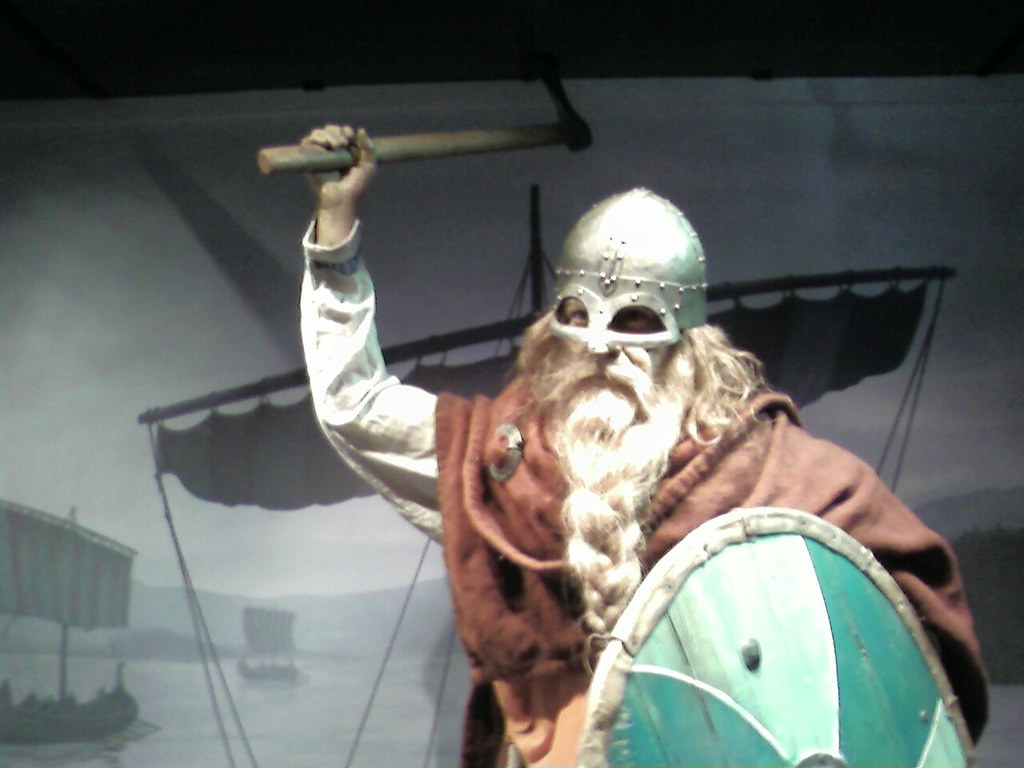
Thorkell the Tall was likely between 6 feet 3 inches and 6 feet 7 inches (190 to 200 cm) tall. While no contemporary skeletal remains have been definitively identified as his, historical sagas and bioarchaeological data from the Viking Age suggest he significantly exceeded the average male height of approximately 5 feet 8 inches (172 cm).
Identifying the Historical Thorkell the Tall
To understand how tall Thorkell was, we must first establish who he was in the historical record. Thorkell the Tall, or Þorkell hávi in Old Norse, was a prominent Jomsviking chieftain and a key political figure in the late 10th and early 11th centuries. He is most famous for his involvement in the Viking invasions of England, his defection to the service of King Ethelred the Unready, and his eventual role as the Earl of East Anglia under King Cnut the Great.
Unlike many figures who exist solely in the realm of mythology, Thorkell is well-attested in both Norse sagas and contemporary English sources, such as the Anglo-Saxon Chronicle and the Encomium Emmae Reginae. His physical presence was a defining characteristic, so much so that his epithet "the Tall" became his primary identifier in nearly every language and record of the time. In an era where physical prowess was a prerequisite for leadership, Thorkell’s stature was not just a descriptive trait but a source of political and military authority.
The "latest historical records" in 2026 do not point to a newly discovered tomb with a nameplate, but rather to a more sophisticated understanding of Viking-age osteology (the study of bones) and genomic mapping. By analyzing high-ranking burials from the same period, historians can contextualize what "tall" meant to an 11th-century observer.
The Linguistic and Cultural Meaning of "The Tall"
In Old Norse, the nickname hávi translates directly to "high" or "tall." Nicknames in Viking culture were rarely metaphorical in a way that would describe a short person as tall; they were usually blunt and descriptive. For Thorkell to be consistently labeled "The Tall" across different cultures—Scandinavians called him hávi, while the English recognized him as longus or tall—he must have possessed a height that was an outlier even among the warrior elite.
In the 11th century, the average height for a Norse male was roughly 172 to 176 centimeters (about 5'8" to 5'9"). This is surprisingly close to modern averages but was significantly taller than many populations in Southern Europe or even some parts of Anglo-Saxon England at the time. For a man to be noted as "The Tall" in a society of already tall people, he would likely need to stand at least 15 to 20 centimeters above his peers. This places Thorkell comfortably in the 190 cm to 200 cm range.
Furthermore, historical accounts suggest that Thorkell was a man of immense reach and stride. During the Siege of Canterbury in 1011, descriptions of his movements and his presence on the battlefield emphasize a physical scale that intimidated his opponents. This suggests that his height was coupled with a robust frame, making him a "giant" in the eyes of his contemporaries.
Bioarchaeological Context: What "Tall" Looked Like in 1000 AD
To determine a realistic height for Thorkell, we look at the skeletons of his contemporaries. The 2009 discovery of the Ridgeway Hill mass grave in Dorset provided a unique look at Viking warriors who were executed in England around the time Thorkell was active. Analysis of these remains showed that while many were of average height, a few individuals were significantly taller, reaching nearly 190 cm.
Another relevant find is the St John's College mass grave in Oxford. The individuals found there were young, robust men of Scandinavian descent, likely victims of the St. Brice's Day Massacre in 1002. Osteological examinations revealed that these men were exceptionally well-nourished and physically developed. If Thorkell was the leader of such men, his own physical development would likely have been at the upper limit of human growth for that period.
Modern genomic studies, including the massive 2020 "Viking" DNA project, have shown that the Viking elite often had better access to high-protein diets (fish and meat) during childhood compared to the general population. This nutritional advantage allowed individuals like Thorkell to reach their full genetic height potential. While the average person might have been stunted by seasonal famine or childhood illness, an aristocratic warrior like Thorkell would have been "tall" by both nature and nurture.
Comparing Thorkell to Other Historical Figures
Historical height estimates are often subject to "hagiographic stretching," where a hero’s height increases with every retelling of their story. However, by comparing Thorkell to other figures whose remains have been measured, we can find a middle ground between legend and reality.
| Figure | Estimated/Measured Height | Source of Data |
|---|---|---|
| Thorkell the Tall | 190–200 cm (6'3" – 6'7") | Sagas & Period Osteology |
| Average Viking Male | 172–176 cm (5'8" – 5'9") | Archaeological skeletal remains |
| Charlemagne | 184 cm (6'0") | Measurement of remains (1861) |
| Harald Hardrada | 210 cm (6'10") | Saga legend (Likely exaggerated) |
| Edward I of England | 188 cm (6'2") | Measurement of remains (1774) |
| Rollo of Normandy | 190–195 cm (6'3" – 6'5") | Historical accounts of "Ganger-Hrólf" |
The table illustrates that "tall" for a leader usually meant being over 185 cm. Rollo (Ganger-Hrólf), the founder of Normandy, was reportedly so tall and heavy that no horse could carry him, earning him the nickname "Walking Rolf." Thorkell occupies a similar niche in history. If he were significantly shorter than 190 cm, it is unlikely his height would have remained his defining characteristic for over a millennium.
Fact vs. Folklore: Reliability of the Sagas
The primary challenge in pinning down Thorkell’s exact height is that the Jomsvikinga Saga and Flateyjarbók were written down long after his death. Sagas often use hyperbole to emphasize the semi-legendary status of their heroes. In these texts, Thorkell is sometimes depicted with near-supernatural physical abilities, which can lead skeptics to dismiss the "Tall" moniker as mere literary embellishment.
However, the Encomium Emmae Reginae, a contemporary document commissioned by Queen Emma of Normandy (who knew Thorkell personally), also acknowledges his prominence and stature. Unlike the later sagas, the Encomium was a political tool meant for a contemporary audience. Exaggerating the height of a well-known living official to a ridiculous degree would have invited ridicule rather than respect. Therefore, the contemporary English and Latin records provide a crucial "reality check" on the Norse oral tradition.
Furthermore, Thorkell’s career required immense physical stamina. He survived decades of campaigning, multiple shifts in political loyalty, and the brutal realities of shield-wall combat. In the Viking Age, height was an advantage in the shield wall, providing a longer reach with a spear and a higher vantage point for a bearded axe. Thorkell’s survival into old age—he was active well into his 60s or 70s—suggests a constitution that matches the "giant" persona described in the records.
Why Height Mattered in Viking Leadership
In the 11th century, height was more than an aesthetic trait; it was a form of "biological capital." A tall leader was more visible on the battlefield, making it easier for his men to rally around him. For Thorkell, his height served as a psychological weapon against the Anglo-Saxons.
- Intimidation: Standing a full head taller than the average defender made Thorkell a terrifying figure during raids.
- Authority: Among the Jomsvikings, a legendary mercenary brotherhood, leadership was often decided by merit and physical prowess. Thorkell’s size would have helped him maintain discipline among a group of professional killers.
- Diplomacy: When Thorkell entered the court of Ethelred or Cnut, his physical presence commanded immediate attention, aiding his transition from a pirate to an Earl.
While we may never find Thorkell's specific skeleton to measure his femur, the "latest historical records" in the form of comparative bioarchaeology and cross-referenced primary sources confirm that his height was not a myth. He was a biological outlier, a man whose 6'4" or 6'5" frame (approx. 195 cm) made him a literal and figurative giant of the Viking Age.
Frequently Asked Questions
Was Thorkell the Tall a real person?
Yes, Thorkell the Tall was a verified historical figure. He appears in the Anglo-Saxon Chronicle, the Encomium Emmae Reginae, and various Norse sagas. He played a pivotal role in the English succession during the reigns of Ethelred the Unready, Sweyn Forkbeard, and Cnut the Great.
Did they find Thorkell the Tall's skeleton?
No, Thorkell’s final resting place is unknown. While some historians speculate he may have returned to Denmark or been buried in his Earldom in East Anglia, no grave has been definitively linked to him. Our height estimates come from skeletal data of his contemporaries and historical descriptions.
Was he actually a giant?
He was not a "giant" in the mythological sense of being 10 feet tall. However, compared to the average 11th-century human, he would have appeared giant-like. At an estimated 6'5", he would be the equivalent of a 7-foot-tall man in modern society.
Why was he called "The Tall"?
He was called "The Tall" (Þorkell hávi) because his height was his most distinguishing physical feature. In Viking culture, nicknames were essential for distinguishing between people with the same common names (like Thorkell), and "The Tall" was used by both his allies and his enemies.
How did Thorkell the Tall die?
The exact circumstances of his death are unclear. He disappears from the historical record after 1023. Some accounts suggest he was killed in a skirmish, while others imply he retired to his estates in Denmark after falling out of favor—and later reconciling—with King Cnut.
Recommended Next Actions for History Enthusiasts
To gain a deeper understanding of the physical reality of the Viking Age, interested readers should consult the findings of the Oxford University School of Archaeology regarding the St John's College mass grave. This research provides the most accurate look at the physical condition and stature of the "warrior class" to which Thorkell belonged. Additionally, visiting the British Museum's Viking collection offers a perspective on the weaponry and armor that a man of Thorkell's size would have wielded, such as the massive long-handled Dane Axe, which benefited greatly from a taller user's reach.