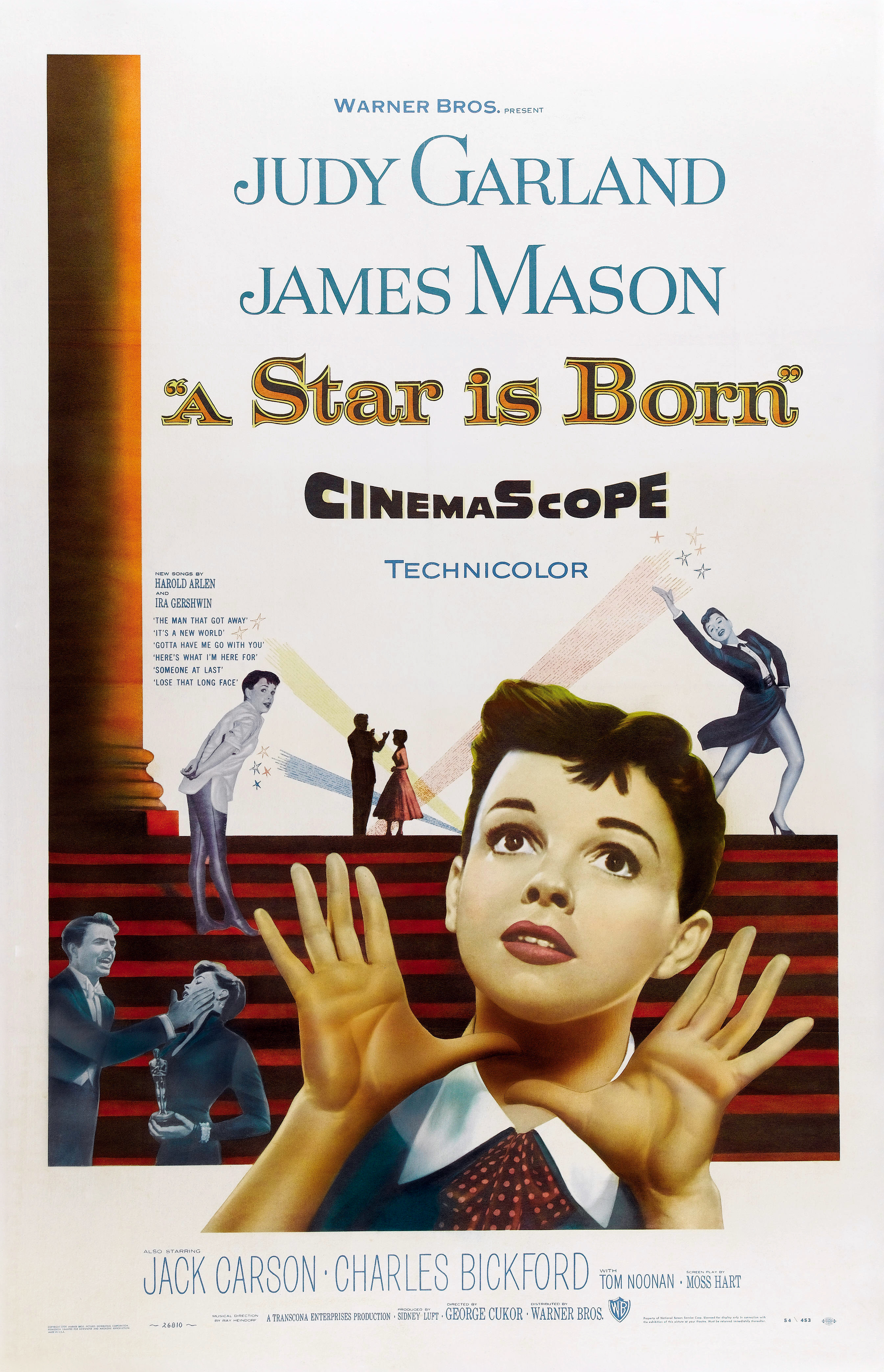
The 1954 version of A Star Is Born, directed by George Cukor and starring Judy Garland and James Mason, is widely considered the definitive cinematic interpretation of this classic Hollywood tragedy. This musical drama serves as both a showcase for Garland’s unparalleled vocal talent and a scathing critique of the industry that created and eventually discarded its own stars.
The Genesis of the 1954 Remake
The path to the 1954 production of A Star Is Born began as a vehicle for Judy Garland’s return to the screen. After being released from her contract at MGM in 1950 following years of personal struggles and exhaustion, Garland’s career appeared to be in jeopardy. Her husband and producer, Sid Luft, recognized that her talent remained undiminished and sought a project that could re-establish her as a premier dramatic and musical talent. They settled on a remake of the 1937 film of the same name, which had starred Janet Gaynor and Fredric March.
Warner Bros. eventually backed the project, seeing the potential for a massive "comeback" narrative. George Cukor, who had ironically turned down the chance to direct the 1937 original because he felt it was too close to his previous film What Price Hollywood? (1932), was recruited to direct. Cukor’s sophisticated visual style and his reputation as a "woman's director"—a term he disliked but which reflected his skill in eliciting nuanced performances from female leads—made him the ideal choice to navigate the film’s complex emotional landscape.
The production was ambitious from the start. It was intended to be Warner Bros.' answer to the burgeoning threat of television, utilizing the newest technological advancements of the era. However, the production was plagued by delays, budget overruns, and the technical challenges of working with early widescreen formats, eventually costing over $5 million, an astronomical sum for the mid-1950s.
Technical Innovation: CinemaScope and WarnerColor
As of 2026, film historians still cite A Star Is Born as one of the most sophisticated early uses of the CinemaScope process. When the film began production, 20th Century Fox had just introduced the anamorphic lens technology. George Cukor, initially hesitant about the wide aspect ratio, eventually used it to create intimate spaces within a grand frame.
Unlike many early widescreen films that used flat, theatrical staging, Cukor and cinematographer Winton Hoch (and later Sam Leavitt) utilized deep staging and complex blocking. A prime example is "The Man That Got Away" musical sequence. Filmed in a dimly lit after-hours club, the camera follows Garland in a single, fluid take that emphasizes the cavernous, empty space around her, mirroring the character's internal isolation.
The use of WarnerColor was equally deliberate. The film transitions from the harsh, artificial glitz of Hollywood premieres to the somber, naturalistic tones of Norman Maine’s beach house. The color palette serves as a visual barometer for the characters' emotional states, with vibrant reds and blues often appearing during Esther’s rise, while Norman’s decline is characterized by shadowy, desaturated environments.
Narrative Depth: The Tragedy of Norman Maine and Vicki Lester
The core strength of the 1954 screenplay, written by Moss Hart, lies in its refusal to simplify the relationship between Esther Blodgett (Vicki Lester) and Norman Maine. While the 1937 version was a straightforward drama, the 1954 iteration infuses the story with musical numbers that are integrated into the plot as part of Vicki’s professional life.
James Mason’s portrayal of Norman Maine is often cited as the most empathetic version of the character. Unlike a simple "villainous drunk," Mason plays Maine as a man of immense charm and fading self-respect who genuinely loves Esther and realizes that his presence is a parasite on her burgeoning career. The tragedy is not merely his alcoholism, but his awareness of his own obsolescence in an industry that prizes novelty over legacy.
Judy Garland’s Esther Blodgett is a masterclass in vulnerability. Because Garland’s own real-life struggles with the studio system were well-known to audiences, the line between the actress and the character blurred significantly. This meta-textual layer added a depth of realism to the performance that remains potent. When Vicki Lester cries in her dressing room about her husband’s condition, the audience is witnessing a raw, emotional honesty that was rare in the highly polished studio era of the 1950s.
The Infamous "Cut" and the Restoration History
One of the most significant chapters in the history of A Star Is Born is the studio’s decision to mutilate the film shortly after its premiere. The original cut ran approximately 181 minutes. After disappointing early box office returns and complaints from exhibitors that the long runtime limited the number of daily screenings, Warner Bros. head Jack Warner ordered the film to be cut by 27 minutes.
The cuts were made haphazardly, removing crucial character development scenes and several musical moments. Most devastatingly, the original negative of the deleted footage was reportedly melted down to recover the silver content, a common practice at the time. For decades, the film existed only in its truncated 154-minute version, which many critics felt was disjointed.
In 1983, film historian Ronald Haver of the Academy of Motion Picture Arts and Sciences undertook a massive restoration project. He managed to locate the complete three-hour stereo soundtrack, even though the visual footage for some scenes was lost. To bridge these gaps, Haver used a "pan and scan" technique with original production stills over the recovered audio. This reconstructed version allowed audiences to finally experience the film’s intended pacing and narrative arc. In 2026, the 176-minute reconstructed version is the standard for high-definition home media and theatrical retrospectives.
Comparing the Adaptations of A Star Is Born
To understand the 1954 version's place in history, it is helpful to compare it across the four major iterations of the story.
| Feature | 1937 Version | 1954 Version | 1976 Version | 2018 Version |
|---|---|---|---|---|
| Lead Actress | Janet Gaynor | Judy Garland | Barbra Streisand | Lady Gaga |
| Lead Actor | Fredric March | James Mason | Kris Kristofferson | Bradley Cooper |
| Industry Focus | Hollywood (Acting) | Hollywood (Musical/Acting) | Music Industry (Rock) | Music Industry (Country/Rock) |
| Primary Format | Technicolor (Standard) | CinemaScope / WarnerColor | Panavision / Color | Digital / Atmos |
| Key Song | N/A (Non-musical) | "The Man That Got Away" | "Evergreen" | "Shallow" |
| Ending Motif | "This is Mrs. Norman Maine" | "This is Mrs. Norman Maine" | Tribute Concert | "This is Mrs. Norman Maine" |
While the 2018 version was a massive commercial success and the 1976 version captured the rock-and-roll zeitgeist, the 1954 version remains the most technically accomplished in terms of traditional filmmaking. It bridges the gap between the old-school studio system and the modern, auteur-driven cinema that would follow in the 1960s.
Critical Reception and the 1955 Academy Awards
The 1954 release was met with near-universal critical acclaim, particularly for Garland’s performance. However, the 27-minute cut hindered its long-term box office potential and created a sense of "failure" around the project that was not reflected in the quality of the work.
The film received six Academy Award nominations, including Best Actress for Judy Garland and Best Actor for James Mason. The 27th Academy Awards (held in 1955) are still remembered for one of the biggest upsets in Oscar history. Garland was the heavy favorite to win Best Actress; she was so favored that a television crew was stationed in her hospital room (where she had just given birth to her son, Joey Luft) to capture her acceptance speech.
In a shocking turn, Grace Kelly won for The Country Girl. Groucho Marx famously sent Garland a telegram following the ceremony, calling her loss "the biggest robbery since Brink's." James Mason also lost to Marlon Brando for On the Waterfront. Despite the lack of wins, the film’s reputation has only grown over the decades, far outstripping many of the films that actually won that year.
Essential Viewing: Key Sequences and Musical Numbers
For those studying the film in 2026, several sequences are mandatory for understanding the technical and emotional depth of the work:
- "The Man That Got Away": As mentioned, this is a masterclass in long-take cinematography and lighting. It establishes Esther as a professional who "belongs" on the stage before she ever becomes a star.
- The "Born in a Trunk" Medley: This 15-minute sequence was actually directed by Richard Barstow rather than Cukor. While some critics feel it slows the film down, it serves as a definitive showcase of Garland’s versatility, encompassing dance, comedy, and torch songs.
- The Dressing Room Monologue: This scene, where Vicki Lester vents her frustration and heartbreak to a studio executive (played by Charles Bickford), is often cited as Garland’s finest dramatic moment. It provides the "why" behind her character's loyalty to Norman Maine.
- The Final Scene: The transition from grief to public resolve during the benefit concert at the Shrine Auditorium remains one of the most iconic endings in cinema history. The delivery of the line, "Hello everybody, this is Mrs. Norman Maine," provides a perfect, tragic bookend to the narrative.
Frequently Asked Questions
Why was the 1954 version of A Star Is Born cut so heavily?
Warner Bros. executives and theater owners were concerned that the 181-minute runtime prevented theaters from showing the film enough times per day to maximize profit. Despite George Cukor’s protests, 27 minutes were removed, which many believe cost the film its chance at greater commercial success and likely contributed to its Oscar losses.
Is the original 181-minute version available today?
Not exactly. Because the visual footage for the cut scenes was destroyed, the "complete" version available today is a reconstruction. It uses the full 181-minute audio track, but some sections use still photographs to fill in the missing visual information. This version is widely available on Blu-ray and 4K UHD.
Did Judy Garland actually sing live on set?
While most musical films of that era used pre-recorded tracks, Garland did sing "The Man That Got Away" live to a playback track for timing, but her vocal performance in the final film is a mix of studio recording and live emotion. Her ability to sync her physical performance with her pre-recorded vocals was considered extraordinary.
How does the 1954 version differ from the 2018 Lady Gaga version?
The 1954 version focuses on the transition from the Big Band/Vaudeville era to the world of Hollywood film musicals. The 2018 version translates the story into the modern music industry (Country and Rock). The 1954 version also places a greater emphasis on the "studio system" as a character itself, acting as a controlling and sometimes cold force in the lovers' lives.
Who was the original choice for Norman Maine?
Cary Grant was George Cukor’s first choice for the role of Norman Maine. Grant reportedly turned it down because he didn't want to play a "has-been" and because he had issues with Cukor during previous collaborations. Humphrey Bogart and Frank Sinatra were also considered before James Mason was cast.
Viewing Recommendations for Film Enthusiasts
To fully appreciate A Star Is Born (1954), it is recommended to watch the 176-minute restored version. This version provides the necessary context for Norman Maine's decline and Esther’s rise that is lost in the shorter theatrical cut. Viewers should pay close attention to the spatial relationship between the characters; Cukor often places Norman Maine at the edges of the CinemaScope frame or behind foreground objects to visually represent his fading presence in the world.
For a deeper technical understanding, compare the "Born in a Trunk" sequence with the more naturalistic scenes directed by Cukor. The contrast between the "stage" persona and the "real" Esther Blodgett is the engine that drives the film's emotional impact. By 2026, the film's 4K restorations have made it possible to see the intricate details of the WarnerColor production, making it a vital watch for anyone interested in the history of cinematography and the evolution of the Hollywood musical.