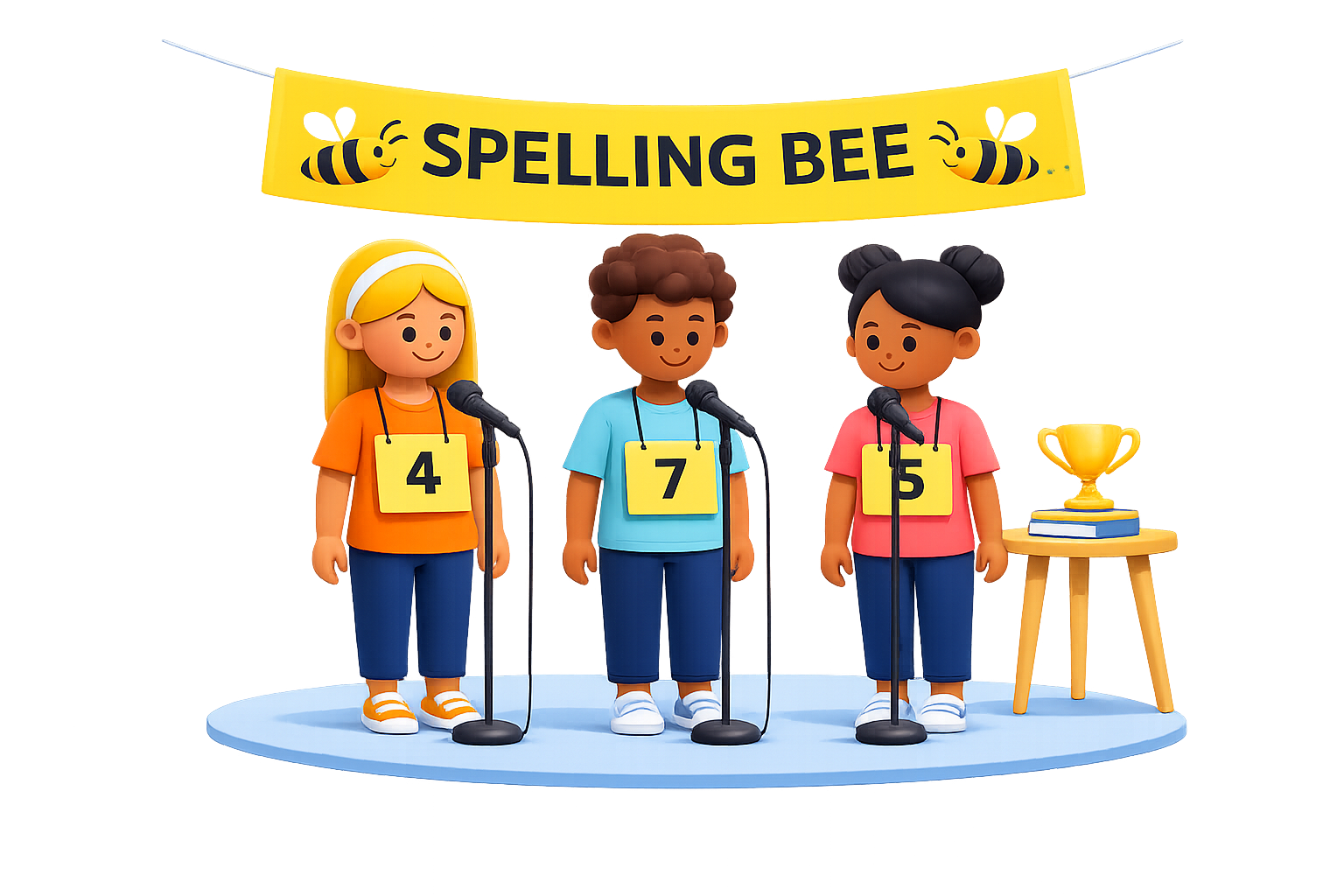
A spelling bee is a structured academic competition in which participants are asked to spell aloud a designated sequence of words with varying linguistic difficulty. Guided by an official pronouncer, spellers analyze phonetic patterns, root meanings, and language origins to correctly spell words letter-by-letter under strict time constraints and competition rules.
While the term "spelling bee" modernly extends to popular digital word games—most notably the daily puzzle hosted by The New York Times—the primary focus of competitive orthography is the traditional oral contest. Rooted in North American educational history and now hosted globally, academic spelling bees test a student's linguistic mastery, memory, and composure under pressure.
Understanding the Spelling Bee: Academic Competitions vs. Digital Games
To navigate the world of spelling bees effectively, it helps to distinguish between the traditional academic tournament and the contemporary online puzzle.
- Spelling Bee
- Academic Bee (e.g., Scripps)
- Oral competition
- Etymology & roots
- Pronouncer & judges
- Digital Word Game (e.g., NYT Bee)
- Solo digital puzzle
- Anagram construction
- Center-letter rule
- Academic Bee (e.g., Scripps)
The academic spelling bee is an official educational event for elementary and middle school students. Participants proceed through local, regional, and national levels, culminating in prestige competitions such as the Scripps National Spelling Bee. In these tournaments, spellers stand before a panel of judges, receive a spoken word, and recite its spelling aloud letter-by-letter.
Conversely, digital word games use the "spelling bee" moniker for casual word-construction puzzles. In games like the NYT Spelling Bee, players receive a honeycomb grid of seven letters and must construct as many words as possible using the central letter. While these digital games foster general vocabulary and anagramming skills, they operate under completely different rules and mechanics than official stage competitions.
Official Rules and Competition Mechanics
Academic spelling bees operate under strict, standardized governing rules to ensure fairness across all rounds. While minor regional variations exist, national competitions universally rely on official dictionaries—such as Merriam-Webster Unabridged—as their ultimate authority.
The Standard Speller Workflow
When a speller approaches the microphone, the official clock begins (typically offering two minutes total per word). The sequence follows a specific interactive workflow:
- Pronunciation: The pronouncer reads the word clearly into the microphone.
- Clarifying Questions: The speller may ask allowable questions to gather linguistic clues.
- Word Repetition: The speller repeats the word to confirm they heard it correctly.
- Letter Recitation: The speller speaks each letter clearly and sequentially.
- Final Word Repetition: The speller repeats the word a final time to signal completion.
Allowable Questions
Spellers are not forced to guess blindly based on acoustics alone. To help identify tricky spellings caused by homophones or reduced vowels (such as the schwa sound), spellers are legally permitted to ask the pronouncer for specific information:
- Definition: The dictionary definition of the word.
- Part of Speech: Whether the word functions as a noun, verb, adjective, adverb, etc.
- Language of Origin: The etymological roots (e.g., Latin, Greek, French, German, Japanese).
- Use in a Sentence: An official example sentence provided in the pronouncer's guide.
- Alternate Pronunciations: Any acceptable variant pronunciations listed in the official reference text.
Critical Rule Violations and Disqualifications
Judges monitor every letter uttered by the contestant. Disqualifications occur under precise, non-negotiable conditions:
- Incorrect Letter Sequence: Uttering an incorrect letter at any point in the word.
- Retracing or Changing Letters: Once a letter is spoken, it cannot be changed or corrected. A speller may pause and restart the word from the beginning, but they must repeat the exact same letters already spoken. Altering a letter during a restart results in immediate elimination.
- Exceeding the Time Limit: Failing to complete the spelling within the allotted time frame.
- Unclear Pronunciation: Mumbling or slurring letters so that judges cannot definitively determine the intended spelling.
The Ladder of Competition: From School to the National Stage
Competing in an official spelling bee pathway requires advancing through structured tier levels. In North America and participating international schools, this structure follows an annual cycle leading to the national championship held each spring.
- School Bee: Classroom & School-wide Bees (Nov/Dec)
- District/League: School District or Local Group (Jan/Feb)
- Regional Level: City, County, or Regional Sponsors (March/April)
- National Level: Scripps National Spelling Bee (May/June)
1. School-Level Bees
The process begins in individual elementary and middle schools (typically grades 3 through 8). Teachers administer preliminary classroom spelling tests to select representatives for the school-wide bee. Winning a school bee qualifies the student for district or county competitions.
2. Regional and State Competitions
Regional sponsors—often local newspapers, universities, or educational service agencies—host regional bees. These events frequently combine written preliminary tests (including both spelling and vocabulary sections) with traditional oral elimination rounds. Winning a regional bee grants the student an official championship slot at the national level, often with travel and accommodation expenses covered by the regional sponsor.
3. National Championships
The pinnacle of academic spelling is the Scripps National Spelling Bee, held annually in the Washington, D.C. area. Spellers compete through rigorous preliminary rounds, quarter-finals, semi-finals, and live televised finals. The national event incorporates both oral spelling on stage and computer-based vocabulary and spelling exams to narrow down hundreds of regional champions to a single winner.
Linguistic Frameworks: Etymology, Phonology, and Roots
Top-tier spellers do not rely on brute memorization of millions of dictionary entries. Instead, they study linguistics—specifically etymology (the origin of words) and morphology (the structure of words). Understanding how languages pass down spelling conventions allows spellers to deduce the spelling of unfamiliar words on stage.
Key Language Families and Spelling Conventions
Greek Roots: Words of Greek origin frequently feature unique consonant clusters and letter representations.
- Phonetics: The /f/ sound is spelled ph (phonics, diaphanous). The /k/ sound is often spelled ch (chronology, archetype).
- Vowel patterns: The /y/ sound is often spelled with a y (idiosyncrasy, presbyopia).
Latin Roots: Latin forms the backbone of scientific, legal, and academic English.
- Prefixes and Assimilation: Prefixes like ad- change based on the root letter (e.g., ad- + claim = acclaim; ad- + fluent = affluent).
- Ending rules: Soft /s/ sounds at the end of nouns often end in -ence or -ance, influenced by Latin conjugation rules (benevolence, surveillance).
French Loanwords: Words entering English through French retain soft consonants and unique vowel pairings.
- Silent letters: Final consonants are frequently silent (bourgeois, croissant).
- Sound mappings: The /sh/ sound is often spelled ch (chivalry, charlatan); the /zh/ sound is spelled j or g (beige, camouflage).
Germanic Roots: Native English and early German words usually feature direct, hard phonetic sounds, though silent letters persist from historic pronunciations.
- Consonant patterns: Features combinations like gh (knight, trough), kn (knead), and wr (wrestle).
| Word Origin | Characteristic Sound Pattern | Example Spelling Pattern |
|---|---|---|
| Greek | /f/ sound as "ph" | Diaphanous, Philanthropy |
| Greek | /k/ sound as "ch" | Synecdoche, Chronological |
| Latin | Double consonants (prefix) | Accommodation, Aggression |
| French | /sh/ sound as "ch" | Chauvinism, Chiffon |
| French | Silent final consonants | Rapport, Gouge |
| Germanic | Silent initial consonants | Knapsack, Wrestling |
Comparison of Competition Tiers
The rules, expectations, and preparation required evolve substantially as a speller advances up the competition ladder.
| Feature | School Level | Regional Level | National Level |
|---|---|---|---|
| Target Audience | Grades 3–8 (Local school) | School Champions | Regional Champions |
| Word List Source | School Study Lists (e.g., Words of the Champions) | Advanced Study Lists & Regional Word Banks | Full Unabridged Dictionary (Merriam-Webster) |
| Testing Format | Oral Spelling | Oral Spelling + Written Vocabulary Test | Computerized Prelims, Oral Semis & Finals |
| Vocabulary Tested? | Rarely | Frequently (in written rounds) | Yes (Mandatory in preliminary/semi rounds) |
| Primary Difficulty | Basic phonetic awareness | Intermediate etymology & common roots | Rare loanwords, obscure roots, precise diacritics |
| Time Limit Per Word | Flexible (1–2 minutes) | Standard 2 minutes | Strict 2 minutes with countdown timer |
A Structured Study Plan for Aspiring Spellers
Preparing for a spelling bee requires systematic, long-term habit building rather than cramming. Successful spellers structure their studies around three primary phases.
- Phase 1: Foundation (Months 1-3)
- Master core study lists (e.g., Words of the Champions)
- Memorize high-frequency Latin and Greek roots
- Phase 2: Etymological Expansion (Months 4-6)
- Study language-specific rules (French, German, Italian, Sanskrit)
- Practice mock bees with a timer and pronouncer
- Phase 3: Unabridged Dictionary Mastery (Months 7+)
- Drill obscure loanwords and homophones
- Conduct regular vocabulary tests and timed oral simulation
1. Foundation Phase: Core Word Lists
Begin with official curated lists provided by competition organizers, such as Scripps' Words of the Champions. Categorize words into three groups:
- Known Words: Words spelled correctly on the first attempt without hesitation.
- Rule-Based Words: Words missed due to a preventable phonetic error or misread prefix.
- Obscure Words: Words requiring full memorization and deep etymological analysis.
2. Intermediate Phase: Root and Affix Mastery
Shift focus from individual words to root systems. Learning a single root allows a speller to correctly deduce dozens of related terms.
- Example Root Study:
- Root: Chron (Greek for "time") $\rightarrow$ Anachronism, Chronometer, Synchronous.
- Root: Cern / Cret (Latin for "to separate or judge") $\rightarrow$ Discernment, Secretory, Excretory.
3. Advanced Phase: Dictionary Browsing and Mock Bees
For national-level preparation, spellers transition to studying directly from Merriam-Webster's Unabridged Dictionary. Use digital study aids, flashcard engines (like Anki), and specialized software (like SpellPundit) to track review intervals.
Conduct regular mock bees with a parent, coach, or teacher playing the role of the pronouncer. This replicates the audio environment, requiring the speller to ask allowable questions under a running clock.
On-Stage Strategy and Pressure Management
Knowing how to spell a word on paper differs significantly from spelling it correctly aloud under spotlight lighting and intense scrutiny. Developing a routine at the microphone prevents panic and avoids costly mechanical mistakes.
1. The Five-Step Microphone Routine
Every speller should establish a fixed habit every time they step up to the microphone:
- Listen Intently: Allow the pronouncer to finish speaking completely without interrupting.
- Request Information Systematically: Ask for the definition, origin, part of speech, and sentence—even if you think you know the word. This buys valuable thinking time and confirms the word's identity.
- Trace the Word: Write the letters mentally or physically on your hand or forearm using your index finger. Visualizing the written form prevents oral missteps.
- Pronounce Before Spelling: Say the word clearly so the judges know you have parsed the pronunciation correctly.
- Spell Slowly and Deliberately: Enunciate each letter clearly. Maintain a steady rhythm to avoid slipping up on silent letters or double consonants.
2. Handling Unknown Words Under Pressure
If handed a completely unfamiliar word:
- Identify the language of origin immediately. If the word is derived from Sanskrit, for example, the /ch/ sound is almost always spelled with ch rather than tsch or cz.
- Break the word down into its morphemes (prefixes, roots, suffixes).
- Ask for alternate pronunciations to reveal hidden schwa vowels or soft consonants.
- Rely on standard orthographic rules for that specific language family rather than making a phonetic guess based on English sound patterns.
Frequently Asked Questions
What happens if a speller mispronounces the word before spelling it?
Mispronouncing the word before spelling does not cause automatic disqualification, provided the speller spells the word correctly. However, mispronouncing the word may indicate to the judges that the speller has misunderstood the word being requested. It is best practice to ask the pronouncer for confirmation if there is any doubt about the pronunciation.
Can a speller change a letter after saying it out loud?
No. Once a speller pronounces a letter at the microphone, that letter is officially recorded by the judges and cannot be changed or retracted. If a speller restarts the spelling of a word, they must repeat the exact same sequence of letters already spoken up to that point. Changing even a single letter during a restart results in immediate elimination.
How are ties handled in competitive spelling bees?
In modern competitions, ties are rare due to vocabulary tests and multi-round elimination structures. In the event that final contestants exhaust the designated word lists for a round, co-championships may be awarded, or tie-breaker rounds featuring higher-difficulty, off-list words from the unabridged dictionary are used to determine a single champion.
What is the age limit for participating in the Scripps National Spelling Bee?
To be eligible for the Scripps National Spelling Bee, a speller must not have passed the eighth grade on or before February 1 of the competition year and must not have reached their 15th birthday before August 31 of the calendar year prior to the competition. Additionally, spellers cannot have previously won the national championship.
Why are vocabulary questions included in traditional spelling bees?
Vocabulary questions were introduced into official competition tiers to ensure that spellers understand the contextual meaning of words rather than engaging solely in rote letter-memorization. Testing vocabulary reinforces the ultimate academic objective of spelling bees: improving literacy, reading comprehension, and overall language competence.
Next Steps for Students, Parents, and Educators
Whether preparing for an upcoming school competition or organizing a local event, structured preparation yields the best outcomes:
- For Students: Download the current year's official study list from your school coordinator. Dedicate 15 to 30 minutes daily to analyzing word origins, roots, and definitions rather than simple visual memorization.
- For Educators & School Coordinators: Register your school officially with national platforms like the Scripps National Spelling Bee early in the academic year to receive official study materials, pronouncer guides, and school competition rules.
- For Parents: Support spellers by conducting practice drills, helping them build root-word flashcards, and instilling stress-management techniques to ensure the experience remains engaging and academically enriching.