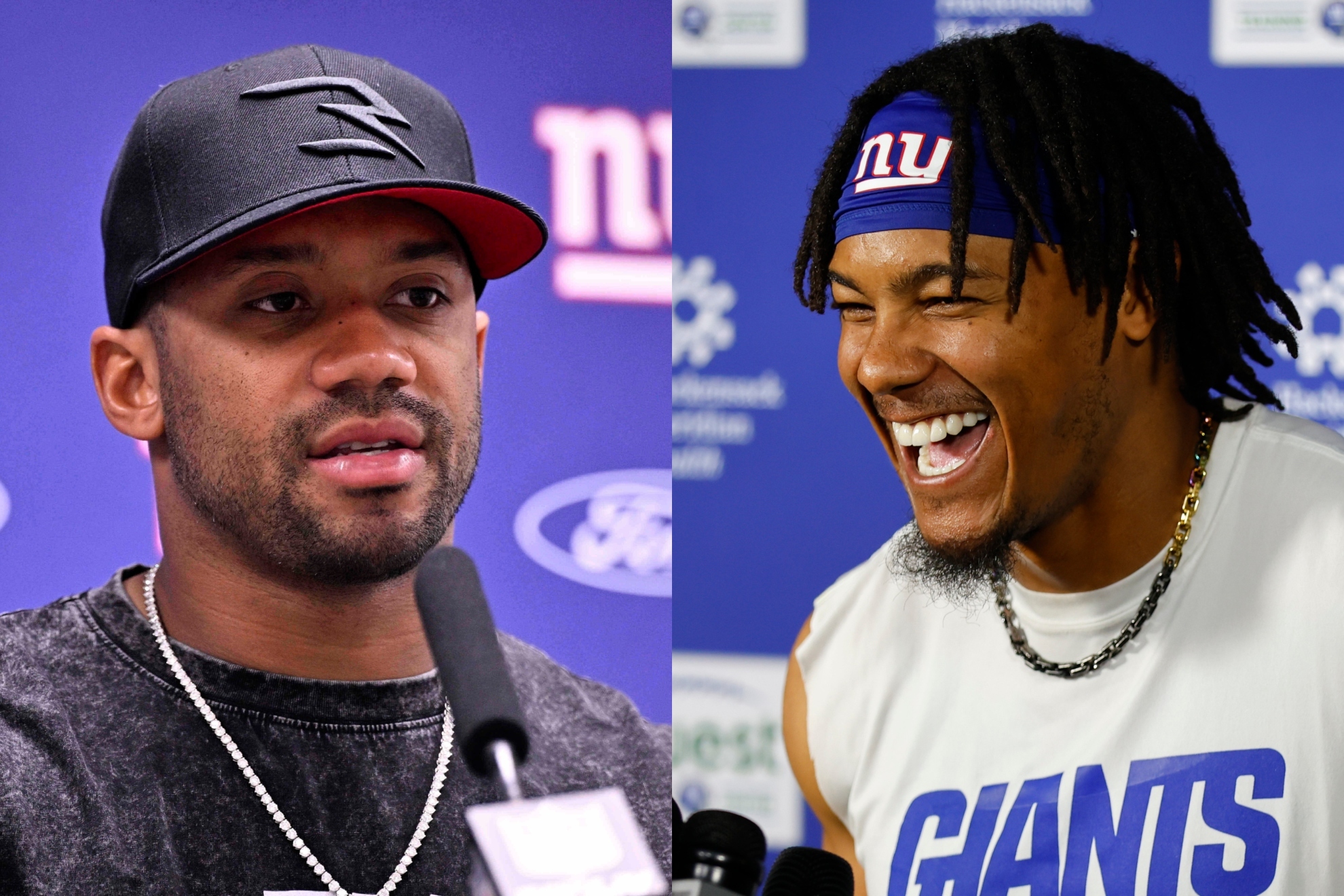
As of 2026, Khalil Shakir and Wan’Dale Robinson have both completed their initial four-year rookie contracts and established themselves as premier slot-specialist wide receivers in the NFL. While Robinson entered the league as a high second-round investment for the New York Giants, Shakir emerged as a fifth-round "value" star for the Buffalo Bills, resulting in vastly different career earnings despite similar on-field impacts.
The 2022 NFL Draft class produced several high-profile wide receivers, but the career trajectories of Khalil Shakir and Wan’Dale Robinson offer a fascinating case study in draft capital versus performance-based scaling. Both players operate primarily in the slot, relying on lateral agility and high-percentage catch rates. However, the financial architecture of their careers was fundamentally dictated by their respective draft slots—Robinson at 43rd overall and Shakir at 148th. As they navigate the 2026 landscape, their financial profiles reflect a convergence of market value that was not present during their first four seasons in the league.
The Foundation: 2022 Rookie Contract Comparisons
In the NFL’s collective bargaining agreement (CBA), rookie contracts are strictly slotted based on draft position. This created a significant initial wealth gap between Robinson and Shakir. Wan’Dale Robinson, selected in the early second round, signed a four-year deal worth approximately $8.18 million. His contract included a signing bonus of roughly $3.13 million, providing him with immediate liquid capital and a high degree of "dead money" protection that ensured his roster spot during his early recovery from an ACL injury.
Conversely, Khalil Shakir’s fifth-round status meant his initial four-year contract was valued at approximately $3.99 million, with a signing bonus of only $332,000. For the first three years of his career, Shakir was one of the most underpaid players in the league relative to his production. While Robinson was earning an average annual value (AAV) of over $2 million, Shakir was playing for a sub-$1 million AAV, highlighting the massive financial advantage of being a Day 2 versus a Day 3 draft pick.
Wan’Dale Robinson’s Career Path and Financial Evolution
Wan’Dale Robinson’s career has been defined by his role as a high-volume "chain-mover" for the New York Giants. Despite a significant setback in his rookie year—a torn ACL that curtailed his 2022 season—the Giants remained committed to his development due to the significant draft capital invested in him.
From a financial perspective, Robinson’s profile is stabilized by his reliability in the short-passing game. By 2024 and 2025, he became a focal point of the Giants' offensive scheme, often leading the team in targets and receptions, even if his average depth of target (aDOT) remained low. This volume is a critical metric for contract negotiations; high reception totals, regardless of yardage, often trigger incentives or set high floors for veteran contract extensions.
By the time he reached the 2026 offseason, Robinson had successfully leveraged his "Yards After Catch" (YAC) metrics to position himself for a significant second contract. Teams value his ability to act as a safety valve for quarterbacks, making him a low-risk, high-floor financial asset. His financial profile in 2026 is bolstered by his health durability following his initial knee surgery, which has silenced concerns regarding his smaller frame (5'8", 185 lbs) and its longevity in a physical league.
Khalil Shakir’s Financial Breakout in Buffalo
Khalil Shakir’s financial trajectory is the inverse of Robinson’s. While Robinson had the "pedigree," Shakir had the "efficiency." Following the departures of veteran receivers in Buffalo during the 2024 and 2025 offseasons, Shakir ascended to a primary role in Josh Allen’s offense. In 2024, Shakir posted some of the highest catch rates in the modern era, famously catching over 85% of his targets during significant stretches of play.
For a fifth-round pick, this level of production allows for "Performance-Based Pay" distributions, a fund established by the NFL to provide additional compensation to players whose playing time exceeds their salary level. Throughout his rookie deal, Shakir likely earned several hundred thousand dollars in supplemental income from this fund, though it still did not bridge the gap to Robinson’s second-round earnings.
However, entering 2026, Shakir’s financial profile has shifted from "bargain asset" to "market setter." His synergy with an elite quarterback and his proven ability to perform in the postseason have made him a candidate for a Tier 2 wide receiver contract, which in the 2026 market ranges between $14 million and $18 million annually.
Detailed Financial and Career Comparison (2022–2026)
The following table outlines the estimated financial standing and career metrics for both players as they concluded their rookie deals and moved into the 2026 league year.
| Financial/Career Metric | Wan’Dale Robinson (NYG) | Khalil Shakir (BUF) |
|---|---|---|
| Draft Slot | Round 2, Pick 43 | Round 5, Pick 148 |
| Initial 4-Year Contract Value | ~$8,185,000 | ~$3,990,000 |
| Guaranteed Money (at signing) | ~$4,900,000 | ~$332,000 |
| Total Career Earnings (est. thru 2025) | ~$8.5M (incl. incentives) | ~$4.8M (incl. PB Pay) |
| Primary Offensive Role | High-Volume Slot / YAC | High-Efficiency / Deep Slot |
| 2026 Market Valuation (AAV) | $12M – $15M | $14M – $18M |
| Contractual Strength | High Draft Pedigree | Elite Efficiency Metrics |
The 2026 Market for Slot Receivers
The financial landscape for wide receivers changed dramatically between 2022 and 2026. With the NFL salary cap exceeding $280 million in 2026, the "middle class" of wide receivers—those who are not necessarily 1,500-yard superstars but are essential to offensive consistency—has seen a massive surge in AAV.
Robinson and Shakir represent the two different ways teams value this position:
- The Volume Asset (Robinson): Teams pay for a high floor. A receiver who can guarantee 80+ catches a year is a bankable asset for a young or struggling quarterback.
- The Efficiency Asset (Shakir): Teams pay for the "big play" potential within the slot. A receiver who catches 90% of his targets and generates a 120.0+ passer rating when targeted is a luxury that playoff-caliber teams are willing to overpay for to keep their windows open.
In 2026, contract structures have also evolved to include more "void years" and larger signing bonuses to spread the cap hit over longer periods. For both Robinson and Shakir, their first veteran contracts likely include 40% to 50% of the total value in full guarantees, a standard for established starters in the current market.
Contractual Nuances: Guarantees and Incentives
When analyzing the financial profiles of these two athletes, one must look beyond the "sticker price" of the contract. For Wan’Dale Robinson, his second contract likely emphasizes guaranteed money at signing. Given his early-career injury history, his agents would prioritize security over total potential value.
For Khalil Shakir, the focus is often on escalators. Since he has a history of outperforming his projections, a contract with escalators based on All-Pro nods or specific catch-percentage thresholds would be beneficial. In the 2026 cap environment, "Signing Bonus Proration" remains the primary tool for teams like Buffalo to fit Shakir’s new salary into a tight cap dominated by a high-priced quarterback.
Both players are also subject to the "Three-Year Rule" regarding extensions. While Robinson was eligible for an extension after the 2024 season, his injury recovery timeline likely pushed serious negotiations into 2025. Shakir, as a late-round pick, had significantly more leverage to hold out or demand an early extension after his 2024 breakout, as his base salary was non-proportional to his role as a WR1/WR2.
Frequently Asked Questions
Did Wan’Dale Robinson’s rookie injury affect his career earnings?
Yes, but primarily in terms of timing rather than total value. The ACL tear in late 2022 prevented him from hitting high-performance escalators in his second year. However, because he was a second-round pick, his salary was already largely guaranteed. His 2024 and 2025 "bounce-back" seasons effectively restored his market value for his 2026 veteran contract.
Is Khalil Shakir considered a "richer" player than Robinson now?
Technically, no. Due to his second-round draft slot, Robinson’s total career earnings through the end of 2025 remained significantly higher than Shakir’s. However, as of the 2026 signing period, Shakir’s projected AAV on his new contract may exceed Robinson’s if he maintains his elite efficiency ratings, potentially allowing him to overtake Robinson in total net worth by 2028.
How does the Buffalo Bills' cap situation affect Shakir's financial profile?
The Bills have had to navigate a "cap crunch" for several years. This often leads to players like Shakir receiving "backloaded" contracts with high signing bonuses. From a financial profile standpoint, this gives Shakir more immediate cash (liquid assets) while the team takes a smaller cap hit in 2026, with the "bill" coming due in 2028 or 2029.
What are the "Performance-Based Pay" amounts Shakir received?
The NFL's Performance-Based Pay program rewards players with low salaries who play a high percentage of snaps. As a starter on a fifth-round salary, Shakir likely earned between $300,000 and $500,000 annually in extra compensation during his third and fourth seasons, which significantly bolstered his "rookie" earnings compared to other late-round picks.
Which player has a higher "Market Value" in 2026?
As of 2026, Khalil Shakir generally holds a slightly higher market value. NFL scouts and cap analysts currently prize "efficiency and explosion" (Shakir) over "volume and short-area PPR value" (Robinson), though the difference is marginal and largely dependent on the specific offensive scheme of the signing team.
Practical Guidance for Evaluating NFL Financial Profiles
When comparing players like Shakir and Robinson, it is essential to look at the "effective" earnings rather than just the total contract value. For fans, fantasy managers, or sports analysts, understanding that draft position creates a four-year "earnings ceiling" is vital.
If you are tracking the financial health of an NFL career, always prioritize the "Guaranteed at Signing" figure over the "Total Contract Value." In the cases of Shakir and Robinson, their 2026 profiles have finally moved away from the rigid structures of the rookie wage scale and into the "true market" phase, where their bank accounts finally reflect their on-field production rather than their 2022 draft day evaluation.