A Series of Unfortunate Events is a 13-book gothic literary series created by Daniel Handler under the pen name Lemony Snicket. The narrative follows the three Baudelaire orphans—Violet, Klaus, and Sunny—as they escape their villainous relative Count Olaf, uncover a clandestine secret society named V.F.D., and attempt to solve their parents' mysterious demise.
The Core Narrative: Plot, Characters, and the Baudelaire Legacy
The narrative begins with a tragic catalyst: a mysterious fire destroys the Baudelaire family mansion, taking the lives of Bertrand and Beatrice Baudelaire. Their surviving children—fourteen-year-old inventor Violet, twelve-year-old researcher Klaus, and infant Sunny, whose sharp teeth and burgeoning culinary skills evolve throughout the story—are left under the stewardship of Mr. Poe, a well-meaning but incompetent banker managing the Baudelaire estate.
Mr. Poe places the siblings in the care of Count Olaf, a theatrical villain intent on usurping the fortune inherited by Violet upon her eighteenth birthday. Olaf’s relentless pursuits structure the early entries of the series, where he adopts ludicrous disguises—ranging from a sea captain to a receptionist—to infiltrate the homes of subsequent guardians. The Baudelaires rely entirely on their specialized skills to escape Olaf’s traps:
- Violet Baudelaire: Her inventive talent relies on resourcefulness, converting everyday items into mechanical devices under strict time constraints.
- Klaus Baudelaire: His expansive knowledge of literature, law, and history serves as the primary tool for deciphering villains' schemes and decoding hidden ciphers.
- Sunny Baudelaire: Initially providing comic relief through her powerful bite, her role expands into critical defensive actions and early culinary achievements that assist the orphans' survival.
As the story progresses, the focus shifts from self-contained escape stories to an overarching conspiracy. The Baudelaire children discover that their parents were members of a covert, multi-generational organization known as V.F.D., which suffered a bitter schism that split its members into altruistic volunteers and fire-starting villains.
- Baudelaire Mansion Fire
- Escaping Count Olaf
- Uncovering V.F.D. Secrets
- The Great Schism
Complete Reading Order for the 13 Main Novels and Companion Works
Understanding the sequence of publication is critical to tracking the gradual build from simple episodic misadventures to intricate meta-literary mysteries. The main series comprises 13 core novels published by HarperCollins between 1999 and 2006.
| Book # | Title | Original Release Year | Primary Setting / Guardian | Key Narrative Milestones |
|---|---|---|---|---|
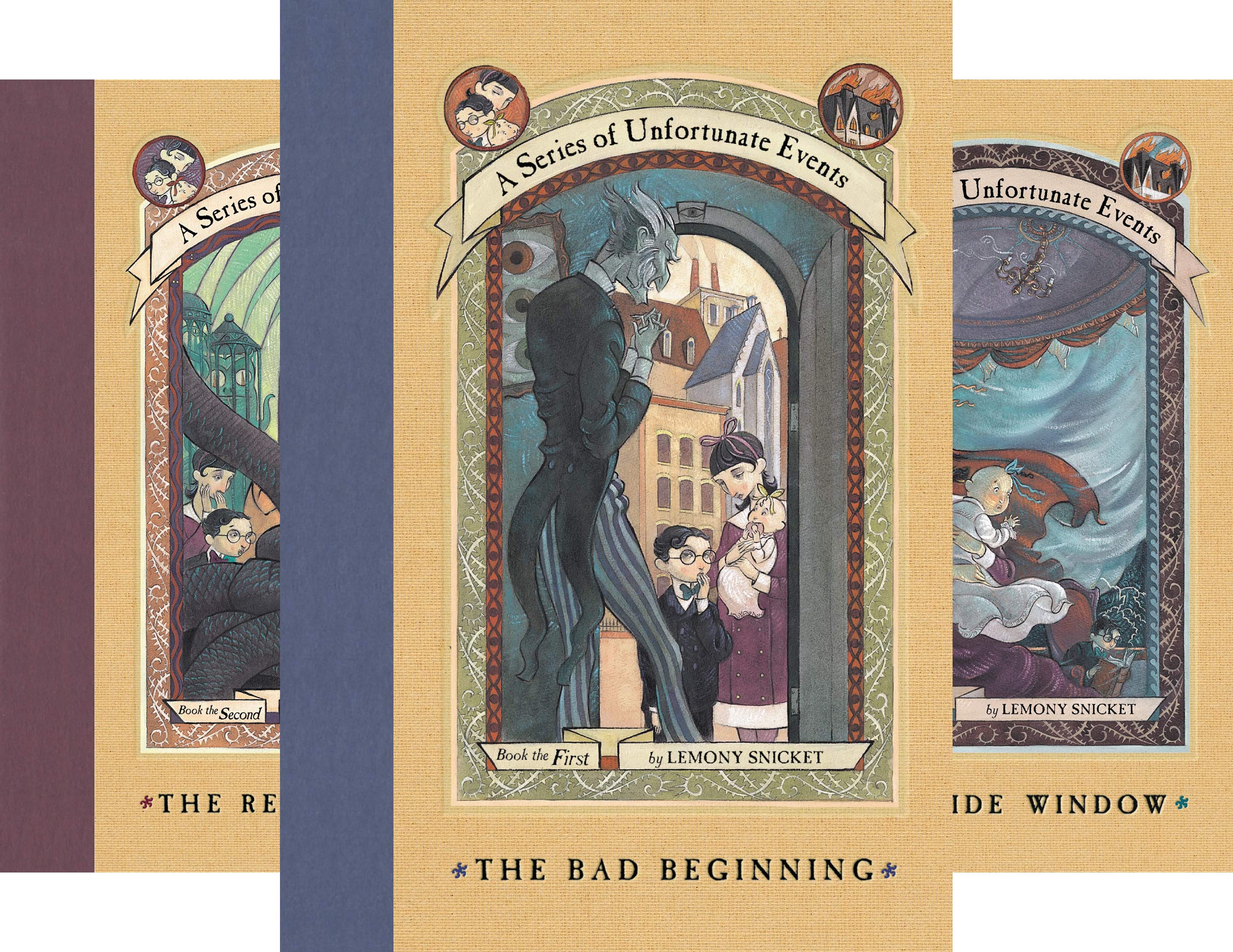
| 1 | The Bad Beginning | 1999 | Count Olaf's Dilapidated House | Introduction of Count Olaf and the Baudelaire fortune quest |
| 2 | The Reptile Room | 1999 | Uncle Monty's Herpetological Sanctuary | First appearance of the mysterious Sugar Bowl motif |
| 3 | The Wide Window | 2000 | Aunt Josephine's Cliffside House | Explores linguistic clues, fear, and unreliable guardians |
| 4 | The Miserable Mill | 2000 | Lucky Smells Lumbermill | Shifts tone into worker exploitation and psychological conditioning |
| 5 | The Austere Academy | 2000 | Prufrock Preparatory School | Introduces the Quagmire Triplets and initial V.F.D. references |
| 6 | The Ersatz Elevator | 2001 | 667 Dark Avenue (Esmé Squalor) | Highlights high-society obsession and introduces Esmé Squalor |
| 7 | The Vile Village | 2001 | The Village of V.F.D. | The Baudelaires are framed for murder, shifting them to fugitives |
| 8 | The Hostile Hospital | 2001 | Heimlich Hospital | Transition from victims to active participants in secret operations |
| 9 | The Carnivorous Carnival | 2002 | Caligari Carnival | The orphans adopt disguises to survive, testing moral boundaries |
| 10 | The Slippery Slope | 2003 | The Mortmain Mountains | Introduction of the V.F.D. Headquarters and Quigley Quagmire |
| 11 | The Grim Grotto | 2004 | The Queequeg Submarine | Explores ecological danger (Medusoid Mycelium) and submarine life |
| 12 | The Penultimate Peril | 2005 | Hotel Denouement | Gathering of all surviving characters for a high-stakes trial |
| 13 | The End | 2006 | An Unnamed Island | Isolation, historical resolution, and moral ambiguity |
Beyond the core thirteen titles, the broader universe features several supplemental texts authored by Handler that add depth to the universe:
- ** Lemony Snicket: The Unauthorized Autobiography (2002)**: A collection of red-acted documents, photos, and letters explaining the operational mechanics of V.F.D.
- ** The Beatrice Letters (2006)**: A correspondence collection spanning past and future timelines, elaborating on the identity of Beatrice and her relationship to Lemony Snicket.
- ** All the Wrong Questions (2012–2015)**: A four-part prequel series chronicling Lemony Snicket's adolescent apprenticeship within V.F.D. in the declining town of Stain'd-by-the-Sea.
Unraveling V.F.D. and the Lore of Lemony Snicket
The central driving force of the latter half of the series is V.F.D., an acronym primarily standing for Volunteer Fire Department, though it is assigned dozens of alternative meanings throughout the text (e.g., Very Flammable Department, Valorous Farm Animals, Village of Fowl Devotees).
The Schism and Moral Ambiguity
Historically, V.F.D. operated as a secret society dedicated to literacy, critical thinking, cultural preservation, and fire prevention. Members were recruited in childhood through disguised tests and trained in disguise, code writing, and observation.
A central event, referred to simple as "The Schism," divided the organization into two fiercely opposed factions:
- The Volunteer Side: Dedicated to putting out fires, preserving books, and archiving historical truth.
- The Fire-Starting Side: Focused on arson, extortion, theft, and destroying written records for personal gain.
The line between these factions blurs as the Baudelaire children are forced to commit arson, theft, and deceit to escape capture. Handler uses this descent to dismantle traditional black-and-white morality common in children's literature, illustrating how extreme circumstances can compromise ethical purity.
The Unreliable Narrator
Lemony Snicket serves as both the fictionalized author and an active in-universe participant in the history he documents. He routinely breaks the third wall to address the reader directly, offering vocabulary definitions, philosophical commentary, and explicit warnings to put the book down in favor of lighter material.
Snicket’s account is inherently biased and partially incomplete. He tracks the Baudelaires out of a combination of personal devotion to their deceased mother, Beatrice—whom Snicket loved prior to his exile and presumed death—and an obsessive journalistic endeavor to record the truth of the Schism.
Adaptations Compared: Feature Film vs. Netflix Series
The unique narrative style and gothic design of the books inspired two major screen adaptations, each approaching the source material differently.
- A Series of Unfortunate Events Adaptations
- 2004 Feature Film (Paramount / DreamWorks)
- Covers Books 1–3 | 108 Minutes | Gothic Comedy Focus
- 2017–2019 Netflix Series (3 Seasons)
- Covers Books 1–13 | 25 Episodes | Faithful Meta-Narrative Expansion
- 2004 Feature Film (Paramount / DreamWorks)
The 2004 Feature Film (Lemony Snicket's A Series of Unfortunate Events)
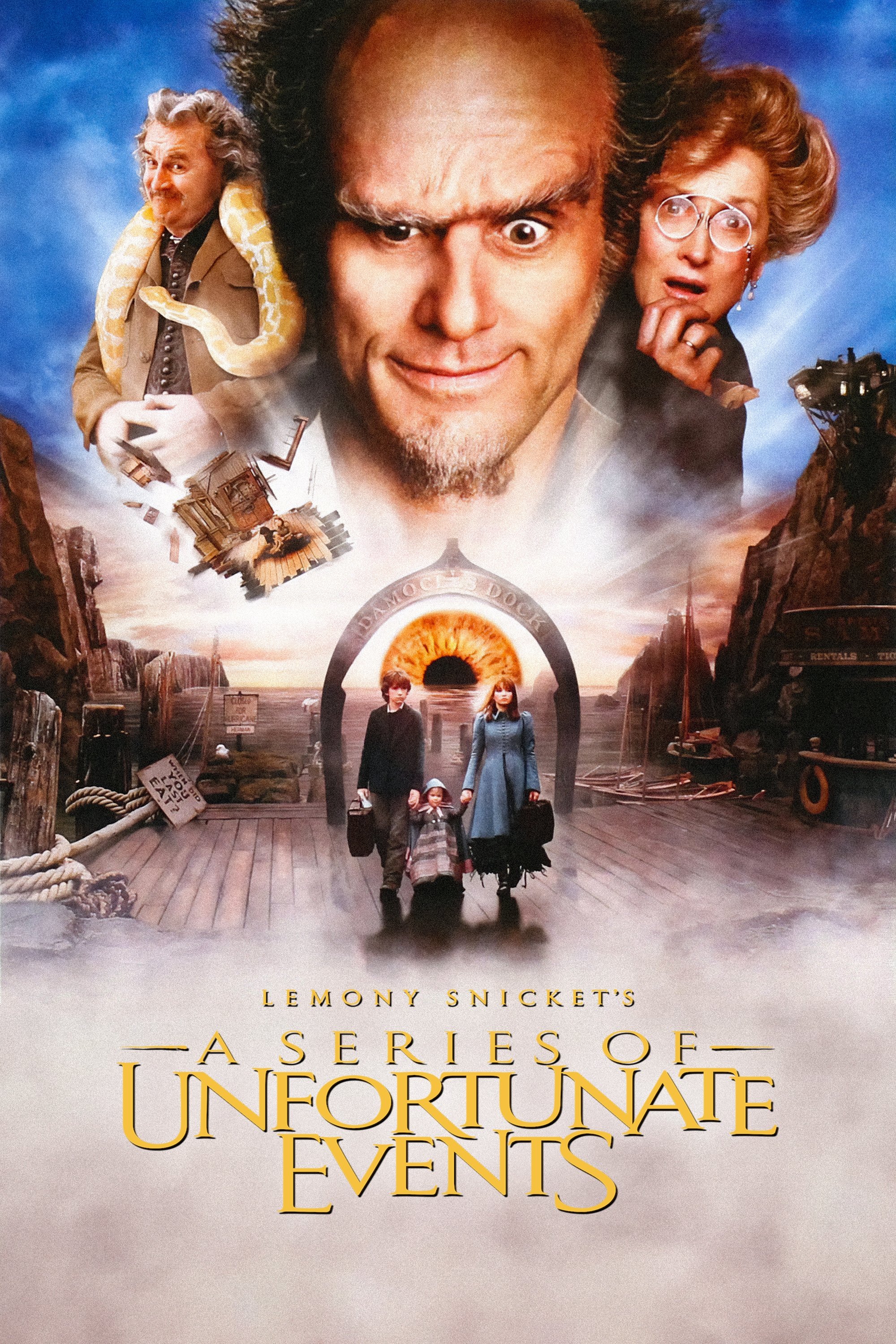
Directed by Brad Silberling and starring Jim Carrey as Count Olaf, this cinematic release condensed the first three books (The Bad Beginning, The Reptile Room, and The Wide Window) into a single 108-minute feature.
- Visual Style: High-budget aesthetic combining Victorian gothic architecture with mid-century retro-futurism, earning an Academy Award for Best Makeup.
- Structure: Rearranged major narrative beats, placing the climax of The Bad Beginning (the forced wedding play) at the end of the film to establish a traditional movie climax.
- Tone: Prioritized physical comedy and character acting from Jim Carrey, softening the darker philosophical themes of the original novels.
The 2017–2019 Netflix Television Series
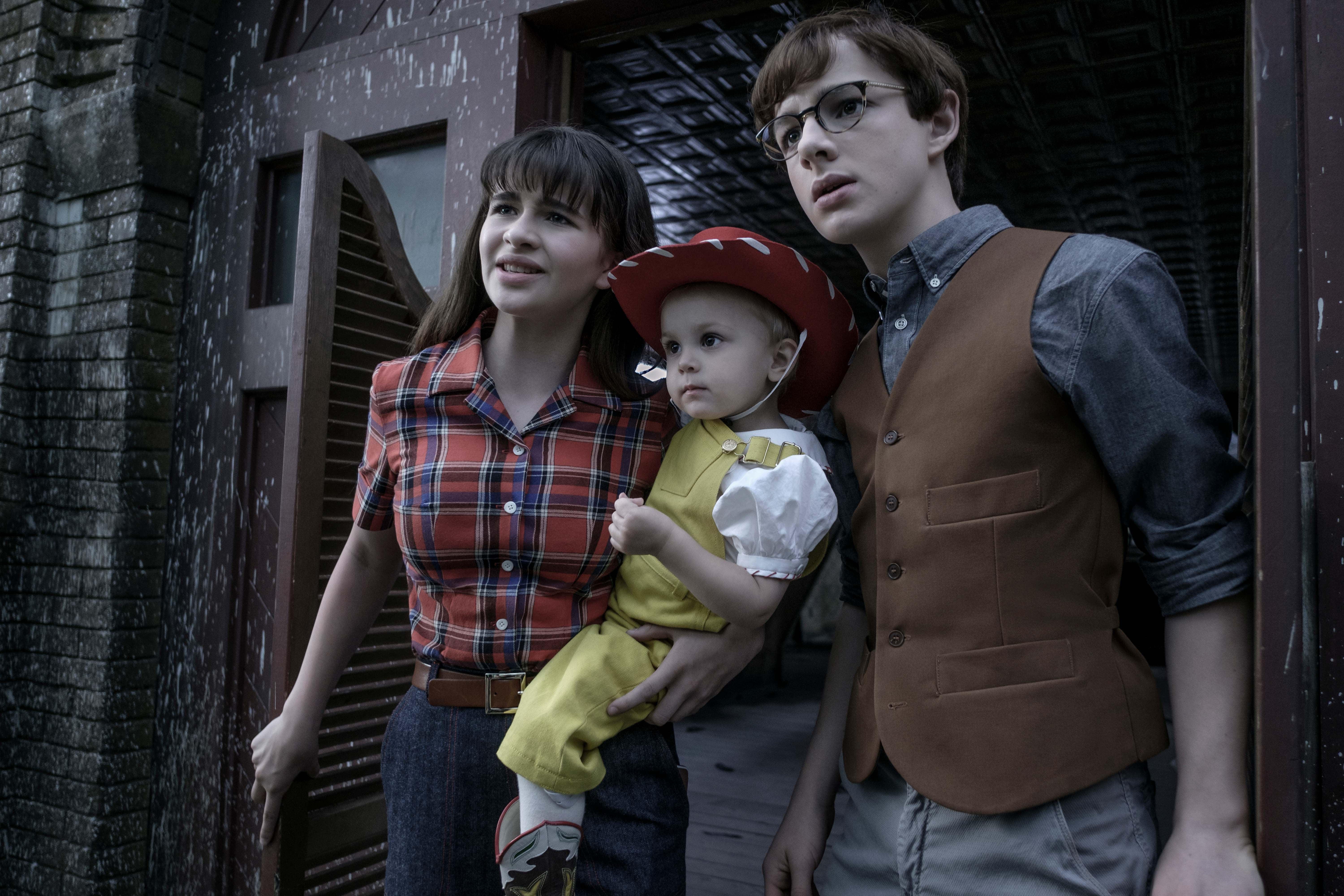
Produced over three seasons comprising 25 episodes, the Netflix adaptation directed by Barry Sonnenfeld systematically adapted all 13 main novels. Neil Patrick Harris portrayed Count Olaf, while Patrick Warburton appeared on screen as Lemony Snicket to deliver the narrative commentary.
- Pacing: Allocated two episodes per book (with The End receiving a single feature-length finale), allowing space for world-building and character development.
- Lore Integration: Introduced V.F.D. storylines, side characters (such as Jacques Snicket and Larry Your-Waiter), and the mystery of the Sugar Bowl much earlier than they appear in the novel sequence.
- Tonal Alignment: Retained the absurd, deadpan, metanarrative commentary of Handler's prose, maintaining the dark humor while explicitly preserving the fatalistic outcomes of major secondary characters.
Reading and Viewing Guidance: Target Audience, Themes, and Tone
Navigating A Series of Unfortunate Events requires an understanding of its literary tone and underlying themes, which deliberately deviate from standard middle-grade fiction.
Ideal Reading Level and Age Appropriateness
- Target Book Reading Age: 9 to 14 years (Middle Grade / Young Adult crossover).
- Lexile Framework: Ranging between 900L and 1100L due to sophisticated vocabulary, complex syntax, and satirical literary allusions.
- Themes of Loss and Resilience: While dark, the stories avoid graphic violence, focusing instead on psychological tension, grief, existential dread, and the absurdity of adult authority.
Key Literary Themes
- Institutional Incompetence and Ignorance: Adults in the series—even those with good intentions—are frequently blind to obvious danger, rigid in their adherence to nonsensical rules, and dismissive of children's intellect.
- The Power of Literacy and Knowledge: Information is the Baudelaires' primary defense mechanism. Reading books, understanding precise definitions, and preserving historical documentation are portrayed as essential tools for survival.
- Moral Gray Areas: Characters are rarely purely good or evil. Key figures within V.F.D. exhibit flawed judgment, and the Baudelaires themselves are forced into compromising choices to survive.
Frequently Asked Questions
What does V.F.D. stand for in A Series of Unfortunate Events?
V.F.D. primarily stands for Volunteer Fire Department. Throughout the books and adaptations, the acronym is also used for dozens of localized groups, disguises, and locations, including Village of Fowl Devotees, Veritable French Dinner, and Very Flammable Department.
What is inside the Sugar Bowl?
The contents of the Sugar Bowl are never explicitly revealed in the main 13 novels. In the companion lore and the Netflix adaptation, it is strongly implied to contain a botanical immunity sample against the lethal Medusoid Mycelium mushroom—specifically, a strain of horseradish or apple fungus—making it a crucial tool of defense for both factions of V.F.D.
Is Lemony Snicket a real person?
Lemony Snicket is the pen name and fictional persona of author Daniel Handler. Handler wrote the novels from the perspective of Snicket, who exists within the book's universe as a disgraced researcher tracking the Baudelaire orphans' history.
Should I watch the movie or the Netflix show first?
The Netflix series provides a complete, faithful adaptation of all 13 books. The 2004 movie only covers the first three books and reshuffles the ending. Readers seeking an accurate visual translation of the complete story should start with the Netflix series.
What order should I read the extra companion books in?
Read the 13 main books first. Following The End, read Lemony Snicket: The Unauthorized Autobiography and The Beatrice Letters. Finally, read the four-book prequel series All the Wrong Questions to explore the origin of V.F.D.
Recommended Next Steps for Readers and Viewers
To engage with the full scope of A Series of Unfortunate Events, follow a clear path based on your goals:
- For New Readers: Begin with the novel The Bad Beginning. Read the main 13-book series sequentially to appreciate how the simple early episodic structure gives way to complex serialization.
- For Parents and Educators: Use the series as an introduction to advanced vocabulary, gothic fiction tropes, literary devices (such as ironies and allusions), and discussions on media literacy.
- For Franchise Completionists: Read the companion text The Beatrice Letters immediately after finishing The End, then transition to the All the Wrong Questions prequel series to fully understand the historical context of the Schism.
- For Screen Viewing: Watch the 2017–2019 Netflix series alongside or after reading the novels to compare how textual metanarratives were adapted into visual television devices.