A Quiet Place: Day One (2024) expanded Paramount Pictures' hit post-apocalyptic franchise by detailing the initial alien arrival in New York City. Operating on a reported $67 million production budget, the film demonstrates how mid-to-high budget studio filmmaking can successfully combine large-scale urban destruction with intimacy, minimal dialogue, and tension-driven survival horror mechanics.
Understanding the Scope: Production Budget and Strategic Allocation
When analyzing survival horror in cinema, budget allocation dictates not just scale, but narrative structure. Directed by Michael Sarnoski from a story co-developed with John Krasinski, A Quiet Place: Day One operates on a $67 million production budget. This represents a significant expansion compared to the original 2018 film A Quiet Place, which was produced for roughly $17 million, and a slight increase over 2020's A Quiet Place Part II, which carried a $61 million price tag.
| Film | Budget | Scope |
|---|---|---|
| [2018] A Quiet Place | $17M | Isolated rural farmhouse |
| [2020] A Quiet Place Part II | $61M | Suburban expansion |
| [2024] A Quiet Place: Day One | $67M | Dense urban metropolis |
Understanding how this budget was divided illuminates how modern studio horror balances computer-generated imagery (CGI) against atmospheric build-up:
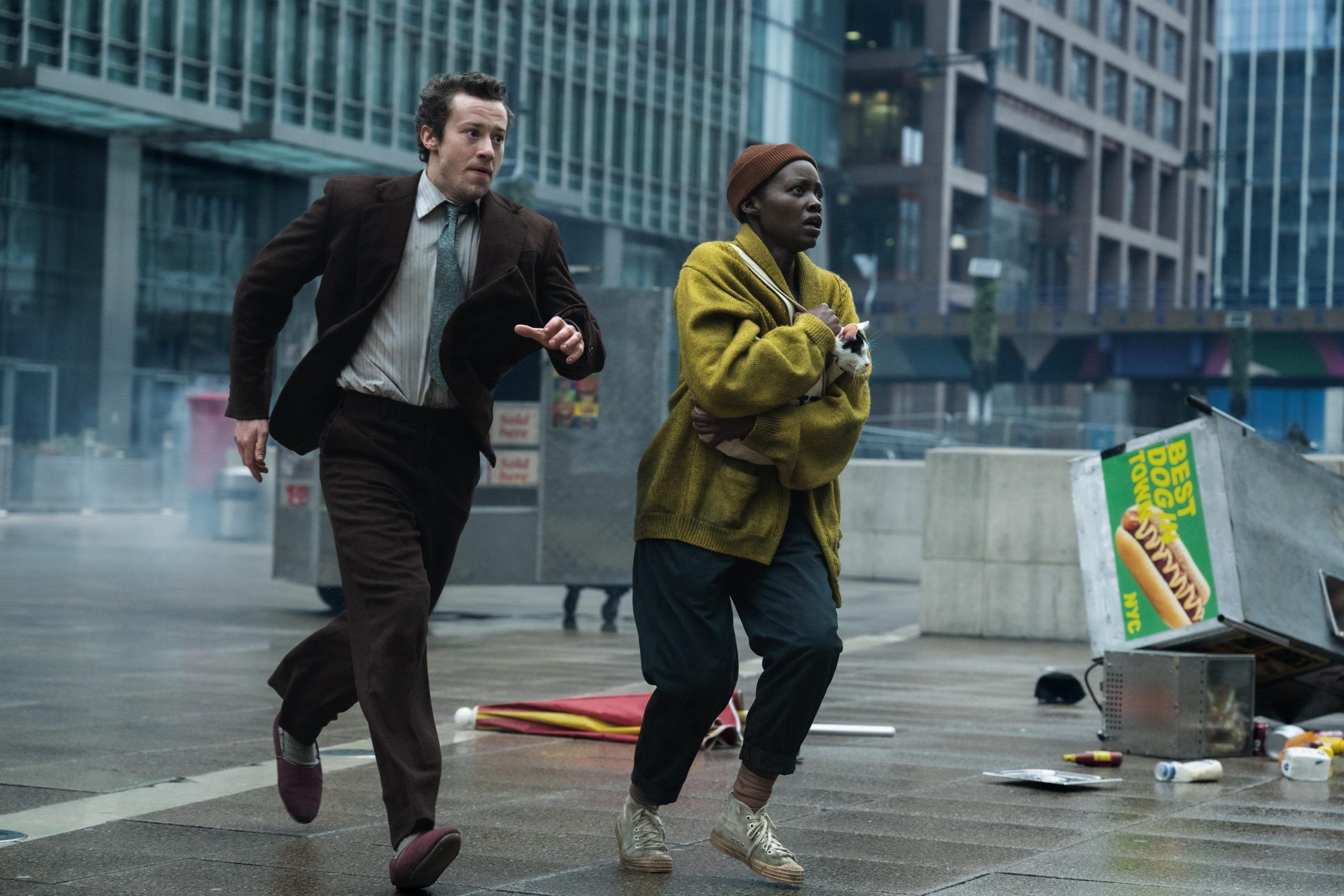
- Principal Photography & Set Construction: Rather than filming extensive sequences on location in New York City—which presents extreme logistical and financial hurdles—production was centered at Warner Bros. Studios Leavesden in Hertfordshire, England. Elaborate exterior sets depicting New York's Chinatown and Harlem neighborhoods were constructed to grant the crew complete control over street layouts, lighting, debris placement, and physical stunt work.
- Visual Effects (VFX) Pipeline: Industrial Light & Magic (ILM) handled the visual effects for the blind extraterrestrial creatures (Death Angels). Budgeting for hundreds of creatures in a dense metropolitan area required strategic visual conservation: creatures are frequently obscured by smoke, dust clouds, rain, and low-light environments to maximize render efficiency while heightening claustrophobia.
- Cast and Talent: The film relies on a small core cast led by Academy Award winner Lupita Nyong'o (Samira) and Joseph Quinn (Eric), alongside Alex Wolff and Djimon Hounsou. Limiting the main speaking cast controlled talent payroll while keeping character dynamics intimate.
- Audio Engineering & Post-Production: In sound-centric horror, audio production carries equal or higher priority than visual effects. A substantial portion of post-production spending was dedicated to custom Foley recording, spatial Dolby Atmos sound mixing, and precise acoustic engineering designed to manipulate extreme dynamic range.
Sound Design as a Survival Horror Driving Force
In traditional action films, high budgets fund massive explosions and continuous gunfire. In sound-driven survival horror, capital is invested in shaping absence and silence. The core mechanic of the A Quiet Place universe—that the creatures hunt exclusively by hyper-sensitive hearing—demands a specialized acoustic methodology.
Atmospheric Audio and Dynamic Range
The sound design team, building on the framework created by sound editors Ethan Van der Ryn and Erik Aadahl in earlier installments, uses high-dynamic-range audio mixing. The film contrasts near-total silence (ambient levels around 20 dB) with abrupt, high-decibel auditory spikes (exceeding 100 dB) when objects drop or creatures strike.
| Decibel Level | Context in Film Sound Design |
|---|---|
| 0 dB | Threshold of human hearing |
| 20 dB | Ambient silence in A Quiet Place setting (footsteps on sand, soft breathing) |
| 60 dB | Normal conversational speech (lethal in the film's context) |
| 100+ dB | Sudden noise impact / Creature attack spike |
For screenwriters and audio directors, this dynamic range creates instant physical stakes. The audio mix forces the audience into the same sensory baseline as the protagonist: every shuffle of feet, rustle of clothing, or heavy breath carries existential risk.
Environmental Sound Masking
A critical survival tactic introduced in the franchise and heavily utilized in Day One is natural sound masking. Sarnoski highlights environments where ambient sound exceeds the noise generated by human movement:
- Thunderstorms and Heavy Rain: Torrential downpours create a continuous acoustic buffer, allowing characters to move, breathe heavily, and speak in low tones without triggering attacks.
- Waterfalls and Running Water: The continuous white noise of falling water masks localized footsteps and minor collisions.
- Industrial/Metropolitan Collapses: Construction sites, subway tunnels, and falling rubble generate low-frequency rumbles that overwhelm creature acoustic tracking.
By integrating these environmental rules into the narrative, the script creates natural safe zones where exposition and character development can take place without breaking the internal logic of the survival horror premise.
Production Design and Location Control: Recreating Urban Chaos
Executing an apocalyptic invasion inside one of the world's most populous cities requires careful environment management. Filming on actual Manhattan streets involves astronomical municipal permitting fees, strict shooting windows, and complex crowd management. The production team mitigated these costs through a combination of set builds, practical physical effects, and digital environmental extensions.
Production Location Cost Strategy:
- Actual Location Shooting (NYC): High cost, low control
- Soundstage Builds (Leavesden): Controlled cost, high detail
- Digital Matting & VFX Extensions: Scalable detail, optimized
Soundstage World-Building
At Leavesden Studios, production designer Simon Bowles constructed multi-block streetscapes that replicated New York City architecture. These physical sets allowed the production to:
- Deconstruct buildings with physical debris, burned-out vehicles, and ash layers that remained consistent across weeks of filming.
- Rig practical physical destruction, such as falling structural elements, breaking glass, and water pipe breaches, without risking real urban infrastructure.
- Maintain precise acoustic isolation. Soundstages prevent unwanted real-world noise (aircraft overflights, traffic, ambient urban noise) from corrupting the delicate, multi-track audio recordings needed for post-production sound mixing.
Environmental Elements as Visual Filters
To keep visual effects expenditures focused, Day One frequently uses atmospheric filters within the frame:
- Ash and Dust Clouds: Following initial strikes, dense gray ash coats the city. This creates an eerie, desaturated visual palette that hides distant geometry and allows VFX artists to render creatures only when they emerge from the haze.
- Low-Key Lighting and Night Sequences: Set during power outages and nighttime escapes, shadows naturally mask creature contours, heightening dread while lowering CGI rendering complexity.
- Refraction and Water Effects: Rain-slicked streets, flooded subway shafts, and wet windows distort light, allowing practical lighting setups to suggest large-scale destruction beyond the immediate physical camera rig.
Narrative Mechanics of Survival Horror: Pacing and Character Motives
Survival horror narrative design relies on clear spatial goals, finite resources, and escalating environmental threats. A Quiet Place: Day One departs from standard apocalyptic action by subverting traditional survival motivations.
Traditional Apocalyptic Horror vs. Day One Narrative Structure:
- Traditional Horror:
- Inciting Incident
- Find Weapons/Military
- Defeat Threat / Escape
- Day One Structure:
- Inciting Incident
- Accept Terminal Reality
- Micro-Goal: Personal Meaning (Pizza)
Micro-Goals vs. Epic Survival
In traditional invasion narratives, protagonists seek military evacuation, scientific cures, or defensive strongholds. In Day One, Samira is a terminally ill cancer patient living in a hospice facility. Her primary objective is not long-term physical survival, but a deeply personal micro-goal: traveling from Chinatown to Patsy's Pizzeria in Harlem to retrieve a specific slice of pizza tied to memories of her late father.
This narrative framing serves two distinct survival horror functions:
- Fixed Spatial Trajectory: Moving north through Manhattan provides a rigid linear path. Every block represents a discrete level or obstacle course with escalating physical hazards (overcrowded bridges, flooded subways, crumbling alleyways).
- Emotional Stakes Independent of Trope Clichés: Because Samira's health is already failing, her journey focuses on autonomy and dignity rather than self-preservation. When she assists Eric, a displaced law student struggling with panic attacks, their survival partnership is built on mutual support rather than tactical utility.
Minimalist Screenwriting and Dialogue
Writing a feature-length film with minimal spoken dialogue requires an emphasis on physical performance, visual storytelling, and character-driven cause and effect.
- Non-Verbal Communication: Characters communicate using hand signals, eye contact, facial expressions, and written notes.
- Focal Character Elements: Frodo the cat serves as an effective narrative device. As a non-verbal companion, the cat adds immediate tension during stealth sequences (e.g., navigating water or tight spaces without making sound) while anchoring character empathy visually without requiring dialogue.
Comparative Budget and Mechanical Matrix across the Franchise
To contextualize how A Quiet Place: Day One balances budget, scale, and horror mechanics, the following matrix compares the three main cinematic entries in the franchise:
| Metric / Element | A Quiet Place (2018) | A Quiet Place Part II (2020) | A Quiet Place: Day One (2024) |
|---|---|---|---|
| Estimated Production Budget | $17 Million | $61 Million | $67 Million |
| Primary Setting Scope | Rural Farm / Silo / Forest | Abandoned Steel Mill / Suburbs | Metropolitan New York City |
| Worldwide Box Office | ~$341 Million | ~$297 Million | ~$261 Million |
| Primary Horror Environment | Open nature, creaky wooden structures | Industrial ruins, train cars, island | Dense asphalt streets, subways, brownstones |
| Creature Visibility Level | Low (Hidden until 3rd act) | Medium (Visible in daylight sequences) | High (Mass swarm sequences and close-ups) |
| Core Character Objective | Family protection & birth survival | Relocation to survivor enclave | Personal journey / Terminal dignity |
| Dominant Acoustic Hazard | Floorboards, footfalls, baby crying | Metal doors, furnace noise, radio signals | Glass debris, crowd panic, thunder, rainfall |
| Principal Filming Location | Upstate New York (Real locations) | Upstate New York & Western NY | Leavesden Soundstages (UK) |
Practical Framework: How to Execute Sound-Driven Survival Horror on Any Budget
Whether analyzing professional cinema or developing an independent film project, the core principles of sound-driven survival horror rely on disciplined craft rather than ballooning budgets. Filmmakers can apply several foundational guidelines drawn from the production of A Quiet Place: Day One:
4-Step Framework for Sound-Driven Horror Production
- Establish Unyielding Rules: Define strict, clear physics
- Audio Over Visual CGI: Invest heavily in multi-track sound
- Leverage Masking Noise: Build scenes around natural noise
- Enforce Spatial Boundaries: Constrain character movement
1. Establish Rigid, Intelligible Rules Early
A horror premise breaks down if the audience cannot track the parameters of danger. Define early:
- What sound volume triggers a threat response?
- How fast does the antagonist react to sensory cues?
- What tools or materials suppress sound (e.g., unrolled carpet, bare feet, sand paths)?
2. Prioritize Multi-Track Audio Over Visual CGI
In sound-driven horror, audio carries the narrative weight. Independent productions should allocate resources toward professional sound design, custom Foley work, and spatial audio mixing rather than expensive, low-quality visual effects. A creature kept in shadow whose movements are conveyed through terrifying, spatial sound design is routinely more effective—and vastly cheaper—than a fully visible digital monster.
3. Leverage Environmental Noise Masking
Design scenes around real-world acoustic environments that justify dialogue or movement:
- Coastal areas with crashing waves.
- Industrial spaces with heavy running machinery.
- Weather events like windstorms or heavy rain. These settings allow characters to interact naturally while maintaining constant tension regarding when the background noise might suddenly stop.
4. Enforce Spatial Geometry and Constraints
Keep settings geographically concise. Map out precise corridors, doorways, stairwells, and sound traps (e.g., dry leaves, broken glass, metal grates). When the audience understands the exact physical path a character must navigate without making sound, spatial awareness generates suspense organically.
Frequently Asked Questions
What was the official budget for A Quiet Place: Day One?
The official reported production budget for A Quiet Place: Day One was approximately $67 million. This budget covered extensive set builds at Leavesden Studios in the UK, visual effects by Industrial Light & Magic, lead cast compensation, and extensive post-production sound design.
How does A Quiet Place: Day One balance CGI creatures with tension-based survival horror?
The film balances digital visual effects with tension by keeping the creatures obscured during key suspense sequences. By utilizing environmental elements like smoke, ash, darkness, rain, and tight architectural spaces, director Michael Sarnoski builds suspense through sound and reaction shots before delivering high-cost CGI monster reveals.
Why is sound design more critical than visual effects in sound-driven horror films?
In sound-driven horror, audio establishes the physical rules of the world. Silence sets the baseline, while sudden sound spikes trigger instinctual fear reactions in the audience. Sound design can evoke unseen threats around every corner at a fraction of the cost of full CGI rendering, making audio the primary narrative engine for building suspense.
Where was A Quiet Place: Day One filmed to control production costs?
Despite being set in Manhattan, A Quiet Place: Day One was filmed primarily at Warner Bros. Studios Leavesden in Hertfordshire, England. Building controlled exterior street sets on soundstages was more cost-effective and logistically manageable than shutting down actual New York City neighborhoods, while ensuring absolute control over acoustic environments.
How can indie filmmakers recreate A Quiet Place survival horror mechanics on a low budget?
Indie filmmakers can replicate these mechanics by establishing clear environmental rules, relying on off-screen audio cues instead of complex monster visuals, setting scenes near natural acoustic buffers like rain or running water, and emphasizing practical physical obstacles such as squeaky floorboards or broken glass.
Strategic Recommendations for Filmmakers and Genre Analysts
For screenwriters, film students, and survival horror creators analyzing A Quiet Place: Day One, practical application comes down to mastering execution within strict constraints.
For Screenwriters
- Write for the Microphone: Structure scripts by explicitly detailing auditory cues in action blocks. Describe sensory details—the scraping of metal, the crunch of gravel, the hiss of escaping steam—with the same precision used for dialogue.
- Establish Clear Spatial Constraints: Map out environments on paper before writing sequence mechanics. Ensure character movements relative to hazards and exits follow clear physical logic.
For Directors and Producers
- Invest Early in Sound Architecture: Bring sound designers into pre-production rather than treating audio strictly as a post-production task. Pre-visualizing how audio cues integrate with scene pacing improves shooting efficiency on set.
- Control the Filming Environment: Where budgets allow, use controlled spaces or quiet isolated locations to capture clean production audio. Retroactively stripping ambient noise from poorly managed location shoots is costly and undermines delicate silence.
For Film Studies Researchers and Analysts
- Examine Franchise Scaling: Study how the franchise escalated from a $17 million low-budget concept into a $67 million urban studio project without losing its core sensory identity. Analyze how visual density increases alongside budget while retaining core silence-based mechanics.