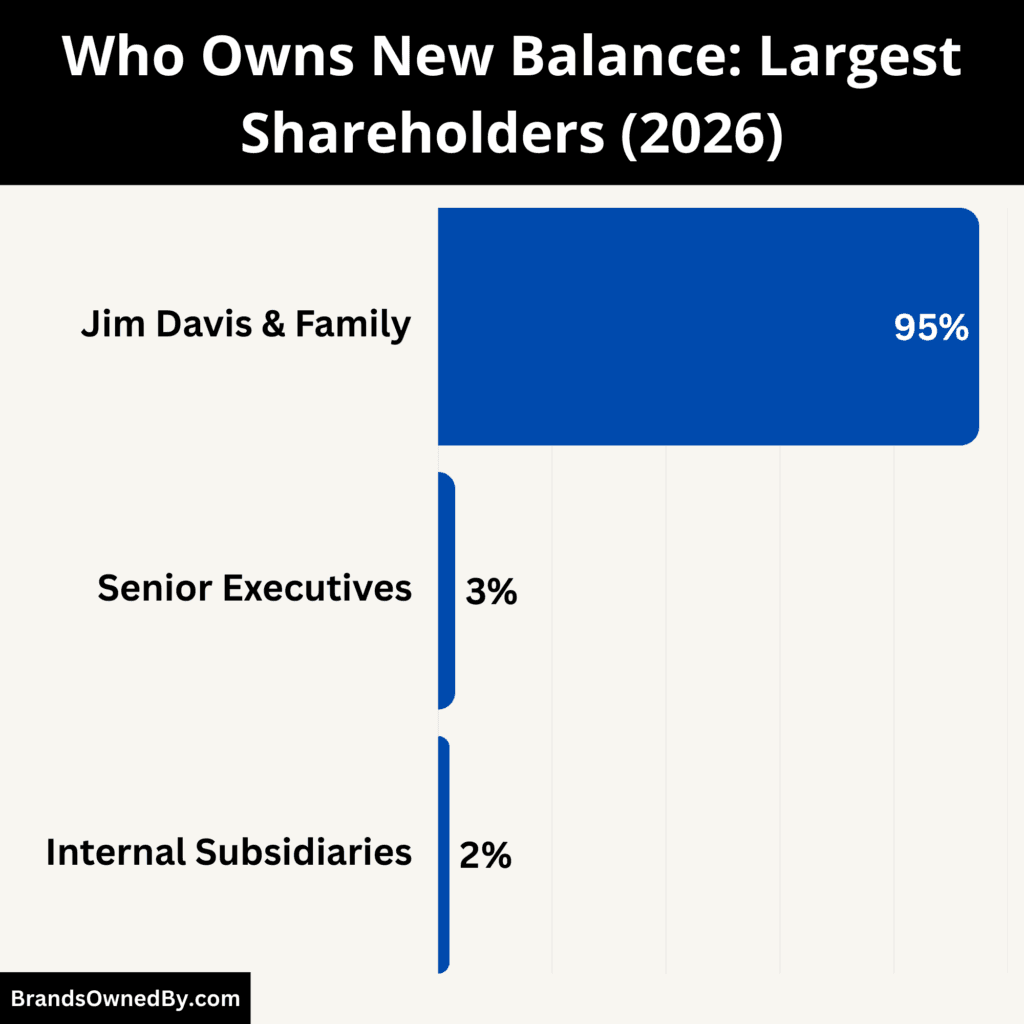
New Balance is a privately held American corporation primarily owned by billionaire businessman Jim Davis and his family. Unlike publicly traded competitors, New Balance has no public shareholders. Operational leadership is headed by President and Chief Executive Officer Joe Preston, while Jim Davis serves as Chairman and Anne Davis serves as Vice Chairman, maintaining majority family control over company equity.
Private Ownership Model: The Davis Family Shareholding
New Balance Athletics, Inc. operates under a private ownership structure, distinguishing it from major athletic footwear and apparel competitors like Nike, Adidas, and Puma. The business is privately held, meaning its stock does not trade on public exchanges such as the New York Stock Exchange (NYSE) or NASDAQ. Consequently, the company is not subject to institutional shareholder mandates, hostile takeover bids, or the quarterly earnings performance pressures typical of publicly traded enterprises.
The foundational ownership architecture of modern New Balance was established in 1972. On the day of the Boston Marathon that year, James S. "Jim" Davis purchased the company—then a small, six-person shoemaking operation founded in 1906 by William J. Riley—for approximately $100,000. Under Davis’s direction, along with his wife Anne Davis, who joined the business in 1978, New Balance expanded into a global footwear and athletic equipment conglomerate.
- Davis Family (Majority Owners)
- New Balance Inc. (Parent Entity)
- New Balance Athletics (Operating Corp)
- Warrior Sports (Equipment/Lax)
- Domestic Manufacturing (USA & UK Facilities)
- Global Operations (EMEA, APAC, LatAm)
- New Balance Athletics (Operating Corp)
- New Balance Inc. (Parent Entity)
Because New Balance remains privately held, exact shareholder percentages are not mandated for public release via U.S. Securities and Exchange Commission (SEC) filings. However, business registries, legal filings, and financial reports confirm that the Davis family holds the overwhelming majority of voting stock and equity. Institutional asset management firms such as Vanguard, BlackRock, or State Street—which typically own massive equity blocks in public footwear giants—hold no stock in New Balance.
This concentration of equity gives the Davis family total governance authority. Key strategic advantages of this private shareholding structure include:
- Long-Term Capital Allocation: Freedom to invest heavily in long-term projects, such as domestic manufacturing facilities, without justifying immediate profit margin compression to Wall Street analysts.
- Corporate Identity Autonomy: Ability to maintain proprietary production models (such as the "Made in USA" and "Made in UK" manufacturing initiatives) even when offshore production might yield higher short-term gross margins.
- Agile Governance: A simplified board structure that allows rapid capital deployments, brand repositioning, and strategic athletic sponsorships without public proxy votes or activist shareholder intervention.
Executive Leadership and Corporate Governance
While the Davis family maintains top-level governance through the Board of Directors, day-to-day managerial responsibility rests with an executive management team led by long-time industry veteran Joe Preston.
- Jim Davis (Chairman) & Anne Davis (Vice Chair)
- Joe Preston (President & CEO)
- Finance & Ops (CFO & COO Team)
- Product & Marketing (Design & Merch)
- Commercial Operations (Regional Presidents)
- Joe Preston (President & CEO)
Key Executive Leadership Roles
- Jim Davis (Chairman): Serves as Chairman of the Board. Davis established the brand’s core business philosophy of technical fit, multi-width sizing, and domestic production. His role centers on long-term strategy, corporate governance, and capital oversight.
- Anne Davis (Vice Chairman): Co-led executive management alongside Jim Davis for decades, establishing internal corporate culture, organizational development, and community initiatives. She continues to shape board-level decisions.
- Joe Preston (President & Chief Executive Officer): Promoted to CEO in late 2018 (taking full executive command in 2019), Preston began his career at New Balance in 1995 as Senior Product Manager for Running. Over three decades, he led global marketing, international commercial operations, and brand management before assuming chief executive duties. Preston directs global expansion, digital commerce strategy, and retail partnership models.
- Executive Leadership Team: Includes senior vice presidents overseeing global operations, finance, product innovation, brand marketing, supply chain, and human resources. This leadership operationalizes global strategies across North America, Europe, Asia-Pacific, and Latin America.
Corporate Structure and Subsidiary Entities
New Balance Athletics, Inc. operates as the primary operational entity of the business. It is structured as a parent enterprise with specialized functional operating divisions and wholly owned subsidiaries spanning athletic hardware, lifestyle products, and apparel manufacturing.
- New Balance Athletics, Inc. (Global Corporate HQ: Boston, MA)
- Domestic Footwear Mfg
- Boston, MA
- Lawrence, MA
- Methuen, MA
- Norridgewock, ME
- Skowhegan, ME
- Warrior Sports, Inc.
- Lacrosse Hardware
- Hockey Equipment
- Team Apparel
- Specialized Distribution
- Global Commercial Subsidiaries
- New Balance Europe (UK)
- New Balance Japan
- New Balance China
- New Balance Australia
- Domestic Footwear Mfg
Headquarters and Regional Operating Centers
The global corporate headquarters is situated in Boston, Massachusetts, within the "Landing at Boston Landing" development complex in Brighton. This campus houses corporate management, research and development design laboratories, digital commercial hubs, and the flagship Sports Research Lab. Regional corporate centers exist worldwide:
- North America: Boston, Massachusetts (Global Headquarters and Innovation Hub).
- Europe, Middle East, and Africa (EMEA): Warrington, United Kingdom, coordinating regional marketing, compliance, and logistics across European markets.
- Asia-Pacific (APAC): Regional operating entities in Tokyo, Japan, and Shanghai, China, managing market-specific product adaptations, retail networks, and regional sponsorships.
Key Portfolio Subsidiaries and Historical Acquisitions
Over its corporate history, New Balance has acquired and divested complementary athletic brands to diversify its product portfolio:
- Warrior Sports: Acquired by New Balance in 2004, Warrior Sports is a major subsidiary operating out of Warren, Michigan. It designs and manufactures ice hockey and lacrosse equipment, apparel, and footwear. Warrior operates as a specialized team-sports unit within the parent entity.
- PF Flyers (Historical): Acquired by New Balance in 2003 to capture heritage canvas footwear market share. In 2021, New Balance sold the PF Flyers brand to Kassia Davis (founder of Renewed Brands), transferring ownership outside of the main New Balance corporate structure.
- Brine (Historical Integration): Acquired in 2006 to expand presence in soccer, field hockey, and lacrosse. Key assets and product categories from Brine were later integrated into Warrior Sports and main corporate brand operations.
New Balance vs. Publicly Traded Competitors
Understanding New Balance’s equity model requires evaluating how its private governance contrasts with the public capital market structures of its principal competitors.
| Metric / Governance Dimension | New Balance Athletics, Inc. | Nike, Inc. | Adidas AG | Puma SE |
|---|---|---|---|---|
| Ownership Structure | Privately Held | Publicly Traded | Publicly Traded | Publicly Traded |
| Primary Stock Exchange | None (Private) | NYSE (NKE) | XETRA (ADS) | XETRA (PUM) |
| Major Shareholders | Jim & Anne Davis (~Majority Equity) | Vanguard Group, BlackRock, Phil Knight / Travis Knight Trusts | Institutional Investors (Free Float ~80%+), Groupe Artémis | Kering / Groupe Artémis (Historical majority), Institutional Free Float |
| Board Oversight Focus | Family Continuity & Brand Legacy | Quarterly EPS, Institutional Returns | Quarterly Earnings, Global Shareholder Value | Operating Margins, Institutional Dividends |
| Manufacturing Footprint | Offshore + Dedicated Domestic (USA/UK) | Heavily Offshore (Asia-focused contract factories) | Heavily Offshore (Asia-focused contract factories) | Heavily Offshore (Asia-focused contract factories) |
| SEC Reporting Obligation | None (Privately disclosed revenue) | Quarterly 10-Q & Annual 10-K Filings | Annual / Semi-Annual IFRS Reporting | Annual / Semi-Annual IFRS Reporting |
Financial Accountability and Capital Strategy Differences
Publicly traded shoe companies must publish detailed financial statements audited under strict public regulatory regimes, disclosing gross margins, marketing budgets, regional revenues, and share repurchase programs.
As a private company, New Balance is not required to publish audited balance sheets, income statements, or executive compensation details to the general public. While the leadership team periodically discloses top-line annual global sales figures—reflecting steady expansion over the past decade—it retains discretion over internal capital allocation.
This enables New Balance to undertake capital-intensive, lower-margin ventures, such as expanding domestic U.S. footwear factories, without risking equity sell-offs from institutional investors seeking maximum immediate profit margins.
Manufacturing Infrastructure and Operational Strategy
A defining feature of New Balance's corporate identity and operational structure is its commitment to domestic manufacturing. While the vast majority of global athletic shoe companies completely outsourced assembly to contract factories in Asia by the late 20th century, New Balance preserved internal manufacturing capacity in New England and northern England.
- New Balance Global Production Model
- Owned Domestic Assembly (High-Skill, High-Priced Lines)
- 5 New England Factories (USA)
- Boston, Lawrence, Methuen, Norridgewock, Skowhegan
- 1 Cumbria Factory (UK)
- Flimby Plant
- 5 New England Factories (USA)
- Offshore Contract Supply (Mass Volume & Performance Lines)
- Vietnam Contract Partners
- China Contract Partners
- Indonesia Contract Partners
- Global Material Suppliers
- Owned Domestic Assembly (High-Skill, High-Priced Lines)
Domestic Manufacturing Facilities
New Balance owns and operates five manufacturing facilities across New England:
- Boston, Massachusetts: Located near corporate headquarters, functioning as an assembly and manufacturing innovation facility.
- Lawrence, Massachusetts: Focuses on premium footwear manufacturing, lifestyle lines, and custom athletic builds.
- Methuen, Massachusetts: Serves as a key production component hub.
- Norridgewock, Maine: Specialized in high-volume domestic assembly and leather cutting operations.
- Skowhegan, Maine: Dedicated to upper stitching, lasting, and sole attachment for "Made in USA" lines.
In addition to its American facilities, New Balance operates a dedicated factory in Flimby, Cumbria, United Kingdom. The Flimby facility handles the manufacturing of premium "Made in UK" lines, distributing lifestyle and running footwear across European, Asian, and North American markets.
Supply Chain Balance: Domestic vs. Offshore Production
New Balance operates a dual supply chain model:
- Domestic "Made in USA / Made in UK" Operations: Footwear labeled "Made in USA" contains a domestic value of 70% or more, adhering to Federal Trade Commission (FTC) standard guidelines. These lines target high-end running enthusiasts and lifestyle consumers willing to pay a premium price point for specialized craftsmanship.
- Global Offshore Manufacturing: For mass-market technical performance running models and high-volume lifestyle silhouettes, New Balance partners with audited contract manufacturers across Asia, primarily in Vietnam, China, and Indonesia. This dual strategy balances brand identity with global volume demands.
Frequently Asked Questions
Is New Balance a publicly traded company?
No, New Balance is a privately held corporation. Its stock is not listed on any public stock exchange, and its equity is predominantly held by Jim Davis and the Davis family.
Who is the current CEO of New Balance?
Joe Preston is the President and CEO of New Balance. He was appointed to the position in late 2018 (taking effect in 2019) after serving in various leadership roles within the company since 1995.
Does Nike, Adidas, or another footwear giant own New Balance?
No. New Balance is entirely independent and is not owned by Nike, Adidas, Puma, or any parent multi-brand luxury conglomerate. It operates as an autonomous enterprise headquartered in Boston, Massachusetts.
What brands are currently owned by New Balance?
New Balance Athletics, Inc. owns its core brand divisions alongside Warrior Sports, a specialist manufacturer of ice hockey and lacrosse equipment. Historical holdings such as PF Flyers have been divested.
How does New Balance's private ownership affect its product pricing?
Private ownership allows New Balance to reinvest capital into higher-cost domestic manufacturing facilities (such as its "Made in USA" and "Made in UK" plants) without pressure from public shareholders to maximize margins. This leads to distinct product tiers, ranging from mass-produced offshore lines to higher-priced domestically assembled collections.
Navigating New Balance Corporate and Market Data
For researchers, industry analysts, legal professionals, and journalists examining New Balance's enterprise governance, traditional SEC tools like Form 10-K or Form 10-Q are unavailable due to the company's private status. To perform accurate corporate analysis:
- Utilize Official Corporate Communications: Review press updates, executive announcements, and sustainability reports directly from the New Balance Newsroom for official operational statements.
- Cross-Reference State Registry Filings: Examine corporate registration records filed with the Corporations Division of the Secretary of the Commonwealth of Massachusetts for corporate entity listings, registered agent addresses, and board filings.
- Evaluate Trade and Patent Databases: Assess innovation velocity, product development trends, and proprietary technologies through the United States Patent and Trademark Office (USPTO) by searching assigned trademarks and design patents held under New Balance Athletics, Inc.