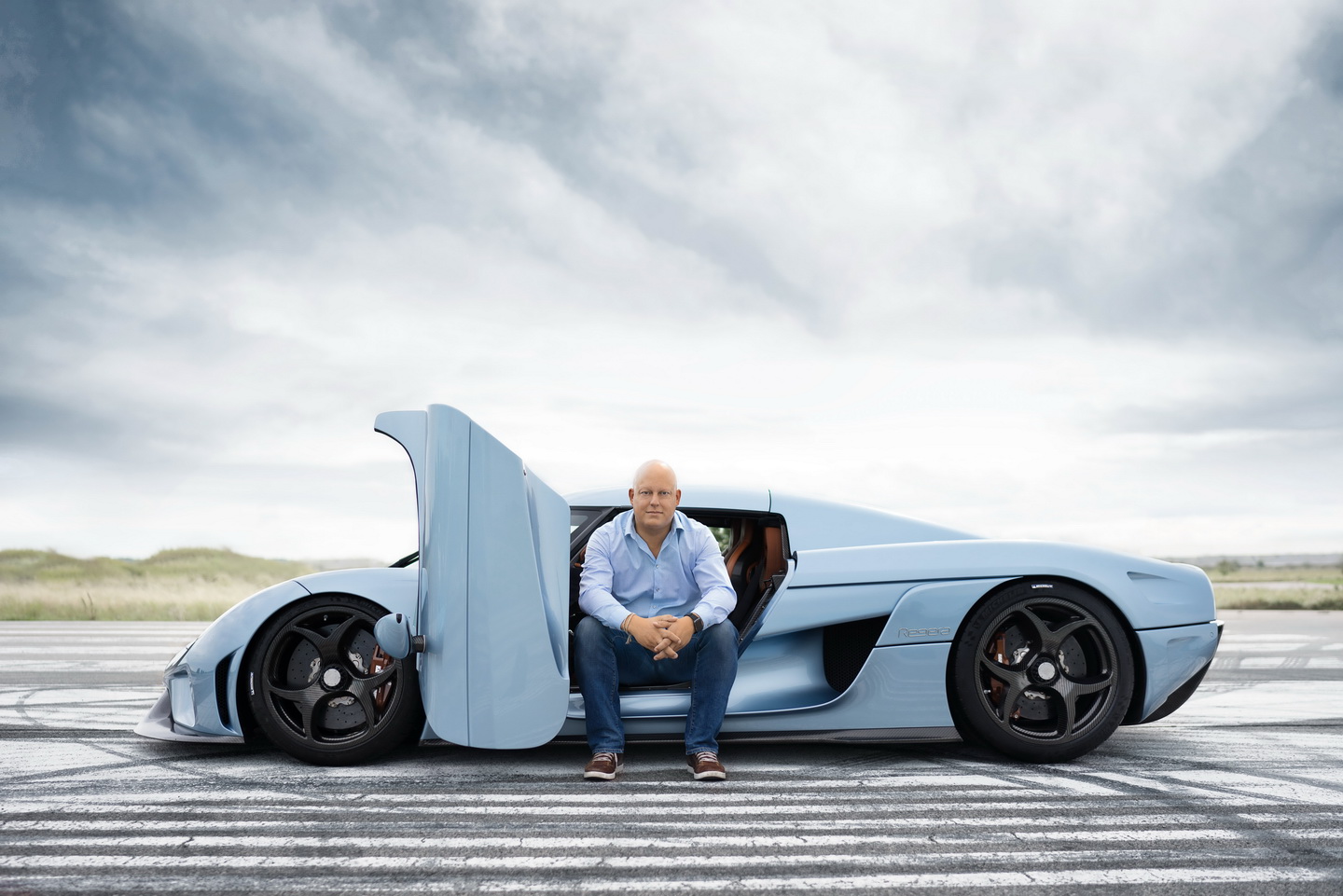
Koenigsegg Automotive AB is majority-owned and controlled by its founder, Christian von Koenigsegg, and his family through their primary holding company, Alpraaz AB. Although external entities—most notably National Electric Vehicle Sweden (NEVS)—held temporary minority stakes in recent years, Christian von Koenigsegg repurchased full ownership of the core automotive manufacturing business, maintaining the company's fierce corporate independence and engineering autonomy.
Core Ownership: Christian von Koenigsegg and Alpraaz AB
At the center of Koenigsegg’s corporate hierarchy sits Alpraaz AB, a Swedish private holding company registered in Ängelholm, Sweden. Alpraaz AB acts as the parent holding entity through which Christian von Koenigsegg and his wife, Halldora von Koenigsegg (who serves as Chief Operating Officer), exercise majority voting control and ultimate equity ownership over the broader Koenigsegg enterprise.
Unlike mass-market luxury automakers operating as subsidiaries of massive corporate conglomerates—such as Bugatti (owned by the Bugatti Rimac joint venture), Lamborghini (Volkswagen Group via Audi), or Ferrari (publicly traded under Exor equity influence)—Koenigsegg retains a unique, founder-led corporate structure. This structural independence permits the business to allocate immense financial capital toward experimental research and development (R&D) without answering to public shareholders or quarterly margin pressures typical of publicly traded automotive corporations.
Christian von Koenigsegg serves as the Chief Executive Officer and principal visionary, holding significant personal equity alongside strategic family trusts held within Alpraaz AB. The board of directors and executive leadership team remain tightly integrated with everyday operations at the company’s headquarters in Valhall Park, Ängelholm.
The Historical Evolution of Koenigsegg Shareholding
Understanding who owns Koenigsegg today requires examining how the company’s equity structure evolved from its founding in 1994 through high-profile equity investments and subsequent buybacks.
Founding and Early Capital Raising (1994–2018)
When 22-year-old Christian von Koenigsegg established Koenigsegg Automotive in 1994, funding was secured through personal assets, private angel investments from Swedish business networks, and government innovation grants. Throughout the production of early models—such as the CC8S, CCR, CCX, and Agera—Koenigsegg maintained a small circle of private Swedish and Scandinavian investors. Voting rights were structured carefully to ensure Christian retained direct creative and operational command over vehicle development.
The 2019 NEVS / Evergrande Investment Deal
In January 2019, Koenigsegg executed a major strategic transaction to fund aggressive commercial expansion and modern production facilities. National Electric Vehicle Sweden (NEVS)—a Swedish EV manufacturer then owned by China's Evergrande Health Industry Group—acquired a 20% minority stake in Koenigsegg Automotive AB for €150 million (approximately $170 million USD at the time).
Simultaneously, the two companies formed a joint venture called Menapi AB (with Koenigsegg holding 65% and NEVS holding 35%) aimed at developing high-volume, electrified hypercars—a collaboration that laid early technical groundwork for the four-seater Gemera megacar.
Equity Buyback and Full Operational Control
The financial instability of NEVS's parent company, China Evergrande Group, prompted Koenigsegg to restructure its corporate alliances. Recognizing the need to shield its core brand and technology from external liquidations, Koenigsegg negotiated a deal to buy back NEVS’s 20% minority stake in Koenigsegg Automotive AB.
By late 2021, Koenigsegg successfully completed the equity buyback, re-establishing 100% ownership of its automotive manufacturing division under Alpraaz AB and associated family-controlled holding vehicles. This strategic buyout consolidated full patent rights, manufacturing assets, and commercial intellectual property back into Swedish hands.
Breaking Down the Koenigsegg Group Corporate Structure
The broader Koenigsegg group is organized into specialized corporate entities designed to segregate commercial automobile manufacturing from specialized technology licensing and advanced engineering services.
- Alpraaz AB (Ultimate Family Holding Entity)
- Koenigsegg Automotive AB (Operational & Production Hub)
- Freevalve AB (Camless Tech)
- Koenigsegg Advanced Eng.
- Strategic R&D / Joint Ventures
- Koenigsegg Automotive AB (Operational & Production Hub)
1. Alpraaz AB (Parent Holding Entity)
Alpraaz AB is the apex entity of the Koenigsegg corporate matrix. It serves strictly as an asset management and holding company, owning the controlling shares of the operational subsidiaries. It acts as the financial vault for intellectual property, brand trademarks, and long-term corporate governance.
2. Koenigsegg Automotive AB (Main Operational Entity)
Registered under Swedish organization number 556574-7006, Koenigsegg Automotive AB is the primary operating company responsible for the design, development, hand-assembly, and global sales of Koenigsegg hypercars (such as the Jesko, Gemera, and CC850). It employs the vast majority of the company's workforce across design, carbon-fiber fabrication, engine building, and final assembly at Valhall Park.
3. Freevalve AB
Freevalve AB is a technology subsidiary tied directly to Koenigsegg’s innovation arm. Freevalve focuses on developing electro-hydraulic-pneumatic actuator technology that eliminates traditional overhead camshafts in internal combustion engines. This "camless engine" technology allows independent digital control over each intake and exhaust valve, vastly increasing thermal efficiency, reducing emissions, and boosting engine output.
4. Koenigsegg Advanced Engineering (KAE)
Operating as a specialized business unit within the corporate structure, Koenigsegg Advanced Engineering commercializes the company's proprietary technology for external original equipment manufacturers (OEMs). KAE offers engineering consultancy, high-density electric motor technology, carbon-fiber structural integration, and inverter tech (such as the proprietary David silicon carbide inverter) to third-party aerospace, defense, and high-performance mobility companies.
Entity Overview and Corporate Ownership Breakdown
The following table summarizes the key legal entities, ownership status, and functional duties within the Koenigsegg enterprise:
| Entity Name | Primary Ownership / Control | Headquarter Location | Operational Role |
|---|---|---|---|
| Alpraaz AB | Koenigsegg Family (Majority) | Ängelholm, Sweden | Parent holding company; corporate governance & strategy |
| Koenigsegg Automotive AB | 100% owned by Alpraaz AB / Koenigsegg Group | Ängelholm, Sweden | Hypercar design, manufacturing, chassis assembly, & marketing |
| Freevalve AB | Majority Koenigsegg Group ownership | Ängelholm, Sweden | Research & development of camless internal combustion technology |
| Koenigsegg Advanced Engineering | Business Division of Koenigsegg Automotive AB | Ängelholm, Sweden | B2B technology licensing, electrification component supply |
| Menapi AB (Historical JV) | Koenigsegg (65%) / NEVS (35%) (Restructured) | Ängelholm, Sweden | Project vehicle development entity for joint powertrain research |
Strategic Independence and the In-House Innovation Model
Koenigsegg’s ownership structure directly shapes its technical philosophy. Most luxury supercar manufacturers rely on existing platform hardware, crate engines, or off-the-shelf transmission systems supplied by major parent corporations. Koenigsegg’s corporate independence forces—and enables—the company to engineer nearly every critical component in-house.
Vertical Integration and IP Ownership
By maintaining complete equity control over Koenigsegg Automotive AB, Christian von Koenigsegg ensures that all intellectual property remains owned directly by the company. Key in-house innovations include:
- The Light Speed Transmission (LST): A nine-speed, multi-clutch transmission engineered without a traditional clutch pedal, enabling instant gear shifts between any ratio.
- Quark E-Motor & Terrier Drive Unit: Ultra-compact, high-power-density electric motors utilizing radial-axial flux topology (dubbed Raxial Flux).
- Carbon Fiber Wheels & Monocoques: Hollow-space carbon fiber production (Aircore technology) manufactured in-house to exact aerospace standards.
Because the Koenigsegg family does not have to seek approval from external parent-company boards to pursue radical engineering concepts, the brand can rapidly prototype and commercialize extreme automotive concepts that larger corporate entities reject as financially risky.
How to Verify Koenigsegg’s Corporate Filings
Because Koenigsegg Automotive AB and Alpraaz AB are registered limited liability companies in Sweden (Aktiebolag), their corporate ownership, annual financial returns, executive board compositions, and official share capital are publicly documented under Swedish law.
Researchers, financial analysts, and corporate investigators can verify Koenigsegg's corporate data through official regulatory bodies:
- Bolagsverket (Swedish Companies Registration Office): The official government agency maintaining the Swedish enterprise register. Searches for Koenigsegg Automotive AB (Org.nr 556574-7006) or Alpraaz AB yield public filings detailing board members, managing directors, and submitted financial reports. Official filings can be accessed via the Bolagsverket official portal.
- Allabolag.se: A recognized Swedish financial aggregator that compiles audited annual reports (årsredovisningar), revenue growth figures, and corporate balance sheets for registered Swedish entities. Financial summaries for Koenigsegg are searchable directly through Allabolag.
Frequently Asked Questions About Koenigsegg’s Ownership
Does the Volkswagen Group own Koenigsegg?
No. The Volkswagen Group has never owned Koenigsegg. While Volkswagen has owned or controlled high-performance luxury brands like Bugatti, Lamborghini, and Porsche, Koenigsegg has remained an independent Swedish manufacturer led by Christian von Koenigsegg.
Is Koenigsegg a publicly traded company on the stock market?
No. Neither Koenigsegg Automotive AB nor its parent entity Alpraaz AB is listed on any public stock exchange. Koenigsegg is a privately held corporation, shielding it from hostile takeovers and public market volatility.
Did Evergrande or NEVS acquire Koenigsegg?
No. National Electric Vehicle Sweden (NEVS)—which was owned by Evergrande—purchased a temporary 20% minority stake in Koenigsegg Automotive AB in 2019. Koenigsegg subsequently repurchased that 20% stake, restoring complete ownership of its car manufacturing operations to the Koenigsegg group.
Where are Koenigsegg hypercars manufactured?
All Koenigsegg vehicles are engineered, hand-built, and tested at the company’s headquarters located at Valhall Park in Ängelholm, Sweden. The site was formerly the home of the Swedish Air Force's F 10 Ängelholm fighter jet squadron, which inspired Koenigsegg's iconic "Ghost" insignia.
Summary of Koenigsegg’s Corporate Standing
Koenigsegg Automotive AB operates under a private ownership structure anchored by founder Christian von Koenigsegg, his family, and executive management through the primary holding company Alpraaz AB. By repurchasing minority shares previously held by external corporate partners like NEVS, Koenigsegg has preserved its long-term corporate independence, intellectual property security, and unique freedom to pioneer hypercar engineering.
Investors, researchers, and automotive analysts seeking up-to-date corporate governance records should consult official filings submitted to Bolagsverket to monitor ongoing shareholding structures and annual financial statements.