During the 2025-26 season, the average NHL player earns approximately $3.5 million to $4 million annually, though this figure is heavily skewed by elite stars. The league minimum for the 2025-26 season is strictly set at $775,000, while top-tier players frequently command annual cap hits exceeding $11 million to $13 million.
The NHL Salary Cap and Economic Climate in 2025
The financial landscape of the National Hockey League reached a significant milestone in 2025. Following years of stagnant growth caused by the repayment of the "COVID debt" to league owners, the salary cap for the 2025-26 season surged to $92.5 million. This represents a substantial increase from the $88 million ceiling seen in 2024, providing franchises with unprecedented breathing room to sign free agents and extend core players.
The salary cap is dictated by the Collective Bargaining Agreement (CBA) between the NHL and the NHLPA (National Hockey League Players’ Association). The system is designed as a "hard cap," meaning teams cannot exceed the upper limit except through specific exceptions like Long-Term Invisible Reserve (LTIR). Because the cap is tied to Hockey Related Revenue (HRR), the league's success in securing new media deals, jersey sponsorships, and expanded playoff formats directly correlates to player paychecks.
In 2025, we are seeing the direct results of this revenue growth. Teams that were previously "cap-strapped" are now able to accommodate multiple players with eight-figure salaries. This has also shifted the "middle class" of the NHL, where reliable second-line forwards and top-four defensemen are now regularly signing contracts in the $5.5 million to $7 million range.
Minimum Salaries and the Entry-Level System
While the headlines focus on multi-million dollar deals, a significant portion of the league plays for the league minimum or close to it. For the 2025-26 season, the NHL minimum salary is $775,000. This floor is collectively bargained to ensure that even the 23rd man on a roster earns a professional wage reflecting the league's status as a premier global sports entity.
Younger players entering the league are subject to the Entry-Level Contract (ELC) system. All players under the age of 25 signing their first NHL contract must sign an ELC, the length of which is determined by their age at the time of signing. In 2025, the maximum base salary for an entry-level player remains capped at $950,000. However, these players can earn significantly more through performance bonuses.
Performance bonuses are categorized into "Schedule A" and "Schedule B" bonuses:
- Schedule A Bonuses: These are awarded for individual achievements such as ice time, goals (usually 20+), points, or making the All-Rookie team. These are capped at a total of $1 million.
- Schedule B Bonuses: These are larger rewards for elite performance, such as winning a major league award (like the Calder or Hart Trophy) or finishing in the top ten in league scoring.
When bonuses are fully realized, a top draft pick can have a "cap hit" of $950,000 but actually take home over $4 million in a single season. This system ensures that while rookies are "cheap" for team cap management, the highest-performing young stars are compensated for their immediate impact.
High-Value Contracts: The $10 Million Club
As of 2025, the elite tier of NHL compensation has expanded. The percentage of the cap that a single player can occupy is limited to 20%. With the 2025-26 cap at $92.5 million, the maximum individual salary permitted is $18.5 million. While no player has reached that absolute ceiling yet, the "internal" ceiling of the league has moved past the $12 million mark.
The shift toward signing bonuses has also changed how these high-value contracts are structured. Players like Auston Matthews and Nathan MacKinnon have pioneered contracts where the vast majority of the money is paid out in a lump sum on July 1st of each year. This provides the player with immediate access to capital for investment and serves as "lockout protection," as signing bonuses are generally guaranteed even if a season is shortened or canceled due to labor disputes.
Furthermore, the "Average Annual Value" (AAV) or "cap hit" is the most important number for fans to track. A player might sign a 7-year, $70 million deal, resulting in a $10 million AAV. However, the actual cash paid out in 2025 might be $12 million, while in 2028 it might drop to $8 million. This back-loading or front-loading is a common tactic used by GMs to balance their internal budgets.
Professional Salaries in the Minor Leagues (AHL and ECHL)
Professional hockey exists beyond the NHL, though the pay scales drop significantly once you leave the top flight. The American Hockey League (AHL) serves as the primary developmental circuit. Players in the AHL are often on "two-way" contracts.
A "two-way" contract specifies two different salary rates: one for when the player is in the NHL and another for when they are "assigned" to the AHL. For 2025, a player might earn $775,000 in the NHL but only $85,000 in the AHL. For veteran minor-leaguers or high-end prospects, "guaranteed" AHL salaries can reach between $250,000 and $500,000, though these are rarer and usually reserved for players a team views as critical depth.
Further down the ladder is the ECHL (formerly the East Coast Hockey League). In 2025, ECHL salaries remain modest. The weekly minimum salary for ECHL players is roughly $600 to $700 for rookies and slightly more for returning veterans. Most ECHL players earn between $15,000 and $30,000 for a full season. While the pay is low, the ECHL provides housing allowances and other perks to help players manage living expenses while pursuing a call-up to the AHL.
International Context: European League Earnings
For players who do not make the NHL, Europe offers a lucrative alternative. The Swiss National League (NL) and the Swedish Hockey League (SHL) are currently the highest-paying European circuits outside of the KHL (which has seen significant financial volatility in recent years).
In the Swiss NL, top imports (non-Swiss players) can earn between $200,000 and $400,000 USD tax-free, as many teams cover the players' tax liabilities and provide housing and vehicles. This makes a $300,000 Swiss contract comparable to a $600,000 NHL contract when factoring in the lower cost of living and lack of escrow.
The German DEL and Finnish Liiga offer slightly lower averages, with most top players earning between $80,000 and $200,000. For many North American professionals, the allure of a shorter schedule and the opportunity to live in Europe makes these leagues a viable career path if they are "stuck" in the AHL.
Net Pay: The Role of Escrow, Taxes, and Agent Fees
It is a common misconception that a "million-dollar player" takes home $1 million. The reality of professional hockey finances in 2025 involves several significant deductions that drastically reduce net income.
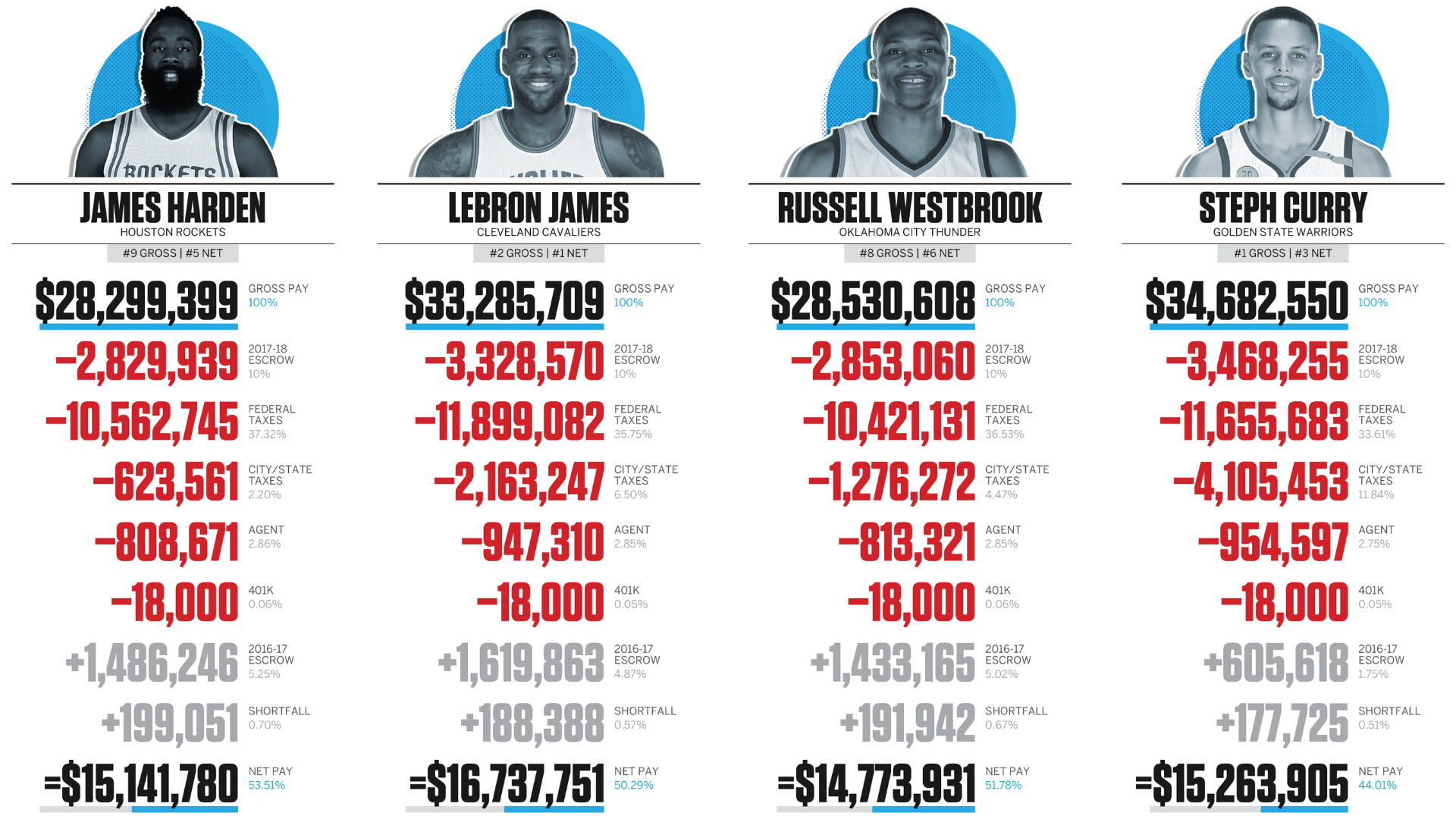
- Escrow: This is the most controversial aspect of NHL finances. To ensure a 50/50 revenue split between players and owners, a percentage of every player's paycheck is held in escrow. If league revenue falls short, the owners keep that money. In 2025, the escrow rate has stabilized at approximately 6% due to the new CBA MOU, which is a significant relief for players who saw double-digit escrow percentages in the early 2020s.
- Taxes: Players are taxed based on where they play. This includes the "jock tax," where players pay income tax in every state or province they play a game in. Players in Florida, Nevada, or Tennessee benefit from no state income tax on home games, which can result in a net gain of several hundred thousand dollars compared to players in high-tax jurisdictions like California or Ontario.
- Agent Fees: Standard agent fees in hockey range from 3% to 5% of the gross contract value.
- HPA Dues: Players pay dues to the NHLPA to fund the union's operations and legal protections.
2025-26 NHL Salary Benchmarks
| Category | Amount (USD) | Description |
|---|---|---|
| League Minimum Salary | $775,000 | The lowest amount an active NHL player can be paid. |
| Max Entry-Level Base | $950,000 | The ceiling for a rookie's base salary (pre-bonuses). |
| Team Salary Cap | $92.5 Million | The total limit a team can spend on its active roster. |
| Team Salary Floor | $66.5 Million | The minimum a team must spend to remain compliant. |
| Typical AHL Salary | $55k - $150k | Average range for players on two-way or AHL-only deals. |
| Top Star Cap Hit | $12.5M - $14.5M | The AAV for the league's top 1% of performers. |
Frequently Asked Questions
Do NHL players get paid in the playoffs?
NHL players do not receive their regular salary during the playoffs. Instead, the league creates a "playoff pool" which is distributed to teams based on how far they advance. For example, winning the Stanley Cup provides a larger pool for the team to split among players than losing in the first round. While these bonuses are significant for league-minimum players, they are often a fraction of a star player's daily regular-season rate.
How often are NHL players paid?
Players are typically paid twice a month during the regular season (October to April). They do not receive salary checks during the off-season, which is why signing bonuses—paid on July 1st—are so highly valued. If a player receives a $5 million signing bonus, they receive that lump sum at the start of the "league year," regardless of the upcoming season's schedule.
What happens to a player's salary if they are injured?
NHL contracts are fully guaranteed for skill and injury. If a player is injured during the course of their duties, they continue to receive their full salary. If the injury is long-term, the team may place them on Long-Term Injured Reserve (LTIR), which allows the team to exceed the salary cap by the amount of the injured player's cap hit to find a replacement.
Can a team lower a player's salary if they perform poorly?
No. Unlike the NFL, where contracts are often not fully guaranteed, NHL contracts cannot be restructured or reduced due to performance. A team's only recourse for a high-salary, low-performance player is to trade them, demote them to the minors (which only provides minor cap relief), or "buy them out" during specific summer windows. A buyout pays the player a portion of their remaining salary over twice the remaining length of the contract.
Are ECHL players part of the NHLPA?
No, ECHL players are represented by the Professional Hockey Players' Association (PHPA), which also represents AHL players. The NHLPA only represents players currently on an NHL roster or those on NHL contracts who have been "loaned" to minor league affiliates.
Strategic Financial Tracking for 2025
For fans and analysts looking to stay updated on these figures, the landscape changes daily based on "accrued cap space." Because the salary cap is calculated daily, teams that stay under the cap early in the season can "bank" that space, allowing them to trade for a player with a much higher salary at the trade deadline.
If you are tracking player earnings, it is essential to distinguish between Total Cash and Cap Hit. As we move through 2026, many of the large contracts signed in the 2024 and 2025 off-seasons will begin to shift in their cash delivery, even if the cap hit remains the same. Utilizing verified databases like PuckPedia or CapFriendly (or its successor platforms) is the best way to verify the exact structure of a contract, including "No-Move" or "No-Trade" clauses that often accompany high-salary deals to give players control over their careers.