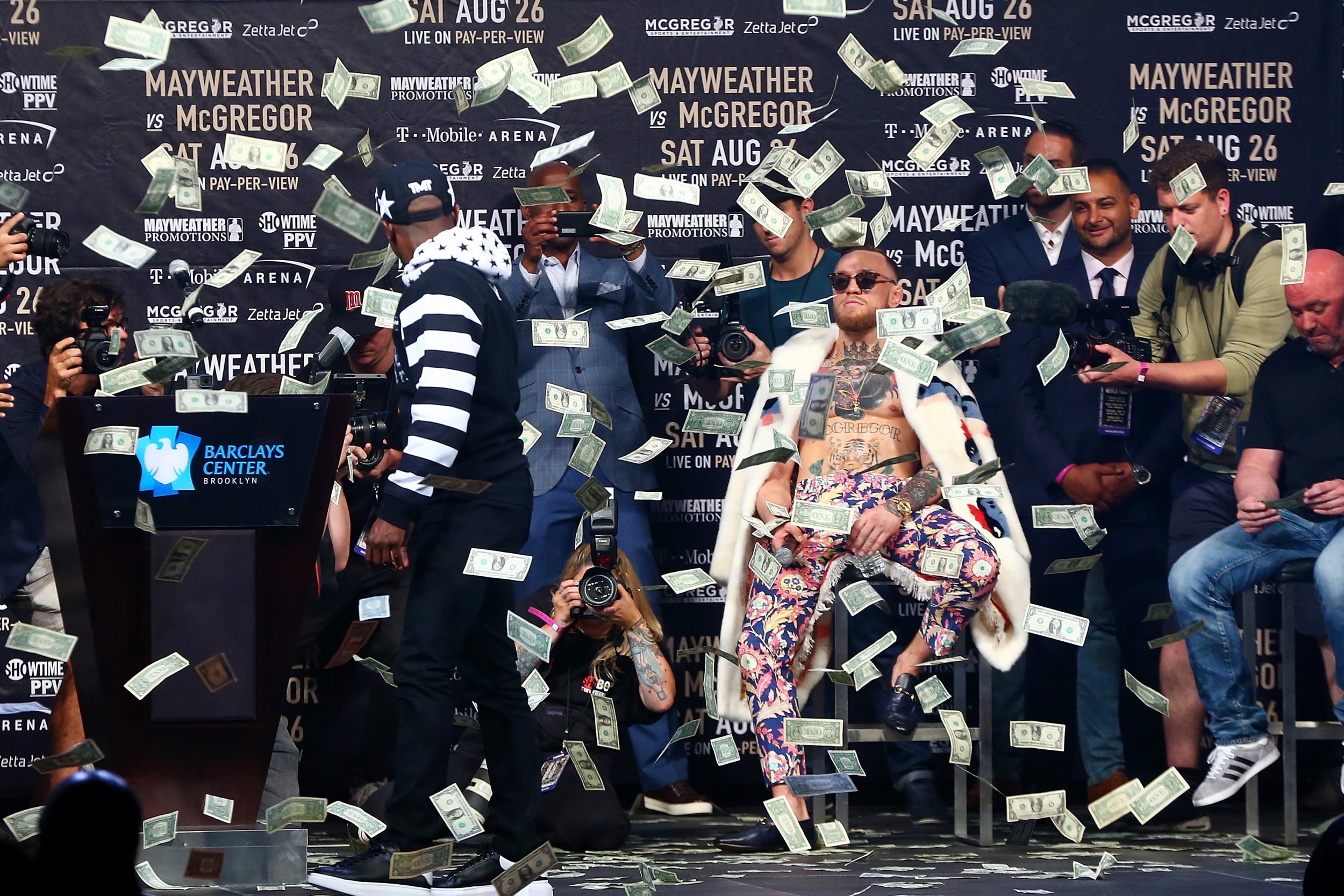
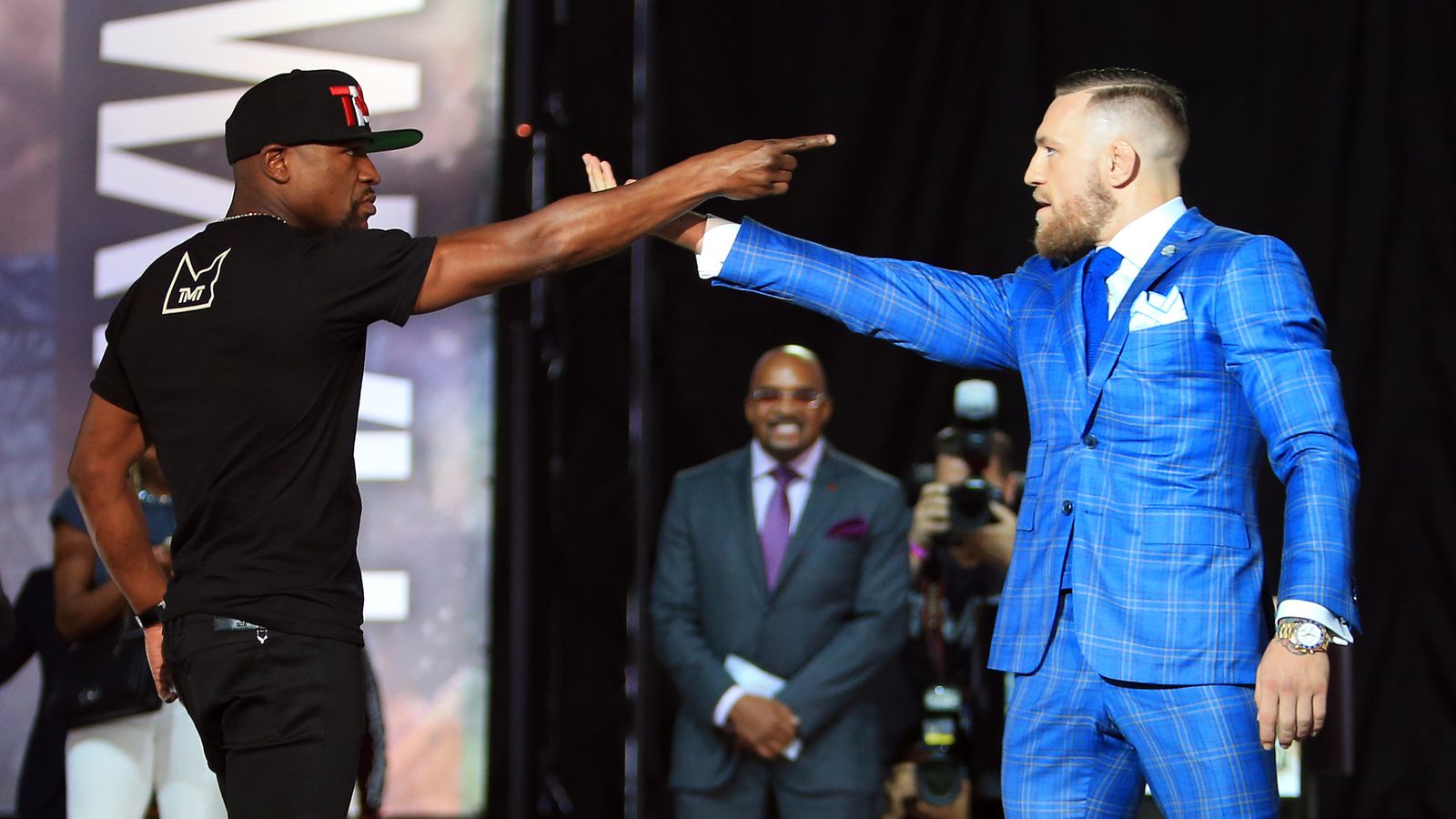
The August 26, 2017 boxing match between Floyd Mayweather Jr. and Conor McGregor generated over $600 million in total gross revenue. Official filings with the Nevada State Athletic Commission guaranteed Mayweather $100 million and McGregor $30 million upfront. However, after factoring in pay-per-view buys, live gate receipts, international broadcasting rights, and corporate sponsorships, Mayweather netted approximately $275 million to $300 million, while McGregor earned between $85 million and $100 million.
Baseline Guaranteed Purses vs. Post-Event Financial Realities
In professional combat sports, the headline figure submitted to state athletic commissions represents only the contractually guaranteed floor, not the fighter's actual compensation. Before any punches were thrown at the T-Mobile Arena in Las Vegas, the Nevada State Athletic Commission (NSAC) confirmed the official baseline purses: Floyd Mayweather Jr. was guaranteed $100 million, while Conor McGregor was guaranteed $30 million.
These baseline figures are established to satisfy legal obligations, escrow requirements, and sanctioning body fees. They serve as the minimum guaranteed payout regardless of the event's commercial success. For context, McGregor's guaranteed $30 million purse surpassed any previous Ultimate Fighting Championship (UFC) payout by a wide margin, while Mayweather’s $100 million baseline matched his base earnings from his 2015 bout against Manny Pacquiao.
However, high-profile mega-fights are structured heavily around backend revenue sharing. The ultimate earnings for both fighters expanded significantly beyond these baseline figures. The final compensation packages were heavily augmented by percentage dividends drawn from pay-per-view (PPV) sales, live ticket revenue, international television distribution deals, venue closed-circuit broadcasts, merchandise, and individual brand sponsorships.
Primary Revenue Drivers: PPV, Live Gate, and Global Broadcasting
To understand how baseline guarantees tripled for both fighters, it is necessary to examine the core revenue streams of the event, commonly dubbed "The Money Fight."
Pay-Per-View (PPV) Revenue
The dominant revenue generator was domestic pay-per-view sales. Distributed via Showtime Boxing in North America, the event was priced at $89.95 for standard definition and $99.95 for high definition.
- Domestic Buys: The fight achieved approximately 4.3 million domestic PPV buys in North America, making it the second-highest selling PPV event in combat sports history, trailing only Mayweather vs. Pacquiao (4.6 million buys).
- Gross Domestic PPV Revenue: Domestic PPV purchases alone grossed over $400 million.
Live Gate Receipts
While initial expectations aimed to surpass the record $72.2 million live gate of Mayweather vs. Pacquiao, ticket pricing adjustments were required closer to event night.
- Tickets Sold: According to official NSAC reports, 13,094 tickets were sold alongside 1,373 complimentary tickets.
- Gross Gate: The live gate generated $55,414,865.79, standing as the second-largest ticket gross in boxing history.
Sponsorships and Commercial Partnerships
Corporate sponsors paid unprecedented rates to align with the global media spectacle:
- Event Sponsorships: Craft beer brands, watchmakers, and fantasy sports platforms contributed an estimated $20 million to $25 million in combined title sponsorships.
- Ring & Apparel Real Estate: Mayweather reportedly charged individual brands up to $3.5 million to appear on his fight trunks, shoes, and ring corner pads.
Total Generated Event Revenue: ~$600 Million+
- Domestic PPV: ~$400 Million (4.3M buys @ ~$99.95)
- Live Gate: ~$55.4 Million (13,094 paid tickets)
- International Rights & Closed Circuit: ~$50 Million+
- Sponsorships & Merchandise: ~$30 Million+
Detailed Payout Breakdown and Revenue Distribution
The financial split between the two fighters was dictated by a confidential bout agreement signed prior to the promotional tour. While exact percentages remain bound by non-disclosure agreements, industry reporting and post-event financial disclosures confirm that Mayweather secured the dominant share of the revenue split, estimated between 70/30 and 75/25 in his favor across total backend revenues.
| Financial Metric | Floyd Mayweather Jr. | Conor McGregor | Total Event Metric |
|---|---|---|---|
| Guaranteed Base Purse (NSAC) | $100,000,000 | $30,000,000 | $130,000,000 |
| Estimated Backend PPV Share | ~$150,000,000 – $175,000,000 | ~$45,000,000 – $55,000,000 | ~$195,000,000 – $230,000,000 |
| Sponsorships & Personal Apparel | ~$25,000,000 | ~$10,000,000 – $15,000,000 | ~$35,000,000 – $40,000,000 |
| Estimated Total Gross Earnings | ~$275,000,000 – $300,000,000+ | ~$85,000,000 – $100,000,000+ | ~$600,000,000+ Gross |
| Domestic PPV Buys Supported | N/A | N/A | 4.3 Million Buys |
| Live Gate Contribution | N/A | N/A | $55,414,865.79 |
Note: The figures listed above reflect pre-tax earnings and pre-agent/promoter cuts.
Contractual Distribution Mechanics: Mayweather Promotions vs. UFC
The distribution of payouts differed substantially in structure for each fighter due to their respective promotional positions.
Floyd Mayweather’s Financial Structure
As the head of Mayweather Promotions and the primary executive promoter of the card alongside Showtime, Mayweather acted as both talent and event owner. This dual role allowed him to eliminate traditional promoter cuts.
Mayweather received direct dividends from every revenue stream:
- Gross PPV revenue after cable/satellite distributors took their standard ~50% cut.
- Direct percentages of the $55.4 million ticket gate.
- Revenue from closed-circuit venue broadcasts in Las Vegas theater properties.
- Foreign television distribution rights sold to over 200 territories.
- In-ring branding rights, including corner pads, victory caps, and shorts.
By avoiding third-party promotional fees, Mayweather captured the vast majority of the event's net profit margin, pushing his total payout past the $275 million mark.
Conor McGregor’s Financial Structure
McGregor’s revenue path was unique because he was under an exclusive contract with the Ultimate Fighting Championship (UFC). For McGregor to compete in a professional boxing match, the UFC, under parent company Endeavor, had to co-promote the event alongside Mayweather Promotions and Showtime.
Consequently, McGregor’s payout underwent internal corporate splits:
- The UFC Cut: The UFC served as a co-promoter and retained a contractual percentage of McGregor’s total earnings. While undisclosed, combat sports analysts estimate the UFC took roughly 20% to 30% of McGregor’s overall payout for licensing his contractual rights.
- McGregor Sports & Entertainment: McGregor established his own promotional entity, McGregor Sports & Entertainment, to claim co-branding rights, allowing him to feature his personal whiskey brand (Proper No. Twelve) prominently throughout the buildup and fight week broadcast.
- Net Personal Revenue: Despite the UFC's promoter cut, McGregor walked away with an estimated $85 million to $100 million gross, making it the single largest payday for an mixed martial artist in combat sports history.
Tax Liabilities, Sanctioning Body Fees, and Net Proceeds
Gross earnings figures do not account for mandatory deductions. Both fighters faced significant financial obligations before calculating their take-home income.
- Gross Earnings ($275M - $300M Mayweather / $85M - $100M McGregor)
- Federal Income Taxes (U.S. IRS: ~39.6% top marginal rate)
- State Taxes (Nevada has 0% state income tax)
- Sanctioning Fees & Athletic Commission Assessments
- Management, Coaching Staff, Training Camp, & Legal Fees
- Net Take-Home Pay
Federal Income Taxes (United States)
Because the event occurred in Las Vegas, Nevada, all earnings were subject to U.S. federal income tax laws. Nevada does not levy a state income tax, which saved both fighters millions compared to hosting the fight in states like California or New York.
- Federal Rate: At the time of the event in 2017, the top federal marginal income tax rate in the United States was 39.6%.
- Non-US Tax Implications: McGregor, an Irish citizen, was subject to U.S. withholding taxes on income earned within the United States, though foreign tax credits under international treaties helped mitigate double taxation upon transferring funds back to Ireland.
Regulatory and Commission Fees
The Nevada State Athletic Commission levies specific administrative and drug-testing fees. Additionally, professional bouts typically require sanctioning body fees paid to organizations such as the WBC, WBA, or IBF. However, because this was a custom 154-pound contest with the specially commissioned WBC "Money Belt," standard sanctioning body percentages (which can take up to 3% of a purse per belt) were reduced or waived.
Team and Management Commissions
Both athletes paid out substantial percentages to their supporting infrastructure:
- Training Camp Costs: Sparring partners, specialized nutritionists, head coaches, and conditioning coaches.
- Management & Legal: Typical management contracts range from 5% to 10% of total earnings, alongside substantial legal fees for negotiating complex multi-party agreements between Mayweather Promotions, Endeavor/UFC, and Showtime.
Frequently Asked Questions
What was Floyd Mayweather’s guaranteed purse for the McGregor fight?
Floyd Mayweather was guaranteed a baseline purse of $100 million, as filed with the Nevada State Athletic Commission. His total earnings exceeded $275 million after accounting for pay-per-view buys, live gate receipts, international broadcasting rights, and individual sponsorships.
How much did Conor McGregor make compared to his UFC fights?
Conor McGregor earned an estimated $85 million to $100 million for fighting Floyd Mayweather. By comparison, his highest disclosed base purse in the UFC prior to this bout was $3 million (at UFC 202 against Nate Diaz), though his total UFC payouts with PPV bonuses reached approximately $15 million to $20 million per fight. The Mayweather bout yielded roughly five times his largest UFC payday.
Did the UFC take a percentage of Conor McGregor’s payout?
Yes. Because McGregor was under an exclusive UFC contract, the promotion acted as a co-promoter for the event. While the exact contractual percentage remains confidential, industry reports indicate the UFC retained a co-promotional fee estimated between 20% and 30% of McGregor's total financial allocation.
How many pay-per-view buys did Mayweather vs. McGregor sell?
The event generated approximately 4.3 million pay-per-view buys in North America. This ranks as the second-highest domestic PPV buy rate in combat sports history, behind the 4.6 million buys recorded by Floyd Mayweather vs. Manny Pacquiao in 2015.
What was the total live gate revenue generated by the fight?
The live gate at the T-Mobile Arena in Las Vegas generated $55,414,865.79 from 13,094 paid ticket admissions. It stands as the second-highest grossing live gate in boxing history.
Key Takeaways for Evaluating Combat Sports Financial Models
Analyzing the payout structure of Mayweather vs. McGregor provides clear insight into how modern mega-fights operate at the elite financial level:
- Guaranteed Purses are Baseline Figures: Never evaluate a top-tier fighter's compensation solely by state athletic commission filings. Backend PPV dividends, global television syndication, and gate splits comprise the majority of the final payout.
- Promotional Ownership Drives Profit Margins: Floyd Mayweather’s ability to act as his own promoter allowed him to capture non-diluted dividends, doubling his base earnings. Athletes tied to promotional contracts (like McGregor with the UFC) must share backend margins with their parent organizations.
- Distribution Matters: Domestic PPV pricing ($99.95 HD) combined with massive international rights distribution transformed a single sporting event into a $600 million gross commercial enterprise.
For fans, fighters, and sports business analysts, the 2017 event established a financial blueprint for crossover combat sports events that continues to influence commercial combat sports negotiation structures today.