A lifestyle biography is a narrative format that prioritizes an individual's personal philosophy, daily rituals, and aesthetic choices over a strictly chronological account of historical events. Unlike traditional biographies that focus on "what" happened, a lifestyle biography explores the "how" and "why" behind a subject’s existence, serving as both a portrait and a practical blueprint for readers seeking inspiration.
Defining the Lifestyle Biography in the Modern Era
As we move through 2026, the definition of biography has expanded beyond the dusty, thousand-page tomes of political figures. The lifestyle biography has emerged as a dominant sub-genre within narrative non-fiction. At its core, this format seeks to capture the "essence" of a person’s life as it is lived in the present or was lived in the private spheres of the past. It is less concerned with the date of a subject’s first major promotion and more concerned with the morning routine that facilitated their productivity, the design of their living space, and the specific philosophies that govern their decision-making.
The shift toward this format reflects a broader cultural desire for actionable intimacy. Readers no longer just want to admire a figure from afar; they want to understand the mechanics of their success and the texture of their daily existence. A lifestyle biography functions as a hybrid between a memoir, a character study, and a self-optimization guide. It treats the subject's life as a curated work of art, examining the intersections of professional achievement and personal wellness.
To write or analyze a lifestyle biography effectively, one must look at the environmental narrative. This refers to how a person’s surroundings—their home, their office, their chosen geography—reflect their internal state. In 2026, this often includes a digital component, examining how a subject manages their "digital estate" and online presence as part of their total lifestyle.
The Core Pillars of a Lifestyle Narrative
A successful lifestyle biography is built upon four foundational pillars that distinguish it from standard biographical reporting. These pillars ensure the content remains relevant to a contemporary audience looking for depth rather than just data.
1. Ritual and Routine
The most granular level of a lifestyle biography is the study of habit. This involves documenting the subject's relationship with time. Does the subject practice deep work? What are their nutritional philosophies? How do they decompress? By detailing these rituals, the biographer provides a "human-scale" view of the subject. This approach humanizes even the most titanic figures, showing that greatness is often the result of small, repeated actions.
2. Aesthetic and Environment
Lifestyle is inherently visual and tactile. A biography in this niche must describe the subject’s "world-building." This includes their sartorial choices, their architectural preferences, and the objects they surround themselves with. In the context of 2026, where minimalism and "functional luxury" are frequent themes, the biographer analyzes whether the subject’s environment is a sanctuary, a laboratory, or a stage.
3. Philosophy and Values
Beyond the physical, the lifestyle biography explores the "operating system" of the individual. This involves identifying the core values—such as sustainability, stoicism, or radical transparency—that dictate how the subject interacts with the world. This pillar provides the intellectual weight that prevents the biography from becoming a mere list of possessions or habits.
4. Social and Relational Dynamics
No life is lived in a vacuum. This pillar examines the subject’s "tribe." It looks at the quality of their relationships, their mentorship style, and how they contribute to their community. In a lifestyle context, this often focuses on the art of hosting, the philosophy of friendship, and the balance between public service and private life.
Differentiating Lifestyle Biographies from Related Genres
It is easy to confuse a lifestyle biography with a memoir or a standard biography. However, the intent and structure are markedly different. A traditional biography is an objective, third-person account focused on historical impact. A memoir is a first-person account focused on a specific emotional journey or period of transformation.
A lifestyle biography, conversely, can be written in the first or third person but always maintains a focus on the "curation of life." It is designed to be an immersive experience. While a biography tells you about a person, a lifestyle biography invites you to live like them for the duration of the reading experience.
| Feature | Traditional Biography | Memoir | Lifestyle Biography |
|---|---|---|---|
| Primary Focus | Historical events & legacy | Personal growth & memory | Philosophy, habits & aesthetics |
| Structure | Chronological (Birth to Death) | Narrative/Thematic | Behavioral/Habitual |
| Reader Takeaway | Knowledge of historical facts | Emotional resonance/Empathy | Inspiration & lifestyle modeling |
| Tone | Objective & academic | Subjective & reflective | Aspirational & practical |
| Visual Element | Documentative (Archival photos) | Occasional personal photos | High-end photography/Art direction |
How to Construct a Compelling Lifestyle Biography
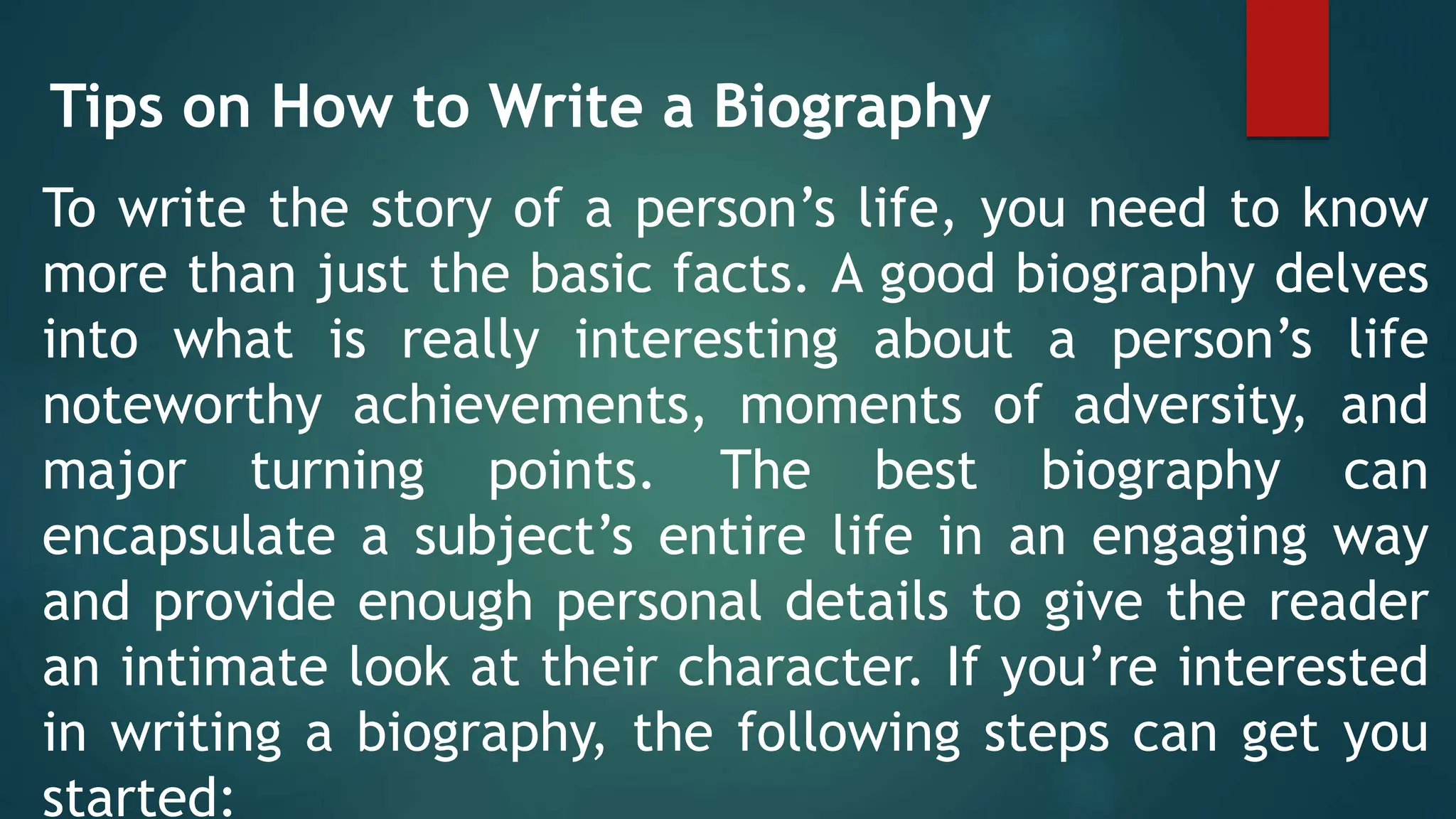
Writing a lifestyle biography requires a different toolkit than standard journalism. You must act as part historian, part psychologist, and part interior designer. The following steps outline the process of documenting a life through the lens of lifestyle.
Step 1: Identify the "Life Thesis"
Every subject has a central theme that runs through their choices. For some, it might be "The Pursuit of Quiet." For others, "Maximum Efficiency." Before writing, you must identify this thesis. Every habit, object, and story included in the biography should serve to illustrate this core theme. If a detail doesn't support the life thesis, it is likely extraneous to the lifestyle narrative.
Step 2: Conduct "Immersion Interviews"
Standard interviews often yield standard anecdotes. To capture lifestyle, you need to observe the subject in their natural habitat. Watch how they make coffee; observe their posture during a meeting; note the books on their nightstand. If the subject is historical, this involves "forensic lifestyle reporting"—analyzing their personal correspondence, receipts, and domestic inventories to reconstruct their daily world.
Step 3: Map the Temporal and Spatial Journey
Instead of a timeline of years, create a timeline of a "Typical Day." Then, map the "Sacred Spaces." Describe the office where the work happens and the garden where the reflection happens. Using sensory language—smell, texture, lighting—is crucial here. The goal is to make the reader feel the atmosphere of the subject's life.
Step 4: Balance Aspiration with Authenticity
In 2026, audiences are highly sensitive to "curated perfection" that feels fake. A lifestyle biography must include the "friction." What are the subject’s struggles with their routine? Where does their philosophy fail them? Including these elements makes the aspirational aspects feel attainable and real.
The Role of Visuals and Multimedia in 2026
In the current publishing landscape of 2026, a lifestyle biography is rarely just text. The "visual biography" has become a standard. This involves high-production photography that captures the subject’s environment in a way that words cannot. For digital editions, this may include embedded video snippets of the subject’s environment or audio cues that represent the "soundscape" of their life.
For those self-publishing a lifestyle biography—perhaps as a brand-building tool—the integration of aesthetic consistency is paramount. The font choice, the paper stock (for physical books), and the layout must all reflect the lifestyle being described. A biography of a minimalist should not have cluttered margins or flamboyant typography. The book itself becomes an artifact of the lifestyle it describes.
Ethical Considerations and the "Performance of Self"
A significant challenge in writing a lifestyle biography is navigating the line between reality and performance. When a subject knows they are being documented, they naturally tend to perform a "better" version of their life. As a writer or editor, your responsibility is to look past the performance to find the truth.
There is also the ethical question of "aspirational guilt." By presenting a highly optimized life, these biographies can sometimes make readers feel inadequate. To counter this, many modern lifestyle biographies (especially those published in 2025 and 2026) include a "Reality Check" section or a transparent look at the support systems—such as assistants, chefs, or cleaners—that make the subject's lifestyle possible. This transparency is essential for maintaining credibility with a sophisticated modern audience.
According to the Biographers International Organization, maintaining the integrity of the subject’s story while providing a compelling narrative is the hallmark of professional biographical work. This is particularly true in lifestyle writing, where the temptation to "sanitize" for the sake of an aesthetic is high.
Navigating the Future of Personal Narratives
As we look toward the latter half of the decade, the lifestyle biography is expected to become even more personalized. We are seeing the rise of "AI-curated biographies" where individuals use their own data—health metrics, calendar entries, and photo libraries—to generate lifestyle narratives for their families or followers.
However, the human element remains irreplaceable. The ability of a skilled writer to synthesize a person’s disparate habits into a cohesive philosophy is what gives a lifestyle biography its staying power. It is not just about the data of a life; it is about the poetry of a life.
FAQ
What is the difference between a lifestyle biography and a standard biography?
A standard biography focuses on a chronological account of major life events, public achievements, and historical impact. A lifestyle biography focuses on the internal and external "mechanics" of a person's life—their daily habits, personal philosophy, aesthetic choices, and the specific way they curate their environment and time.
Can a lifestyle biography be about a non-famous person?
Yes. In fact, many modern lifestyle biographies focus on "ordinary" individuals who have mastered a specific way of living, such as professional organizers, sustainable farmers, or master craftsmen. The value lies in the inspiration and methodology of their lifestyle rather than their fame.
How long should a lifestyle biography be?
While there is no fixed rule, most commercially published lifestyle biographies range from 60,000 to 80,000 words. However, because they often include heavy visual elements, the "page count" might be higher than a traditional book, often landing between 200 and 300 pages.
Is a lifestyle biography the same as a "coffee table book"?
Not necessarily. While many lifestyle biographies are visually beautiful and may resemble coffee table books, they contain much deeper narrative substance. A coffee table book is primarily visual; a lifestyle biography uses visuals to support a deep, analytical text about the subject’s life philosophy.
How do I start writing my own lifestyle biography?
Start by documenting your "Daily Architecture." Track your time for a week and note your recurring rituals. Identify the three core values that drive your decisions. From there, describe your environment and how it influences your mood and productivity. This collection of data forms the raw material for a lifestyle narrative.
Strategic Advice for Aspiring Biographers
When embarking on a lifestyle biography project, your primary goal should be utility through storytelling. Ask yourself: "What can the reader take away from this person's life to improve their own?" Even if the subject's life is vastly different from the reader's, the underlying principles—discipline, creativity, or resilience—should be universal.
Focus on the "sensory details" that other biographers miss. Mention the specific brand of ink a writer uses or the exact temperature at which a chef keeps their kitchen. These tiny details are the "DNA" of lifestyle. Finally, ensure that the structure of your narrative reflects the subject. If you are writing about someone whose life is defined by chaos and creativity, a rigid, chronological structure may feel dishonest. Match the form of the biography to the function of the life.