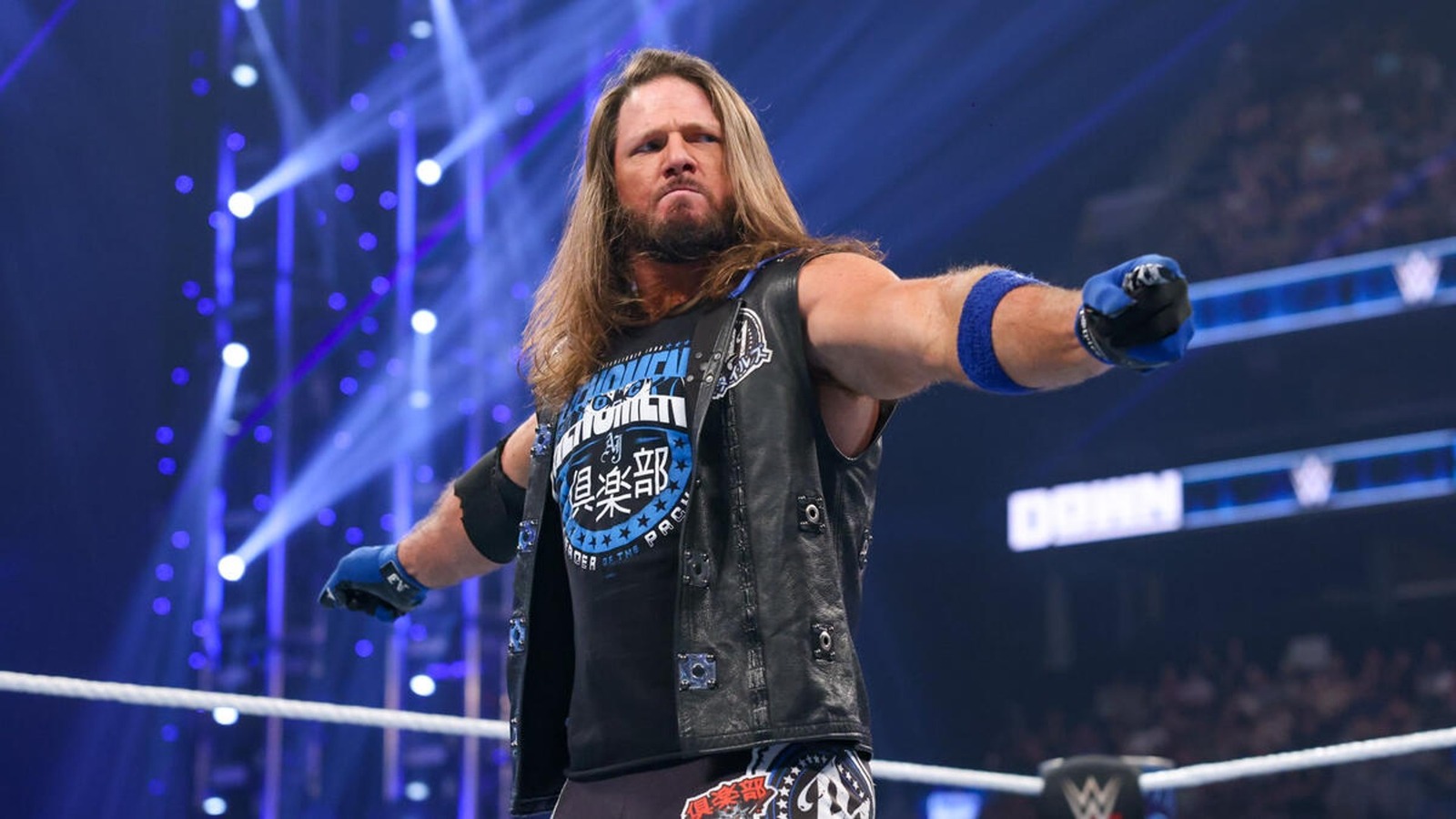
AJ Styles, born Allen Neal Jones, derived his ring name by combining his real-life initials with the surname "Styles," a moniker given to him by a promoter during his early days in the Georgia independent circuit. His legacy is defined by being the "Phenomenal One" who conquered every major global promotion, including TNA, NJPW, and WWE.
The Etymology of "The Phenomenal One": Allen Jones to AJ Styles
The transition from Allen Neal Jones to AJ Styles was less a calculated branding exercise and more a product of the fast-paced nature of the independent wrestling scene in the late 1990s. When Jones began his career in Georgia-based promotions like National Championship Wrestling (NCW), he initially wrestled under a mask as "Mr. Olympia." However, when he moved toward performing unmasked, he needed a name that resonated with the high-energy, athletic persona he was developing.
The "AJ" is a direct carryover of his legal initials. The "Styles" suffix was reportedly suggested by a promoter to give the name a rhythmic, professional flair. Unlike many modern wrestlers who spend months in developmental "renaming" sessions, the name AJ Styles was adopted almost by accident and stuck because of the immediate impact he made in the ring. Over time, the "Styles" name became synonymous with a specific "style" of wrestling—a hybrid of high-flying cruiserweight maneuvers, Japanese "Strong Style" striking, and traditional Southern technical wrestling.
The "meaning" behind the name has evolved from a simple stage name into a benchmark for excellence. By the time he reached the global stage, the moniker was inseparable from his "Phenomenal" nickname. To fans, AJ Styles does not just represent a person; it represents a gold standard of in-ring performance that transcends promotional boundaries.
The Georgia Roots and the WCW Prelude
Before he was a household name, AJ Styles was a standout athlete in Gainesville, Georgia. His wrestling legacy began in the small, often gritty venues of the Southeast. His work in NWA Wildside was particularly influential, as it served as a laboratory for the "X-Division" style that would later revolutionize the industry.
In 2001, Styles had a brief but notable stint in World Championship Wrestling (WCW) during the company’s final months. Competing as "Air Styles" alongside Air Paris in the tag team "Air Raid," he showcased a level of aerial precision that was rare for American television at the time. While the sale of WCW to the WWF (now WWE) put a temporary halt to his mainstream exposure, this period established his reputation as a "can't-miss" prospect. He famously turned down a developmental contract with WWE at the time because the travel requirements would have interfered with his wife’s college education—a decision that defined his character as a family-first performer and set the stage for a legendary "alternative" career path.
Defining an Era: The Founding Father of TNA Wrestling
If there is one organization that AJ Styles is most historically intertwined with, it is Total Nonstop Action (TNA) Wrestling, now known as IMPACT. Joining the promotion at its inception in 2002, Styles became the "Face of the Franchise." His legacy in TNA is built on three distinct pillars:
- The X-Division Revolution: Styles proved that smaller, faster athletes could headline shows. His matches against Jerry Lynn, Low Ki, and Christopher Daniels redefined what fans expected from televised wrestling.
- The Triple Crown and Grand Slam: Styles was the first person to achieve both the Triple Crown and Grand Slam championships in TNA history, proving his versatility across the tag team, mid-card, and world title divisions.
- The Main Event Elevation: Unlike many "indie darlings," Styles successfully transitioned into a heavyweight main-eventer, holding the NWA World Heavyweight Championship and the TNA World Heavyweight Championship multiple times against legends like Sting, Kurt Angle, and Jeff Jarrett.
His departure from TNA in 2013 marked the end of an era. He had become "Mr. TNA," but his refusal to accept a reduced contract led him back to the independent circuit and, eventually, to Japan, where his legacy would take a global turn.
International Dominance and the Bullet Club Transformation
In 2014, AJ Styles shocked the industry by joining New Japan Pro-Wrestling (NJPW) and immediately seizing the IWGP Heavyweight Championship from Kazuchika Okada. This move was critical to his legacy because it erased any perception that he was "only" a TNA star.
Styles took over the leadership of the Bullet Club from Prince Devitt (now Finn Bálor), transitioning from a pure "babyface" (hero) to a cold, calculating "heel" (villain). This era added a layer of grit and international prestige to his persona. His matches against Shinsuke Nakamura and Hiroshi Tanahashi are often cited by critics as some of the greatest technical displays in the history of the sport. By the time he left Japan in 2016, he was widely considered the best active wrestler in the world, a consensus that made his eventual WWE debut one of the most anticipated moments in modern wrestling.
The WWE Tenure: Cementing "Phenomenal" Status
When AJ Styles debuted at the 2016 Royal Rumble, there were concerns about how his legacy would be treated by a company that often prioritized "homegrown" talent. Those concerns were silenced within months. Styles’ WWE career has been a masterclass in adaptation and consistency.
As of 2026, looking back at his WWE run, his legacy is defined by his ability to bridge the gap between "sports entertainment" and "pure wrestling." He became a multi-time WWE Champion, notably holding the title for 371 days between 2017 and 2018—the longest reign in SmackDown history at that time. His "Face that Runs the Place" era, characterized by a high-profile rivalry with John Cena, proved that he could not only keep up with WWE's franchise player but also surpass him in in-ring storytelling.
Key Milestones in the AJ Styles Legacy
| Promotion | Key Achievement | Impact on Legacy |
|---|---|---|
| TNA / IMPACT | First Grand Slam Champion | Established him as the premier "alternative" star to the WWE system. |
| NJPW | 2x IWGP Heavyweight Champion | Proven "World Class" status and global drawing power outside North America. |
| WWE | 2x WWE Champion | Validated his career in the largest promotion in the world; Hall of Fame trajectory. |
| ROH | First Pure Champion | Cemented his reputation as a technician and "wrestler's wrestler." |
Technical Innovation and the "Styles Clash"
Beyond championships, Styles’ legacy is found in the physical vocabulary of the ring. He popularized the Styles Clash, a unique face-plant powerbomb that requires immense core strength from both the giver and the receiver. Despite the move's complexity, Styles utilized it as a signature finish for over two decades.
He also successfully transitioned his finishing move to the Phenomenal Forearm (a springboard forearm smash) and the Calf Crusher (a technical leg lock) later in his career. This ability to evolve his move set to protect his body while maintaining high-impact visuals is why he remained a top-tier performer well into his 40s. As we observe the landscape in 2026, his influence is visible in almost every modern high-flyer who incorporates "transitional" strikes and springboard attacks into their repertoire.
The 2026 Perspective: A Legacy of Longevity
In 2026, AJ Styles occupies a space reserved for the "elder statesmen" of the industry. Having navigated the transition from the "Indie Boom" of the early 2000s to the global multi-platform era of today, his legacy is one of unwavering professionalism. He is often cited by younger talent as the ultimate mentor—a veteran who never "lost a step" and remained humble despite his accolades.
His legacy is not just the matches he won, but the path he cleared. Before Styles, there was a prevailing belief that a wrestler had to be over six feet tall and "WWE-made" to be a global icon. AJ Styles broke that ceiling, proving that elite-level work rate, combined with a relatable "family man" persona, could create a superstar of equal or greater magnitude.
Frequently Asked Questions
What does the name "AJ Styles" actually mean?
The name is a combination of his real initials (Allen Jones) and a promoter-chosen surname. While it doesn't have a hidden linguistic meaning, it has come to represent a "phenomenal" standard of versatile, high-level professional wrestling that spans multiple global styles.
Is AJ Styles his real name?
No. His birth name is Allen Neal Jones. He has used the name AJ Styles for the vast majority of his career, though he briefly used the name "Air Styles" during his short stint in WCW.
What is AJ Styles' most significant career achievement?
While he has many world titles, his most significant achievement is being the only wrestler to have held the NWA, TNA, IWGP, and WWE World Championships. This "quadruple crown" of major world titles is a feat few in history have ever come close to matching.
Did AJ Styles ever wrestle for ECW?
No. While many of his contemporaries from the early 2000s indie scene appeared in the dying days of ECW or the later WWE revival, Styles built his reputation primarily in NWA Wildside and TNA.
How did AJ Styles get the nickname "The Phenomenal One"?
The nickname was given to him during his early days in TNA. It was intended to highlight his extraordinary athletic ability and the fact that he was doing things in the ring that no one else was doing at the time, particularly in the X-Division.
Continuing the Phenomenal Standard
For those looking to understand the full scope of AJ Styles' impact, the best course of action is to study his transition periods: specifically his final year in TNA (2013), his debut year in NJPW (2014), and his first year in WWE (2016). These three years demonstrate a masterclass in character evolution and the ability to maintain a high-performance "brand" regardless of the corporate environment. Aspiring wrestlers and fans alike should view his career as a blueprint for professional longevity and in-ring excellence.