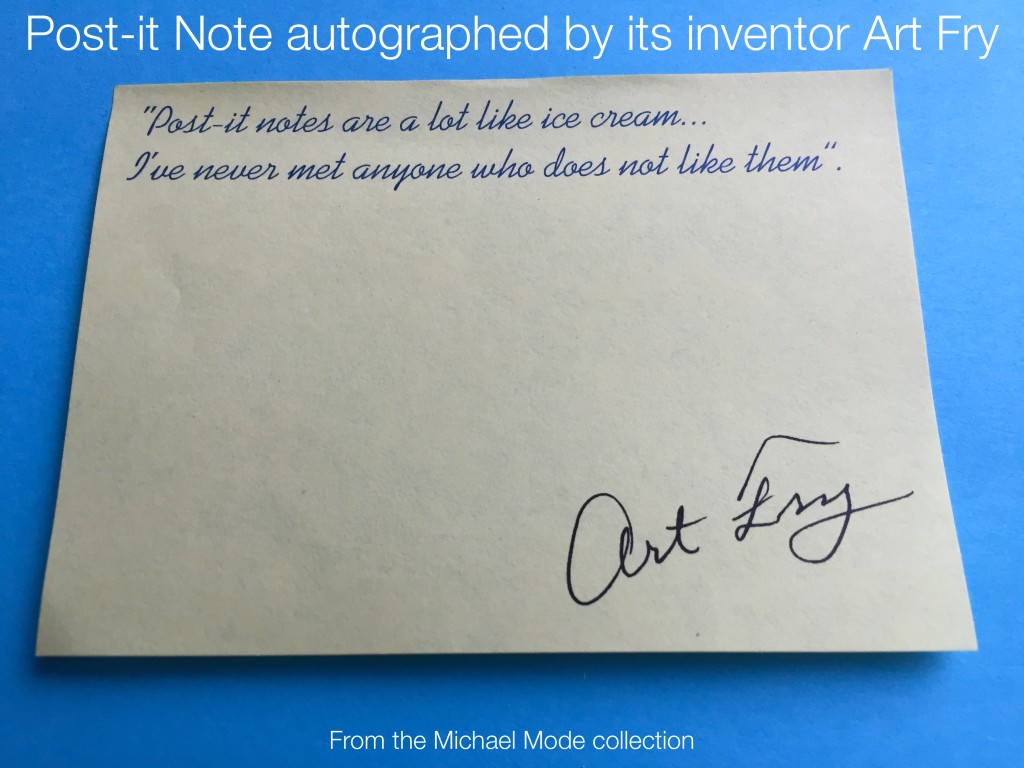
The Post-it Note was co-invented by 3M scientists Dr. Spencer Silver and Arthur Fry. Silver developed the unique, low-tack adhesive in 1968, while Fry conceived the practical application for a repositionable bookmark in 1974. Together, their collaboration transformed a perceived chemical failure into one of the world's most ubiquitous office products.
The Chemistry of a "Failed" Experiment: Spencer Silver’s Discovery
The journey of the Post-it Note began not with a goal to create a bookmark, but with a quest for a super-strong adhesive. In 1968, Dr. Spencer Silver, a senior scientist at 3M’s Central Research Laboratories, was working to develop a high-strength glue for the aerospace industry. During his experiments, he created something entirely unexpected: a "low-tack" adhesive made of tiny, cross-linked acrylate copolymer microspheres.
Unlike traditional adhesives that form a flat, permanent film, these microspheres were essentially tiny bubbles that would not dissolve or break down. They were incredibly resilient but only contacted surfaces at tangent points, providing just enough grip to hold paper together but allowing it to be peeled away without leaving residue or damaging the surface.
At the time, 3M considered this a failure. Silver had created a glue that was, by all technical definitions of the era, "weak." However, Silver was convinced that his "solution without a problem" had potential. For five years, he promoted his discovery within 3M through internal seminars, often referred to as "the sticky stuff that won't stick." He envisioned it being used in spray form or as a surface for bulletin boards, but the idea failed to gain traction until it met the right problem.
The "Eureka" Moment: Arthur Fry and the Church Hymnal
The second half of the invention story took place in 1974. Arthur Fry, another 3M scientist and a member of his local church choir, was frustrated with a recurring problem. During choir practice, he used small scraps of paper to mark the songs in his hymnal. Frequently, these bookmarks would flutter to the floor, causing him to lose his place.
Fry recalled one of Spencer Silver’s internal seminars about the low-tack microsphere adhesive. He realized that if he could apply Silver’s adhesive to the back of a piece of paper, he would have a bookmark that stayed in place but could be removed without ruining the pages of the hymnal.
The following Monday, Fry began working on a prototype in the lab. The challenge was technical: he needed to "anchor" the adhesive to the paper so that when the note was pulled away, the glue stayed on the note and didn't transfer to the book. This required a primer—a chemical bridge between the paper and the microspheres. Through the 3M "15% Rule"—a policy allowing employees to spend 15% of their time on side projects—Fry and Silver collaborated to refine the product that would eventually become the Post-it Note.
The Iconic Canary Yellow Color
One of the most recognizable features of the original Post-it Note is its Canary Yellow color. Interestingly, this was also an accident. When Fry and his team were developing the initial prototypes at the 3M laboratory, the only scrap paper available in the lab next door happened to be yellow.
The team grew accustomed to the color, and when it came time to launch the product, they stuck with yellow because it provided a high-contrast background for various ink colors and stood out against standard white office documents. While Post-it Notes are now available in hundreds of colors and sizes in 2026, the original yellow remains the global trademark of the brand.
The "Boise Blitz": Overcoming Market Skepticism
Even with a working prototype, the Post-it Note faced a difficult path to the market. Initial consumer testing in 1977 under the name "Press 'n Peel" in four cities was disappointing. Consumers didn't understand why they needed a sticky note when they already had scrap paper and paperclips.
3M executive Geoff Nicholson and his team realized that the product had to be experienced to be understood. In 1978, they launched the "Boise Blitz," a massive sampling campaign in Boise, Idaho. They distributed free samples to office workers across the city. The results were staggering: nearly 90% of those who used the product said they would buy it. This proved that the Post-it Note was a "pull" product—once people integrated it into their workflow, it became indispensable.
On April 6, 1980, 3M officially launched Post-it Notes in US stores. Within a year, it was a staple of the American office environment, and by 1981, it was launched in Canada and Europe.
Comparison of Adhesive Technologies
To understand why the Post-it Note was revolutionary, it is helpful to compare the microsphere adhesive to other common bonding agents of the time.
| Feature | Standard Glue (PVA) | Pressure-Sensitive Tape | Post-it Microsphere Adhesive |
|---|---|---|---|
| Bond Strength | High / Permanent | Moderate / Semi-Permanent | Low / Temporary |
| Residue | Leaves dried film | Often leaves sticky residue | Leaves zero residue |
| Surface Impact | Can tear paper fibers | Likely to lift ink or paper | Safe for delicate surfaces |
| Reusability | None | Low (single use) | High (multiple repositions) |
| Mechanism | Chemical drying | Viscoelastic flow | Mechanical tangent contact |
The Role of 3M’s Innovation Culture
The invention of the Post-it Note is often cited in business schools as the ultimate example of successful corporate culture. 3M’s "15% Rule" was instrumental. Without the freedom to pursue "failed" ideas, Spencer Silver might have been forced to abandon his microspheres in 1968.
Furthermore, the collaboration between Silver (the chemist) and Fry (the product developer) highlights the necessity of cross-departmental communication. Silver had the technology, but Fry had the "use case." This synergy, supported by leadership like Geoff Nicholson, allowed a niche lab experiment to evolve into a multi-billion dollar product line.
Evolution and the Digital Age in 2026
As we look at the product in 2026, the Post-it brand has expanded far beyond the simple yellow square. The technology has evolved to meet modern demands, including:
- Post-it Super Sticky Notes: Developed with a stronger version of the microsphere adhesive to hold better on vertical and rough surfaces like computer monitors and walls.
- Extreme Notes: Water-resistant notes designed for construction sites and kitchens, capable of sticking to wood, brick, and stainless steel.
- Digital Integration: The Post-it App allows users to take photos of physical notes and instantly convert them into digital boards for remote collaboration in platforms like Miro, Trello, and Microsoft Teams.
- Sustainability: Since the early 2020s, 3M has transitioned much of its production to use 100% recycled paper and plant-based adhesives, ensuring the product remains relevant in an eco-conscious market.
Frequently Asked Questions
Did Spencer Silver get rich from the Post-it Note?
While Dr. Spencer Silver was a highly respected scientist at 3M and received numerous internal awards and royalties as part of his employment, the patent for the adhesive was owned by 3M. He lived a comfortable life and continued to innovate at 3M until his retirement in 1996, holding over 30 patents.
Why do Post-it Notes eventually lose their stickiness?
The adhesive works through "microspheres" that act like tiny suction cups. Every time a note is removed and reapplied, these spheres pick up microscopic dust, skin oils, and paper fibers. Eventually, the surface of the spheres becomes "clogged," preventing them from making clean contact with the next surface.
Is there a difference between "Post-it" and "Sticky Notes"?
Yes. Post-it is a registered trademark of 3M. While many companies produce "sticky notes" or "repositionable notes," only 3M products can carry the Post-it brand name. Generic versions often use different adhesive formulas that may not offer the same "clean remove" properties as the original microsphere technology.
Who is Geoff Nicholson in the Post-it story?
Geoff Nicholson was a technical director at 3M who is often called the "Father of the Post-it Note" from a business perspective. He was the executive who championed the project when other managers wanted to cancel it, and he personally helped oversee the marketing strategy that led to the product's global success.
Can Post-it Notes be recycled?
Yes, in 2026, standard Post-it Notes are fully recyclable. The adhesive is removed during the de-inking process at paper recycling plants. Most Post-it products are also now made from paper certified by the Sustainable Forestry Initiative (SFI) or are 100% recycled.
Optimizing Your Use of Post-it Notes
To get the most out of this invention, consider the "Side-to-Side" peel method. Most users pull a note from the bottom toward the top, which causes the note to curl and eventually fall off the surface. Instead, peel the note from left to right (or right to left). This keeps the paper flat, ensuring the microspheres make maximum contact with the surface, which significantly extends the life of the note on a wall or monitor.
Whether you are using them for "Kanban" boards in a software development sprint or simply leaving a reminder on the fridge, the Post-it Note remains a testament to the fact that sometimes, the greatest successes are born from the most persistent "failures."