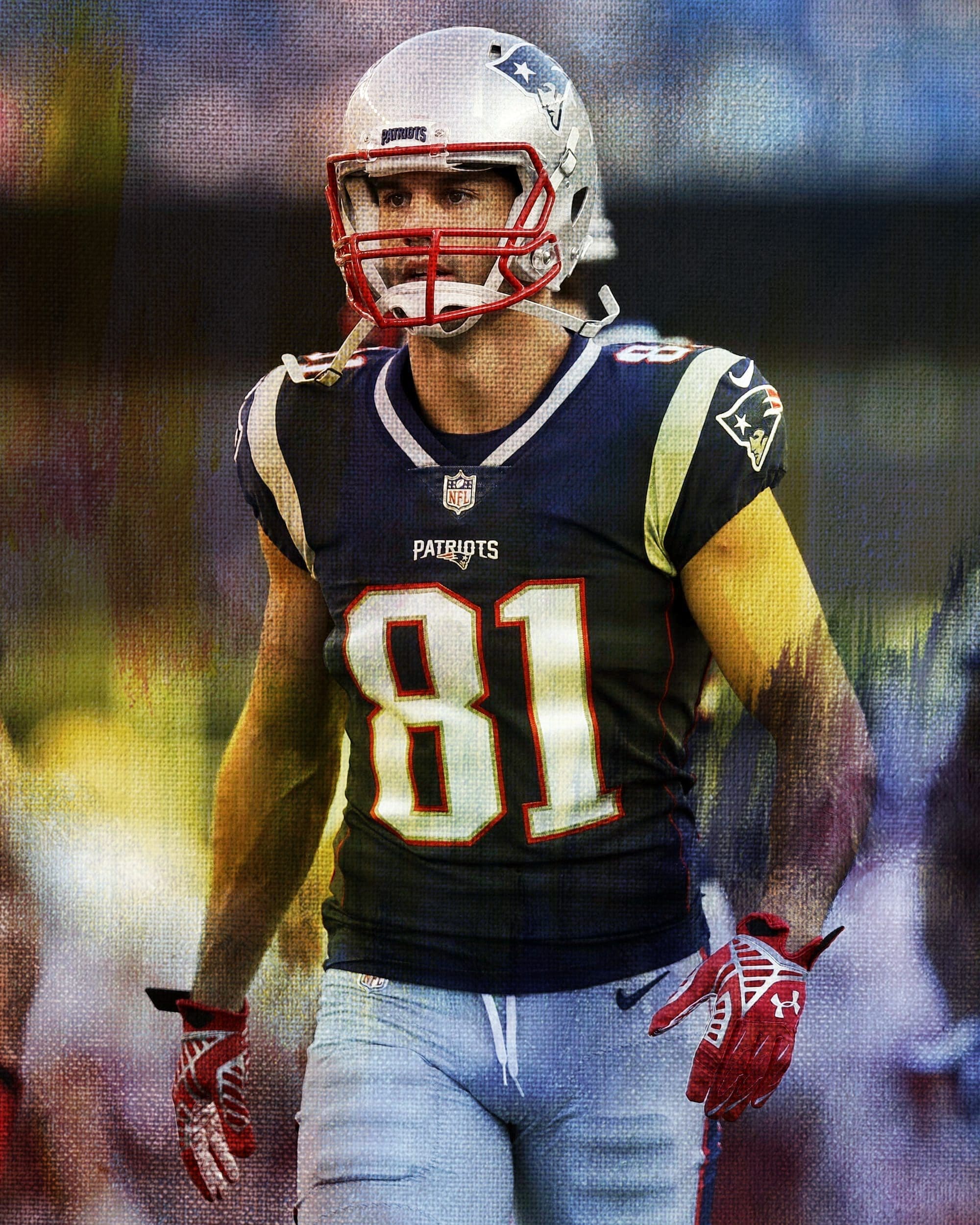
Eric Decker was a premier wide receiver in the NFL, known for his precise route running, exceptional size, and elite red-zone efficiency. Over an eight-season active career spanning from 2010 to 2017, Decker played for the Denver Broncos, New York Jets, and Tennessee Titans, establishing himself as one of the most reliable possession targets of his era.
The Foundation: From Minnesota to the NFL Draft
Before becoming a household name in the NFL, Eric Decker was a standout multi-sport athlete at the University of Minnesota. His collegiate career is notable not just for his football prowess but also for his talent on the baseball diamond, where he was drafted twice by Major League Baseball teams (the Milwaukee Brewers in 2008 and the Minnesota Twins in 2009). However, his commitment to football remained his primary focus, despite a significant foot injury during his senior year that hindered his draft stock.
Standing 6'3" and weighing approximately 214 pounds, Decker possessed the ideal frame for an NFL "X" or "Z" receiver. The Denver Broncos recognized his potential, selecting him in the third round (87th overall) of the 2010 NFL Draft. At the time, the Broncos were in a state of transition, and Decker was viewed as a high-upside prospect who could eventually anchor a young receiving corps. His technical proficiency and ability to catch the ball in traffic made him a favorite of scouts, even if he lacked the elite "burner" speed of some of his contemporaries.
The Denver Broncos Era (2010–2013)
Decker’s tenure in Denver is widely considered the peak of his professional career. This period can be divided into two distinct phases: the developmental years under various quarterbacks and the explosive years paired with Hall of Famer Peyton Manning.
Early Development and the Tebow Year
In his rookie season (2010), Decker was primarily a special teams contributor, recording only six receptions. However, his breakout occurred in 2011 during the "Tebow-mania" era. Despite playing in an offense that was heavily run-oriented and statistically unconventional, Decker emerged as Tim Tebow’s most trusted target. He finished the 2011 season with 44 receptions for 612 yards and eight touchdowns, proving that he could produce even in a low-volume passing attack.
The Manning Transformation
The trajectory of Decker’s career changed forever in 2012 when the Broncos signed Peyton Manning. In Manning’s sophisticated, timing-based passing offense, Decker’s precise route running flourished. He formed a lethal tandem with fellow receiver Demaryius Thomas.
In 2012, Decker hauled in 85 receptions for 1,064 yards and 13 touchdowns. His 13 scores ranked among the best in the league, cementing his reputation as a "red-zone monster." He followed this up in 2013 with an even more impressive statistical campaign, recording 87 receptions for 1,288 yards and 11 touchdowns. He was a vital component of the 2013 Broncos offense, which set the NFL record for the most points scored in a single season. This era culminated in an appearance in Super Bowl XLVIII, though the Broncos fell to the Seattle Seahawks.
The New York Jets Years (2014–2016)
Following his massive success in Denver, Decker entered free agency in 2014 and signed a five-year, $36.25 million contract with the New York Jets. Critics at the time questioned whether Decker was a true "No. 1" receiver or merely a product of Peyton Manning’s greatness.
Proving the Critics Wrong
Decker’s first year in New York (2014) was challenging due to inconsistent quarterback play from Geno Smith and Michael Vick. Despite these hurdles, he managed 74 receptions for 962 yards and five touchdowns, leading the team in all major receiving categories.
The 2015 season served as a definitive rebuttal to his skeptics. With the arrival of veteran quarterback Ryan Fitzpatrick and fellow star receiver Brandon Marshall, Decker excelled. He and Marshall became one of the most productive receiving duos in Jets history. Decker recorded 80 receptions for 1,027 yards and 12 touchdowns. Remarkably, Decker and Marshall set an NFL record that year for the most games in a single season where both teammates scored a touchdown.
Injury Struggles
The 2016 season marked the beginning of the end for Decker’s time in New York. He suffered a torn rotator cuff and a hip injury early in the season, limiting him to just three games. The Jets, entering a rebuilding phase, opted to release Decker in the summer of 2017 to clear salary-cap space, ending a productive but injury-marred stint in the Meadowlands.
The Tennessee Titans and Final Season (2017)
In June 2017, Eric Decker signed a one-year deal with the Tennessee Titans. The move was seen as a way to provide a veteran presence for a young Marcus Mariota and a developing receiving corps featuring Corey Davis and Rishard Matthews.
While Decker was no longer the explosive vertical threat he was in Denver, he remained a vital "chain-mover" for Tennessee. He played in all 16 games, recording 54 receptions for 563 yards. Perhaps his most significant contribution came in the playoffs; during the AFC Wild Card game against the Kansas City Chiefs, Decker caught the game-winning touchdown pass from Mariota, helping the Titans secure their first playoff victory in 14 years.
Retirement and the New England Patriots Stint
Following his season with the Titans, Decker signed with the New England Patriots in August 2018. The pairing seemed logical, as Decker’s skill set—precise routes and high football IQ—perfectly matched the requirements of a Tom Brady-led offense. However, after several weeks of training camp and preseason action, Decker realized his body was no longer performing at the level he demanded of himself.
On August 26, 2018, Eric Decker officially announced his retirement from the NFL. In a heartfelt social media post, he acknowledged that while his passion for the game remained, he wanted to prioritize his health and his family. As of 2026, he remains retired, focusing on various business ventures and his life with his wife, Jessie James Decker, and their children.
Career Statistical Summary and Timeline
The following table provides a year-by-year breakdown of Eric Decker’s performance throughout his NFL career. These figures highlight his remarkable consistency, particularly his ability to find the end zone.
| Year | Team | Games | Receptions | Receiving Yards | Touchdowns | Avg Yards/Catch |
|---|---|---|---|---|---|---|
| 2010 | Denver Broncos | 14 | 6 | 106 | 1 | 17.7 |
| 2011 | Denver Broncos | 16 | 44 | 612 | 8 | 13.9 |
| 2012 | Denver Broncos | 16 | 85 | 1,064 | 13 | 12.5 |
| 2013 | Denver Broncos | 16 | 87 | 1,288 | 11 | 14.8 |
| 2014 | New York Jets | 15 | 74 | 962 | 5 | 13.0 |
| 2015 | New York Jets | 15 | 80 | 1,027 | 12 | 12.8 |
| 2016 | New York Jets | 3 | 9 | 194 | 2 | 21.6 |
| 2017 | Tennessee Titans | 16 | 54 | 563 | 1 | 10.4 |
| Total | -- | 111 | 439 | 5,816 | 53 | 13.2 |
Technical Analysis: Why Eric Decker Succeeded
To understand Eric Decker’s impact, one must look beyond the box score. He was often categorized as a "possession receiver," a term that sometimes carries a negative connotation of lacking speed. However, Decker’s success was built on three technical pillars that are still studied by wide receiver coaches in 2026.
1. The Slot-Fade and Red-Zone Efficiency
Decker was one of the league’s most proficient practitioners of the "slot-fade" route. Because of his size, he could out-muscle smaller nickel cornerbacks, and his ability to track the ball over his shoulder was elite. This made him a favorite target for quarterbacks inside the 20-yard line. Over his career, nearly 12% of his total receptions resulted in a touchdown—a remarkably high efficiency rate for a non-tight end.
2. Route Discipline
Unlike many receivers who rely on pure athleticism to "win" a route, Decker was a master of nuances. He used subtle head fakes and "stem" adjustments to move defensive backs off their platforms. This technical discipline allowed him to remain productive even as he aged and his top-end speed naturally declined.
3. Catch Radius and Toughness
Decker was frequently asked to run "in-breaking" routes (like slants and digs) where contact from safeties was inevitable. His ability to maintain focus while bracing for a hit made him a reliable third-down option. According to advanced metrics from Pro Football Reference, Decker’s catch percentage remained consistently high throughout his prime years, rarely dipping despite being the primary focus of opposing defenses.
FAQs About Eric Decker’s NFL Career
Which NFL teams did Eric Decker play for?
Eric Decker played for three teams during his active NFL career: the Denver Broncos (2010–2013), the New York Jets (2014–2016), and the Tennessee Titans (2017). He also spent a brief period in the 2018 preseason with the New England Patriots but retired before the regular season began.
Did Eric Decker ever win a Super Bowl?
No, Eric Decker did not win a Super Bowl ring during his career. He came closest in 2013 with the Denver Broncos, appearing in Super Bowl XLVIII, where the Broncos lost to the Seattle Seahawks. He was a key part of the historic offense that reached the championship game that season.
What were Eric Decker's best career stats?
Statistically, Decker’s best season was 2013 with the Denver Broncos, where he recorded 1,288 receiving yards and 11 touchdowns. However, his 2012 season was also elite, featuring a career-high 13 touchdowns. He surpassed the 1,000-yard mark three times in his career (2012, 2013, and 2015).
Why did Eric Decker retire from the NFL?
Eric Decker retired primarily due to the physical toll of the game and a desire to spend more time with his family. After undergoing major surgeries on his hip and shoulder in late 2016, and experiencing the grind of a 2018 training camp with the Patriots, he decided it was the right time to step away while his health was still intact.
How many touchdowns did Eric Decker have in his career?
Eric Decker finished his NFL career with 53 regular-season receiving touchdowns. Additionally, he recorded one postseason touchdown, which was the game-winner for the Tennessee Titans in their 2017 Wild Card victory over the Kansas City Chiefs.
Verifying Eric Decker's Legacy
For fans and researchers looking to verify the specifics of Decker’s impact, reviewing his historical performance against top-tier cornerbacks of the 2010s reveals a consistent ability to produce. His career serves as a blueprint for how size and technical skill can overcome raw speed in the modern NFL.
If you are looking to analyze his impact on the teams he played for, the most effective next step is to examine his "Target Share" during the 2013 and 2015 seasons. These years highlight how he functioned as both a complementary piece to other stars and a primary focal point of an offense. For those interested in the current activities of former players, following official NFL alumni associations or his verified social media channels provides the most accurate updates on his post-football life in 2026.