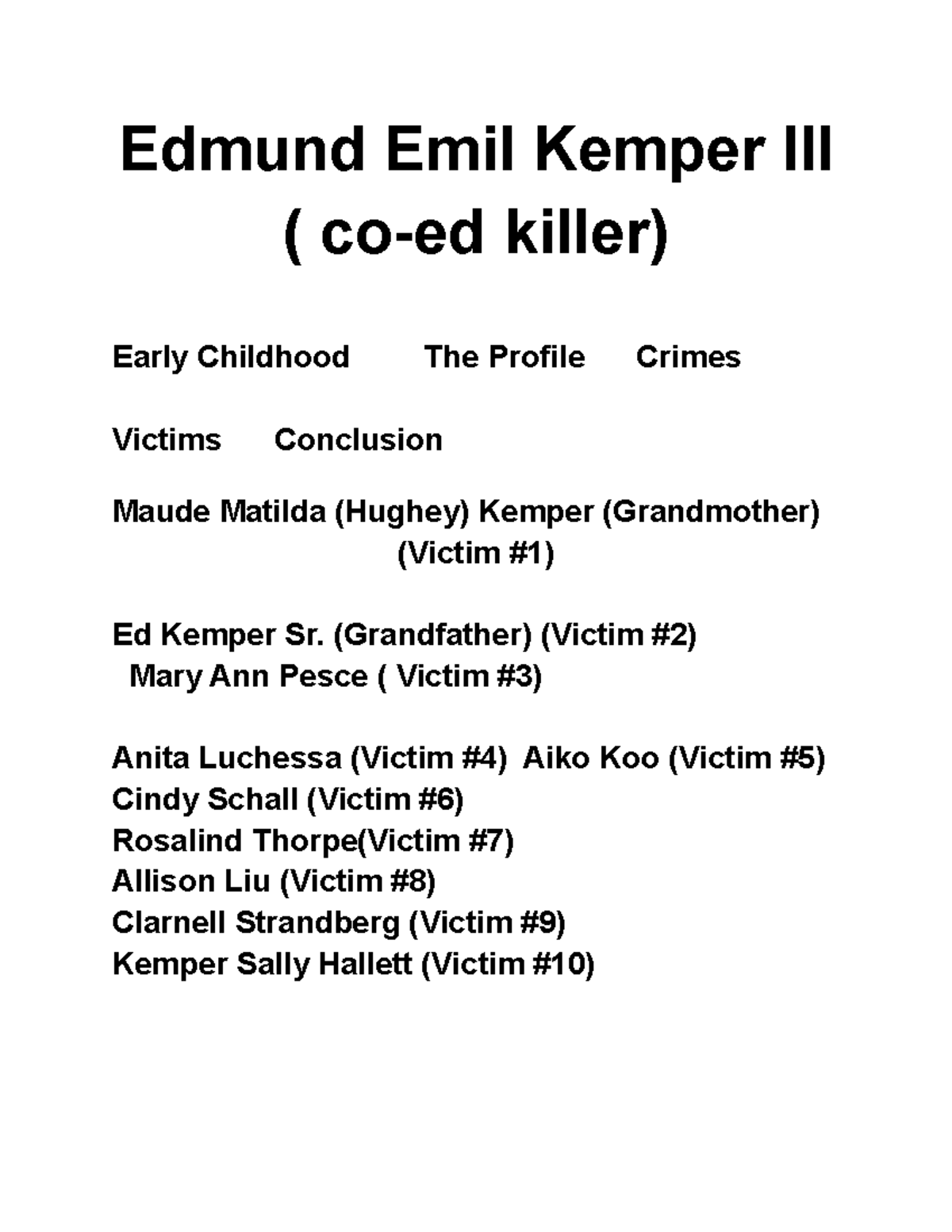
Edmund Kemper III, known as the "Co-ed Killer," remains one of the most significant figures in the history of criminology and forensic psychology. Standing 6'9" with an IQ of 145, Kemper murdered ten people, including his grandparents and his mother, before turning himself in. His detailed cooperation with FBI profilers helped establish the foundational techniques used in modern criminal behavioral analysis.
As of 2026, Ed Kemper remains incarcerated at the California Medical Facility in Vacaville, serving eight concurrent life sentences. His case is frequently studied not only for its brutality but for the chillingly lucid way Kemper was able to articulate his motives, his descent into necrophilia, and the psychological "logic" behind his choice of victims. Unlike many serial killers who remain elusive or deceptive, Kemper provided the FBI’s Behavioral Science Unit (BSU) with an unprecedented look into the mind of a predatory offender.
The Early Life and Developmental History of Ed Kemper
The psychological profile of Ed Kemper begins long before his first murder, rooted in a deeply dysfunctional domestic environment. Born in 1948 in Burbank, California, Kemper was the middle child and only son. His developmental years were defined by a volatile relationship with his mother, Clarnell Strandberg, whom he described as abusive, emasculating, and hyper-critical.
Psychologists often point to Kemper’s childhood as a "perfect storm" for the development of antisocial personality traits. Clarnell, fearing her son would grow up to be like his father or potentially harm her, forced him to sleep in a dark, cramped basement to keep him away from his sisters. This isolation, combined with constant verbal humiliation, led Kemper to retreat into a world of dark fantasies.
During his youth, Kemper exhibited several "MacDonald Triad" symptoms—a set of three behavioral characteristics associated with later sociopathic behavior:
- Animal Cruelty: Kemper ritualistically killed family pets, including a cat he decapitated and buried, only to dig it up and place its head on a stake.
- Social Isolation: Despite his high intelligence, he struggled to form healthy peer relationships, largely due to his massive physical size and the psychological weight of his home life.
- Dark Fantasies: He frequently engaged in "roleplay" involving his own execution or the death of those around him.
The North Fork Murders (1964)
At age 15, Kemper was sent to live with his paternal grandparents on their ranch in North Fork, California. On August 27, 1964, following a minor argument with his grandmother while she sat at the kitchen table, Kemper shot her in the head and back with a rifle. When his grandfather returned home shortly after, Kemper shot him in the driveway to "save him the pain" of finding his wife dead.
Kemper called his mother, who then instructed him to call the local authorities. He was committed to the Atascadero State Hospital, a facility for the criminally insane. Because he was a juvenile, he was released on his 21st birthday in 1969, against the recommendations of several hospital staff members. He had successfully manipulated the psychiatric board into believing he was rehabilitated, demonstrating an early mastery of the "mask of sanity."
The Co-ed Killer: A Timeline of Victims
Between May 1972 and April 1973, Kemper engaged in a series of abductions and murders in the Santa Cruz area. His methodology was chillingly consistent: he would pick up female hitchhikers—often students from the University of California, Santa Cruz—using his "big, friendly" persona to put them at ease.
| Victim Name | Date of Murder | Age | Location/Notes |
|---|---|---|---|
| Mary Ann Pesce | May 7, 1972 | 18 | First hitchhiker victim; kidnapped with Anita Luchessa. |
| Anita Luchessa | May 7, 1972 | 18 | Killed alongside Mary Ann Pesce near Alameda. |
| Aiko Koo | September 14, 1972 | 15 | Abducted while walking to a dance class. |
| Cindy Schall | January 8, 1973 | 18 | Body parts were buried in his mother's garden. |
| Rosalind Thorpe | February 5, 1973 | 24 | Murdered alongside Alice Liu. |
| Alice Liu | February 5, 1973 | 21 | Murdered alongside Rosalind Thorpe. |
| Clarnell Strandberg | April 20, 1973 | 52 | Kemper's mother; the primary target of his lifelong rage. |
| Sally Hallett | April 21, 1973 | 59 | His mother's best friend; killed to delay discovery of the scene. |
The murders typically involved strangulation or shooting, followed by the transportation of the bodies back to his home (or his mother's home when she was away). Kemper engaged in post-mortem mutilation and necrophilia, which he later explained as a way of "possessing" the victims entirely. He sought to fulfill a deep-seated need for control that he lacked in his relationship with his mother.
The Psychological Profile: High Intelligence and the Organized Killer
Ed Kemper is classified in criminology as an Organized Serial Killer. This classification is based on several key behavioral indicators that Kemper displayed throughout his spree. Unlike disorganized killers who act impulsively, Kemper planned his crimes with meticulous detail.
Intelligence and Manipulation
With an IQ of 145, Kemper was technically a genius. This intelligence allowed him to maintain a dual life. He was a regular at the "Jury Room," a bar frequented by Santa Cruz police officers. He became so well-liked by the officers that they nicknamed him "Big Ed." He would often listen to them discuss the "Co-ed Killer" investigation, providing him with real-time feedback on how to avoid detection.
The Role of Paraphilias
Kemper’s psychological profile is heavily defined by extreme paraphilias, specifically necrophilia and necro-sadism. For Kemper, the act of killing was merely the "entry fee" to the primary act, which was the absolute physical possession of the body. He described the victims as "trophies" or "dolls." This behavior is often linked to a profound fear of rejection; a dead victim cannot judge, ridicule, or leave.
The "Mother-Hate" Catalyst
Psychologically, Kemper’s victims were "surrogates" for his mother. Every time he killed a young woman, he was effectively rehearsing the murder of Clarnell Strandberg. When he finally killed her in April 1973, he felt the "need" to kill vanish. He decapitated her and used her head as a target for darts, a symbolic act of silencing the voice that had criticized him for decades.
The FBI Collaboration and Impact on Criminology
One of the most enduring legacies of the Ed Kemper case is his contribution to the FBI’s Behavioral Science Unit (BSU). In the late 1970s and 1980s, Special Agents John Douglas and Robert Ressler began interviewing incarcerated serial killers to develop profiling templates. Kemper was their most cooperative and articulate subject.
Kemper’s insights helped the FBI understand:
- The Cooling-Off Period: The time between murders where the killer returns to a "normal" life.
- Staging and Post-Mortem Behavior: Why certain killers choose to move or mutilate bodies.
- The Killer’s Logic: Kemper explained that he didn't hate his victims; they were simply the "wrong people in the wrong place" to satisfy a biological and psychological urge.
His interviews were foundational in moving criminal profiling from guesswork to a structured social science. He provided the terminology and the psychological framework that helped investigators understand that these crimes were not "senseless," but followed a rigid internal logic dictated by the killer's pathology.
Current Status and Legal Standing in 2026
As of 2026, Edmund Kemper has spent over 50 years in the California prison system. Despite his high intelligence and lack of disciplinary issues within the prison, he has been consistently denied parole. His own testimony during parole hearings has often been his own greatest obstacle; he has historically stated that he does not believe he should be released, acknowledging that the "urge" could potentially return if he were placed back into society.
Kemper’s health has declined in recent years due to his age and sedentary lifestyle, but he remains mentally sharp. He spent decades narrating hundreds of audiobooks for the blind through the Volunteers of Vacaville program, a task that many find a haunting paradox given the nature of his crimes.
Frequently Asked Questions
What was Ed Kemper’s IQ?
Ed Kemper had a tested IQ of 145, placing him in the "Genius" category. This high intelligence is a key factor in why he was able to manipulate psychiatric professionals at Atascadero and evade police for over a year during his killing spree.
Why did Ed Kemper turn himself in?
Kemper surrendered because he felt that the "mission" was over after he killed his mother. He stated that the original urge to kill was driven by his resentment toward her, and once she was dead, there was no longer a purpose for his crimes. He called the police from a phone booth in Colorado because he was frustrated that they hadn't caught him yet.
Is Ed Kemper still alive in 2026?
Yes, as of 2026, Ed Kemper is alive and remains incarcerated at the California Medical Facility in Vacaville. He is one of the longest-serving inmates in the California system.
Was Ed Kemper the inspiration for the show Mindhunter?
Yes, the character of Ed Kemper in the Netflix series Mindhunter (played by Cameron Britton) is based directly on the real-life interviews Kemper conducted with FBI agents John Douglas and Robert Ressler. The dialogue in the show often uses direct transcripts from those actual interviews.
Further Research and Verification
For those researching the psychological underpinnings of serial homicide, the Kemper case serves as a primary case study. Students of criminal justice are encouraged to review the original FBI BSU interview transcripts and the psychiatric evaluations from the 1973 trial. These documents provide essential context on the intersection of developmental trauma, high-functioning sociopathy, and the evolution of predatory behavior.