Charles Dickens’s 1843 novella, A Christmas Carol, is a foundational work of Victorian literature that chronicles the spiritual transformation of Ebenezer Scrooge. Through a series of supernatural visitations, the story critiques the industrial era’s neglect of the poor while redefining Christmas as a season of charity, reflection, and communal joy.
The Historical Genesis of a Holiday Classic
To understand the depth of A Christmas Carol, one must look at the socio-economic conditions of early 1840s Britain. Often referred to as the "Hungry Forties," this period was marked by economic depression, failed harvests, and the harsh realities of the New Poor Law of 1834. Charles Dickens, who had experienced the trauma of poverty and a father in debtors' prison during his childhood, was deeply affected by the plight of London’s "ragged schools"—charitable institutions providing basic education to the city’s most destitute children.
In late 1843, following a visit to the Field Lane Ragged School, Dickens initially considered writing a political pamphlet titled "An Appeal to the People of England on behalf of the Poor Man’s Child." However, he realized that a compelling narrative would have a more profound impact on the public consciousness than a dry manifesto. He began writing the novella in October 1843, completing it in a mere six weeks.
The book was published on December 19, 1843, and became an immediate sensation. By Christmas Eve, the first edition had sold out. Dickens’s decision to self-finance the publication led to financial frustrations despite its popularity, yet the book’s cultural "sledge-hammer blow"—as he called it—successfully challenged the Malthusian view that the poor were merely a "surplus population."
The Narrative Structure: The Five Staves
Dickens chose a musical structure for his story, dividing the novella into five "staves" rather than chapters. This nomenclature reinforces the title, framing the entire work as a "carol" meant to be shared and sung.
Stave One: Marley’s Ghost
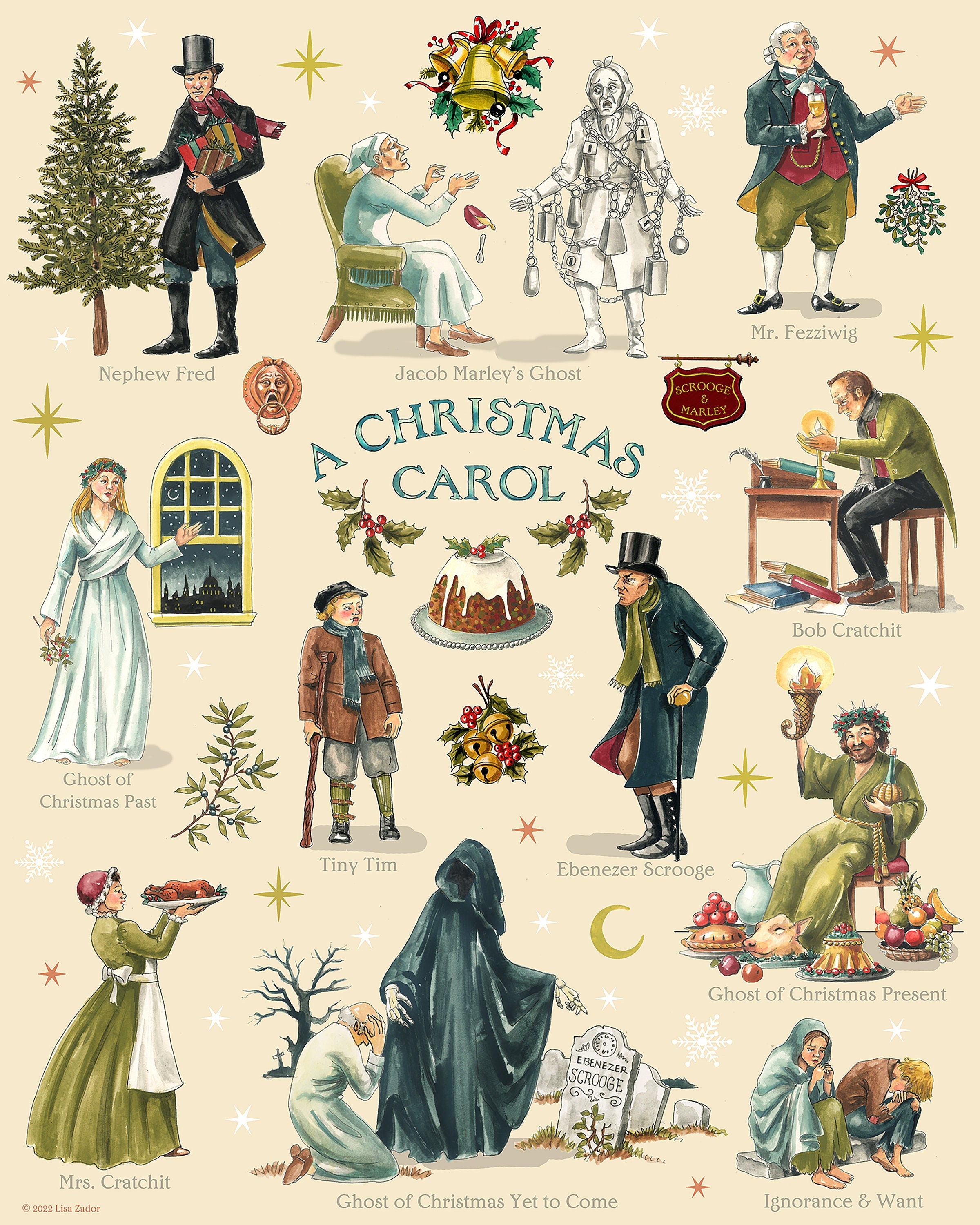
The story opens on Christmas Eve with a stark reminder of mortality: "Marley was dead: to begin with." We are introduced to Ebenezer Scrooge, a "squeezing, wrenching, grasping, scraping, clutching, covetous, old sinner." Scrooge’s coldness is literalized in his refusal to heat his office or assist his clerk, Bob Cratchit. The arrival of the ghost of Jacob Marley, Scrooge’s former partner, serves as the inciting incident. Marley is weighed down by heavy chains forged from ledgers, keys, and purses—symbols of a life devoted to avarice rather than humanity.
Staves Two through Four: The Supernatural Journey
The middle staves represent the "reclamation" of Scrooge. The Ghost of Christmas Past takes him back to his lonely school days and his apprenticeship with the jovial Fezziwig, highlighting how he gradually traded love and connection for the pursuit of wealth. The Ghost of Christmas Present reveals the hidden joys and struggles of the contemporary world, including the Cratchit family’s meager but loving dinner and the terrifying personifications of "Ignorance" and "Want." Finally, the Ghost of Christmas Yet to Come—a silent, hooded figure—shows Scrooge the grim reality of a death unmourned and the potential loss of Tiny Tim.
Stave Five: The End of It
The final stave marks Scrooge’s rebirth. On Christmas morning, he is a changed man, manifesting his transformation through immediate action: sending a prize turkey to the Cratchits, donating generously to charity, and reconnecting with his nephew, Fred. The narrative concludes with the assurance that Scrooge became as good a friend and as good a man as the "good old city knew."
Character Analysis and Symbolic Roles
The enduring power of A Christmas Carol lies in its archetypal characters, each representing a specific facet of Victorian society or a moral lesson.
- Ebenezer Scrooge: He is the personification of the "cold" intellect and the philosophy of utility. His transformation is not merely a change of heart but a fundamental shift in his worldview, moving from isolation to community.
- Bob Cratchit: As Scrooge's clerk, Cratchit represents the working class—diligent, loyal, and resilient despite systemic oppression. His character humanizes the "surplus population" that Scrooge initially dismisses.
- Tiny Tim: The youngest Cratchit child, who is disabled, serves as the moral center of the story. His possible death represents the tragic consequences of social neglect, while his survival symbolizes the hope that comes with social reform and individual charity.
- Fred (The Nephew): Fred serves as a foil to Scrooge. He is the voice of the "Christmas Spirit," arguing that the holiday is a time when men and women "open their shut-up hearts freely."
Comparison of the Four Supernatural Visitors
| Entity | Visual Appearance | Primary Function | Symbolic Meaning |
|---|---|---|---|
| Jacob Marley | Bound in heavy iron chains and cashboxes | Warning and prophecy | The weight of wasted opportunity and greed |
| Ghost of Christmas Past | A flickering, candle-like figure with a light-emitting head | Reflection and memory | The formative power of childhood and lost innocence |
| Ghost of Christmas Present | A giant in a green robe, surrounded by a feast | Observation and social awareness | The abundance of the world vs. the cruelty of neglect |
| Ghost of Christmas Yet to Come | Shrouded in deep black, silent, and pointing | Fear and consequence | The inevitability of death and the power of legacy |
Thematic Depth: More Than a Ghost Story
While A Christmas Carol is celebrated as a festive tale, its thematic depth addresses complex issues of social justice and human psychology.
Social Critique and the "Ignorance and Want"
Perhaps the most harrowing scene in the book is when the Ghost of Christmas Present reveals two "yellow, meagre, ragged, scowling, wolfish" children hiding beneath his robes. These children are Ignorance and Want. The Spirit warns Scrooge to "beware them both," but especially to beware the boy (Ignorance), for on his brow is written "Doom." This was Dickens’s direct warning to the Victorian ruling class: neglecting the education and welfare of the poor would lead to the eventual collapse of society.
The Invention of the Modern Christmas
Dickens is often credited with "inventing" the modern Christmas. While the holiday existed long before 1843, Dickens popularized the emphasis on family gatherings, seasonal food and drink, and the concept of "Christmas Spirit" as a year-round moral compass. His portrayal of the Fezziwig ball and the Cratchit dinner standardized the cultural image of a "traditional" English Christmas that persists even in 2026.
Reclamation vs. Redemption
The story explores the nuance between being "reclaimed" (brought back to one's true self) and being "redeemed" (saved from sin). Scrooge’s journey is one of psychological reintegration. By revisiting his past, he understands why he became cold; by witnessing the present, he feels empathy; and by seeing the future, he feels the urgency of time.
Cultural Legacy and Adaptations into 2026
By 2026, A Christmas Carol has been adapted hundreds of times across every conceivable medium. Its flexibility is a testament to the universality of its message.
- Literature: The novella has never been out of print since its initial publication. It remains a staple of Victorian literature curricula worldwide.
- Film and Television: From the 1951 Alastair Sim classic to modern immersive virtual reality experiences, the story is reimagined for every generation. Notable adaptations include The Muppet Christmas Carol (celebrated for its faithfulness to the text) and various gritty modern reinterpretations.
- Theatre: The story is a perennial favorite for stage productions, with the Royal Shakespeare Company and various Broadway troupes staging annual performances.
- Language: Terms like "Scrooge" (for a miser) and "Bah! Humbug!" have entered the common lexicon, surviving nearly two centuries of linguistic evolution.
Frequently Asked Questions
What does the word "Humbug" actually mean in the context of the story?
In the 19th century, "humbug" referred to a hoax, a fraud, or something deceptive. When Scrooge says "Bah! Humbug!", he isn't just being grumpy; he is expressing his belief that the sentimentality and joy of Christmas are a deceptive facade—a fraudulent excuse for people to avoid work and pick his pocket.
Why is the book divided into "Staves"?
A stave is a set of lines used in musical notation (also known as a staff). Since the book is titled "A Christmas Carol," Dickens carried the musical metaphor through the structure of the chapters. This suggests the story is meant to be a harmonious piece of social "music" that resonates with the reader.
Did Charles Dickens really save Christmas?
While Dickens did not invent the holiday, he significantly shifted its focus. Before the Victorian era, Christmas was a quieter, primarily religious event or a rowdy folk festival. Dickens centered the holiday on the hearth, the family, and the moral obligation to the poor, which aligned perfectly with the rising middle-class values of the time.
What is the significance of the Ghost of Christmas Past's "extinguisher cap"?
The Ghost of Christmas Past carries a metal cap used to extinguish candles. At the end of the visitation, Scrooge uses the cap to force the Spirit into the ground, suppressing the light. This symbolizes Scrooge's historical habit of suppressing painful memories and the truth of his own past to avoid emotional discomfort.
Is Tiny Tim based on a real person?
Dickens likely based Tiny Tim on his own sickly nephew, Harry Burnett, who died at a young age. The portrayal was also informed by Dickens’s observations at the London hospitals and ragged schools, where he saw firsthand the devastating effects of malnutrition and lack of medical care on children of the working poor.
Guidance for Modern Readers and Educators
To fully appreciate A Christmas Carol in 2026, it is recommended to read the original text rather than relying solely on adaptations. While films capture the "spirit," they often omit Dickens's biting satirical commentary and the hauntingly beautiful descriptions of 19th-century London.
For students and scholars, focusing on the "Stave Three" description of Ignorance and Want provides the most direct link to Dickens's social activism. Educators should consider pairing the novella with historical documents from the 1840s, such as the Parliamentary Commission reports on child labor, to provide students with the necessary context for Scrooge’s initial callousness. For a general audience, the best way to experience the work is to read it aloud—as Dickens himself did during his famous public reading tours—allowing the rhythmic, "carol-like" prose to bring the Victorian winter to life.