Chris Van Allsburg is a renowned American author and illustrator celebrated for his surreal, meticulously detailed children’s books, most notably Jumanji and The Polar Express. A two-time Caldecott Medal winner, his work is distinguished by its cinematic perspective, psychological depth, and a unique artistic style rooted in his background as a sculptor.
For over four decades, Chris Van Allsburg has occupied a singular space in the world of picture books. While many children's authors aim for whimsical brightness, Van Allsburg’s work often leans into the uncanny, the mysterious, and the structurally profound. His stories do not merely entertain; they invite readers of all ages to question the boundaries between reality and imagination. As of 2026, his influence remains a cornerstone of literary and visual arts education, with his books serving as primary examples of how visual storytelling can achieve the complexity of fine art.
The Artistic Foundations: From Sculpture to Illustration
To understand who Chris Van Allsburg is, one must first understand that he did not set out to be an illustrator. Born in 1949 in Grand Rapids, Michigan, Van Allsburg’s early academic life was dedicated to the physical world of three-dimensional form. He attended the University of Michigan, where he majored in sculpture, and later earned a Master of Fine Arts from the Rhode Island School of Design (RISD) in 1975.
This background in sculpture is the "secret ingredient" in his illustrations. Unlike many of his contemporaries who used flat watercolors or thin line work, Van Allsburg approached the page as if he were carving space. His drawings possess a tangible weight and volume. When he depicts a house, a train, or a jungle-dwelling animal, the subject feels as though it has mass and exists within a 360-degree environment.
Van Allsburg’s transition to books was encouraged by his wife, Lisa Van Allsburg, and an editor at Houghton Mifflin who saw his charcoal drawings and realized they told a story. His debut book, The Garden of Abdul Gasazi (1979), immediately signaled the arrival of a new kind of visual storyteller. The book was named a Caldecott Honor book, an extraordinary feat for a debut work, and it established his signature use of "chiaroscuro"—the dramatic treatment of light and shade.
Defining the Van Allsburg Style: Surrealism and Perspective
The hallmark of a Chris Van Allsburg book is its visual perspective. He frequently employs "low-angle" or "worm's-eye" views, which make ordinary objects appear monolithic and imposing. This technique places the reader in the physical position of a child—looking up at a world that is much larger and more mysterious than themselves.
The Use of Mediums
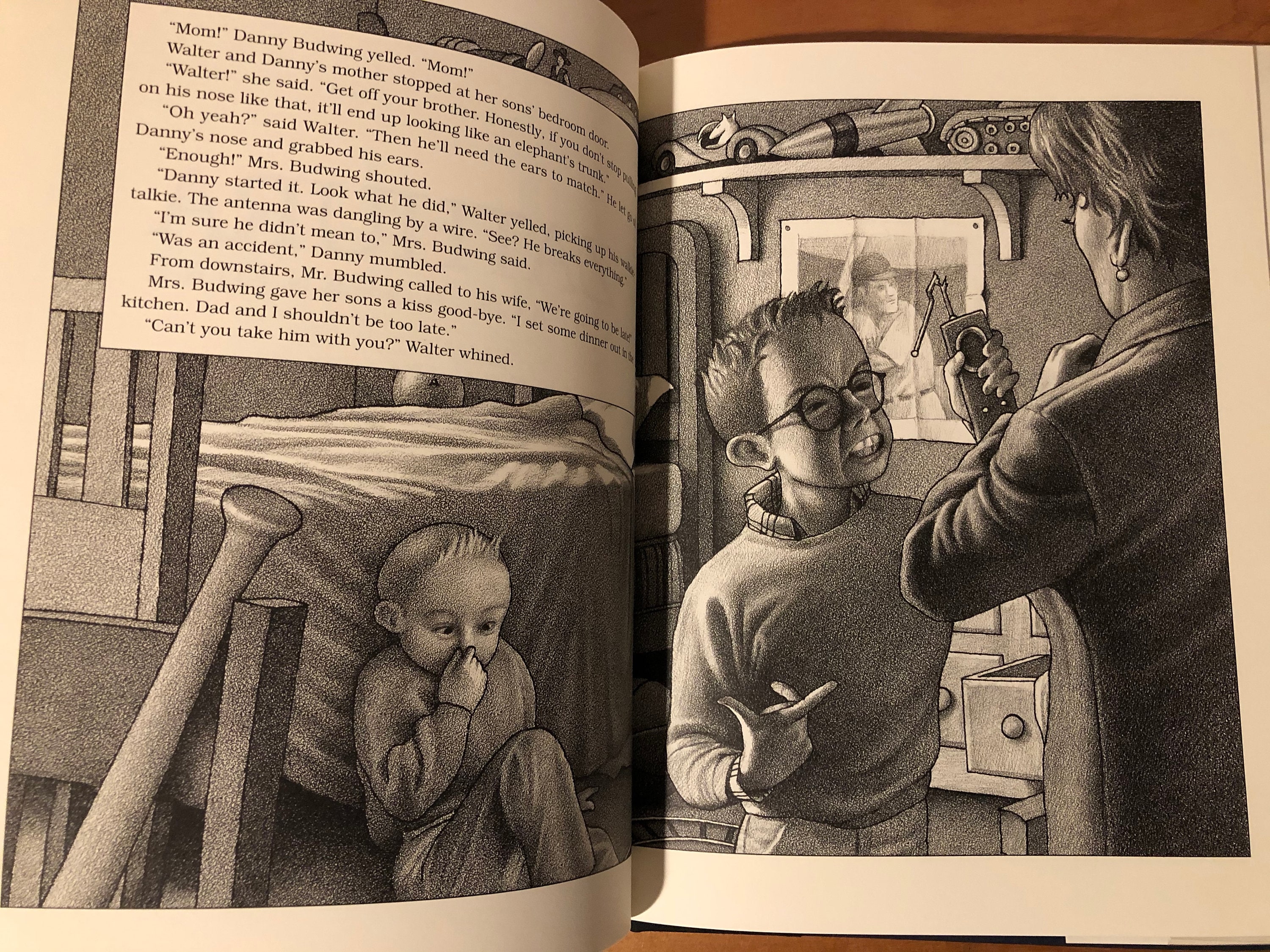
Van Allsburg is a master of diverse artistic mediums, though he is perhaps most famous for his work in charcoal, carbon pencil, and oil pastels. In books like The Mysteries of Harris Burdick, his use of grainy, soft-edged charcoal creates a dreamlike atmosphere where shadows seem to move. In The Polar Express, he utilized oil pastels to create a glowing, atmospheric warmth that perfectly captured the "magic" of a cold winter night. He avoids the "cartoonish" style, preferring a realism that makes the supernatural elements of his stories feel grounded and, therefore, more impactful.
The Recurring "Fritz" Cameo
In nearly every one of his books, Van Allsburg hides a small tribute to his past: a bull terrier named Fritz. Originally a character in The Garden of Abdul Gasazi, Fritz has appeared as a toy, a patterned rug, or a background character in subsequent works. This "Easter egg" has become a beloved tradition for readers, encouraging a closer, more analytical look at his dense illustrations.
Landmark Works and Their Cultural Impact
While Van Allsburg has written and illustrated over 20 books, a few titles have defined his career and reshaped the landscape of children’s literature.
Jumanji (1981)
The winner of the 1982 Caldecott Medal, Jumanji tells the story of two children who find a mysterious board game that brings a jungle to life inside their suburban home. The brilliance of Jumanji lies in the contrast between the mundane domestic setting and the wild, dangerous animals rendered in stark, photographic black and white. It explored the concept of "consequences" in a way that felt thrilling rather than didactic.
The Polar Express (1985)
Perhaps his most famous work, The Polar Express earned Van Allsburg his second Caldecott Medal. The story of a boy’s journey to the North Pole on Christmas Eve became an instant classic. Its success was driven by its ability to tap into the universal feeling of wonder and the transition from childhood innocence to adulthood. The book has sold millions of copies worldwide and remains a seasonal staple in 2026.
The Mysteries of Harris Burdick (1984)
This book is a departure from traditional narrative. It is presented as a collection of "found" illustrations from a mysterious man named Harris Burdick, each accompanied by only a title and a single caption. This meta-fictional approach turned the reader into the author, prompting generations of students and writers (including Stephen King) to write their own stories based on the haunting images.
From Page to Screen: Major Film Adaptations
Chris Van Allsburg’s cinematic drawing style made his work a natural fit for Hollywood. However, translating his specific visual language to the screen proved a significant technical challenge.
- Jumanji (1995 & Modern Reboots): The original film starring Robin Williams captured the chaotic spirit of the book, while the later sequels expanded the "game" concept into the digital age.
- The Polar Express (2004): Directed by Robert Zemeckis and starring Tom Hanks, this was a landmark film in the history of "performance capture" animation. It sought to replicate Van Allsburg’s oil-pastel glow through high-end CGI.
- Zathura (2005): Often considered a spiritual successor to Jumanji, this space-themed adventure was directed by Jon Favreau and maintained the "board game comes to life" premise.
These adaptations have ensured that Van Allsburg’s stories reach audiences far beyond the library, though many critics argue that the quiet, contemplative mystery of his original drawings can never be fully replicated by big-budget cinema.
Comparative Overview of Key Publications
The following table highlights the diversity of Van Allsburg's most influential works and the awards they garnered.
| Book Title | Publication Year | Primary Medium | Major Awards/Recognition | Core Theme |
|---|---|---|---|---|
| The Garden of Abdul Gasazi | 1979 | Carbon Pencil | Caldecott Honor | The boundary of reality |
| Jumanji | 1981 | Conté Crayon/Pencil | Caldecott Medal | Nature vs. Domesticity |
| The Mysteries of Harris Burdick | 1984 | Charcoal | NYT Best Illustrated | Creative Imagination |
| The Polar Express | 1985 | Oil Pastel | Caldecott Medal | Faith and Wonder |
| The Widow's Broom | 1992 | Sepia-tone Charcoal | ALA Notable Book | Tolerance and Magic |
| The Wreck of the Zephyr | 1983 | Oil Pastel | NYT Best Illustrated | Ambition and Gravity |
The Legacy of Chris Van Allsburg in 2026
By 2026, Chris Van Allsburg is recognized not just as a children’s author, but as a significant American artist. His work is frequently the subject of museum retrospectives, where his original drawings are analyzed for their composition and technical mastery.
He helped move children’s literature away from simple morality tales and toward "visual literacy." His books require the reader to slow down and look for clues, making the act of reading an active investigation. He proved that children are capable of handling ambiguity and "the quiet," showing that a book doesn't need to be loud to be powerful.
Impact on Contemporary Illustrators
A generation of artists has grown up under the influence of Van Allsburg’s "heavy" realism. You can see his shadow in the work of many modern illustrators who prioritize lighting and perspective over simple character design. His insistence on high-quality production—thick paper, deep ink saturation, and large formats—set a standard for the industry that persists today.
Frequently Asked Questions
Why does Chris Van Allsburg put a dog in every book?
The dog, a bull terrier named Fritz, was originally based on a real dog owned by Van Allsburg's brother-in-law. After Fritz's "debut" in The Garden of Abdul Gasazi, Van Allsburg began including him as a hidden tribute and a playful way to reward observant readers. Finding Fritz has become a rite of passage for young fans.
Is Chris Van Allsburg still writing?
While he has slowed his output in recent years, Van Allsburg remains an active figure in the arts. He continues to oversee the legacy of his works and occasionally contributes to new editions and artistic collaborations. His primary focus has remained on the integrity of the visual and narrative experience.
What makes his art style "surreal"?
Surrealism involves the juxtaposition of the ordinary with the impossible. Van Allsburg achieves this by drawing everyday objects (like a living room or a bed) with extreme, photographic realism, then introducing a logic-defying element (like a tidal wave or a steam engine) into that realistic space.
Did he write Zathura?
Yes, Zathura was published in 2002 as a thematic sequel to Jumanji. While it features different characters and a space-based setting, it shares the central conceit of a board game that alters the physical world.
What is the most famous Chris Van Allsburg book?
In terms of cultural reach and holiday longevity, The Polar Express is his most famous work. However, Jumanji is arguably as famous due to its successful film franchise.
How to Explore the World of Chris Van Allsburg
For those looking to dive deeper into the work of this master illustrator, the following steps are recommended:
- Seek Out Original Hardcover Editions: Van Allsburg’s work is highly dependent on the quality of the print. To truly appreciate the texture of his charcoal and oil pastels, view the books in their large-format hardcover versions rather than digital screens.
- Analyze the Perspectives: When reading a Van Allsburg book, pay attention to the "camera angle." Ask yourself: "Where is the narrator standing?" You will find that he rarely draws from eye level, which is what gives his books their cinematic tension.
- Visit Museum Exhibits: Many major art museums, such as the Mazza Museum of International Art from Picture Books, hold his original drawings. Seeing the scale of the original charcoal pieces reveals details and textures that are often lost in the shrinking process for book publication.
- Use Harris Burdick for Creative Writing: If you are an educator or an aspiring writer, use The Mysteries of Harris Burdick as a prompt. It remains one of the most effective tools for sparking narrative creativity in both children and adults.
By engaging with his work as fine art rather than just "bedtime stories," readers can fully appreciate why Chris Van Allsburg remains a titan of the genre in 2026.