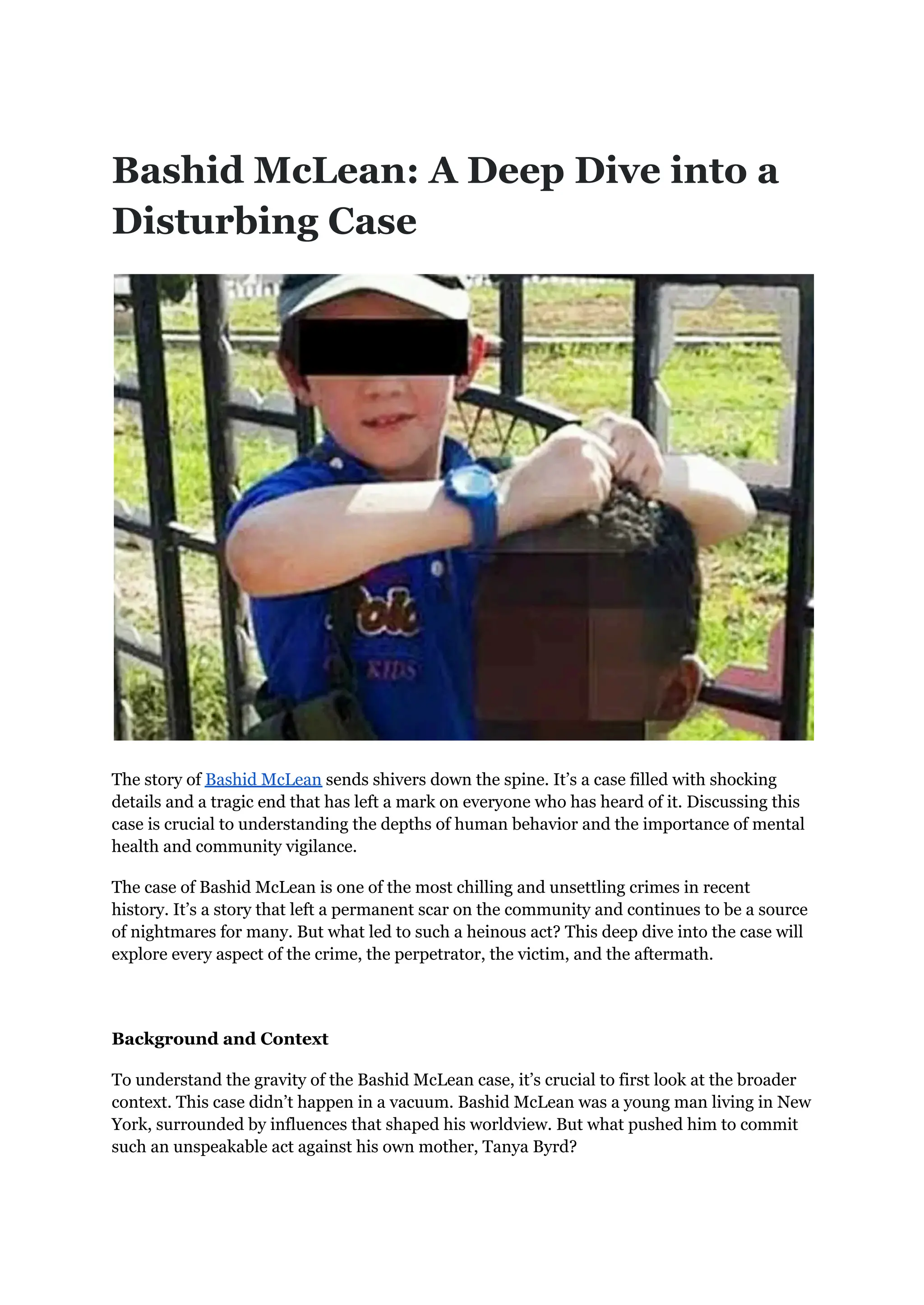
The search query regarding visual documentation related to Bashid McLean often stems from public interest in high-profile legal cases. This article clarifies the availability and ethical context of such materials in the 2026 digital landscape, focusing on privacy standards, media distribution laws, and the technical realities of image processing. Note: This content discusses public record information and does not provide restricted or illegal non-consensual imagery.
Legal and Ethical Frameworks Governing Public Records in 2026
When individuals search for specific visual media related to criminal justice cases, they are often navigating the intersection of public record access and privacy rights. As of 2026, judicial transparency laws in the United States balance the right of the public to be informed with the victim's right to dignity and the defendant's right to a fair trial.
Court-sanctioned media—often referred to as mugshots or courtroom photographs—are categorized as public records once they are entered into evidence or released by law enforcement agencies. However, the distribution of these files is subject to strict oversight by state and federal regulations to prevent harassment and the unauthorized proliferation of sensitive information.
Regulatory Guidelines for Media Distribution
- Data Privacy Acts: Modern 2026 digital statutes place restrictions on third-party aggregators that monetize mugshot databases.
- Judicial Discretion: Judges reserve the right to seal specific visual evidence to protect the identities of witnesses or the integrity of sensitive investigations.
- Ethical Journalism Standards: Reputable news organizations are guided by codes of conduct that prioritize the public interest over the dissemination of gratuitous or inflammatory imagery.
Technical Realities of Image Clarification and Processing
Users searching for unblurred images often operate under the misconception that digital image processing can reliably reconstruct high-definition detail from low-resolution or intentionally obscured source files. From a technical forensics standpoint, this is a complex challenge.
When an image is blurred for privacy or legal reasons, high-frequency data is lost or overwritten by pixelated values. While artificial intelligence and neural networks have advanced significantly by 2026, they are not "recovering" the original data; they are "hallucinating" or synthesizing probable pixels based on massive training datasets.
Forensic Imaging Limitations
- Resolution Loss: Genuine blurring algorithms act as low-pass filters that permanently discard the data necessary to resolve fine facial features.
- Artifact Introduction: AI-based "unblurring" software often introduces artifacts that can lead to misidentification, making such tools unreliable for legal or investigative use.
- Computational Integrity: Professional forensic image analysis prioritizes the preservation of the original file's metadata and raw pixels to maintain chain of custody, which precludes the use of generative "sharpening" tools.
Comparison of Public Interest vs. Personal Privacy
It is essential to distinguish between the legitimate public interest in a criminal case and the individual's right to control their likeness. The following table outlines how different entities approach the management of controversial visual assets in 2026.
| Entity Type | Policy Toward Sensitive Media | Primary Motivation |
|---|---|---|
| Government Archives | Restricted / Verified | Legal documentation and history |
| Mainstream News | Regulated / Ethical | Informing the public of facts |
| Third-Party Data Brokers | Opportunistic | Revenue generation and traffic |
| Forensic Investigators | Analytical | Evidence validation and truth |
Navigating Legal Databases for Authentic Records
If your interest in documentation is based on historical research or legal study, you should rely exclusively on verified government repositories rather than third-party sites that promise "unblurred" or "exclusive" content. Accessing government databases ensures that you are interacting with authentic, unaltered records.
Recommended Research Protocols
- Primary Sources: Utilize the official website of the court or correctional facility where the individual is held. These portals are maintained according to strict 2026 cybersecurity protocols.
- Verified Academic Repositories: For legal scholarship, use platforms that partner with official judicial clerkships to display evidence without editorial bias.
- Public Records Requests: If a document is not available online, file a Freedom of Information Act (FOIA) request at the federal level or the state-specific equivalent to obtain documented evidence through legal channels.
Frequently Asked Questions Regarding Media Access
Why are many images of public figures blurred?
Images are typically blurred to comply with privacy policies, protect the rights of minors or victims, or adhere to court-ordered suppression of sensitive visual evidence. This prevents the unauthorized dissemination of non-consensual or protected media.
Can AI actually unblur a photograph?
While AI can generate a clear image from a blurry source, it does not reveal the "real" underlying detail. It guesses what the original might have looked like, which is often inaccurate and unsuitable for identification or legal purposes.
Where can I find official records of legal cases?
Official records are housed within court clerk portals and regional law enforcement databases. Accessing these via official .gov domains is the only way to ensure the information has not been tampered with or synthesized.
Is it legal to purchase "unblurred" images online?
Purchasing images from unofficial sites is often a security risk and may involve the illegal distribution of protected content. Many states have passed legislation in 2025 and 2026 that penalizes the unauthorized commercialization of sensitive criminal records.
How do I report harmful content?
If you encounter unauthorized or harmful media, use the "Report" features provided by the platform (e.g., social media or search engines) or contact the legal department of the site hosting the data.
Strategic Research Recommendations
For those conducting research on high-profile figures or legal precedents, the priority should always be the verification of source authenticity. Avoid engaging with platforms that prioritize "unblurring" services, as these are rarely legitimate and often represent significant privacy risks. Rely on institutional, verified, and transparent sources that operate within the boundaries of 2026 digital ethics and law. If you are seeking records for a specific case, contact the Clerk of the Court in the presiding jurisdiction for authorized copies of public filings.