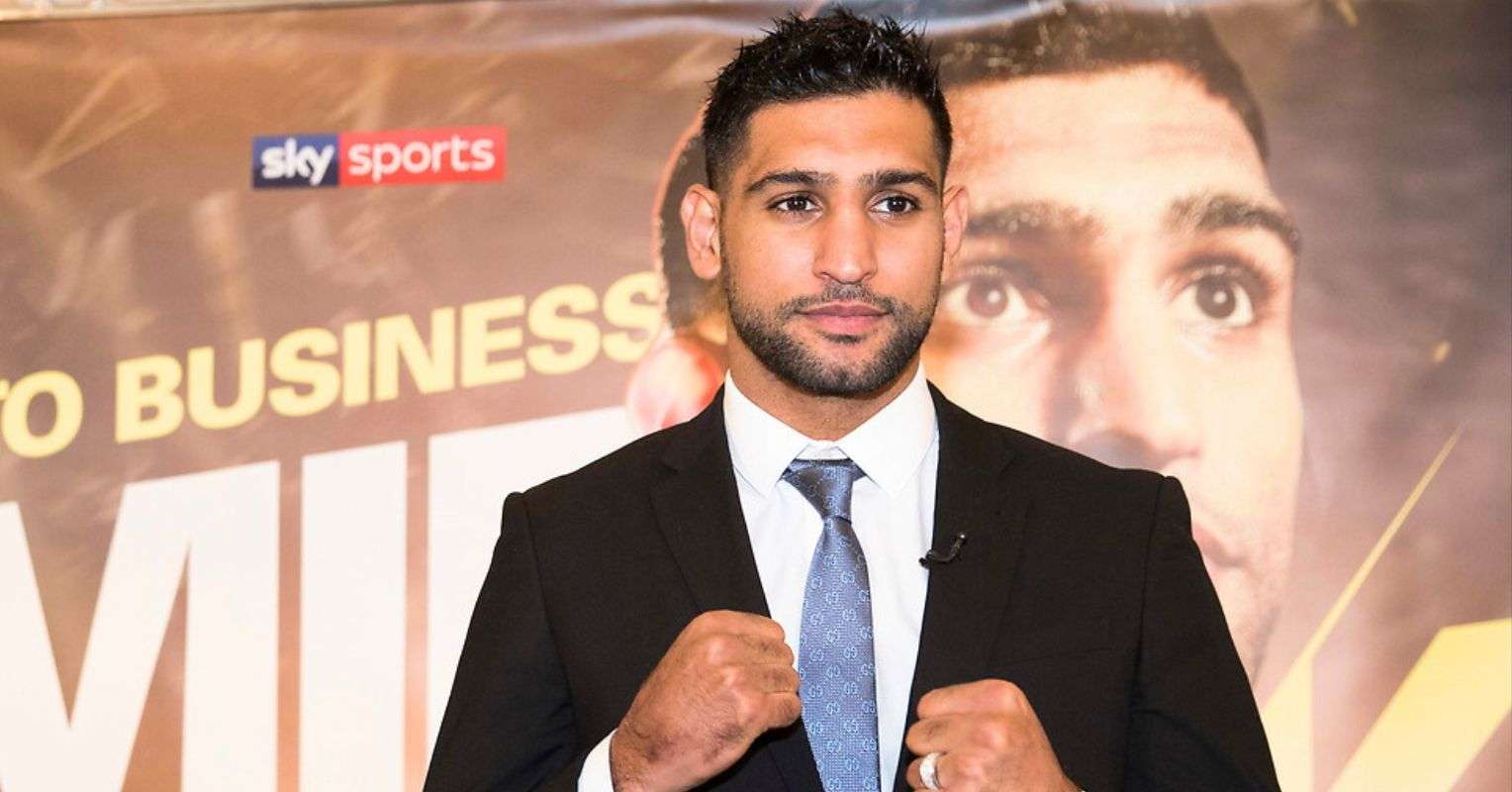
Amir Khan is a former British professional boxer who achieved international prominence as a two-time light-welterweight world champion and a 2004 Olympic silver medalist. Known for his explosive hand speed, high volume combinations, and participation in high-stakes mega-fights, Khan remains one of the most visible British combat sports figures of his generation.
Early Life and the Historic 2004 Olympic Breakthrough
Born on December 8, 1986, in Bolton, Greater Manchester, Amir Iqbal Khan began boxing at the age of eight at the Halliwell Amateur Boxing Club. His amateur trajectory was characterized by rapid technical development and an exceptional natural talent for hand speed and reflexes. Representing Great Britain on the international stage, Khan gained widespread national recognition at the 2004 Summer Olympics in Athens, Greece.
At just 17 years old, Khan was the youngest member of the British Olympic boxing team and Great Britain's sole representative in the sport at those Games. Competing in the lightweight division (60 kg), he produced a remarkable tournament run, defeating seasoned international amateurs including Dimitar Stilianov and Serik Yeleuov. In the Olympic final, Khan faced Cuba's legendary double Olympic champion Mario Kindelán. Although Khan lost a competitive decision to claim the silver medal, his performance captivated the British public and established him as the country's youngest Olympic boxing medalist in history.
Khan avenged his loss to Kindelán in a high-profile amateur rematch in May 2005 before turning professional under the promotional banner of Frank Warren's Sports Network. His Olympic success provided an unprecedented springboard, creating immense anticipation for his professional debut.
Professional Growth and Unified Light-Welterweight Titles
Amir Khan made his professional debut in July 2005 at the Wembley Arena, securing a first-round technical knockout against David Bailey. Guided in his early professional career by trainer Oliver Harrison and later briefly by Jorge Rubio, Khan quickly accumulated victories across the lightweight and super-lightweight divisions. However, his rapid rise hit a major roadblock in September 2008 when he suffered a shocking 54-second knockout defeat to Prescott at the Manchester Arena.
The setback against Prescott prompted immediate structural changes in Khan's training setup. He relocated his training camp to the Wild Card Boxing Club in Hollywood, California, to work under legendary trainer Freddie Roach. Under Roach’s tutelage, Khan refined his offensive combinations, improved his lateral movement, and integrated better defensive guard positioning to protect against counterpunches.
Amir Khan's Career Progression Framework:
- Amateur Distinction
- Olympic Silver (2004)
- Pro Debut (2005)
- Prescott Defeat (2008)
- Trainer Change: Freddie Roach
- WBA World Title (2009)
- IBF Title Unification (2011)
- Multi-Weight Catchweight Mega-Fights
- Retirement (2022)
The adjustments paid off rapidly. In July 2009, at age 22, Khan defeated Ukrainian veteran Andreas Kotelnik via unanimous decision at the Manchester Arena to capture the WBA Light-Welterweight World Championship. Khan utilized a masterclass of long-range jabbing, rapid footwork, and volume punching to outpoint the champion over 12 rounds.
Key Title Defenses and Unification Battles
Khan's tenure as a world champion at 140 pounds featured several defining fights that highlighted both his elite offensive speed and his physical durability:
- Marcos Maidana (December 2010): Held at the Mandalay Bay Events Center in Las Vegas, this bout was named the Boxing Writers Association of America Fight of the Year. Khan knocked Maidana down in the first round with a devastating body shot, weathered extreme damage in the 10th round, and fought through heavy fatigue to win a unanimous decision.
- Zab Judah (July 2011): Khan unified the light-welterweight division by facing IBF champion Zab Judah in Las Vegas. Khan dominated the contest with superior hand speed and distance control before landing a legal body shot to the solar plexus in the fifth round to claim the IBF belt by knockout.
- Paulie Malignaggi (May 2010): In his American debut at Madison Square Garden Theater, Khan showcased sharp combination punching to force an 11th-round stoppage against the craft technician Malignaggi.
Khan lost his unified titles in December 2011 via a controversial split decision to Lamont Peterson in Washington, D.C., a result later marred by referee point deductions and off-ring administrative disputes. A scheduled rematch was canceled after Peterson tested positive for a banned substance. In July 2012, Khan faced Danny Garcia for the vacant Ring Magazine and WBA titles, suffering a fourth-round TKO loss after being caught by a wide left hook while exchanging in close quarters.
Division Jumps, Catchweights, and High-Profile Mega-Fights
Following the Garcia defeat, Khan hired veteran trainer Virgil Hunter to emphasize defensive responsibility, inside head movement, and clinch control. Khan re-established momentum with convincing victories over Carlos Molina, Julio Díaz, Luis Collazo, and Devon Alexander, transitioning fully into the welterweight (147 lbs) division.
Driven by a desire for landmark pay-per-view events, Khan routinely pursued bouts against the sport's biggest star figures, including Floyd Mayweather Jr. and Manny Pacquiao. While those specific matchups failed to materialize, Khan accepted high-risk fights across multiple weight classes.
Challenging Canelo Álvarez and Terence Crawford
In May 2016, Khan made a dramatic leap up in weight to challenge WBC Middleweight Champion Saul "Canelo" Álvarez at a catchweight of 155 pounds at the T-Mobile Arena in Las Vegas. For the first four rounds, Khan’s hand speed and rapid lateral movement allowed him to outbox the heavier Mexican champion. However, in the sixth round, Canelo timed Khan's jab and delivered a clean, overhand right counter knockout. Despite the loss, Khan received praise for his willingness to step up two weight divisions to face one of boxing's premier power punchers.
In April 2019, Khan challenged WBO Welterweight Champion Terence Crawford at Madison Square Garden. Crawford’s elite switch-hitting ability and timing created significant tactical difficulties for Khan. The fight ended prematurely in the sixth round after Khan was struck by an accidental low blow and his corner indicated he was unable to continue, resulting in a TKO victory for Crawford.
Key Career Statistics and Fight Summary
The table below outlines the core metrics and high-profile results defining Amir Khan’s professional boxing career.
| Event / Opponent | Date | Weight Class / Title | Outcome | Key Tactical Factor |
|---|---|---|---|---|
| Mario Kindelán | Aug 2004 | Lightweight (Olympics) | Loss (Points) | Olympic Silver Medal match; high-level amateur contest. |
| Breidis Prescott | Sep 2008 | Lightweight | Loss (KO 1) | Early career setback revealing chin vulnerability to power counters. |
| Andreas Kotelnik | Jul 2009 | Light-Welterweight (WBA) | Win (UD 12) | Won first world title via superior footwork and jab frequency. |
| Marcos Maidana | Dec 2010 | Light-Welterweight (WBA) | Win (UD 12) | Survived 10th-round assault; earned 2010 Fight of the Year. |
| Zab Judah | Jul 2011 | Light-Welterweight (WBA/IBF) | Win (KO 5) | Unified 140-lb division with precision body shots. |
| Danny Garcia | Jul 2012 | Light-Welterweight (WBA/WBC) | Loss (TKO 4) | Caught by counter left hook while trading combinations. |
| Devon Alexander | Dec 2014 | Welterweight | Win (UD 12) | Dominant speed demonstration against a top-tier welterweight. |
| Canelo Álvarez | May 2016 | Middleweight (WBC 155 lbs) | Loss (KO 6) | Jumped two weight classes; caught by timed right hand. |
| Terence Crawford | Apr 2019 | Welterweight (WBO) | Loss (TKO 6) | Challenged pound-for-pound elite; ended after low blow injury. |
| Kell Brook | Feb 2022 | Catchweight (149 lbs) | Loss (TKO 6) | Long-standing domestic grudge match marking final pro fight. |
Final Bout, Anti-Doping Finding, and Official Retirement
The definitive closing chapter of Khan's active ring career occurred on February 19, 2022, when he faced long-time domestic rival Kell Brook at the AO Arena in Manchester. The rivalry, which spanned over a decade of public disputes and contract negotiations, culminated in a dominant performance by Brook, who stopped Khan in the sixth round via technical knockout.
On May 13, 2022, Amir Khan officially announced his retirement from professional boxing, concluding a 17-year professional career with a final record of 34 wins (21 by knockout) and 6 defeats.
Amir Khan Professional Record Breakdown: Total Fights: 40
- Wins: 34 (21 KOs)
- Losses: 6 (5 KOs / TKOs)
- World Titles Held: WBA Light-Welterweight, IBF Light-Welterweight
Following his retirement, UK Anti-Doping (UKAD) announced in April 2023 that Khan had tested positive for the banned substance ostarine in a urine sample collected immediately after his bout against Brook. An independent tribunal accepted Khan's defense that his ingestion of the selective androgen receptor modulator (SARM) was not intentional, but under strict liability anti-doping rules, a two-year ban was imposed, backdated to February 2022. Khan reiterated his lifelong commitment to clean sport, attributing the trace amount to inadvertent contamination.
Philanthropy, Media, and Post-Boxing Business Ventures
Beyond the ring, Khan established himself as a prominent public figure and entrepreneur. In 2014, he founded the Amir Khan Foundation, an international humanitarian charity aimed at providing clean water, orphan care, emergency relief, and youth support programs across Asia, Africa, and the United Kingdom.
Khan’s post-boxing activities include:
- Boxing Promotion & Administration: Serving as president or advisor for various international boxing initiatives, including promoting events in Pakistan and the Middle East to foster grassroots combat sports development.
- Commercial Real Estate: Investing in commercial projects, notably constructing a large-scale wedding and events venue in his hometown of Bolton.
- Media and Television: Appearing on reality broadcasts, such as ITV’s I'm a Celebrity...Get Me Out of Here!, expanding his reach beyond core sports audiences into mainstream entertainment.
Technical Analysis of Khan’s Fighting Style
Boxing analysts frequently study Amir Khan's career as a case study in high-speed, high-risk offensive execution. His physical attributes and technical habits presented distinct strategic advantages and recurring structural challenges in the ring.
Strengths: Speed and Combination Volume
- Hand Speed: Khan possessed some of the fastest hands in boxing history, allowing him to land three-to-four-punch combinations before opponents could register or counter his lead hand.
- Straight Rights and Jabs: His primary weapon was a sharp, rapid double jab followed by a straight right hand, launched with high velocity from long range.
- In-and-Out Footwork: Educated in the amateur system, Khan utilized rapid bouncing steps to enter punching distance quickly and retreat before opponents could set their feet.
Tactical Vulnerabilities
- Defensive Lapses During Exchanges: Khan frequently threw long combinations without resetting his head off the centerline, leaving him exposed to timed counter hooks.
- Recovery and Chin Dynamics: When hurt, Khan’s instinct was often to fight back aggressively rather than clinch, leading to further mid-exchange counterpunches against power punchers like Prescott, Garcia, and Canelo.
Frequently Asked Questions
What was Amir Khan's final professional boxing record?
Amir Khan retired with a professional record of 34 wins, 6 losses, and 0 draws. Of his 34 victories, 21 came by way of knockout.
Which world titles did Amir Khan hold during his career?
Khan held the WBA Light-Welterweight Championship from 2009 to 2011 and unified the division by winning the IBF Light-Welterweight Championship in July 2011. He also captured regional belts, including the WBA International and WBC Silver welterweight titles.
How old was Amir Khan when he won his Olympic medal?
Khan was 17 years old when he won the silver medal in the lightweight division at the 2004 Athens Olympics, making him the youngest British Olympic boxing medalist in history.
Who were Amir Khan's main boxing trainers?
Throughout his career, Khan worked with several world-class trainers, most notably Oliver Harrison in his early pro years, Freddie Roach at the Wild Card Gym, Virgil Hunter, and briefly Joe Goossen and Brian McIntyre toward the end of his career.
Is Amir Khan related to the Bollywood actor Aamir Khan?
No. While both share the same common surname and are prominent public figures of South Asian origin, professional boxer Amir Khan and Indian actor/director Aamir Khan are separate individuals with no immediate family relationship.
Practical Guidance for Analyzing Khan's Ring Legacy
For sports analysts, fight historians, and young boxers studying tape of Amir Khan's fights, his career offers valuable tactical lessons in combination mechanics and defensive management:
- Study Speed Mechanics: Analyze tape from the Kotelnik (2009) and Alexander (2014) bouts to study how straight punching, rhythm variations, and immediate foot displacement can completely neutralize counterpunchers.
- Examine Risk Management: Contrast the Maidana (2010) and Garcia (2012) fights to observe how trading in the pocket without clinch mechanics or head movement alters the risk profile for high-volume punchers.
- Evaluate Weight Class Transitions: Review the physical disparity in the Canelo (2016) bout as an instructive example of the limits of speed when jumping multiple weight divisions against elite, naturally larger power punchers.
Through his amateur distinction, unified world titles, and continuous willingness to fight elite opposition across multiple weight divisions, Amir Khan remains an influential figure in contemporary British boxing history.