Alice’s journey in Lewis Carroll’s 1865 novel Alice’s Adventures in Wonderland is fundamentally a narrative about identity formation, self-assertion, and bodily transformation. Confronted by irrational authority figures and unstable physical dimensions, Alice repeatedly confronts the existential query, "Who in the world am I?" Her identity arc—navigating childhood maturation while resisting arbitrary social rules—has profoundly shaped modern literature, psychoanalysis, film, and contemporary pop culture.
The Narrative Foundation of Alice’s Identity Journey
When Charles Lutwidge Dodgson (writing under the pen name Lewis Carroll) published Alice’s Adventures in Wonderland in 1865, children’s literature in Victorian Britain was dominated by moralizing instructional tales. These stories were designed to teach obedience, decorum, and strict adherence to societal roles. Carroll inverted this tradition by placing a sensible, curious young girl into an utterly illogical universe where traditional rules of behavior, speech, and physical reality fail to apply.
Alice’s identity crisis begins almost immediately after she falls down the rabbit hole. In Chapter 2, "The Pool of Tears," after rapidly changing size, Alice realizes her internal knowledge—such as nursery rhymes and basic geography—has become scrambled. She famously asks herself:
"Dear, dear! How queer everything is to-day! And yesterday things went on just as usual. I wonder if I’ve been changed in the night? Let me think: was I the same when I got up this morning? I almost think I can remember feeling a little different. But if I’m not the same, the next question is, 'Who in the world am I?' Ah, that’s the great puzzle!"
This passage establishes the central psychological engine of the story. Alice’s identity is not a static trait given to her by Victorian society; it is a puzzle she must actively solve. Her journey through Wonderland represents an encounter with the chaotic process of growing up, where physical changes, fluid social expectations, and cognitive disequilibrium constantly challenge her understanding of self.
Key Motifs Shaping Alice’s Quest for Self-Definition
Alice’s identity struggle is expressed through several recurring narrative motifs. These motifs externalize internal psychological processes, transforming her developmental journey into a series of surreal challenges.
- Physical Instability (Potions, Mushrooms, Cakes)
- Loss of Linguistic Control (Scrambled Nursery Rhymes) and Confrontation with Authority (The Caterpillar & Queen of Hearts)
- Reclamation of Agency ("You're nothing but a pack of cards!")
1. Physical Instability and Bodily Metamorphosis
Throughout the narrative, Alice ingests unknown substances—potions labeled "DRINK ME," cakes labeled "EAT ME," and fragments of the Caterpillar’s mushroom—that cause her to grow rapidly or shrink unexpectedly. These physical fluctuations serve as an allegory for biological maturation and puberty.
For a child undergoing physical growth, the body often feels unfamiliar and difficult to manage. Alice experiences bodily alienation when she grows so large in the White Rabbit’s house that her arm sticks out the window, or when her neck elongates so dramatically that a pigeon mistakes her for a serpent. By learning to control her size using the mushroom, Alice transitions from being a passive victim of bodily change to an agent who manages her own physical presence.
2. The Unravelling of Language and Social Rules
In Victorian society, identity was heavily tied to etiquette, recitation, and formal education. In Wonderland, Alice repeatedly attempts to prove her identity by reciting standard educational poems, such as Isaac Watts's "Against Idleness and Mischief." However, the words twist involuntarily into absurd versions, such as "How doth the little crocodile."
This breakdown of memory demonstrates that external societal scripts cannot sustain an individual’s identity when their environment shifts. Alice must build an internal sense of self that relies on direct reasoning and adaptability rather than memorized societal expectations.
3. Resistance to Irrational Authority
Alice encounters various figures who claim absolute authority over Wonderland’s rules:
- The Caterpillar: Demands that Alice explain herself with the blunt question, "Who are you?" When Alice admits she cannot explain herself because she has changed sizes so many times, the Caterpillar challenges her logic, forcing her to articulate her boundaries.
- The Mad Hatter and March Hare: Trap Alice in an endless Tea Party governed by nonsensical etiquette and stalled time, challenging her understanding of social dialogue.
- The Queen of Hearts: Governs through absolute tyranny, arbitrary rules, and the constant threat of execution ("Off with their heads!").
Alice’s climax occurs in the courtroom scene of Chapter 12. Confronted with unjust legal proceedings, Alice regains her full size and asserts her independent judgment, declaring, "You’re nothing but a pack of cards!" By recognizing the arbitrariness of the Queen's authority, Alice shatters the illusion of Wonderland, reclaims her full agency, and wakes up back in the physical world.
Evolution of Alice Across Media Adaptations
Alice’s character and identity arc have been reinterpreted across mediums over the past century and a half. Each adaptation reflects the cultural anxieties, artistic movements, and gender paradigms of its period.
| Period / Adaptation | Primary Format | Central Identity Interpretation | Major Cultural Impact |
|---|---|---|---|
| 1865 Original (Lewis Carroll & John Tenniel) | Illustrated Novel | Child navigating Victorian societal expectations and psychological growth. | Defined children's literary surrealism; introduced enduring visual iconography. |
| 1951 Disney Animated Film | Animated Feature | Innocent, polite child overwhelmed by an absurd, colorful dreamscape. | Globalized Alice's visual identity (blue dress, white apron, headband). |
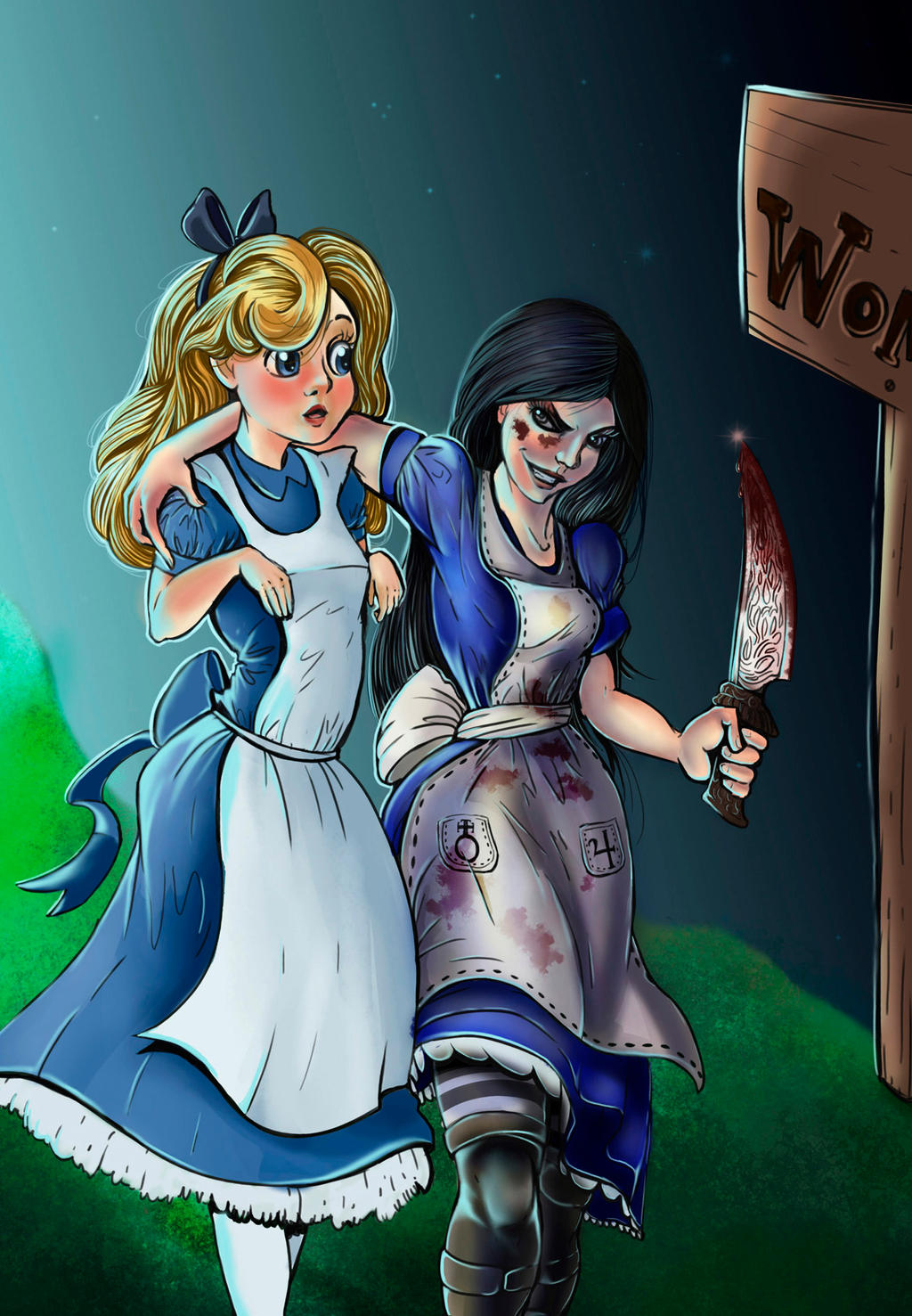
| 2000 / 2011 (American McGee’s Alice series) | Dark Fantasy Video Game | Trauma survivor processing grief, guilt, and mental illness within her own mind. | Popularized gothic, psychological dark-fantasy reimaginings of fairy tales. |
| 2010 Tim Burton Film (Alice in Wonderland) | Live-Action / CGI Film | 19-year-old young adult defying forced Victorian marriage to embrace career autonomy. | Frame-shifted Alice from a child's dream to an explicit female empowerment archetype. |
| 2020s Media (Alice in Borderland, etc.) | TV / Manga / Transmedia | Allegory for modern youth facing existential survival, alienation, and identity loss. | Extended the "Wonderland" concept to dystopian thriller genres. |
Theoretical Interpretations: Psychology, Philosophy, and Feminism
Beyond popular entertainment, Alice’s narrative identity has served as a primary text for scholars across multiple disciplines.
Psychoanalytic Perspectives
Psychoanalytic theorists view Alice’s descent down the rabbit hole as an exploration of the subconscious mind. Her physical shrinking and growing mirror developmental stages defined by Sigmund Freud and Erik Erikson:
- Ego Development: Alice’s struggles represent the ego attempting to mediate between primal impulses (the impulsive March Hare or violent Queen of Hearts) and rigid external structures.
- Lacanian Mirror Stage: French psychoanalyst Jacques Lacan’s theories regarding language and self-perception align with Alice’s experiences in Through the Looking-Glass. Her reflection and her name become unstable signifiers, illustrating how identity is constructed through language and social perception.
Philosophical and Logical Analysis
Philosopher and mathematician Gilles Deleuze analyzed Carroll’s work extensively in The Logic of Sense (1969). Deleuze argued that Alice operates on the surface of sense and nonsense. Unlike traditional literary heroes who seek a hidden depth or transcendent truth, Alice navigates events horizontally. Her identity is not a fixed essence waiting to be discovered, but a continuous series of events and shifts.
- Traditional Hero Arc:
- Known Self
- Quest
- Uncovering Hidden Truth / Fixed Destiny
- Alice's Identity Arc:
- Assumed Self
- Disruption
- Continuous Adaptation
- Autonomous Agency
Feminist Critical Theory
Feminist scholars emphasize Alice's defiance of 19th-century gender expectations. Victorian girls were expected to be submissive, quiet, and emotionally reserved. Alice, by contrast, is:
- Inquisitive: She acts on her curiosity by following the White Rabbit without seeking permission.
- Articulate: She openly debates male authority figures like the Mad Hatter, the Humpty Dumpty figure in Looking-Glass, and the King of Hearts.
- Resilient: She relies on her own rational faculties rather than waiting for a male savior or guide.
Transmedia Legacy: How Alice Shaped Pop Culture Idioms
Alice’s identity narrative has left a permanent mark on language and modern story structures. The terminology of Carroll’s Wonderland has been integrated into everyday discourse and modern media frameworks.
Common Cultural Expressions
- "Down the Rabbit Hole": Originally describing Alice's fall into Wonderland, this phrase now universally denotes embarking on a chaotic, absorbing, or bizarre journey—frequently used to describe internet research, digital algorithms, or deep investigation.
- "Through the Looking Glass": Refers to entering a parallel, inverted, or surreal reality where normal rules are reversed.
- "Mad as a Hatter" / "March Hare": Metaphors for erratic behavior, derived from Victorian occupational hazards (mercury poisoning in hat making) and hare breeding seasons, popularized by Carroll’s characters.
Influence on Science Fiction and Modern Media
Alice's identity story provides the structural template for stories about individuals discovering hidden realities:
- The Matrix (1999): Neo is directly instructed to "follow the white rabbit" and choose between pills that reveal reality or preserve delusion. Morpheus offers him the chance to "see how deep the rabbit-hole goes."
- Spirited Away (2001): Studio Ghibli’s masterpiece mirrors Alice’s arc as a young girl, Chihiro, enters a surreal spirit world, loses her original name (identity), and must navigate strange rules to reclaim her autonomy.
- Coraline (2002/2009): Neil Gaiman’s narrative features a young girl entering an alternate home through a hidden door, confronting an authoritarian figure (the Other Mother), and using her wits to preserve her true identity.
Critical Approaches for Analyzing Alice’s Legacy
When examining Alice’s identity narrative in academic, literary, or media contexts, analysts should apply structured frameworks to unpack the text and its adaptations.
1. Establish Narrative Context and Primary Sources
Always distinguish between Lewis Carroll’s original text (Alice’s Adventures in Wonderland [1865] and Through the Looking-Glass [1871]) and subsequent secondary adaptations. Carroll’s original text relies heavily on wordplay, Victorian social satire, and formal logic, whereas modern visual adaptations often prioritize spectacle or psychological trauma.
2. Apply a Dual-Lens Analytical Framework
- Internal Narrative Analysis: Examine how Alice uses dialogue, logical deduction, and spatial awareness to maintain control over her immediate environment. Trace her transition from passive confusion in early chapters to active confrontation in later chapters.
- External Cultural Analysis: Evaluate what a specific era’s adaptation of Alice reveals about contemporary social anxieties. For instance, Victorian readers saw a challenge to educational pedantry; mid-20th-century audiences saw psychedelic counter-culture themes; modern audiences often view her through the lens of mental health, identity fluidities, or feminist empowerment.
3. Track Metaphorical Realism
Pay attention to how abstract psychological concepts are transformed into physical objects and characters. Analyze how physical changes (shrinking/growing) correlate directly with Alice’s emotional confidence or vulnerability in specific scenes.
Frequently Asked Questions
What is the central identity crisis Alice faces in Wonderland?
Alice’s central identity crisis is her inability to maintain a stable physical size, memory, or social role in a world that disregards Victorian rules. When she forgets familiar nursery rhymes and changes size rapidly, she loses her sense of who she is, leading to her existential question: "Who in the world am I?"
How does the Caterpillar's question "Who are you?" impact Alice?
The Caterpillar’s question forces Alice to confront her internal instability. When she explains that she cannot define herself because she has changed so many times in a single day, the Caterpillar demands logical clarity. This interaction marks a turning point where Alice begins learning to accept change and actively manage her transformations using the mushroom.
Why does physical size change so frequently in Alice's story?
Physical size changes serve as a literary metaphor for the physical and psychological turbulence of childhood growth and puberty. It highlights the feeling of alienation children experience as their bodies grow rapidly and as they navigate shifting boundaries between childhood powerlessness and adult responsibility.
How did Alice influence modern sci-fi tropes like "the white rabbit"?
Alice’s story established the "portal fantasy" archetype where a protagonist follows an unusual trigger (the White Rabbit) into a realm with entirely different operational rules. Sci-fi works like The Matrix use the White Rabbit as a symbol for curiosity, awakening, and the disruption of perceived reality.
How does Alice differ from typical Victorian literary heroines?
Unlike traditional Victorian child characters who were depicted as submissive, passive, or purely instructional models of moral propriety, Alice is curious, outspoken, logical, and willing to challenge irrational authority figures, including kings and queens.
Practical Applications for Literary and Media Studies
To effectively analyze or adapt the narrative of Alice in modern media or academic work, focus on the structural balance between surreal disruption and character agency:
- Map the Catalyst: Identify the specific moment of environmental disruption (e.g., falling down the rabbit hole, stepping through a mirror, or entering a digital void).
- Establish the Core Conflict: Ensure the protagonist's primary struggle is not merely physical survival, but maintaining internal integrity and logic against irrational external rules.
- Analyze Authority Dynamics: Examine how the protagonist interacts with figures claiming absolute control. Resolution should stem from the protagonist recognizing the arbitrary nature of that control.
- Evaluate Transmedia Impact: Compare how contemporary retellings adjust Alice’s age, motivation, and psychological state to reflect modern societal concerns around mental health, gender roles, and existential identity.