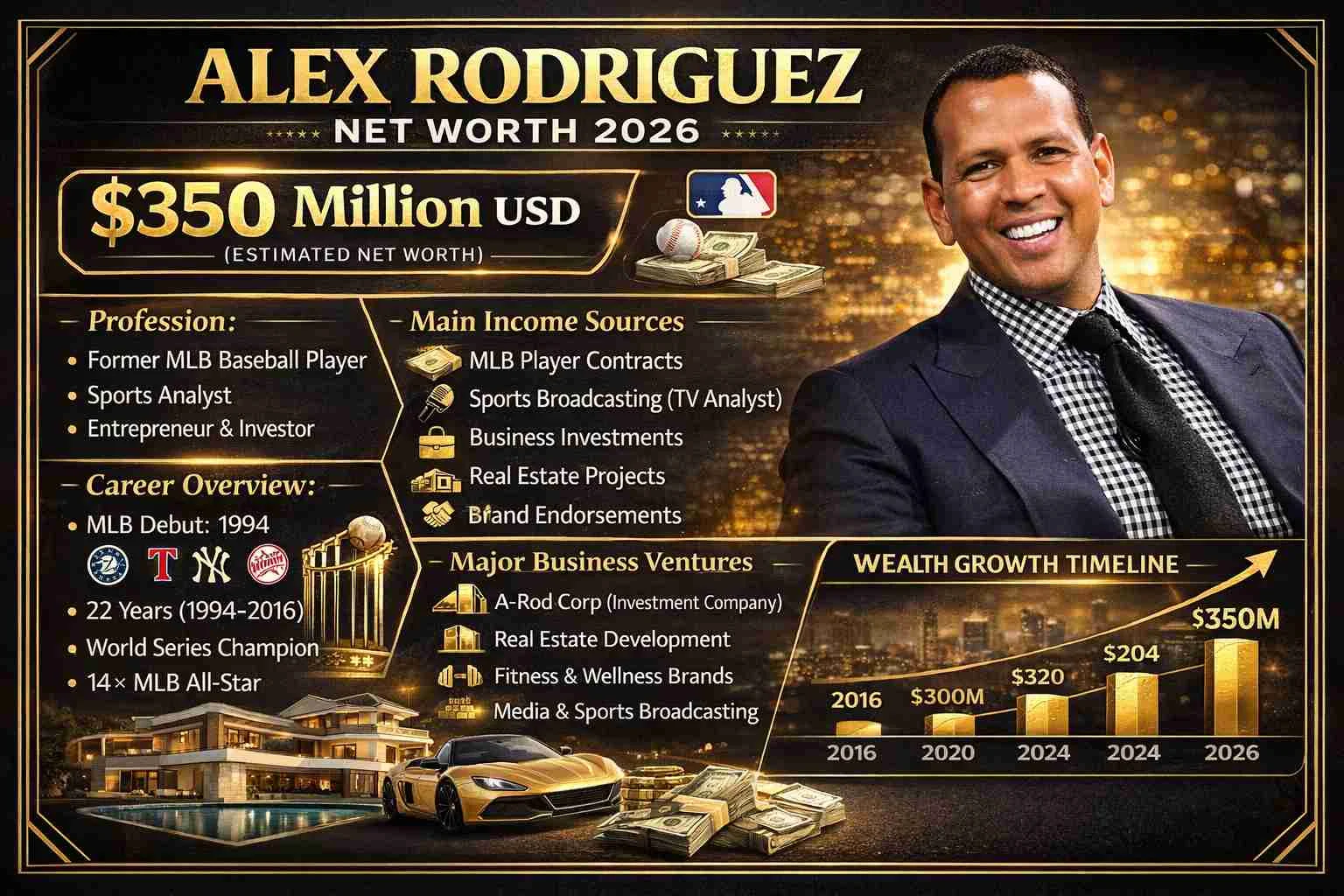
Alex Rodriguez, commonly referred to as A-Rod, stands as one of the most prolific earners in Major League Baseball (MLB) history, with career on-field earnings exceeding $455 million. Beyond his playing days, his financial portfolio has expanded through A-Rod Corp, strategic real estate investments, and media ventures, resulting in a net worth estimated in the hundreds of millions as of 2026.
The Evolution of MLB Salary Contracts
Alex Rodriguez’s transition from a high-draft-pick prospect to the highest-paid player in the sport was defined by three historic contracts. These agreements did more than compensate a generational talent; they fundamentally shifted the economic landscape of professional baseball by raising the benchmark for superstars.
His career began with the Seattle Mariners, where he played under the standard entry-level salary structure. It was not until his departure from the Pacific Northwest that his earnings profile changed dramatically. In 2000, Rodriguez signed a landmark 10-year, $252 million contract with the Texas Rangers. At the time, this deal was the largest in the history of professional sports, signaling the start of the "megacontract" era in MLB.
When Rodriguez was traded to the New York Yankees in 2004, the complexity of his earnings increased. He eventually opted out of his Rangers contract in 2007 to sign a 10-year, $275 million extension with New York. This total, combined with his previous earnings, solidified his status as the highest-earning player in the history of the league, a title he held for several years until subsequent record-breaking contracts were signed by other players in the mid-2020s.
Salary Breakdown by Career Segment
The following table highlights the progression of Rodriguez’s primary playing contracts throughout his 22-year career.
| Career Phase | Team | Contract Duration | Estimated Total Value |
|---|---|---|---|
| 1994–2000 | Seattle Mariners | Rookie/Standard | ~$15 Million |
| 2001–2003 | Texas Rangers | 10-Year Deal | $252 Million |
| 2004–2007 | NY Yankees (Initial) | Acquired Contract | $100 Million+ |
| 2008–2017 | NY Yankees (Extension) | 10-Year Deal | $275 Million |
Note: Figures represent base salary and prorated signing bonuses; performance incentives and endorsements are excluded from these totals.
Diversification and A-Rod Corp
A significant portion of Alex Rodriguez’s current financial stability is attributed to his post-playing career through A-Rod Corp. Founded in 1996, the firm initially focused on residential real estate, specifically multi-family units. Over the decades, the scope of the company broadened significantly to include ventures in technology, sports, and entertainment.
By 2026, his portfolio includes minority ownership stakes in professional sports teams, such as the Minnesota Timberwolves and Lynx, alongside significant investments in fitness chains, construction companies, and media platforms. Unlike his salary, which was subject to the volatility of on-field performance and contract negotiations, these business interests represent passive and active income streams that continue to generate capital independent of his athletic legacy.
The Role of Endorsements and Media
During his peak, Rodriguez was a primary face of major sporting goods brands, including Nike and Rawlings. These endorsement deals were not merely contractual agreements for equipment usage but multi-year brand partnerships. In the years following his retirement, he successfully pivoted into broadcast media as an analyst for networks like ESPN and FOX Sports.
This transition from athlete to media personality allowed him to maintain a high-profile brand, which in turn facilitates his business dealings. His presence in television, podcasts, and digital media serves as a platform for his corporate ventures, effectively creating a symbiotic relationship between his public persona and his private investment interests.
Estimating Net Worth in 2026
Calculating an individual's net worth involves subtracting total liabilities—such as business debts and personal obligations—from the sum of all assets. While private investment portfolios are not publicly disclosed in granular detail, market analysts estimate his net worth to be approximately $350 million to $400 million.
This figure accounts for:
- Liquid Assets: Cash reserves and publicly traded stock portfolios.
- Real Estate Holdings: Ownership stakes in multi-family housing developments and commercial properties managed through his firm.
- Private Equity: Valuations of his stakes in various startups and established corporate entities.
- Debt Obligations: Any leveraged capital used to fund large-scale acquisitions or sports team ownership.
It is important to note that net worth is a fluid measurement. Market fluctuations, specifically within the sports franchise valuations and private equity sectors, mean that his total wealth is subject to periodic adjustment based on the performance of his underlying assets.
Financial Management and Professional Oversight
The scale of wealth managed by figures like Alex Rodriguez requires sophisticated professional infrastructure. He utilizes a dedicated team of legal, accounting, and investment advisors to ensure regulatory compliance across international and domestic jurisdictions.
Individuals managing large portfolios of this nature must navigate complex tax codes, particularly concerning multi-state income earned during his playing career and the varied tax treatments of capital gains versus personal income today. His structure serves as a case study in high-net-worth individual (HNWI) wealth preservation, where the focus shifts from primary income generation to asset diversification and long-term tax efficiency.
Frequently Asked Questions
Was Alex Rodriguez the highest-paid player in MLB history?
Yes, for a significant duration of his career, he held the record for the largest total contract in MLB history. While other players have since signed higher-value contracts in terms of total dollars, his cumulative career earnings remain among the top tier of all retired professional athletes.
Do A-Rod Corp earnings include his MLB salary?
No. A-Rod Corp is a separate business entity that focuses on real estate and private equity. While his MLB salary provided the initial seed capital for the company's early ventures, current earnings for A-Rod Corp are independent of his historical baseball contracts.
How are his sports team ownership stakes valued?
Ownership stakes in teams like the Minnesota Timberwolves are valued based on the total franchise valuation set by league-wide sales and revenue benchmarks. These assets are considered illiquid, meaning they cannot be easily converted to cash without a sale of the stake or the entire franchise.
Does he still receive income from his old MLB contracts?
Most of the deferred compensation from his playing days has been fully realized. In professional sports, deferred payments are common in long-term contracts; however, as of 2026, the primary financial obligations from his New York Yankees and Texas Rangers deals have been settled.
Is his net worth public record?
No. His net worth is a calculated estimate based on public filings, business disclosures, and sports industry reports. Because much of his wealth is held in private entities and real estate, the exact number is known only to his financial advisors and internal team.
Next Steps for Financial Planning
For individuals looking to understand the mechanics of wealth accumulation, the career of Alex Rodriguez emphasizes the importance of transitioning from "earned" income to "invested" income. The most actionable lesson from his financial trajectory is the necessity of diversification. Whether one is managing a high-net-worth portfolio or personal savings, the strategy remains consistent: leverage initial earnings to build a diversified base of assets—such as real estate or private equity—that can provide growth even after an primary career concludes. Readers interested in wealth management should consult with certified financial planners to discuss how these principles of diversification apply to their specific capital levels and risk tolerance.