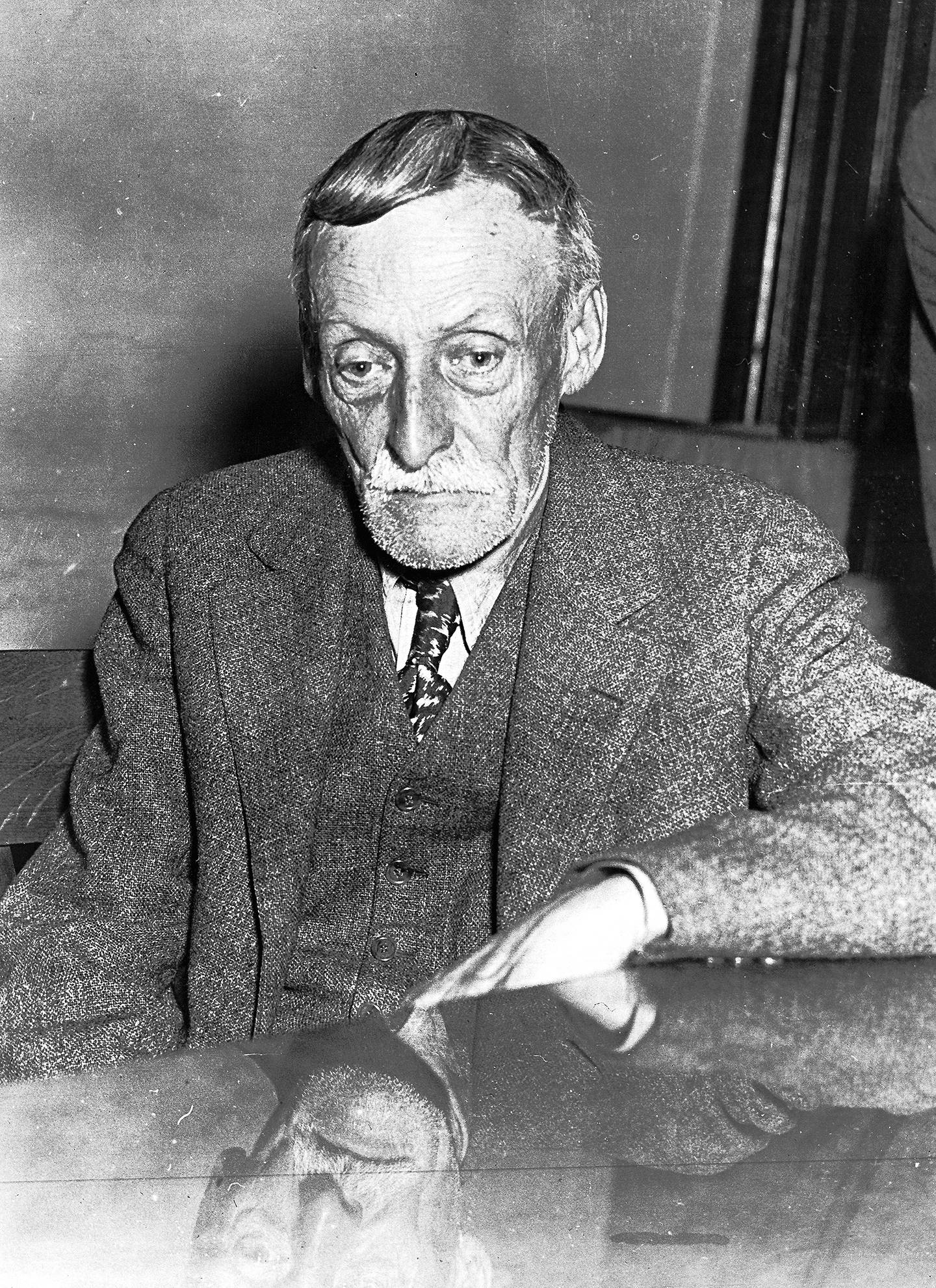
Albert Fish, known as the "Brooklyn Cannibal," the "Gray Man," and the "Boogeyman of Brooklyn," was an American serial killer, child molester, and cannibal who operated during the early decades of the 20th century. Arrested by New York City police in 1934 for the 1928 abduction and murder of ten-year-old Grace Budd, Fish confessed to numerous attacks, abductions, and murders. His 1935 trial became a watershed moment in American forensic psychiatry, highlighting the rigid boundaries of the legal insanity defense prior to his execution at Sing Sing Prison in 1936.
Who Was Albert Fish? The Psychological Profile of the "Gray Man"
Born Hamilton Howard Fish in Washington, D.C., on May 19, 1870, Fish experienced an extraordinarily chaotic childhood marked by family instability and institutionalization. Following the death of his father in 1875, Fish was placed in an orphanage, an environment where he later claimed to have first witnessed and experienced severe physical abuse and sadomasochistic behaviors. As he grew into adulthood, Fish adopted the name Albert and worked primarily as a painter and handyman throughout the East Coast, maintaining a deceptive appearance as a frail, grandfatherly figure.
Behind this unassuming exterior lay an extreme spectrum of psychiatric pathologies. Fish suffered from severe psychosexual sadomasochism, coprophilia, urolagnia, and acute religious mania characterized by complex auditory and visual hallucinations. He frequently engaged in violent self-harm, an aspect of his pathology that remained undiscovered by authorities until his arrest late in life.
Modern criminologists and psychiatrists classify Fish as a complex offender whose crimes were driven by deep-seated sadism combined with severe psychosis. Despite exhibiting behaviors that contemporary clinical diagnostics would categorize as extreme schizophrenia and severe personality disorders, Fish functioned within society for decades. He married, fathered six children, and maintained sporadic employment, using his benign, elderly presentation—which earned him the moniker "The Gray Man"—to evade suspicion while preying on vulnerable children across multiple states.
The Key Cases: Abductions, Murders, and Confessions
While Fish claimed in post-arrest statements to have molested hundreds of children and committed dozens of murders across the United States, criminal investigators and legal authorities definitively linked him to a smaller group of core cases. The disparity between his grandiose confessions and verified evidence remains a point of study for legal historians.
The Murder of Francis McDonnell (1924)
In July 1924, eight-year-old Francis McDonnell disappeared while playing near his home in Staten Island, New York. His body was discovered shortly after in a nearby wooded area, exhibiting clear signs of strangulation and severe physical trauma. Witnesses reported seeing an elderly man with gray hair and a mustache walking near the area shortly before the boy vanished. Although Fish later confessed to McDonnell's murder, providing details consistent with the crime scene, authorities at the time lacked the physical forensic tools to conclusively secure an indictment before Fish was tried for other offenses.
The Abduction and Murder of Billy Gaffney (1927)
Four-year-old Billy Gaffney vanished from the hallway of his apartment building in Brooklyn in February 1927. He had been playing with his older brother and a neighbor child, who later described an old man taking Billy away. The disappearance triggered a massive NYPD search across New York City, but no trace of the child was found. Years later, following his 1934 arrest, Fish provided handwritten and oral confessions detailing Gaffney’s abduction, torturous murder, and cannibalization.
The Murder of Grace Budd (1928)
The crime that ultimately led to Fish’s capture occurred in June 1928. Operating under the alias "Edward Budd," Fish visited the Manhattan home of Delia and Edward Budd in response to a classified advertisement placed by their eighteen-year-old son, Edward Jr., who was seeking employment. During the visit, Fish won the family's trust by presenting himself as a wealthy farmer from Farmingdale, Long Island.
Fish offered to take the Budds' ten-year-old daughter, Grace, to a birthday party at his sister's home in New York City, promising to return her later that evening. Instead, Fish transported Grace to an abandoned house known as Wisteria Cottage in Worthington, New York (near Westchester County). There, he murdered and cannibalized the child. The disappearance sparked a multi-year search that yielded no concrete leads until six years later.
Timeline of Key Events in the Albert Fish Case
- [1870] Born in Washington, D.C.
- [1924] Murder of Francis McDonnell (Staten Island)
- [1927] Abduction of Billy Gaffney (Brooklyn)
- [1928] Abduction and Murder of Grace Budd (Worthington, NY)
- [1934] The "Wisteria Letter" sent; Fish arrested by NYPD (Dec 13)
- [1935] Trial in White Plains, NY; Sane verdict rendered (Mar 11)
- [1936] Executed via Electric Chair at Sing Sing Prison (Jan 16)
The Breakthrough: The Wisteria Letter and the 1934 Arrest
For over six years, the abduction of Grace Budd remained one of New York City’s most notorious cold cases. The breakthrough occurred in November 1934, when Delia Budd received an anonymous, handwritten letter postmarked from New York City. The correspondence, which became known historically as the "Wisteria Letter," contained a graphic description of how the author had lured, murdered, and cannibalized Grace Budd over several days.
Excerpt Analysis: The Wisteria Letter (1934)
"In 1928, June 3, I came to your house... I took your little girl to an empty house in Westchester... She died a virgin. I choked her to death..."
Significance: Provided specific, non-public details of the victim's disappearance while leaving a critical physical clue: an organizational monogram on the envelope's upper left corner.
The author made a critical error by using an envelope bearing the partial insignia of the New York Private Chauffeur Benevolent Association. Detective William F. King, who had worked on the Grace Budd case continuously since 1928, spearheaded the forensic analysis of the envelope.
Envelope Insignia Discovered
Traced to Chauffeur Benevolent Assoc.
Janitor Identified: Took Blank Envelopes
Traced to Rooming House at 409 E. 52nd St.
Surveillance & Arrest of Albert Fish
Insignia Identification: Detective King visited the association’s headquarters and learned that a small batch of stationary had been taken by a former member or employee.
Paper Trail: Investigators traced the specific lot of envelopes to a rooming house located at 409 East 52nd Street in Manhattan.
Landlady Interview: The landlady identified a former tenant, an elderly painter named Albert Fish, who had left a small box of personal items behind, including stationary matching the letter.
Apprehension: On December 13, 1934, Detective King waited at the rooming house when Fish returned to retrieve his mail. When confronted, Fish produced a razor blade from his pocket, but King subdued and arrested him without further casualty.
Following his arrest, Fish made extensive written and verbal confessions to police officers and prosecutors, detailing not only the murder of Grace Budd but numerous other assaults across New York, New Jersey, and Delaware.
| Case / Victim | Date of Crime | Location | Legal Status / Outcome | Primary Evidence |
|---|---|---|---|---|
| Francis McDonnell | July 15, 1924 | Staten Island, NY | Unindicted / Confessed | Eyewitness descriptions matching Fish; post-arrest confession |
| Billy Gaffney | February 11, 1927 | Brooklyn, NY | Unindicted / Confessed | Detailed post-arrest written confession; victim clothing details |
| Grace Budd | June 3, 1928 | Worthington, NY | Convicted of Murder | "Wisteria Letter" matching handwriting; physical remains at scene |
| Unidentified Victims | 1910–1934 (Alleged) | Multi-State (NY, NJ, PA) | Unverified Claims | Self-reported statements; insufficient physical corroboration |
The 1935 Trial: Legal Insanity vs. Medical Insanity
The trial of Albert Fish opened on March 11, 1935, at the Westchester County Courthouse in White Plains, New York, presided over by Judge Frederick P. Close. Prosecutor Elbert F. Gallagher sought the death penalty for the murder of Grace Budd. Defense attorney James Dempsey entered a plea of not guilty by reason of insanity.
The Psychiatric Evidence
The trial became one of the most prominent medical-legal battles of the 20th century. The defense called Dr. Fredric Wertham, a renowned senior psychiatrist and director of the mental hygiene clinic at Bellevue Hospital. Wertham conducted exhaustive psychiatric evaluations of Fish and testified that the defendant suffered from extreme, irreversible mental disease, including complex religious hallucinations, sadomasochistic compulsions, and severe psychosis.
During medical examinations conducted while in custody, physical X-rays of Fish's pelvic region revealed an astounding physical manifestation of his sadomasochism: Fish had self-inserted at least 29 needles into his own groin, perineum, and abdomen over several decades. Dr. Wertham argued that no human being capable of such self-mutilation and horrific acts could be considered legally sane.
| Category | 1935 Insanity Defense Diagnostic Summary |
|---|---|
| Clinical Findings (Dr. Wertham) | • Severe psychosis and active religious mania• Extreme sadomasochism & coprophilia• X-ray evidence of 29 self-inserted needles in pelvic area |
| Legal Determination (M'Naghten Rule Standard) | • Understood the physical nature of his acts• Recognized that murder was prohibited by civil law• Demonstrated consciousness of guilt (used aliases, hid evidence) |
The M'Naghten Standard
Despite the overwhelming psychiatric evidence of profound mental illness, the prosecution argued that Fish met the strict legal standard for sanity established by the 19th-century M'Naghten Rule, which governed New York State criminal law at the time. Under the M'Naghten standard, a defendant was legally sane if they:
- Understood the nature and quality of the act they were committing.
- Knew that the act was legally and morally wrong.
Prosecution expert witnesses argued that Fish demonstrated clear consciousness of guilt. He used fictitious names (such as "Edward Budd"), carefully planned his abductions, carried out his crimes in secluded locations, lied to victims' families, and evaded law enforcement for six years. On March 21, 1935, after brief deliberation, the jury rejected the insanity defense and found Albert Fish guilty of first-degree murder, resulting in a mandatory sentence of death.
Execution at Sing Sing and Criminological Impact
Albert Fish was remanded to the death house at Sing Sing Correctional Facility in Ossining, New York. During his time on death row, he remained impassive and expressed no remorse for his crimes, reportedly telling guards that he looked forward to the experience of electrocution as the ultimate physical sensation.
On January 16, 1936, Fish was executed in the electric chair, colloquially known as "Old Sparky." Historical accounts from prison officials noted that the execution required two separate shocks of electric current, a technical complication that press reports at the time attributed to the metallic needles still embedded within his pelvis, which interfered with the electrical circuit through his body.
Modern Criminological Significance
The legacy of the Albert Fish case remains significant in the fields of forensic psychology, criminal profiling, and legal jurisprudence:
- Limits of the M'Naghten Standard: The case demonstrated the stark divide between medical diagnosis and legal definitions of insanity. While clinically psychotic, offenders who execute deliberate planning remain legally accountable under strict cognitive legal standards.
- Evolution of Serial Killer Profiling: Fish's ability to seamlessly blend into normal society while harboring extreme violent fantasies served as a foundational case study for the FBI's Behavioral Science Unit decades later when developing typologies of organized versus disorganized violent offenders.
- Child Safety and Public Awareness: The case drastically reshaped early 20th-century public awareness regarding child protection, highlighting the dangers of stranger abduction even when presented by seemingly non-threatening, elderly individuals.
Frequently Asked Questions
How was Albert Fish finally caught by the NYPD?
Albert Fish was apprehended after sending a handwritten letter to the mother of victim Grace Budd in 1934. Detective William King traced the custom monogram on the envelope to a rooming house in Manhattan. Investigators identified Fish as a former resident who had taken the stationery, leading to his arrest on December 13, 1934.
What was the Wisteria Letter in the Albert Fish case?
The Wisteria Letter was an anonymous confession sent by Albert Fish to Delia Budd in November 1934. It detailed the murder and cannibalization of ten-year-old Grace Budd at an abandoned property named Wisteria Cottage in Westchester County, New York. The physical evidence on the envelope provided the key clue that broke the cold case.
Why was Albert Fish found legally sane despite extreme mental illness?
Under the legal standard of the era (the M'Naghten Rule), sanity was judged strictly on whether the defendant knew the physical nature of their actions and understood that those actions were illegal. Because Fish used aliases, hid evidence, and intentionally evaded police, the court ruled he possessed consciousness of guilt and was therefore legally responsible for his actions.
How many victims was Albert Fish officially convicted of murdering?
Albert Fish was tried and convicted for a single murder: the 1928 killing of ten-year-old Grace Budd. Although he confessed to killing several other children, including Billy Gaffney and Francis McDonnell, prosecutors focused on the Grace Budd case because it offered the strongest physical evidence and a clear confession supported by scene recovery.
What did X-rays reveal during Albert Fish's medical examination?
Pelvic X-rays taken at Bellevue Hospital prior to his 1935 trial revealed that Fish had inserted at least 29 steel sewing needles directly into his lower abdomen and groin over many years. The discovery served as primary medical evidence of his severe psychosexual sadomasochism during his trial.
Accessing Historical Legal and Psychiatric Records
For historians, legal researchers, and criminologists examining 20th-century legal precedent and forensic psychiatry, primary source materials regarding the Albert Fish case are preserved in several institutional archives:
- New York State Archives (Albany, NY): Holds appellate court records, Sing Sing execution logs, and official governor clemency hearing transcripts related to the 1935 trial People v. Fish.
- The Bellevue Hospital Psychiatric Archives: Contains historical research notes and diagnostic observations compiled by Dr. Fredric Wertham regarding early 20th-century institutional psychiatric evaluations.
- Municipal Archives of the City of New York: Maintains historical NYPD detective bureau logs, cold case files from the 1920s and 1930s, and original arrest reports related to Detective William King's investigation.
Researchers reviewing these historical files should approach the material through the dual lenses of evolving 1930s forensic pathology and the foundational development of modern criminal justice procedures.
EDITORIAL CATEGORY METADATA: