Modern commercial aviation relies on a precisely coordinated division of labor, where flight deck officers and cabin personnel share distinct operational, safety, and customer service duties to ensure every flight proceeds efficiently from pushback to arrival.
Modern commercial aviation operates through a highly regulated and carefully structured hierarchy. Every individual on board a commercial airliner fulfills a specific operational function designed to maximize safety, regulatory compliance, and passenger comfort. Understanding airline crew roles requires examining how distinct training pathways, certifications, and responsibilities intersect within the confined environment of an aircraft cabin and flight deck. From the strategic command of the captain to the specialized medical and security training of flight attendants, each position is governed by international aviation standards established by bodies like the International Civil Aviation Organization (ICAO) and enforced by national regulators such as the Federal Aviation Administration (FAA) or the European Union Aviation Safety Agency (EASA).
The Flight Deck Hierarchy: Captains and First Officers
The flight deck, historically known as the cockpit, represents the operational brain of any commercial flight. Command of the aircraft rests with the captain, who holds ultimate legal and operational responsibility for the safety of the flight, the aircraft, the passengers, and the crew. The captain acts as the pilot-in-command (PIC), a legal designation defined by aviation law that grants ultimate authority to make decisions regarding flight path, weather deviations, emergency protocols, and operational delays.
Assisting the captain is the first officer, often referred to as the co-pilot. The first officer shares equal flying duties with the captain under a system of shared pilot flying (PF) and pilot monitoring (PM) roles that rotate from leg to leg. While one pilot actively manipulates the flight controls and manages the aircraft's trajectory, the other manages radio communications, cross-checks instrument readings, programs the flight management computer (FMC), and monitors checklist execution.
To qualify for these flight deck positions, candidates must undergo rigorous training programs. Captains require an Airline Transport Pilot (ATP) license, thousands of hours of flight experience, and extensive command upgrade training. First officers typically hold a Commercial Pilot License (CPL) with an instrument rating and a multi-engine endorsement, alongside a type rating specific to the aircraft model they operate. Crew resource management (CRM) training is mandatory for both pilots, focusing on interpersonal communication, leadership, and decision-making to mitigate human error in high-stress environments.
Cabin Crew Leadership: Pursers, Purser-In-Charge, and Senior Flight Attendants
Behind the flight deck door, the cabin environment is managed by a supervisory tier of cabin crew personnel, variously known as lead flight attendants, pursers, or cabin service directors, depending on the airline's terminology and the aircraft type. This supervisory role bridges the communication gap between the flight deck and the rest of the cabin crew, ensuring that service standards align with safety directives issued by the captain.
The purser-in-charge is responsible for pre-flight briefings, verifying that all safety equipment is operational, assigning specific emergency stations to junior flight attendants, and coordinating the service flow. During boarding, they manage passenger flow issues, address seating discrepancies, and liaise with ground staff regarding special assistance passengers or late-connecting luggage. In-flight, the purser monitors cabin security, handles disruptive passenger incidents, and acts as the primary conduit for information passing between the cabin and the flight deck.
Advanced training for cabin supervisors focuses on crisis leadership, conflict de-escalation, medical emergency triage, and advanced fire-fighting techniques. Unlike standard flight attendants whose primary focus centers on individual exit rows and designated service zones, the purser maintains a holistic view of the entire cabin ecosystem, ensuring regulatory compliance across multiple galleys and zones on wide-body or narrow-body aircraft.
Flight Attendants: Safety Professionals in the Sky
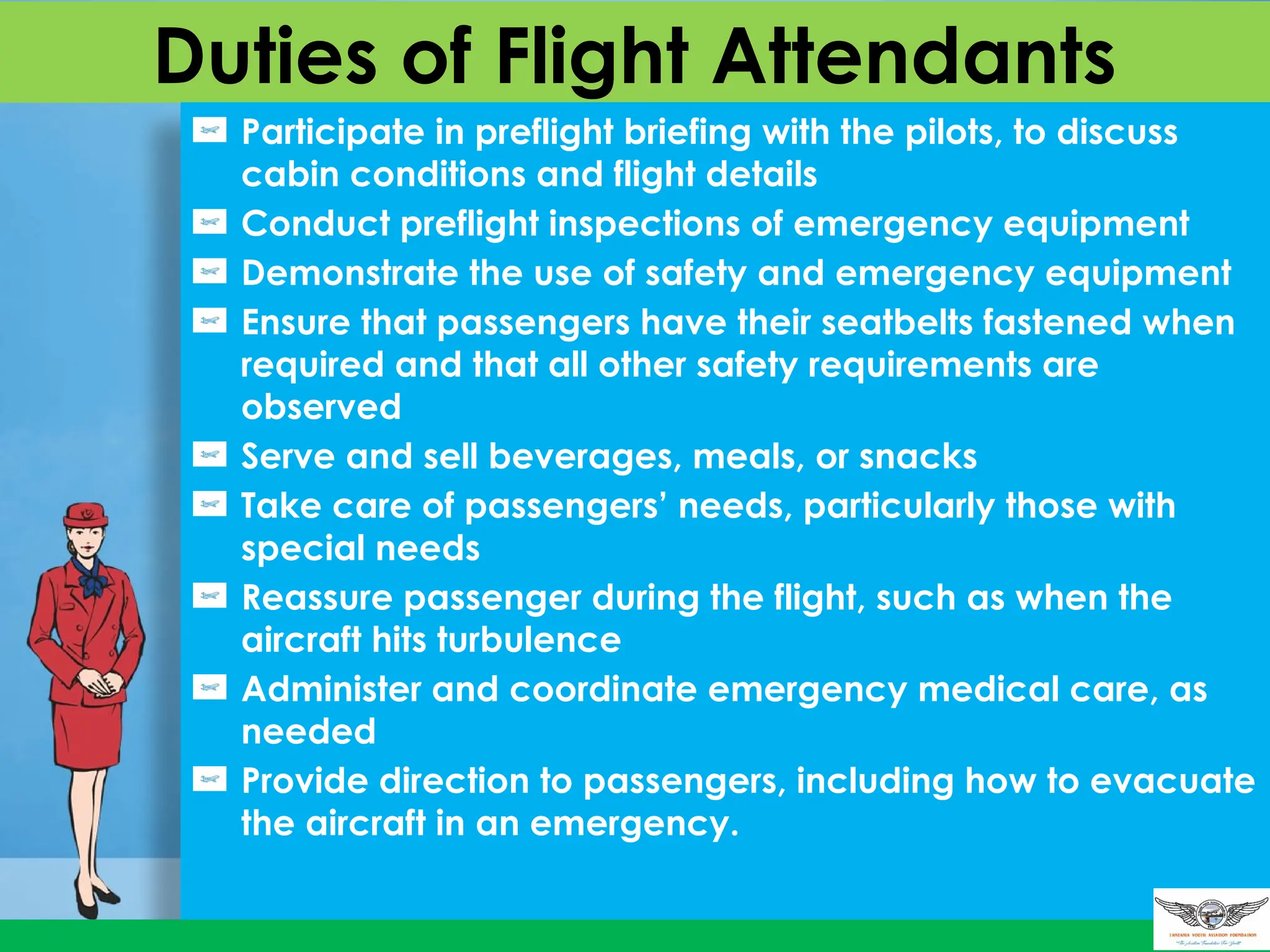
While popular perception often reduces flight attendants to hospitality personnel, international aviation regulations mandate that their primary legal purpose is the evacuation, safety, and security of passengers. Every flight attendant undergoes rigorous initial and annual recurrent training covering emergency evacuation drills, decompression procedures, ditching protocols, survival skills, and hazardous materials management.
Flight attendants are stationed at specific emergency exit doors during critical phases of flight, such as takeoff and landing. They are trained to evaluate exterior environmental hazards—such as fire, smoke, or water—before opening exits during an emergency evacuation. Their training also equips them to handle medical crises ranging from cardiac arrest using an Automated External Defibrillator (AED) to childbirth, severe allergic reactions, and passenger incapacitation.
Beyond emergency duties, flight attendants manage routine cabin operations. This includes securing the cabin for taxi, takeoff, and landing, conducting safety demonstrations, monitoring passenger compliance with seatbelt signs and electronic device regulations, and providing food and beverage services. The balance between customer service excellence and uncompromising safety enforcement forms the core of the modern flight attendant's daily professional reality.
Specialized and Relief Crew Members: Flight Engineers and Relief Pilots
On ultra-long-haul routes and older aircraft generations, specialized crew roles supplement the standard captain, first officer, and flight attendant complement. While two-pilot flight decks have become the global standard for the vast majority of narrow-body and modern wide-body aircraft, certain complex or legacy operations require additional personnel.
Flight engineers, also known as second officers, historically occupied the third seat in three-person flight decks. They monitored and managed complex mechanical, electrical, and fuel systems, allowing the pilots to focus entirely on flight navigation and control. Although advanced automation and glass cockpits have largely phased out the dedicated flight engineer on modern commercial airliners like the Boeing 777 or Airbus A350, they still operate on certain older freighter aircraft and specific military transports.
For long-haul international flights exceeding normal crew duty time limitations, airlines utilize augmented crews that include relief pilots and relief flight attendants. Cruise relief pilots typically hold the same qualifications as the active first officer or captain and relieve them during the cruise phase of flight, allowing the primary crew members mandatory rest periods in dedicated crew rest compartments. This ensures high levels of alertness and cognitive function during critical arrival and landing phases.
| Crew Role | Primary Responsibility | Key Qualifications & Training |
|---|---|---|
| Captain | Ultimate command, flight safety, legal authority | ATP license, type rating, extensive command hours, CRM |
| First Officer | Shared piloting duties, flight monitoring, communication | CPL, instrument rating, type rating, CRM |
| Purser / Lead | Cabin supervision, crew coordination, safety management | Senior flight attendant experience, leadership training |
| Flight Attendant | Passenger safety, emergency evacuation, cabin service | Safety certification, medical training, evacuation drills |
| Cruise Relief Pilot | In-flight cruise management, rest rotation support | ATP or CPL with type rating and airline line training |
Ground and Support Personnel Interfacing with Flight Crews
The execution of airline crew roles depends heavily on an extensive network of ground-based professionals who support the flight and cabin crews before, during, and after each journey. Flight dispatchers, also known as flight operations officers, share joint responsibility with the captain for the operational planning, flight path optimization, fuel load calculation, and weather route analysis of every commercial flight.
Before stepping onto the aircraft, flight crews meet with dispatchers to review operational flight plans (OFPs), NOTAMs (Notices to Air Missions), meteorological charts, and weight and balance manifests. Throughout the flight, dispatchers monitor aircraft progress and provide updated weather advisories or rerouting suggestions if thunderstorms, turbulence, or air traffic control flow restrictions arise.
Maintenance controllers and station duty managers further support crews by troubleshooting technical discrepancies that arise during transit stops. If an aircraft system reports an amber or red advisory message, the flight crew collaborates with maintenance engineering via data link or voice communications to evaluate Minimum Equipment List (MEL) compliance, determining whether a defect permits continued flight or requires immediate rectification on the ground.
Frequently Asked Questions
What is the difference between a captain and a first officer?
A captain holds ultimate legal and operational command of the aircraft, bearing final responsibility for safety and decision-making. A first officer shares flying and monitoring duties equally with the captain, serving as second-in-command and taking control of the aircraft when designated as the pilot flying.
Why are flight attendants legally required on commercial flights?
Flight attendants are mandated primarily as safety and emergency evacuation professionals. While they provide customer service, their core regulatory function is to manage emergency exits, execute rapid evacuations, fight cabin fires, and administer first aid during medical crises.
What is Crew Resource Management (CRM)?
Crew resource management is a training system that focuses on interpersonal communication, leadership, situational awareness, and collaborative decision-making among all flight deck and cabin crew members to prevent human error and enhance flight safety.
Do all long-haul flights require extra pilots?
Long-haul flights exceeding standard maximum flight duty periods require augmented flight crews. These operations include relief pilots who take over monitoring and flying duties during the cruise phase, enabling the primary crew members to utilize designated rest facilities.
Who is responsible for flight planning and fuel calculations?
Flight planning and fuel calculations are executed jointly by the airline flight dispatcher and the captain. The dispatcher generates the initial operational flight plan based on weather, payload, and route efficiency, which the captain then reviews, modifies if necessary, and legally approves before departure.
Optimizing Crew Coordination and Operational Safety
Ensuring seamless execution across all airline crew roles requires a continuous commitment to standardized operating procedures, transparent communication, and joint training exercises. Aviation organizations continually refine their training curricula to incorporate lessons learned from safety data analysis, human factors research, and technological advancements. Airlines, regulatory bodies, and aviation professionals must maintain rigorous standards of communication and mutual accountability to preserve the safety and efficiency of global commercial air transport.