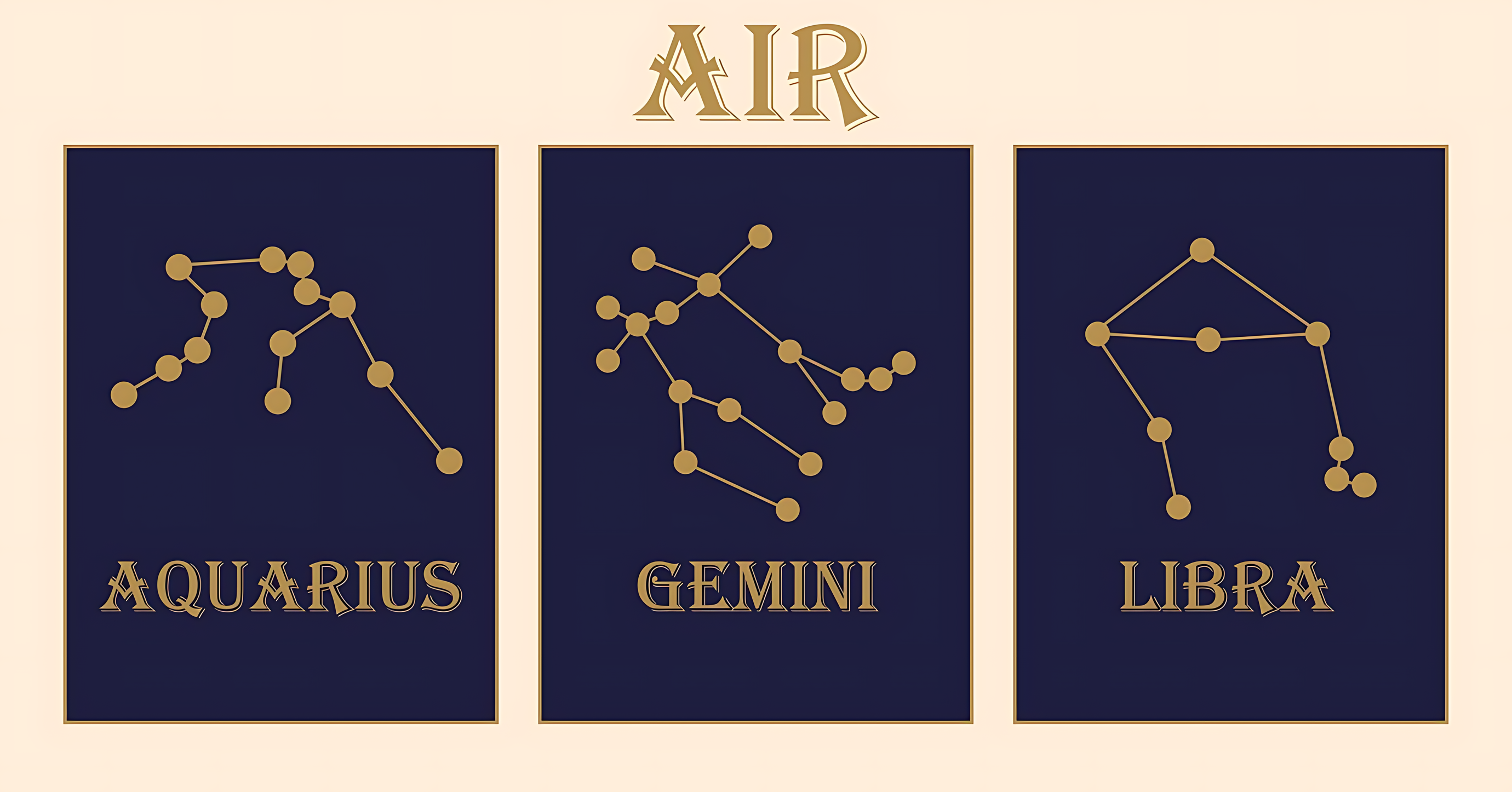
An air sign relationship—whether between two Air signs (Gemini, Libra, or Aquarius) or an Air sign paired with another element—is defined primarily by mental stimulation, active communication, and a shared valuation of personal autonomy. These partnerships excel at conceptual problem-solving, intellectual exchange, and social engagement, though they frequently require intentional effort to develop emotional depth and long-term practical stability.
Core Characteristics of the Air Element in Astrology
In tropical astrology, the Air element represents the mental sphere: intellect, perspective, social connectivity, and the dissemination of ideas. Unlike Water, which processes life through emotion, or Earth, which relies on physical reality, Air operates through abstract thought, logic, and verbal exchange. When Air signs enter romantic or interpersonal relationships, their primary medium of connection is dialogue.
Understanding how an Air sign behaves in a partnership requires examining the three distinct astrological modalities—Mutable, Cardinal, and Fixed—through which the Air element expresses itself:
- Gemini (Mutable Air): Ruled by Mercury, Gemini approaches relationships through curiosity, versatility, and constant mental exchange. As a mutable sign, Gemini adapts quickly to shifting conversations and environments, seeking a partner who offers intellectual variety, playfulness, and fresh perspectives.
- Libra (Cardinal Air): Ruled by Venus, Libra focuses on partnership, relational harmony, aesthetics, and justice. As a cardinal sign, Libra actively initiates connection, weighing options to create balance, fairness, and mutual respect within intimate bonds.
- Aquarius (Fixed Air): Ruled by Saturn and traditionally associated with Uranus, Aquarius approaches relationships through the lens of ideology, friendship, and personal authenticity. As a fixed sign, Aquarius exhibits strong intellectual loyalty and conviction, seeking a partner who respects their independence and shares their broader vision of the world.
When these archetypes interact, they prioritize clear reasoning and open dialogue over emotional intensity. However, an over-reliance on logic can sometimes create a distance between theoretical understanding and lived emotional experience.
The Air-on-Air Bond: Dynamics of Double-Air Pairings
When two Air signs form a relationship, the partnership is characterized by an immediate, effortless conversational rhythm. These couples rarely run out of topics to discuss, easily transitioning from current events and philosophy to creative ideas and social observations.
- Air Sign 1 and Air Sign 2: Intellectual Exchange
- Air Sign 1: High Autonomy & Freedom
- Air Sign 2: Open Dialogue & Curiosity
- Potential Shared Friction:
- Intellectualizing Deep Emotions
- Neglecting Practical Grounding
Key Strengths of Air-on-Air Partnerships
- Mutual Respect for Autonomy: Neither partner feels threatened by the other’s need for personal space, outside friendships, or independent hobbies. Freedom is treated as a fundamental requirement rather than a privilege to be negotiated.
- Low Propensity for Emotional Drama: Conflicts are typically approached rationally. Rather than engaging in explosive emotional confrontations, double-Air pairings prefer to talk through disagreements, dissecting the logic behind each person's perspective.
- Continuous Intellectual Curiosity: These couples inspire one another to learn, read, travel, and explore new concepts, ensuring that the mental spark of the relationship remains active over time.
Systemic Challenges in Double-Air Pairings
- Emotional Avoidance: Because both partners feel comfortable in the intellect, they may instinctively intellectualize their feelings instead of experiencing them directly. Vulnerability can be reframed as a debate or a conceptual problem to be solved.
- Lack of Practical Grounding: Air energy floats; without external grounding elements, double-Air couples may struggle with routine execution, such as long-term financial planning, domestic management, or establishing concrete future structures.
- Superficiality Risks: If conversations remain perpetually light, witty, or analytical, the partnership risks staying at an intellectual surface level, missing the transformative depth that comes from shared emotional risk.
Elemental Cross-Compatibility: Air Signs with Fire, Earth, and Water
To understand the broader spectrum of an air sign relationship, one must evaluate how Air interacts with the other three natural elements. Each combination creates a distinct energetic dynamic with unique growth areas.
- AIR SIGN ENERGY (Intellect & Freedom)
- FIRE (Action & Passion): High Energy (Fuel & Wind)
- EARTH (Structure & Reality): Anchoring Dynamics (Concepts & Reality)
- WATER (Emotion & Intuition): Intellect vs. Feeling (Reason & Vulnerability)
Air and Fire (Aries, Leo, Sagittarius)
Air feeds Fire, and Fire warms Air. This relationship is typically high-energy, dynamic, and full of mutual inspiration. Fire brings passion, instinctual drive, and action to Air’s ideas, while Air provides the vision, strategy, and intellectual clarity that Fire needs to direct its enthusiasm effectively.
- Friction Point: Both elements can be impatient and prone to sudden shifts in focus. Without careful management, the relationship can burn brightly initially but lack the stamina required for long-term endurance.
Air and Earth (Taurus, Virgo, Capricorn)
Air and Earth represent the meeting of ideas and reality. Earth provides the structural foundation, practical execution, and physical stability that Air often lacks. In return, Air brings fresh concepts, objectivity, and mental flexibility to Earth’s methodical approach.
- Friction Point: Earth may view Air as overly theoretical, inconsistent, or ungrounded. Conversely, Air may perceive Earth as rigid, overly cautious, or resistant to new perspectives. Success requires mutual respect for each other’s operational pace.
Air and Water (Cancer, Scorpio, Pisces)
Air and Water pairings bridge the head and the heart. Water introduces emotional depth, intuitive understanding, and empathetic closeness to the relationship, helping Air connect with non-verbal feeling states. Air offers Water objective perspective, rational clarity, and relief from emotional overwhelm.
- Friction Point: Air naturally seeks to explain emotions logically, whereas Water seeks to feel and process them intuitively. If Air dismisses Water’s emotional experiences as irrational, or if Water demands immediate emotional disclosure that Air feels unequipped to provide, emotional distance can develop.
Elemental Relationship Matrix
| Element Pairing | Dominant Relationship Synergy | Primary Source of Friction | Communication Strategy |
|---|---|---|---|
| Air + Air | Exceptional intellectual dialogue, shared respect for freedom. | Avoidance of raw emotional depth; difficulty committing to physical routines. | Intentionally schedule emotional check-ins that focus on feeling rather than analysis. |
| Air + Fire | High enthusiasm, creative innovation, spontaneous adventure. | Impatience, high risk of burnout, lack of structural maintenance. | Establish routine habit loops to transform shared ideas into practical, long-term goals. |
| Air + Earth | Pragmatic execution of intellectual vision; balanced decision-making. | Pace mismatches; Earth feels unanchored, Air feels constrained. | Frame practical routines as enabling freedom rather than restricting flexibility. |
| Air + Water | Dynamic balance between analytical clarity and emotional depth. | Misinterpreting logical analysis as emotional indifference or coldness. | Practice active listening without attempting to immediately "fix" emotional expressions. |
Overcoming Common Pitfalls in Air Sign Relationships
Building a lasting partnership involving Air signs requires targeted strategies to address inherent elemental blind spots. By focusing on emotional literacy, structural accountability, and authentic intimacy, Air sign partnerships can achieve long-term balance.
1. Shifting from Intellectualizing to Feeling
Air signs often default to explaining why they feel a certain way rather than simply feeling it. To cultivate genuine emotional intimacy:
- Name the Physical Sensation: Practice identifying emotions through body awareness (e.g., tight chest, tension in the shoulders) rather than providing a detailed narrative of the situation.
- Pause the Analysis: When a partner expresses hurt or distress, resist the urge to offer immediate logical solutions. Focus instead on emotional validation using empathetic statements such as, "I hear how heavy that feels for you."
2. Balancing Independence with Interdependence
While autonomy is a core value for Air signs, total detachment can prevent the development of a resilient relationship foundation.
- Establish Clear Commitments: Autonomy does not mean an absence of structure. Set explicit expectations around communication cadence, future planning, and shared responsibilities.
- Create Shared Rituals: Maintain individual social lives and hobbies, but protect regular, un-distracted shared experiences (such as weekly dinners or collaborative projects) to maintain relational alignment.
3. Converting Ideas into Concrete Action
Air sign energy generates an abundance of ideas, plans, and theoretical visions. However, without deliberate effort, these concepts can remain unrealized.
- Implement Project Management Frameworks: Treat major shared goals—such as moving in together, planning travel, or managing household finances—with structured timelines and defined responsibility ownership.
- Focus on Consistency over Novelty: Resist the urge to abandon existing shared systems the moment a newer, more interesting idea emerges. Build depth through persistent routine.
Essential Guidance for Partners of Air Signs
If you are dating or partnered with a Gemini, Libra, or Aquarius, understanding their primary psychological drivers will significantly improve your relationship dynamic:
- Engage Their Intellect: The most direct path to an Air sign's affection is compelling conversation. Ask open-ended questions about their interests, share articles or books, and engage in constructive debate without taking differing opinions personally.
- Respect Their Need for Freedom: Air signs thrive when they feel unconfined. Avoid micromanaging their time or demanding constant contact. Demonstrating trust in their independence strengthens their commitment to the relationship.
- State Needs Clearly and Directly: Air signs do not typically pick up on subtle emotional hints or passive-aggressive behavior. They respond best to clear, calm, and articulate communication regarding your expectations and boundaries.
- Maintain Your Own World: Air signs are deeply attracted to partners who possess their own passions, intellectual pursuits, and social networks. Maintaining your personal identity serves as a continuous source of interest and mutual respect within the partnership.
Frequently Asked Questions
What happens when two Air signs fall in love?
When two Air signs fall in love, the connection is marked by instant rapport, deep conversational compatibility, and mutual respect for personal independence. The relationship feels light, intellectually stimulating, and socially active. To ensure long-term stability, both partners must work to build emotional depth and address practical day-to-day responsibilities together.
Are Air signs emotionally cold or detached in relationships?
Air signs are rarely emotionally cold by intent; rather, their primary processing mode is rational and analytical. When faced with strong emotions, their natural instinct is to stepped back, analyze the situation objectively, and seek clarity. While this can sometimes be perceived as detachment, it is simply their framework for processing information safely and logically.
Which Air sign is the most loyal in romantic partnerships?
Aquarius, as a Fixed Air sign, generally exhibits the highest level of stability and structural loyalty among the Air signs. Once an Aquarius commits to a partner who respects their core values and independence, they demonstrate strong dedication. However, both Libra (focused on long-term balance) and Gemini (loyal to deep intellectual bonds) offer strong fidelity when their core relationship needs are met.
How do you resolve conflict with an Air sign partner?
Conflict resolution with an Air sign requires a calm, clear, and logical approach. Present your perspective clearly without relying on intense emotional outbursts or passive-aggressive behavior. Give them space to process the information rationally, and be prepared to discuss concrete solutions collaboratively.
Which element is most compatible with an Air sign overall?
Fire signs (Aries, Leo, Sagittarius) are traditionally considered the most dynamic and natural match for Air signs, as Fire provides excitement, drive, and warmth that complements Air's intellectual energy. However, pairings with Earth offer grounding, and pairings with Water offer emotional depth—meaning overall compatibility ultimately depends on the complete chart dynamic between both individuals.
Cultivating Long-Term Stability in Air Sign Relationships
To ensure an air sign relationship remains fulfilling over many years, partners must bridge the gap between abstract ideas and practical commitment. Intellectual chemistry provides a strong foundation, but enduring closeness requires active cultivation of emotional vulnerability and routine domestic harmony.
Begin by evaluating your current communication patterns. Identify areas where logical analysis may be replacing genuine feeling, and establish clear, consistent habits that encourage physical presence and emotional openness. By balancing freedom with commitment and intellect with empathy, air sign partnerships can achieve both expansive personal growth and lasting stability.