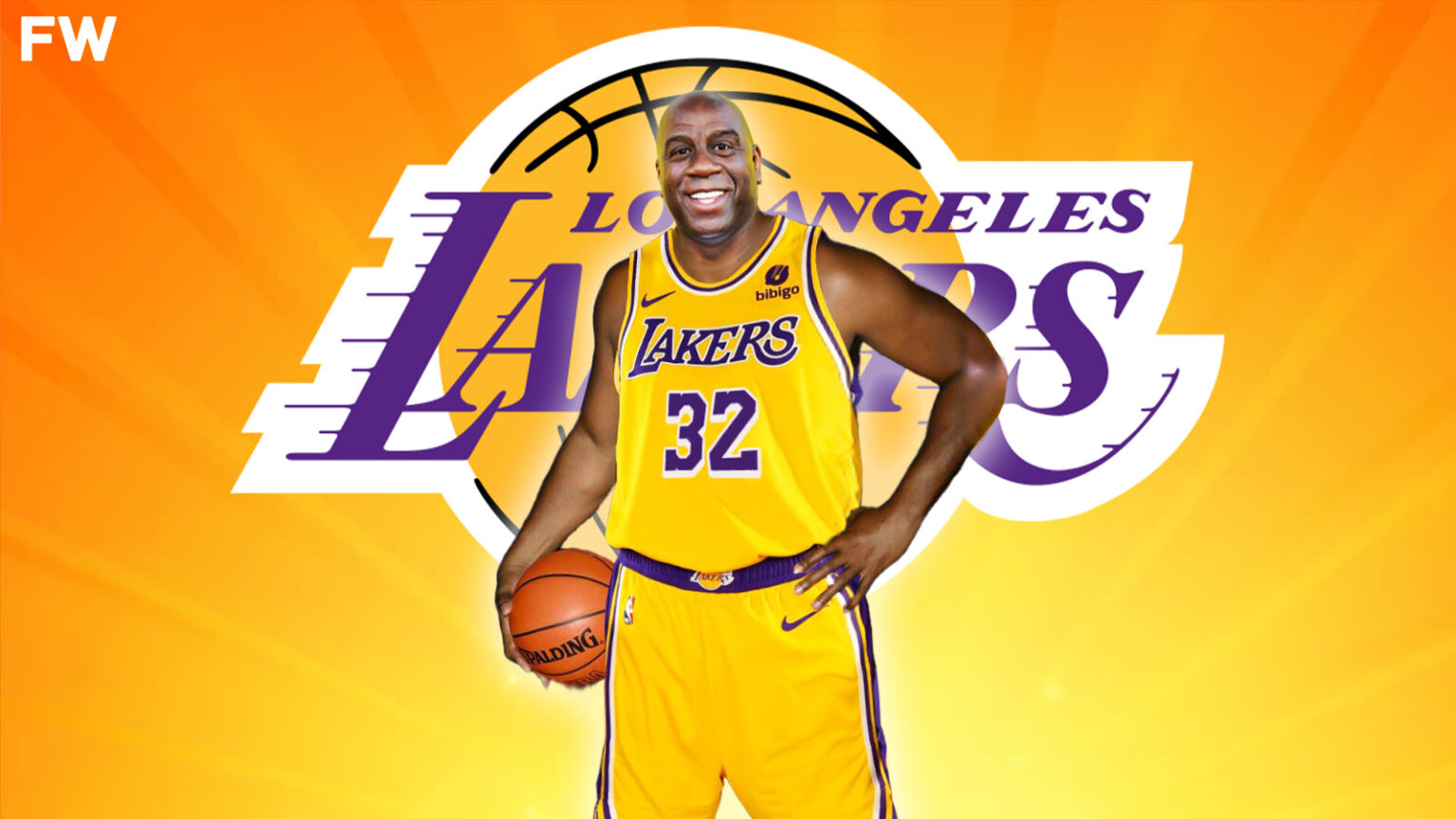
As of August 14, 2026, Magic Johnson is 67 years old. Beyond his age and high-profile business ventures, his NBA legacy is defined by a record-breaking 11.2 career assists per game and "hidden" advanced metrics, including a 40.7% career assist percentage and a .225 Win Shares per 48 minutes, which rank him among the most efficient players in basketball history.
The Architectural Impact of Earvin "Magic" Johnson
To understand the age of Magic Johnson is to understand the evolution of the modern NBA. Born in 1959, Johnson entered a league in 1979 that was struggling with identity and viewership. His arrival, alongside Larry Bird, catalyzed the "Showtime" era of the Los Angeles Lakers. While most fans remember the no-look passes and the five championship rings, the technical depth of his "hidden" legacy lies in how he manipulated the geometry of the court.
Magic was the first true "positionless" superstar. Standing 6'9", he possessed the height of a power forward but the vision and ball-handling of a traditional point guard. This physical anomaly allowed the Lakers to run a high-paced transition offense that relied on defensive rebounding and immediate outlet passing. By 2026, we see the fruits of this evolution in players like Nikola Jokić and LeBron James, who function as primary playmakers despite their size—a blueprint pioneered by Johnson.
Deciphering the Hidden Stats: Beyond Points and Assists
Standard box scores often fail to capture the true efficiency of Magic Johnson's game. To appreciate his "hidden" legacy, one must look at advanced metrics that were not widely discussed during his active playing years (1979–1991, and a brief return in 1996).
Assist Percentage (AST%)
Magic Johnson holds the highest career assists-per-game average in NBA history at 11.2. However, his Assist Percentage (AST%) is the deeper metric. This stat estimates the percentage of teammate field goals a player assisted while he was on the floor. Throughout his prime in the 1980s, Magic’s AST% consistently hovered between 45% and 50%. This means he was directly responsible for nearly half of every basket scored by his teammates while he was in the game, an astronomical level of offensive gravity that forced defenses into constant rotations.
Win Shares per 48 Minutes (WS/48)
Win Shares is an advanced metric that attempts to credit a player for their contribution to team victories. Magic Johnson’s career WS/48 of .225 is remarkably high, placing him in the top 10 all-time. For context, the average NBA player’s WS/48 is roughly .100. This indicates that Magic was more than twice as effective as a standard league player at generating wins, even when adjusting for the high-scoring era of the 1980s.
True Shooting Percentage (TS%)
A common misconception is that Magic was purely a passer. His True Shooting Percentage (TS%), which accounts for field goals, three-pointers, and free throws, was often above 60% during his MVP seasons. For a guard in the 80s, this level of efficiency was rare. It allowed him to remain a scoring threat (averaging 19.5 PPG career), which in turn made his passing lanes more accessible because defenders could not afford to "slack off" him.
The Versatility Metric: The 1980 NBA Finals Anomaly
One of the most significant "stats" in Magic’s legacy isn't a number but a lineup change. In Game 6 of the 1980 NBA Finals, as a 20-year-old rookie, Johnson started at center in place of the injured Kareem Abdul-Jabbar. He finished the game with 42 points, 15 rebounds, and 7 assists.
This performance is often cited by basketball historians as the ultimate proof of his versatility. Statistically, it highlighted his ability to maintain elite efficiency across multiple positions. In 2026, the NBA emphasizes "switchability" on defense and "playmaking from all spots" on offense; Magic Johnson demonstrated the peak of this capability nearly five decades ago.
Comparative Analysis: Magic Johnson vs. Other Legendary Playmakers
To contextualize Magic's dominance, it is helpful to compare his career peak with other legendary guards. The following table highlights the "hidden" efficiency metrics that separate him from his peers.
| Player | Career Assists Per Game | Career AST% | Win Shares / 48 | Championships |
|---|---|---|---|---|
| Magic Johnson | 11.2 | 40.7% | .225 | 5 |
| John Stockton | 10.5 | 50.2% | .209 | 0 |
| Oscar Robertson | 9.5 | 31.0%* | .207 | 1 |
| Chris Paul | 9.3 | 44.5% | .233 | 0 |
| Stephen Curry | 6.4 | 30.6% | .201 | 4 |
*Note: AST% was estimated for eras prior to the mid-70s.
While John Stockton has a higher career assist percentage and total assists, Magic's higher Win Shares per 48 and championship count illustrate his ability to translate individual playmaking into ultimate team success. His impact was not just about the volume of passes, but the leverage of those passes in high-stakes environments.
The Longevity and Health Context
In 2026, Magic Johnson’s health remains a subject of inspiration. When he announced his HIV diagnosis in 1991, it was widely feared to be a terminal sentence. Instead, his survival and continued vitality into his late 60s became a landmark in medical history and public health advocacy.
From a statistical standpoint, his 1991 retirement occurred while he was still at his peak. In his final full season (1990-91), he averaged 12.5 assists and finished second in MVP voting. The "hidden" legacy here is the lost statistical volume. Had his career not been interrupted, he likely would have challenged the all-time records for total assists and steals, which are currently held by John Stockton.
The Showtime Pace: Revolutionizing Team Offensive Rating
Magic Johnson’s influence is best seen in the Offensive Rating (ORTG) of the Los Angeles Lakers. During the 1980s, the Lakers consistently ranked near the top of the league in points produced per 100 possessions.
The "hidden" element was the Pace Factor. Magic’s Lakers played at one of the fastest tempos in the league, yet they maintained a low turnover rate relative to their speed. This combination of high velocity and high precision is what defined "Showtime." Modern teams in the 2020s strive for this same balance, using advanced analytics to maximize possessions, a concept Magic executed intuitively.
Practical Legacy: Why His Stats Still Matter in 2026
For coaches and analysts today, Magic’s career serves as a case study in "Floor Raising" vs. "Ceiling Raising."
- Floor Raising: A player who makes a bad team decent through high usage.
- Ceiling Raising: A player who makes a great team a champion through efficiency and leadership.
Magic Johnson was the ultimate ceiling raiser. His ability to defer to Kareem Abdul-Jabbar or James Worthy when necessary, while still maintaining a massive statistical footprint, is the gold standard for superstar chemistry. His "hidden" stats prove that his value was not just in the highlights, but in the efficiency of every dribble and pass.
Frequently Asked Questions
How many MVPs did Magic Johnson win?
Magic Johnson won three NBA Most Valuable Player (MVP) awards (1987, 1989, and 1990). He also won three NBA Finals MVP awards (1980, 1982, and 1987), making him one of the most decorated individual players in the history of the sport.
What is Magic Johnson’s current role in the NBA?
As of 2026, Magic Johnson does not hold an official front-office position with a team, having famously stepped down as the Lakers' President of Basketball Operations in 2019. However, he remains an influential ambassador for the league and a part-owner of several professional sports franchises, including the Los Angeles Dodgers (MLB) and the Washington Commanders (NFL).
How did Magic Johnson’s height change the point guard position?
Prior to Magic, point guards were typically the smallest players on the court (usually between 6'0" and 6'3"). At 6'9", Magic proved that a player with the size of a forward could possess the agility and vision to lead an offense. This paved the way for modern "giant" playmakers like Ben Simmons, Luka Dončić, and Cade Cunningham.
What are Magic Johnson’s total career stats?
Over 906 regular-season games, Magic Johnson recorded 17,707 points, 6,559 rebounds, and 10,141 assists. In the playoffs, his impact was even more pronounced, as he holds the record for the most playoff assists in NBA history (2,346).
Did Magic Johnson ever lead the league in scoring?
No, Magic Johnson never led the league in scoring. His primary focus was playmaking. His highest scoring average for a single season was 23.9 points per game in the 1986-87 season, the same year he won his first MVP.
Next Steps for Basketball Historians and Analysts
To truly appreciate the depth of Magic Johnson's impact, one should explore the NBA's official historical archives and advanced database tools like Basketball-Reference. Analyzing his game-by-game impact during the 1987 season—often cited as his "statistical masterpiece"—provides a blueprint for how elite playmaking can dominate a league. As the NBA continues to embrace positionless basketball in 2026, looking back at the "Age of Magic" remains the best way to understand the league's future.