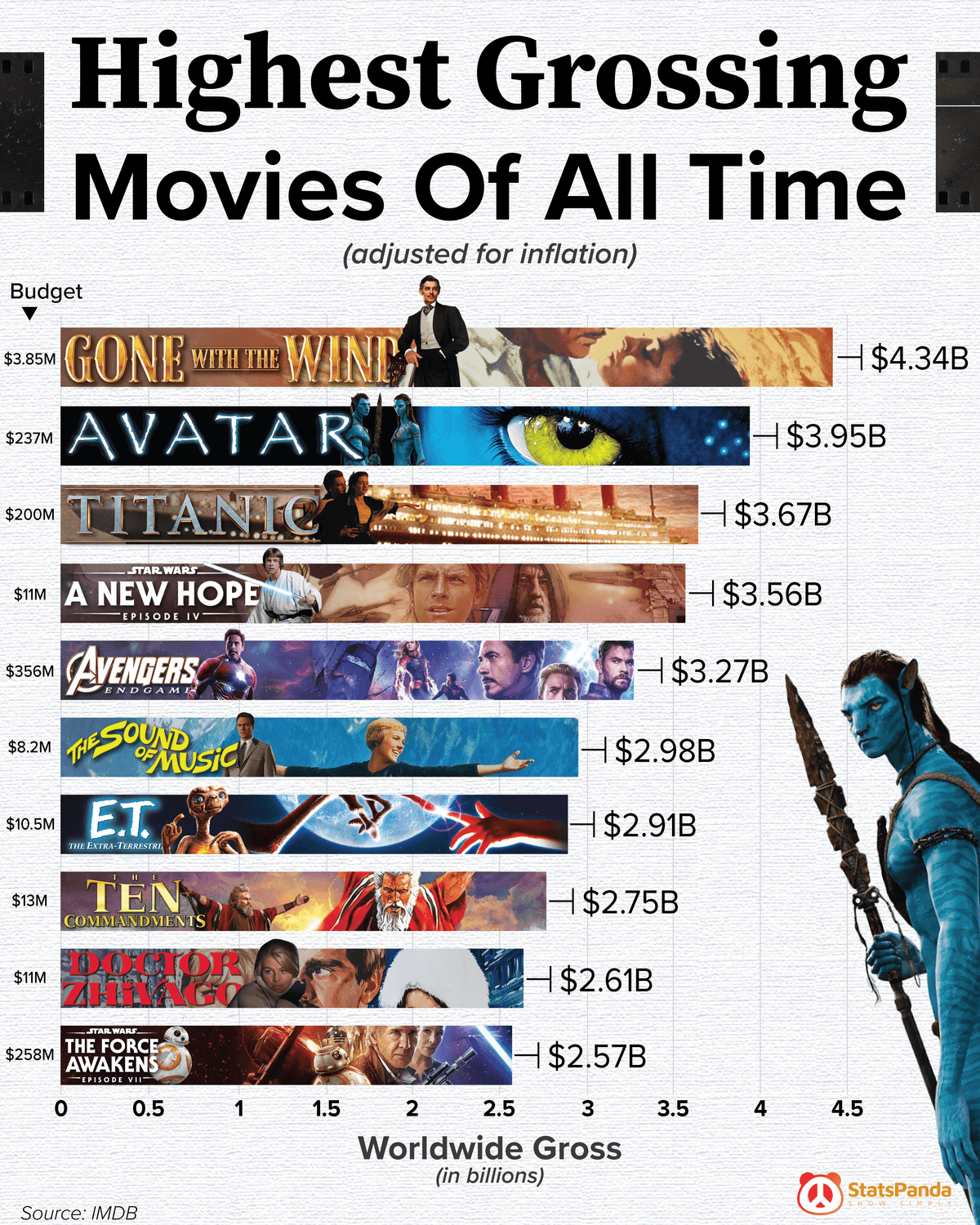
Evaluating box office success through raw, unadjusted ticket sales often distorts cinematic history, making modern blockbusters look far more commercially dominant than legacy classics due to surging ticket prices over the decades. When films are adjusted for inflation, the traditional all-time leaderboards transform dramatically, revealing that vintage epics like Gone with the Wind and Star Wars still hold the true crown for domestic and global attendance supremacy.
Understanding the Mechanics of Box Office Inflation
To evaluate motion picture financial success accurately, analysts must look past the nominal gross—the raw ticket sales collected at the theater door—and focus on real economic value. Nominal box office figures are deeply misleading because they reflect the purchasing power of the currency at the exact year of release. Since general price levels, operating costs, and consumer goods have inflated significantly over the last century, a dollar earned in 1939 possessed vastly different purchasing power than a dollar earned today.
The primary mechanism for calculating adjusted figures involves applying the Consumer Price Index or specialized cinema ticket price indices to historical grosses. Because historical ticket price data is often recorded as an aggregate national average rather than a precise regional breakdown, adjustments introduce minor methodological variations depending on the source. Major tracking entities, such as Box Office Mojo and industry trade publications, utilize estimated average ticket prices for each calendar year to convert older grosses into contemporary equivalents. This process essentially asks a straightforward question: How much money would a film generate if its original audience size purchased tickets at current average prices?
Without this normalization process, the historical box office chart would be heavily skewed toward recent releases. Modern multi-plex pricing, IMAX surcharges, 3D fees, and general ticket inflation ensure that a film released in the modern era can crack major financial milestones with a fraction of the actual ticket sales that a 1970s or 1980s blockbuster achieved. Recognizing the adjusted-for-inflation box office provides a truer measurement of cultural penetration, audience reach, and enduring commercial demand.
The Pitfalls of Raw Gross Comparisons in Cinema History
Comparing the raw box office grosses of films released decades apart is an apples-to-oranges exercise. When a studio boasts about a billion-dollar global haul, casual observers often interpret the milestone as absolute proof of superior popularity. However, structural economic shifts dictate that inflation is only one variable distorting these charts. Population growth, the expansion of international markets, and changes in home entertainment competition also alter how films perform financially across generations.
Consider the theatrical landscape of the mid-20th century. Going to the movies was the dominant form of mass visual entertainment, often functioning as a weekly ritual for millions before the widespread adoption of television, home video, streaming, and mobile gaming. Films played in single-screen downtown theaters for months—sometimes years—on end, building massive cumulative audiences through prolonged, steady runs. Modern distribution models, conversely, rely on wide saturation releases that front-load ticket sales over a compressed three-to-four-week window before rushing titles to digital storefronts.
| Film Title | Original Release Year | Nominal Domestic Gross | Estimated Adjusted Domestic Gross |
|---|---|---|---|
| Gone with the Wind | 1939 | $200 million | $1.8+ billion |
| Star Wars | 1977 | $460 million | $1.6+ billion |
| The Sound of Music | 1965 | $163 million | $1.3+ billion |
| Titanic | 1997 | $674 million | $1.3+ billion |
| Avengers: Endgame | 2019 | $858 million | $950+ million |
Furthermore, the expansion of global exhibition markets means that modern blockbusters derive a massive percentage of their unadjusted grosses from international territories, particularly East Asia, that were practically non-existent for Hollywood exports during the Golden Age of cinema. When analysts adjust domestic figures for inflation, the distortion caused by ticket price escalation becomes starkly visible, stripping away the artificial advantages of modern pricing structures.
Analyzing the Domestic Champions: Gone with the Wind and Star Wars
When domestic box office figures are adjusted for ticket price inflation, Gone with the Wind stands as the undisputed champion of American cinema. Released in 1939 by Metro-Goldwyn-Mayer, the Civil War epic accumulated an extraordinary nominal gross that, when mapped against modern average ticket prices, translates to well over $1.8 billion domestically. Its multi-year theatrical re-releases across subsequent decades continuously replenished its audience pool, solidifying a level of cultural saturation that no modern property has matched on domestic soil.
George Lucas’s 1977 space opera, Star Wars (later subtitled Episode IV: A New Hope), occupies the runner-up position on the adjusted domestic chart. Generating an estimated adjusted domestic gross exceeding $1.6 billion, the original film redefined multiplex culture and sustained an unprecedented theatrical run that kept screens packed for over a year. The film benefited from repeat viewings by fans who treated the cinematic experience as an event, a phenomenon later replicated by franchises like Avengers and Avatar, though without matching the sheer volume of individual ticket purchases achieved by Star Wars or Gone with the Wind.
Other historical titans frequently populate the upper echelon of adjusted domestic charts, including The Sound of Music (1965), E.T. the Extra-Terrestrial (1982), and Titanic (1997). Titanic represents a unique bridge between eras, having harnessed the modern wide-release framework while demonstrating the long-tail theatrical legs characteristic of older cinematic models. Its rare combination of massive opening momentum and months of sustained repeat business allowed it to cross historical thresholds both nominally and when adjusted for inflation.
Global Box Office Realities and International Adjustments
While domestic charts benefit from relatively consistent historical ticket price tracking and stable national consumer data, compiling an accurate adjusted global box office chart introduces monumental complexities. Different countries experience vastly distinct inflation rates, currency devaluations, and economic transformations over time. Furthermore, reliable theatrical box office reporting outside of North America was sporadic or non-existent for much of the early and mid-20th century.
Because historical international data is incomplete, global box office lists adjusted for inflation must be treated with analytical caution. Studios routinely publish worldwide gross figures, but these are almost universally presented in nominal terms. When international markets like China, Japan, and Western Europe matured economically in the late 20th and early 21st centuries, their box office contributions skyrocketed due to rising middle-class disposable incomes and rapid cinema construction.
Consequently, modern global juggernauts like Avatar and Avengers: Endgame dominate the unadjusted worldwide leaderboard. While these films undoubtedly sold tens of millions of tickets globally, calculating their exact position on a truly comprehensive, inflation-adjusted worldwide chart is practically impossible due to missing historical ticketing data from international territories prior to the 1970s. International comparisons must therefore separate domestic rigor from global estimations, acknowledging that historical Hollywood hits like Ben-Hur or The Ten Commandments likely achieved immense international attendance that was never fully captured in past foreign currency reports.
Common Methodological Challenges in Box Office Adjustments
Calculating precise adjusted box office figures requires navigating several persistent economic variables that can skew the final data. Analysts must confront shifting exhibition formats, changing ticket purchasing behaviors, and demographic alterations within the movie-going public. Understanding these variables ensures that box office comparisons remain grounded in economic reality rather than marketing hyperbole.
- [Raw Nominal Gross]
- [Apply Annual Average Ticket Price Index]
- [Normalize for Regional/Format Variations]
- [Adjusted Box Office Chart Position]
The primary methodological hurdle involves accounting for premium-format surcharges. In contemporary markets, a single ticket sale is not uniform; a patron purchasing an IMAX 3D ticket contributes significantly more to the nominal gross than a patron purchasing a standard 2D ticket for the exact same seat. Historical box office calculations often rely on a generalized annual average ticket price, which flattens these variations. If early cinema operated on a single standard admission price, modern exhibition relies on tiered pricing models that complicate straightforward mathematical adjustments.
Another challenge is accounting for population growth. While inflation adjustments measure the changing value of currency, they do not automatically scale for the size of the available audience. The United States population in 1939 was roughly 131 million people, compared to over 330 million in the modern era. The fact that Gone with the Wind achieved its record-shattering attendance figures with a fraction of the total national population makes its achievement even more remarkable from a per-capita engagement perspective.
Frequently Asked Questions
What film is the true box office champion when adjusted for inflation?
Gone with the Wind (1939) remains the undisputed domestic box office champion when adjusted for inflation, with an estimated domestic equivalent exceeding $1.8 billion based on modern ticket prices and cumulative historical re-releases.
Why do studios only use unadjusted box office figures in press releases?
Studios prefer unadjusted nominal grosses because higher raw numbers create powerful marketing momentum, generate major news headlines, and establish perceived prestige without requiring consumers to understand complex economic inflation adjustments.
Do international box office charts account for inflation accurately?
No, comprehensive global inflation-adjusted charts are extremely difficult to compile accurately because reliable, standardized international box office data and historical foreign inflation metrics were not consistently recorded throughout the early and mid-20th century.
How do modern formats like IMAX and 3D affect box office adjustments?
Premium formats introduce higher ticket prices that inflate nominal grosses. Traditional inflation adjustments rely on baseline annual averages, which can sometimes distort the exact volume of individual ticket sales driven by standard versus premium screens.
Is Avatar or Avengers: Endgame higher on the adjusted chart?
While both films rank near the top of modern unadjusted global charts, older legacy titles like Star Wars and The Sound of Music generally outrank them on domestic inflation-adjusted lists due to decades of cumulative theatrical re-releases and different historical viewing habits.
Strategic Evaluation for Film Historians and Industry Analysts
Navigating the nuances of box office data requires balancing raw financial metrics against macroeconomic reality. Industry professionals, researchers, and cinema enthusiasts should verify box office claims by cross-referencing nominal figures against recognized historical ticket price indices rather than accepting studio press releases at face value. When analyzing long-term commercial trends, prioritizing estimated ticket sales over gross revenue offers a far more accurate gauge of a film's genuine cultural impact and audience reach across generations.