Effective adhesive selection requires matching the chemical properties of a bonding agent with the surface energy of the substrates, the anticipated mechanical loads, and the environmental conditions the joint will face. Success depends on prioritizing long-term durability over initial bond speed, ensuring that the adhesive can withstand thermal cycling, chemical exposure, and moisture throughout its lifecycle.
Understanding Substrate Compatibility and Surface Energy
The first and most critical step in adhesive selection is identifying the materials to be joined. In engineering terms, this is often discussed as surface energy. Surface energy determines how well an adhesive "wets" the surface. Wetting is the ability of a liquid to maintain contact with a solid surface, resulting from intermolecular interactions when the two are brought together.
High Surface Energy (HSE) materials, such as most metals (steel, aluminum, copper) and unglazed ceramics, are relatively easy to bond. These surfaces allow the adhesive to spread out and flow into the microscopic valleys of the material, creating a high degree of mechanical and chemical interlocking. Conversely, Low Surface Energy (LSE) materials, such as polypropylene (PP), polyethylene (PE), and PTFE (Teflon), are notoriously difficult to bond. On these surfaces, liquid adhesives tend to bead up rather than spread, similar to water on a freshly waxed car.
When selecting an adhesive for LSE plastics, standard cyanoacrylates or epoxies often fail unless the surface is pre-treated or a specialized "LSE-optimized" structural acrylic is used. By 2026, many manufacturers have developed advanced primers and plasma-treatment protocols that temporarily raise the surface energy of these plastics, but choosing an adhesive formulated specifically for low-energy surfaces remains the most cost-effective and reliable path for high-volume manufacturing.
Analyzing Mechanical Loads: Shear, Peel, and Tension
Adhesives are rarely subjected to a single type of stress. Designers must analyze how the bond will be pulled, pushed, or twisted during use. Most structural adhesives are designed to excel in shear (stress parallel to the bond line) and compression (stress pushing the substrates together). However, many fail prematurely when subjected to peel or cleavage forces.
- Shear Stress: This is the most common stress in lap joints. Modern epoxies and polyurethanes provide exceptional shear strength, often exceeding the strength of the substrates themselves.
- Tension: This occurs when the pull is perpendicular to the bond line. While many adhesives handle tension well, it is vital to ensure the load is distributed evenly across the entire bond area.
- Peel and Cleavage: These are the "bond killers." Peel occurs when one or both substrates are flexible, concentrating the entire load on a thin line at the edge of the bond. Cleavage occurs in rigid joints when the load is applied at one end, creating a prying motion.
If your application involves significant vibration or impact—common in automotive and aerospace sectors—you must select a "toughened" adhesive. Toughened adhesives contain microscopic rubber particles that stop cracks from propagating through the brittle glue line, absorbing energy and preventing catastrophic failure.
Environmental Considerations for Long-Term Durability
An adhesive that holds perfectly in a climate-controlled laboratory may fail within weeks in a real-world environment. Environmental factors are the leading cause of bond degradation over time.
Thermal Cycling and Temperature Extremes As of 2026, industrial standards emphasize the importance of the glass transition temperature ($T_g$). This is the temperature range where an adhesive shifts from a hard, glassy state to a soft, rubbery state. If an assembly operates above its adhesive's $T_g$, the bond strength drops significantly. Furthermore, different materials expand and contract at different rates (Coefficient of Thermal Expansion or CTE). If you are bonding aluminum to glass, the adhesive must be flexible enough to absorb the movement caused by temperature swings without cracking or delaminating.
Moisture and Chemical Exposure Hydrolysis—the chemical breakdown of a bond due to water—is a major concern for polyurethanes and some epoxies. For marine or outdoor applications, specialized moisture-resistant formulations are required. Similarly, if the bond will be exposed to oils, fuels, or industrial solvents, the adhesive chemistry must be inert to those specific substances. For instance, while cyanoacrylates (super glues) are excellent for quick fixes, they generally have poor resistance to long-term moisture and high heat.
Common Adhesive Chemistries and Their Applications
Selecting the right chemistry is the bridge between theoretical requirements and practical implementation. The following table provides a comparison of the dominant adhesive categories used in 2026.
| Adhesive Type | Strength Profile | Cure Speed | Best For | Limitations |
|---|---|---|---|---|
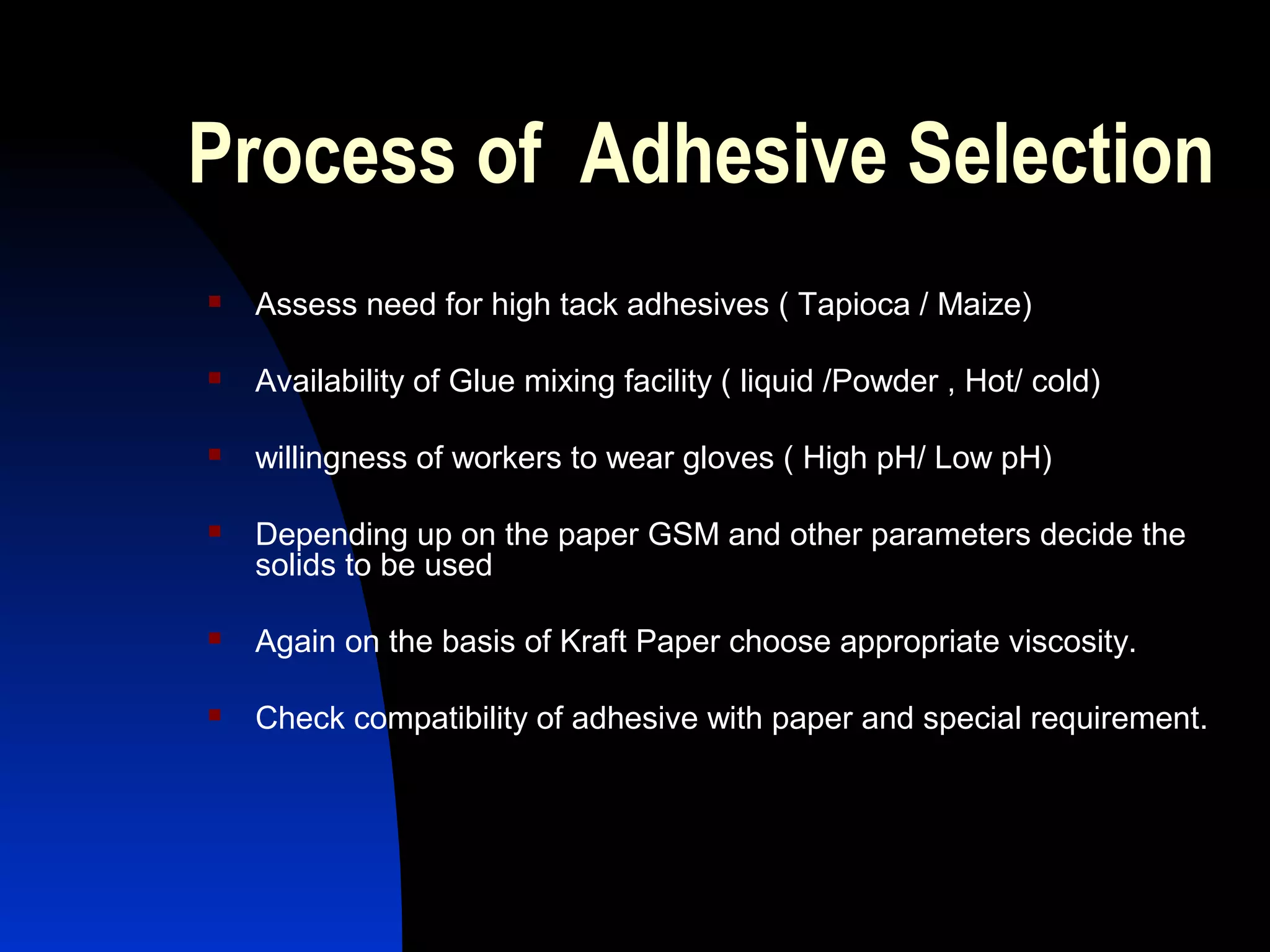
| Epoxies (1 or 2-part) | Very High (Shear) | Slow (Minutes to Hours) | Metals, Ceramics, Structural | Brittle if not toughened; requires mixing |
| Acrylics (Structural) | High | Moderate (5–20 mins) | Plastics, Oily Metals | Strong odor; can be sensitive to gap size |
| Cyanoacrylates | High (Tensile) | Instant (Seconds) | Small parts, Rubber, Plastics | Poor impact resistance; brittle |
| Polyurethanes | Moderate/High | Moderate | Wood, Fiberglass, Composites | Sensitive to moisture during cure |
| Silicones | Low (Structural) | Slow (Moisture cure) | Gaskets, High-heat areas | Low shear strength; hard to paint over |
| MS Polymers | Moderate | Moderate | Construction, Sealing | Lower strength than pure epoxies |
Structural Epoxies
Epoxies remain the gold standard for high-load applications. They offer the highest shear strength and excellent resistance to chemicals and heat. Two-part epoxies allow for room-temperature curing, while one-part epoxies often require heat-induction ovens to trigger the catalyst, making them suitable for automated assembly lines.
Structural Acrylics
Acrylics have gained significant market share by 2026 due to their ability to bond through light layers of mill oil on metal surfaces. They are more "forgiving" than epoxies regarding surface preparation and offer a better balance of shear and peel strength. They are the preferred choice for bonding dissimilar materials where some flexibility is required.
The Essential Checklist for Industrial Adhesive Selection
To ensure a successful bond, engineers should follow a disciplined selection process. Skipping a single step often leads to field failures that are expensive to remediate.
- Define the Substrates: Exactly what materials are being bonded? Are they coated, painted, or oxidized?
- Determine the Gap Fill: Some adhesives, like cyanoacrylates, require very tight-fitting parts (less than 0.05mm). Others, like epoxies or urethanes, can fill gaps of several millimeters.
- Establish Cure Time Requirements: Does the part need to be handled in 30 seconds, or can it sit in a fixture for 24 hours? Faster is not always better; rapid-curing adhesives often have higher internal stress and lower overall durability.
- Identify Regulatory Constraints: Does the adhesive need to be FDA-compliant for food contact? Does it meet low-VOC (Volatile Organic Compound) standards for indoor air quality? In 2026, sustainability certifications are increasingly mandatory for European and North American markets.
- Calculate the Operating Temperature Range: Ensure the $T_g$ of the adhesive is well above the maximum expected operating temperature.
Managing Surface Preparation and Application Constraints
Even the most advanced adhesive will fail if the surface is contaminated. Proper surface preparation increases the effective surface area for bonding and removes weak boundary layers like dust, oils, and mold release agents.
Cleaning and Abrasion The baseline for any bond is a "solvent wipe" using isopropyl alcohol or acetone. However, for structural integrity, mechanical abrasion (sanding or grit blasting) is often necessary. This creates a "micro-rough" surface that allows the adhesive to lock mechanically into the substrate. After abrasion, a second cleaning step is vital to remove the generated debris.
Primers and Adhesion Promoters For difficult-to-bond materials like silicone or polyolefins, a primer acts as a chemical bridge. It reacts with the substrate on one side and the adhesive on the other. In 2026, "all-in-one" adhesives that incorporate these promoters into the base resin are becoming more common, but traditional two-step processes still offer the highest reliability for safety-critical components.
Dispensing Methods Consider how the adhesive will be applied. Manual mixing of two-part systems often introduces air bubbles and inconsistent mix ratios. Static mixing nozzles, which attach to dual-cartridge guns, ensure the resin and hardener are perfectly blended before they reach the substrate. For high-volume production, automated robotic dispensing provides the precision needed to control bond line thickness—a factor that directly influences the stress distribution within the joint.
Frequently Asked Questions
Why did my epoxy bond fail even though it felt "hard"?
A bond can feel cured to the touch but may not have reached its full cross-link density. If the parts were put under load too early, or if the mix ratio was slightly off, the adhesive may be brittle or "cheesy" inside. Additionally, check for "adhesive failure," where the glue peels cleanly off the surface, indicating poor surface preparation or a surface energy mismatch.
Can I use super glue (cyanoacrylate) for outdoor repairs?
Generally, no. Standard cyanoacrylates are highly susceptible to moisture and temperature fluctuations. Over time, water molecules can penetrate the bond line and cause the adhesive to crystallize and lose its grip. For outdoor use, a polyurethane or a specialized weather-resistant epoxy is a far superior choice.
What is the "open time" or "pot life" of an adhesive?
Open time is the maximum amount of time you have to join the parts together after applying the adhesive before it begins to skin over or cure. Pot life refers to how long a mixed batch of adhesive remains usable in a container. If you exceed these times, the adhesive will not wet the second substrate properly, resulting in a weak or non-existent bond.
How do I bond glass without the adhesive showing?
For aesthetic glass bonding, UV-curing adhesives are the industry standard. these adhesives remain liquid until exposed to a specific wavelength of ultraviolet light. They are optically clear and allow for "infinite" positioning time before the bond is instantly cured by a UV lamp.
Is surface roughening always necessary?
While it helps in most cases, some modern structural acrylics are designed to chemically etch the surface of certain plastics, making mechanical roughening redundant. However, for metals, removing the oxide layer through abrasion almost always results in a stronger, more consistent bond.
Recommended Next Actions for Reliable Bonding
To finalize your adhesive selection, move from theoretical research to empirical testing. In 2026, computer modeling can predict many outcomes, but physical verification remains the industry standard.
First, perform a "water break test" on your cleaned substrates. If water beads up, the surface is still contaminated or has low surface energy. If the water sheets out smoothly, the surface is ready for bonding. Second, create several test samples (lap shears) and subject them to "accelerated aging." This involves placing the bonded parts in a high-heat, high-humidity chamber for several days to simulate months of real-world exposure.
Finally, consult with technical data sheets (TDS) specifically for the 2026 versions of your chosen products, as formulations are frequently updated for environmental compliance. If the project is high-stakes, reach out to the manufacturer’s application engineers to verify that your chosen substrate and adhesive combination is supported by their internal testing data.