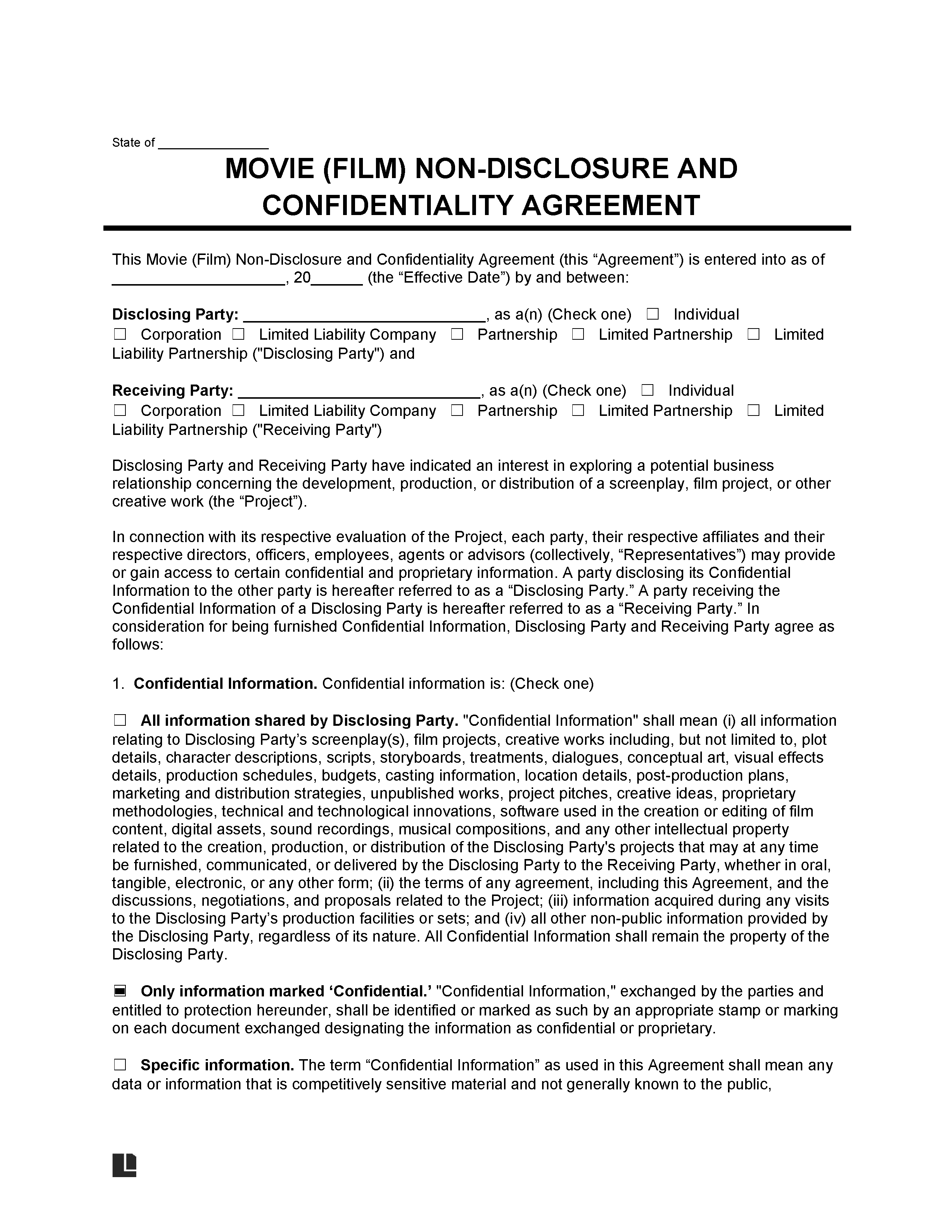
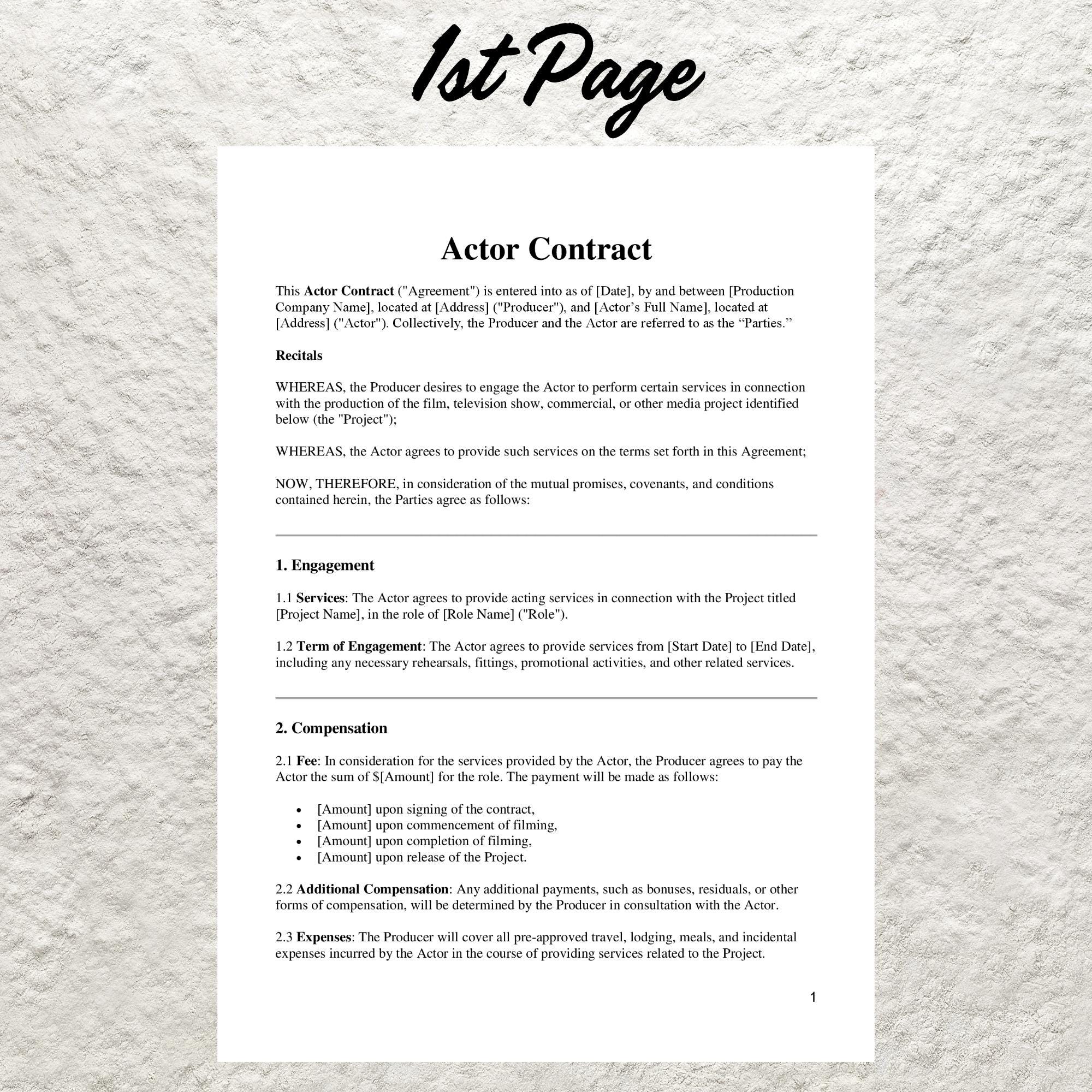
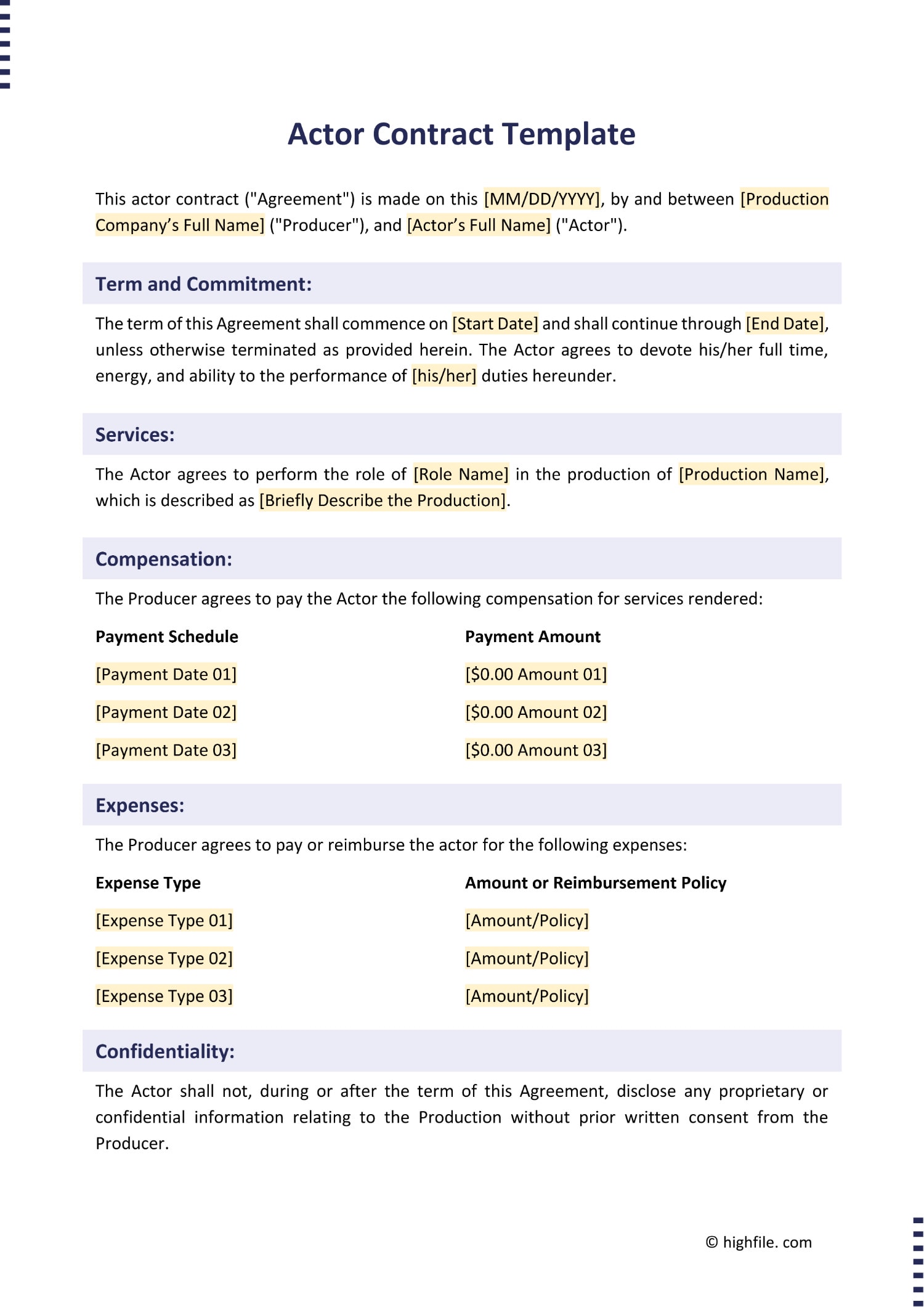
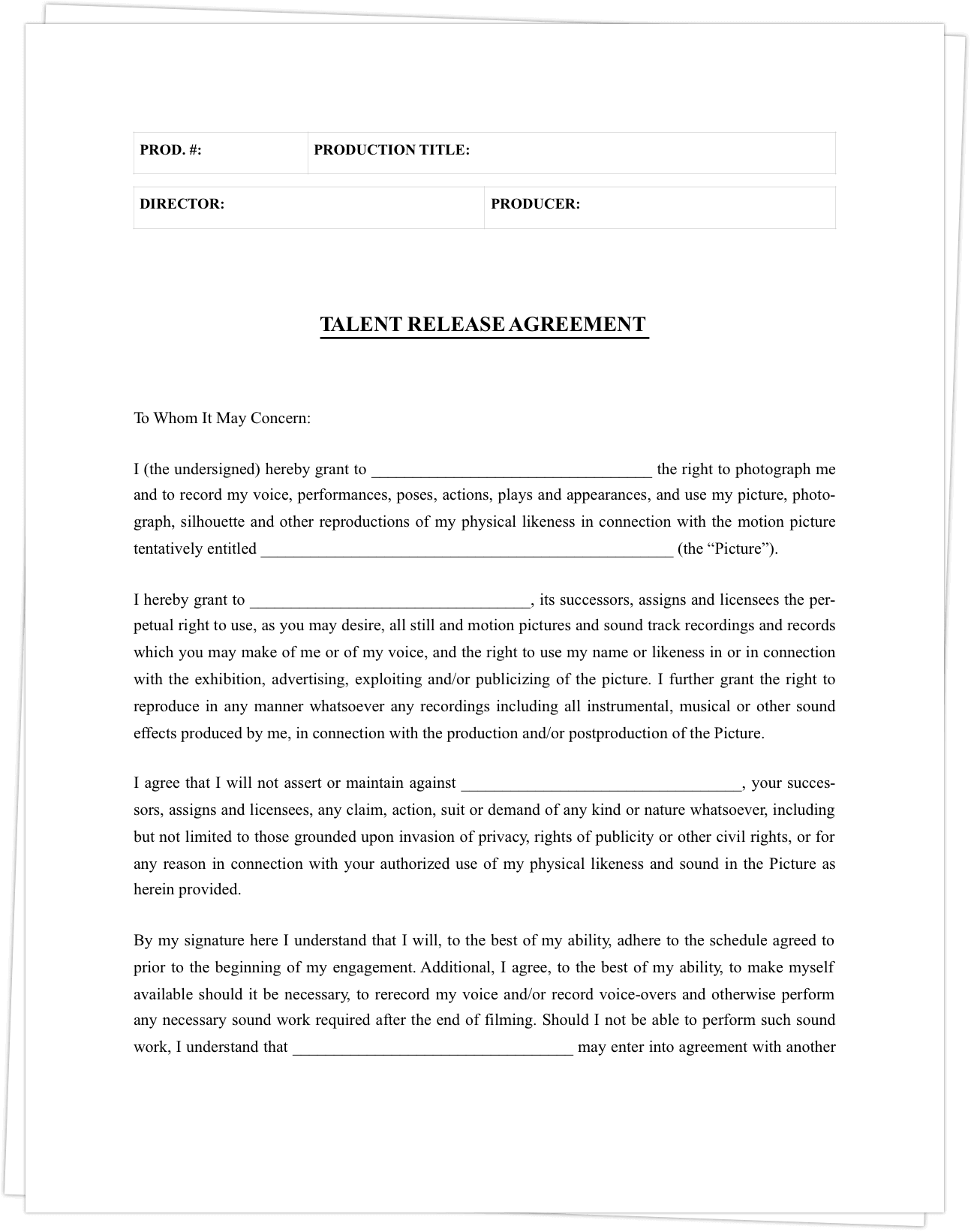
An actor contract is a legally binding agreement between a performer and a production entity that outlines the scope of work, compensation, and the transfer of intellectual property rights. These documents ensure that both parties understand their obligations regarding performance schedules, credit, residuals, and the usage of the actor’s image and voice across various media platforms.
The Fundamental Components of a Modern Actor Contract
At its core, an actor contract serves as the blueprint for the professional relationship between a performer and a producer. Whether for a major motion picture, a television series, or a commercial, every contract must establish several "deal points" to be considered valid and enforceable. These points include the specific role to be played, the duration of the engagement (often referred to as the "term"), and the financial consideration provided in exchange for the services.
Beyond these basics, the contract must define the "work-for-hire" nature of the relationship. Under United States copyright law, and specifically within the context of 2026 industry standards, most actor contracts are structured so that the production company owns the final product entirely. This is achieved through a "Grant of Rights" clause, which typically states that the performer grants the producer the right to use their likeness, voice, and performance "in all media now known or hereafter devised, throughout the universe, in perpetuity." While this language sounds exhaustive, it is the standard requirement for ensuring a project can be distributed globally without constant renegotiation for every new platform.
Furthermore, the contract will detail the specific services required. This includes not just the principal photography dates but also "post-production" services such as Automated Dialogue Replacement (ADR), looping, and promotional appearances. For a contract to be comprehensive, it must also address the "player’s" billing—how and where their name will appear in the credits—and any travel or living expenses if the production is filming on location.
SAG-AFTRA vs. Non-Union Agreements
The landscape of 2026 remains deeply defined by whether a production is a signatory to the Screen Actors Guild-American Federation of Television and Radio Artists (SAG-AFTRA). The distinction between union and non-union contracts is the single most significant factor in determining an actor's protections and pay scale.
Union contracts are governed by "Basic Agreements" or "Codes of Fair Practice." These are master contracts negotiated between the union and the Alliance of Motion Picture and Television Producers (AMPTP). When an actor signs a SAG-AFTRA contract, they are not just signing a private agreement with a producer; they are entering into an agreement that incorporates thousands of pages of negotiated protections by reference. These include mandatory minimum salaries (scale), guaranteed rest periods (turnaround time), health and pension contributions, and strict safety regulations.
Non-union contracts, by contrast, offer significantly less protection. In these agreements, everything is negotiable, and there is no "floor" for compensation other than state and federal minimum wage laws. Non-union actors often find themselves signing away rights to residuals (payments for reused footage) and may have limited recourse if a production fails to provide safe working conditions or timely payment. For performers, the transition to union-covered work is often the primary goal of their early career, as it provides a standardized framework for professional treatment.
Compensation Structures: From Base Pay to Residuals
Compensation in actor contracts is rarely as simple as a flat fee. It is typically divided into "initial compensation" and "contingent compensation." Initial compensation is the "quote" or the amount paid for the actual days or weeks of filming. In 2026, the industry continues to utilize the "Day Player," "Weekly Player," and "Three-Day Player" designations to categorize these pay rates.
Contingent compensation, commonly known as residuals, is where the long-term value of a contract lies. Residuals are payments made to the performer when a production is exhibited beyond the initial platform for which it was created. For example, if a theatrical film is later shown on a streaming service or sold to an international television network, the actor (if unionized) is entitled to a percentage of the revenue or a fixed fee.
The 2023 and 2024 industry-wide negotiations fundamentally reshaped how residuals function in the streaming era. As of 2026, streaming residuals are often tied to viewership metrics on major platforms, ensuring that actors benefit when a project becomes a "hit" on a global scale. Additionally, "deferred compensation" is a common feature in independent film contracts, where an actor agrees to a lower upfront fee in exchange for a payment that is triggered once the film reaches "breakeven" or achieves a specific box office milestone.
Digital Likeness and AI Protection Clauses
One of the most critical developments in actor contracts over the last three years involves the regulation of Artificial Intelligence (AI) and "Digital Doubles." As of 2026, specific language regarding digital replicas is a mandatory component of any professional agreement. Producers must now obtain "clear and conspicuous" consent before creating a digital replica of an actor’s voice or likeness.
These clauses are designed to prevent the unauthorized use of an actor's "persona" to generate new content without further compensation. A standard 2026 contract will specify:
- Purpose of the Replica: Whether the digital double is for a specific scene, for stunt replacement, or for "aging/de-aging" purposes.
- Duration of Use: Whether the digital replica can only be used for the specific project or if it can be archived for future use.
- Compensation for Reuse: The specific daily rate or residual percentage that must be paid if the digital replica is used in a manner that would have otherwise required the actor’s physical presence.
These protections are essential for safeguarding the livelihood of background actors and principal performers alike, ensuring that technology serves as a tool for production rather than a replacement for human talent.
Rights, Usage, and the "Grant of Rights" Section
The "Grant of Rights" is arguably the most legally dense section of an actor's contract. It dictates how the producer can use the actor's performance and image. In the past, this was limited to the film itself. Today, it encompasses "behind-the-scenes" footage, promotional stills, and "making-of" documentaries.
A major point of contention in these sections is the "Exclusivity" clause. For television series regulars, exclusivity prevents the actor from appearing in other programs that might compete with the current show. These clauses can be highly restrictive, often preventing an actor from taking on other roles for the duration of a series' production cycle, which can last several years. Actors and their representatives often negotiate "carve-outs" that allow the performer to do voice-over work, commercials, or guest spots on unrelated networks, provided they do not portray a similar character.
Another vital element is the "Right of Publicity." While the producer owns the copyright to the film, the actor retains certain rights to their own name and likeness for commercial endorsements. A well-drafted contract will clearly distinguish between using the actor's image to promote the film (which the producer is allowed to do) and using the actor's image to sell a product (which usually requires a separate licensing fee).
Comparison of Common Actor Contract Types
| Contract Type | Primary Use Case | Key Compensation | Union Oversight | AI Protections |
|---|---|---|---|---|
| Theatrical Basic | Feature Films (Cinema) | Weekly/Daily Scale + Residuals | SAG-AFTRA Mandated | Full (Informed Consent) |
| Television / New Media | Streaming & Cable Series | Episodic Fee + Viewership Bonuses | SAG-AFTRA Mandated | Full (Usage-specific) |
| Commercial Contract | Brand Advertisements | Session Fee + Usage/Cycles | Union & Non-Union | Variable |
| Short Project Agreement | Indie / Student Films | Deferred or Low Budget Scale | Limited / Optional | Minimal (Negotiable) |
| Corporate/Industrial | Training & Internal Videos | Flat Fee (Buyout) | Usually Non-Union | None (Unless added) |
Termination, Morality Clauses, and Legal Recourse
Actor contracts are not just about the start of a job; they also define how that job ends. "Termination for Cause" allows a producer to fire an actor without further pay if the actor breaches the contract—such as through chronic lateness, failure to follow directions, or illegal activity.
Conversely, "Morality Clauses" (or "Conduct Clauses") have become increasingly prevalent. These allow a studio to terminate a contract if an actor's public behavior brings the project into disrepute or violates certain ethical standards. These clauses are often broadly worded, and an actor’s legal team will typically try to narrow the scope to actual criminal convictions or specific, documented acts of "moral turpitude."
If a dispute arises, most modern contracts include a "Mandatory Arbitration" clause. This means that instead of going to a public court, any legal disagreement must be settled through a private arbitrator. While this can be faster and more discreet, it can also limit an actor’s ability to appeal a decision. For union members, SAG-AFTRA provides a grievance process that acts as an initial layer of protection before full-scale legal action is taken.
Common Questions Regarding Actor Contracts
What is a "Standard Terms and Conditions" (STC) rider?
Most actor contracts consist of a short "Deal Memo" (1-3 pages) and a much longer "Standard Terms and Conditions" (10-30 pages). The Deal Memo contains the specifics like your name, role, and pay. The STC contains the boilerplate legal language regarding copyright, insurance, liability, and dispute resolution. It is essential to review the STC, as it contains the "fine print" that governs your long-term rights.
Can an actor negotiate their credit in the contract?
Yes. Credit negotiation is a standard part of the process for principal performers. This includes "placement" (e.g., first position, shared screen, or "with" and "and" billing), "size" (e.g., 100% of the size of the title), and "duration" of the credit on screen. For many actors, credit is as valuable as compensation because it dictates their "market value" for the next project.
What are "Option" years in a television contract?
In television, an "option" gives the producer the right to keep the actor on the show for subsequent seasons. Usually, a series regular signs a contract for the pilot that includes options for up to six or seven years. The producer can "pick up" the option each year, and the actor is legally obligated to return at a pre-negotiated salary increase.
How do "Per Diem" and travel clauses work?
When an actor is required to work "on location" (away from their home base), the production must provide a "Per Diem"—a daily allowance for meals and incidental expenses. Contracts also specify the class of travel (e.g., coach or business class) and the quality of the hotel accommodations provided.
Are digital signatures on contracts legally binding?
Yes. Since the early 2000s and reinforced through 2026, digital signature platforms like DocuSign or Adobe Sign are the industry standard. Once signed electronically, the contract is as legally enforceable as one signed in ink. Actors should always ensure they receive a "fully executed" copy (signed by both parties) for their records.
What happens if I sign a "Work-for-Hire" agreement?
A "Work-for-Hire" agreement means that you are not the author or owner of the work you create. The production company is legally considered the "author." This means you have no control over how the footage is edited, distributed, or sold in the future, except for the specific limitations and residual payments negotiated in your contract.
Steps for Securing Your Legal Interests
Before signing any actor contract, the most critical step is to have it reviewed by a qualified entertainment attorney or a reputable talent agent. Because these documents involve the long-term transfer of your image rights—including digital likenesses—minor phrasing changes can have significant financial consequences over the course of a career.
For union members, always verify that the "Production Number" and "Signatory Status" are active with SAG-AFTRA. This ensures that your health and pension contributions are being properly reported and that you have the full backing of the union’s legal department in the event of a payment dispute. Finally, maintain a digital archive of every deal memo and contract you sign; in an industry where residuals can flow for decades, having the original documentation is the only way to ensure you are being paid accurately for your life's work.
Disclaimer: This article provides general information regarding actor contracts and does not constitute legal advice. Laws regarding contracts and intellectual property vary by jurisdiction and are subject to change. Consult with a legal professional for specific guidance on your individual circumstances.