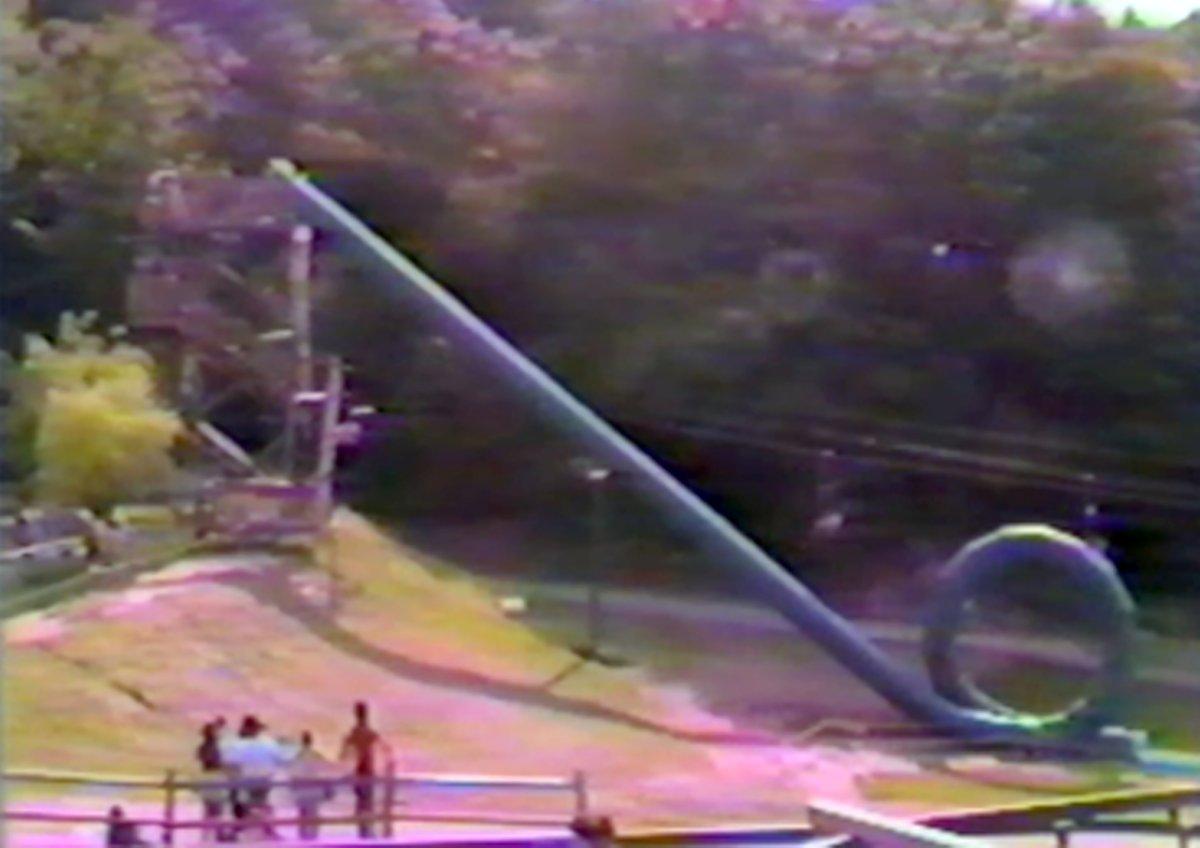
The Action Park loop, officially known as the Cannonball Loop, was an experimental vertical water slide at the former Action Park in Vernon, New Jersey. It matters for theme park safety because its catastrophic design failures spurred the development of modern engineering standards, independent safety inspections, and the rigid G-force regulations that govern the amusement industry in 2026.
The Origin and Design of the Cannonball Loop
In the mid-1980s, the "anything goes" atmosphere of Action Park culminated in the construction of the Cannonball Loop. Built in 1985, the slide was a literal interpretation of a roller coaster’s vertical loop applied to a water slide. It consisted of a steep enclosed drop followed by a 360-degree vertical circle. Unlike modern looping slides that use inclined loops or "trap-door" starts to manage velocity, the Cannonball Loop was a crude PVC-and-asphalt construction that relied entirely on raw momentum to carry a human body through a vertical inversion.
The slide was only open for a few short weeks across its entire existence. Its design was so fundamentally flawed that it became a legend in the theme park industry—not for its thrills, but for the fundamental lessons it provided in what not to do. The developer, Gene Mulvihill, was known for pushing the boundaries of traditional physics, often prioritizing the "novelty" of an attraction over the rigorous mathematical modeling required for passenger safety.
The Engineering Flaw: Circular vs. Clothoid Loops
The primary reason the Action Park loop failed—and why it remains a case study for engineers in 2026—lies in its geometry. The slide utilized a perfectly circular loop. In contrast, modern roller coasters use a "clothoid" loop (a teardrop shape).
A circular loop requires a rider to enter at an extremely high velocity to maintain enough centripetal force to keep them against the slide at the very top. However, this high entry speed creates massive G-forces at the bottom of the loop, where the rider's body is subjected to intense pressure as the direction of travel changes abruptly.
Because the Cannonball Loop was circular, riders experienced two major physical hazards:
- Extreme G-Forces: Riders were slammed into the bottom of the tube with force that frequently caused neck injuries and "blackouts."
- Frictional Deceleration: Unlike a roller coaster car on wheels, a human body on plastic is subject to variable friction. If a rider was too light or the water flow was insufficient, they would lose momentum halfway up the loop and fall several feet to the bottom of the tube, leading to blunt force trauma.
Safety Incidents and the Human Cost of Testing
The testing phase of the Cannonball Loop is often cited as one of the most egregious examples of safety negligence in the history of the industry. Reportedly, the park first tested the slide with weighted mannequins, which were frequently "decapitated" or dismembered by the internal forces or by hitting the top of the loop.
Undeterred, the park offered employees $100 bills to serve as human test subjects. Those who braved the slide often emerged with:
- Abrasions and Lacerations: The interior of the loop was lined with padding that often came loose, and sand or grit from the park floor would collect at the bottom of the loop, acting like sandpaper on the skin of riders.
- Nosebleeds and Internal Bruising: The sudden change in pressure and the physical impact of the loop frequently caused sinus trauma.
- Dental Injuries: Some reports indicated that riders would inadvertently bite their tongues or chip teeth due to the violent shaking inside the pipe.
The slide was eventually shut down by the New Jersey Carnival and Amusement Ride Safety Advisory Board after only brief periods of operation. Its failure highlighted a critical gap in the laws of the time: there were few requirements for professional engineering certifications or third-party physics validation before an attraction could be opened to the public.
How the Action Park Loop Revolutionized Safety Standards
The legacy of the Action Park loop is not just a story of a dangerous ride; it is the foundation of the modern safety culture. The failures of the Cannonball Loop contributed to a massive shift in how amusement parks are regulated in the United States and globally.
1. The Rise of ASTM International Standards
The industry began to rely heavily on ASTM F24 Committee standards. These regulations dictate the "allowable acceleration" or G-force limits for amusement rides. By 2026, these standards have become incredibly sophisticated, using bio-mathematical models to ensure that no ride—regardless of how thrilling—exceeds the physical tolerances of the human body.
2. Mandatory Third-Party Engineering Reviews
In the 1980s, a park owner could essentially build a slide in their backyard and open it to the public. Today, every major attraction must undergo a Peer Review. This involves independent structural engineers and fluid dynamics experts verifying that the ride's math is sound before a single bolt is tightened.
3. State-Level Oversight and Inspections
Following the Action Park era, New Jersey established some of the strictest amusement ride regulations in the world through the Department of Community Affairs (DCA). This includes "Type Certification" and "Individual Submissions," where every modification to a ride must be documented and approved. The Cannonball Loop proved that park owners could not be trusted to self-regulate when profit or novelty was at stake.
Comparison: 1985 Cannonball Loop vs. Modern Looping Slides
To understand how far safety technology has come by 2026, it is helpful to compare the original Action Park design with modern looping water slides, such as the AquaLoop.
| Feature | Cannonball Loop (1985) | Modern Looping Slide (2026) |
|---|---|---|
| Loop Geometry | Perfectly Vertical Circle | Inclined/Angled Loop |
| Entry Mechanism | Manual push into a steep pipe | Automated Trap-Door (Launch) |
| Material | Reinforced PVC / Padded Asphalt | Translucent Fiberglass / Gel-coat |
| Velocity Control | None (Dependent on body weight) | Sensors and constant water-flow monitoring |
| G-Force Management | High/Unregulated (Up to 9 Gs reported) | Strict ASTM F24 Limits (Usually < 3.5 Gs) |
| Safety Features | None (Occasional padding) | Emergency hatch at loop apex for stuck riders |
The Physics of Modern Successors: The AquaLoop
While the Action Park loop was a failure, it proved that there was a market for the concept of an inversion on a water slide. Engineering firms like WhiteWater West eventually solved the problem that Gene Mulvihill could not.
Modern "looping" slides avoid the "circular loop" trap by tilting the loop at a 45 to 60-degree angle. This "inclined loop" reduces the vertical G-force load on the rider's spine while still providing the sensation of an inversion. Furthermore, modern slides use a "trap-door" start, which ensures every rider begins with the exact same gravitational potential energy, making their exit velocity predictable.
Safety sensors now monitor the speed of every rider. If a rider is too light and fails to "make the loop," sensors detect the lack of movement and automated sprayers or emergency hatches at the top of the loop allow the rider to be safely extracted. This is a direct technological response to the stories of riders getting stuck at the top of the Action Park loop.
Frequently Asked Questions
Why did the Action Park loop close?
The slide was closed primarily due to frequent injuries and the intervention of New Jersey state regulators. It was found that the ride was structurally and biologically unsafe for the general public, as the physics required to complete the loop exceeded safe human G-force tolerances.
Did anyone actually die on the Cannonball Loop?
While Action Park was the site of several fatalities across its history (including drownings and an Alpine Slide accident), there were no recorded deaths specifically on the Cannonball Loop. However, the injury rate was nearly 100% during its earliest test phases, leading to its "legendary" status as a dangerous attraction.
How do looping water slides work today?
Modern looping slides use an inclined loop rather than a vertical one. They also utilize a "launch capsule" that drops the rider vertically to ensure they have enough speed to overcome gravity. Engineers use computer modeling to calculate friction based on various body types to ensure everyone safely completes the circuit.
Is Action Park still open?
The original Action Park closed in 1996. The site was later rebranded as Mountain Creek Waterpark. While the park still occupies the same mountain in Vernon, New Jersey, all of the original "experimental" rides like the Cannonball Loop have been removed and replaced with modern, professionally engineered, and state-inspected attractions.
What are the G-force limits for theme park rides in 2026?
Current safety standards under ASTM F24 typically limit sustained G-forces to prevent blackouts (G-LOC). For water slides, the limits are even stricter than roller coasters because the rider is not restrained in a seat. Forces are generally kept below 3 to 4 Gs to prevent spinal compression or neck strain.
Ensuring Personal Safety in Modern Parks
While the era of the "unregulated loop" is over, safety remains a partnership between the park and the guest. In 2026, the most important thing a visitor can do is strictly adhere to the physical requirements of an attraction.
The Action Park loop proved that body weight, clothing friction, and posture can drastically change the outcome of a ride. Modern slides have weight minimums and maximums for a reason—to ensure that the rider's velocity stays within the engineered "safety window." To remain safe, always follow the lifeguard's instructions regarding crossing your ankles and arms, as this reduces the risk of limb injury during high-velocity transitions. The Cannonball Loop stands as a permanent reminder that in the world of amusement, physics is the ultimate authority.