Acting methods encompass the systematic training frameworks, psychological exercises, and physical routines that performers use to inhabit characters, construct believable emotional realities, and execute scripts effectively across stage and screen. These approaches offer structured pathways for interpreting dramatic text, overcoming self-consciousness, and maintaining consistency across multiple performances or takes.
Understanding and selecting the right acting methods requires examining their historical foundations, psychological mechanisms, and practical applications in modern rehearsal rooms. While many contemporary performers adopt an eclectic approach—blending elements from various schools of thought—mastering the core mechanics of individual techniques remains essential for developing technical versatility and emotional availability.
Historical Evolution and the Roots of Modern Performance
The systematic study of acting began to formalize in the late 19th and early 20th centuries, shifting performance styles away from melodramatic convention toward psychological realism. Before this paradigm shift, stage acting frequently relied on externalized gestures, standardized vocal delivery, and formulaic emotional displays that signaled specific feelings to the audience without requiring internal engagement from the performer.
The most influential catalyst for change emerged at the Moscow Art Theatre, co-founded by Konstantin Stanislavski and Vladimir Nemirovich-Danchenko in 1898. Stanislavski sought to create a rigorous, repeatable process that allowed actors to experience genuine organic feelings on stage rather than merely imitating them. His initial framework—frequently referred to as the "Stanislavski System"—focused on objective-driven behavior, given circumstances, and the famous "magic if," which asks actors to imagine how they would act if they were placed in the exact circumstances of the character.
As Stanislavski's writings were translated and disseminated internationally, particularly in the United States through the Group Theatre in the 1930s, American practitioners like Lee Strasberg, Stella Adler, and Sanford Meisner reinterpreted his ideas. This translation gave rise to distinct American acting methods, each emphasizing different facets of the actor's instrument. Strasberg concentrated heavily on affective memory and emotional recall, Adler prioritized imagination and sociological given circumstances, and Meisner anchored his technique in behavioral listening and living truthfully under imaginary circumstances through immediate, instinctual reactions.
Core Acting Methods Compared
Today’s actors draw from a diverse palette of recognized techniques, each defined by distinct philosophical assumptions and technical drills. Examining these frameworks side by side reveals how different practitioners approach the central challenge of performance: transforming text into authentic human behavior.
| Method / Technique | Primary Pioneer | Core Focus | Key Exercise or Concept | Best Suited For |
|---|---|---|---|---|
| The Stanislavski System | Konstantin Stanislavski | Psychological realism, objectives, and given circumstances | The "Magic If" and objective breakdown | Classical and contemporary realism |
| The Method (Method Acting) | Lee Strasberg | Emotional recall and personal substitution | Affective memory and sensory relaxation | Deeply psychological, raw characterizations |
| The Meisner Technique | Sanford Meisner | Behavioral listening and genuine connection | The Repetition Exercise | Film, television, and collaborative scene work |
| Practical Aesthetics | David Mamet / William H. Macy | Action-oriented choices and script analysis | The "Spine" and literal analysis of text | Fast-paced television and rigorous stage work |
| Michael Chekhov Technique | Michael Chekhov | Physical imagination and archetypal movement | Psychological Gesture and atmospheres | Physical theatre, fantasy, and stylized drama |
Psychological Realism and the Stanislavski System
The Stanislavski System serves as the foundational bedrock for nearly all Western dramatic training. Rather than treating acting as a series of external tricks, this approach views character creation as an organic process rooted in human psychology and purposeful action.
At the heart of the system is the concept of the super-objective (the character's primary, overarching goal throughout an entire play or film) and the objective (what the character wants in a specific beat or scene). Every action an actor takes on stage must be justified by an active verb that drives toward securing that objective. Passive verbs like "to cry" or "to be angry" are replaced by active pursuits like "to interrogate," "to comfort," or "to humiliate."
To support these objectives, actors analyze the given circumstances—the factual data provided by the playwright, director, and script, including time period, social status, relationships, and immediate environment. By fully accepting these given circumstances through the lens of the "magic if," the actor bridges the gap between their own identity and the fictional reality of the character, ensuring that physical movements and vocal choices stem from a logical inner impulse.
The Evolution of Method Acting and Emotional Recall
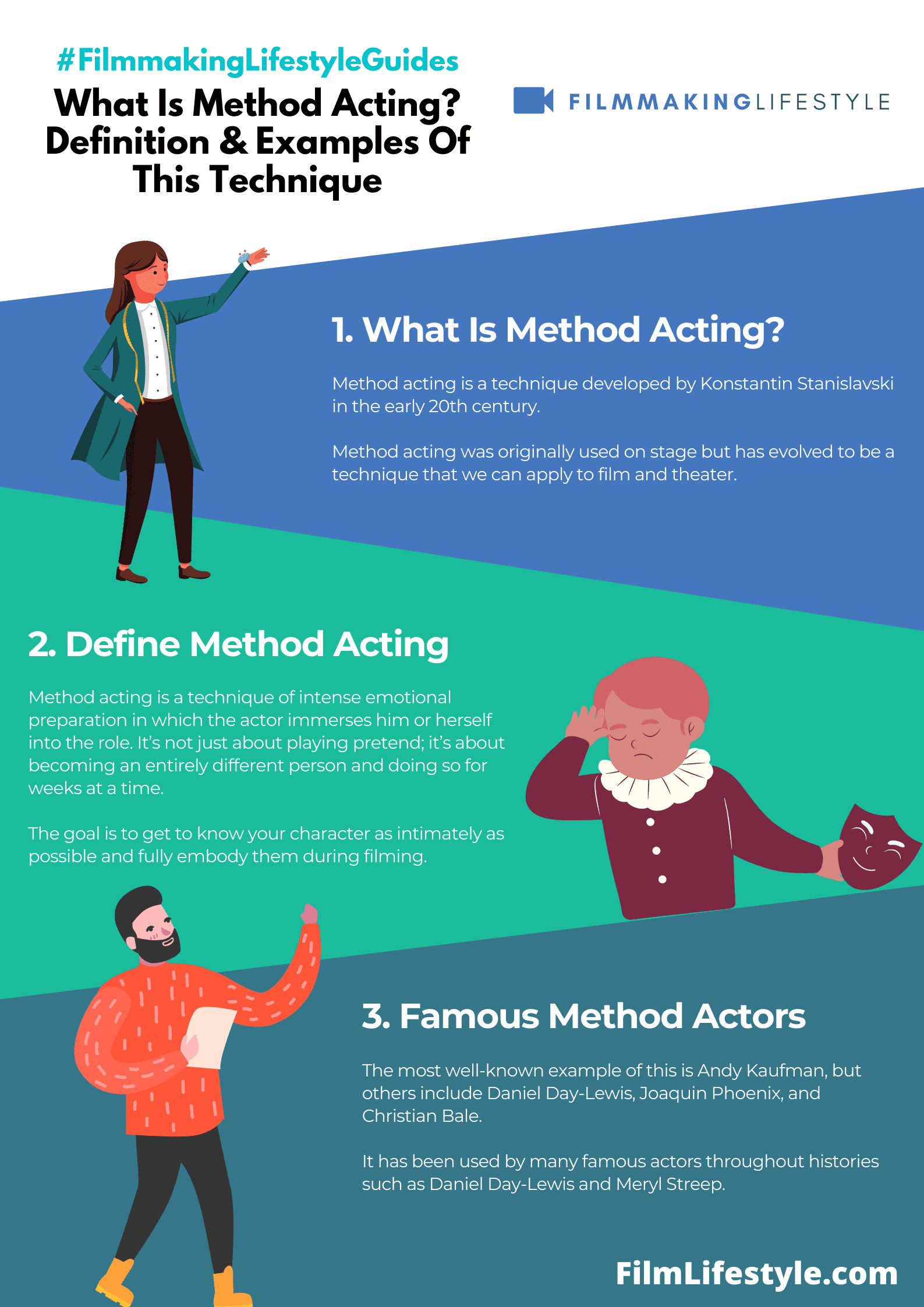
Popularized in America by Lee Strasberg at the Actors Studio, Method Acting takes the psychological principles of early Stanislavski and pushes them toward deep introspection. The defining hallmark of this approach is affective memory (or emotional recall), a process by which actors draw upon their own past emotional experiences to evoke authentic feelings corresponding to the character's situation.
In practice, a Method actor uses sensory relaxation exercises to release physical and mental tension, unlocking access to subconscious triggers. If a scene requires profound grief, the actor might recall a genuine personal loss, utilizing sensory details—sights, sounds, and textures associated with that memory—to stimulate a visceral bodily reaction.
While highly effective for producing intense, emotionally raw performances on screen, the technique requires careful emotional boundaries. Critics note that over-reliance on personal trauma can strain an actor's psychological well-being, leading modern practitioners to adapt the method with healthier self-care protocols while retaining its commitment to sensory truth and psychological depth.
Behavioral Reactivity in the Meisner Technique
Sanford Meisner famously defined acting as "living truthfully under imaginary circumstances." Frustrated by what he viewed as the excessive introspection of early Method acting, Meisner developed a technique centered entirely on the idea that acting originates from the behavior of other actors, not from within one's own isolated psychology.
The cornerstone of Meisner training is the Repetition Exercise, in which two actors face each other and repeat a simple, observational phrase about the other's behavior (e.g., "You're wearing a blue shirt"). As the exercise continues, the emotional tone, inflection, and underlying intent of the phrase shift based entirely on how the actors perceive and react to each other.
This rigorous drill trains performers to stop anticipating lines, drop self-conscious habits, and respond with absolute spontaneity. For film and television actors, where close-ups capture microscopic shifts in attention and listening, Meisner’s emphasis on instinctual behavioral response provides an invaluable toolkit for staying present in the moment.
Physicality and Imagination in Alternative Traditions
While psychological and behavioral methods dominate Western film training, alternative traditions place the body and imagination at the vanguard of character creation.
The Michael Chekhov Technique encourages actors to bypass intellectual analysis entirely, utilizing the body as the primary vehicle for emotional transformation. Chekhov introduced the Psychological Gesture—a distinct, whole-body physical movement that encapsulates the entire psychological profile and objective of a character. By executing this gesture outwardly, the actor absorbs the internal feeling, allowing physical shape to dictate emotional reality.
Similarly, physical theatre traditions, commedia dell'arte, and Viewpoints training (developed by Mary Overlie and Anne Bogart) teach performers to manipulate time, space, shape, and kinetic response. These methods prove indispensable for classical theatre, voice-over work, motion-capture performance, and fantastical genres where physical storytelling supersedes naturalistic dialogue.
Integrating Multiple Methods in Professional Practice
Professional actors rarely adhere to a single acting method with dogmatic exclusivity. Instead, working professionals develop an eclectic toolbox, selecting the technique that best serves the medium, the genre, and the specific demands of a role.
- Text Analysis (Stanislavski): Identify objectives & beats
- Behavioral Readiness (Meisner): Listen and react live
- Physical Anchors (Chekhov): Establish body and posture
- Sensory Triggers (Strasberg): Access emotional stakes
For instance, an actor might use Stanislavski’s structural breakdown to map out a character's arc across a ten-episode television season, apply Meisner-based listening techniques during fast-paced dialogue scenes, and utilize Michael Chekhov's physical gestures to unlock an eccentric creature or historical figure. Understanding the distinct merits of each school allows performers to adapt fluidly to different directors, rehearsal cultures, and artistic challenges.
Frequently Asked Questions
What is the difference between Stanislavski and Method Acting?
While Method Acting evolved directly from Konstantin Stanislavski’s early teachings, it was heavily modified by American practitioners like Lee Strasberg. Stanislavski’s system focuses broadly on objectives, action, and given circumstances using both imagination and logic. Strasberg’s specific "Method" places a much greater emphasis on affective memory, using the actor’s personal past experiences to trigger authentic emotions on cue.
Is Method Acting dangerous for mental health?
Method acting is not inherently dangerous, but intense reliance on traumatic personal memories (affective memory) can take a heavy psychological toll if an actor lacks proper boundary-setting techniques. Modern acting coaches emphasize safe decompression practices, ensuring actors can detach their personal identities from heavy dramatic material when the director calls cut.
Which acting method is best for beginners?
The Stanislavski System is widely considered the best starting point for beginners because it provides clear, logical tools for script analysis, such as breaking a scene down into beats, objectives, and obstacles. It teaches actors how to read a script structurally before diving into emotional or physical experimentation.
Can you combine different acting methods?
Yes, most professional actors use an eclectic approach. They might analyze a script using Stanislavski's objective-driven framework, train their listening skills using Meisner exercises, and employ physical characterization tools from Michael Chekhov or Viewpoints to round out their performance.
Do film actors use different methods than stage actors?
While the fundamental principles of truth and listening remain identical, film acting often requires greater economy of movement due to close-up camera frames. Consequently, techniques that emphasize natural, micro-behavioral reactivity—such as the Meisner Technique—are exceptionally popular among screen actors, whereas large-scale theatrical stages often demand the heightened vocal projection and physical visibility taught in classical and Chekhov training.
How do I choose an acting class or method to study?
Choosing an acting class depends on your career goals, natural learning style, and preferred medium. Research local studios, audit classes to observe teaching philosophies firsthand, and look for instructors who prioritize healthy technique, safety, and practical application over dogmatic adherence to a single dogma.