A successful acceptance speech balances humility, gratitude, and brevity while connecting with the audience’s emotions. To deliver a memorable performance, structure your remarks around a clear "Hook-Thanks-Story-Impact" framework. By focusing on the shared effort behind the achievement and keeping your delivery under two minutes, you ensure the moment remains focused on the honor rather than the individual.
The Essential Framework of a Memorable Acceptance Speech
Crafting a speech from scratch can feel daunting, especially when the pressure of an award is looming. However, most legendary acceptance speeches follow a predictable, effective structure. This structure ensures you hit all the necessary emotional beats without rambling or losing the audience’s attention. In 2026, the trend in public speaking has shifted toward "micro-narratives"—short, punchy stories that illustrate a larger point—rather than long lists of names.
The Gracious Opening (The Hook)
Your first few seconds are critical for setting the tone. Start with a sincere expression of thanks to the awarding body. Avoid the cliché of "I didn't expect this" unless it is genuinely true, as it can sometimes come across as performative. Instead, focus on the prestige of the award or the quality of your fellow nominees. Acknowledging the other people in your category shows class and immediately builds rapport with the room.
The Core Gratitude (The "Whos")
This is where many speakers stumble by listing forty different people. To keep the audience engaged, group your thanks. Mention the primary organization, your immediate team or mentors, and perhaps one specific person who was instrumental to this specific achievement. If you have a long list of people to thank, consider saying, "There are so many individuals who made this possible, and while I cannot name everyone here, please know your contribution is etched into this trophy." This allows you to be inclusive without being tedious.
The Narrative or Significance (The "Why")
This is the heart of the speech. Briefly share a "behind-the-scenes" moment or a challenge you overcame to reach this point. People relate to struggle and perseverance more than they relate to victory. Why does this work matter? What was the "spark" that led to the project or milestone being recognized? By sharing the significance of the work, you shift the spotlight from your personal ego to the collective value of the achievement.
The Future Outlook and Closing (The "What Next")
Wrap up by looking forward. How does this award motivate you or your organization to continue? End on a high note with a final "thank you" that returns the focus to the audience or the cause. A strong closing statement should feel like a period at the end of a sentence—clear, firm, and final—so the audience knows exactly when to applaud.
Expert Tips for Polished Award Delivery in 2026
As we navigate the professional landscape of 2026, the expectations for public speaking have evolved. Audiences value authenticity over practiced perfection. Here are the technical specifications for a modern, high-impact acceptance speech.
1. Master the "Two-Minute Rule" Unless you are receiving a lifetime achievement award at a major televised gala, aim for 90 to 120 seconds. This is the "sweet spot" where you can deliver depth without the audience checking their phones. A typical speaking rate is 130–150 words per minute, meaning your written script should be between 250 and 300 words.
2. Prioritize Eye Contact Over Paper In the digital age, reading directly from a smartphone or a crumpled piece of paper creates a barrier between you and the audience. Use bullet points on a small index card if necessary, but try to memorize the "Hook" and the "Closing." This allows you to look the audience in the eye during the most emotional parts of your speech.
3. Controlled Emotionality It is perfectly acceptable—and often encouraged—to show emotion. If you feel your voice cracking, take a three-second pause and a deep breath. In 2026, "vulnerability-based leadership" is a highly respected trait. However, if you become so overwhelmed that you cannot speak, you lose the opportunity to thank those who helped you. Balance your passion with a steady pace.
4. The "We" Over "I" Approach Except in very rare circumstances, awards are rarely the result of a singular effort. Use "we" and "our" more than "I" and "my." Highlighting the collaboration involved not only makes you look humble but also validates the hard work of your colleagues who may be in the audience.
| Component | Goal | Recommended Duration |
|---|---|---|
| Opening | Acknowledge the honor and nominees | 15–20 Seconds |
| Gratitude | Thank key contributors and mentors | 30–40 Seconds |
| The "Why" | Share a brief story or the impact of the work | 30–40 Seconds |
| Closing | Final thanks and future-facing statement | 15–20 Seconds |
Real-World Acceptance Speech Examples
The following examples demonstrate how to adapt the structure based on the specific niche and audience. These are designed to be templates that you can modify with your specific entities and details.
Example 1: Professional or Corporate Excellence Award
Context: Receiving an "Employee of the Year" or "Innovation in Industry" award at a corporate gala.
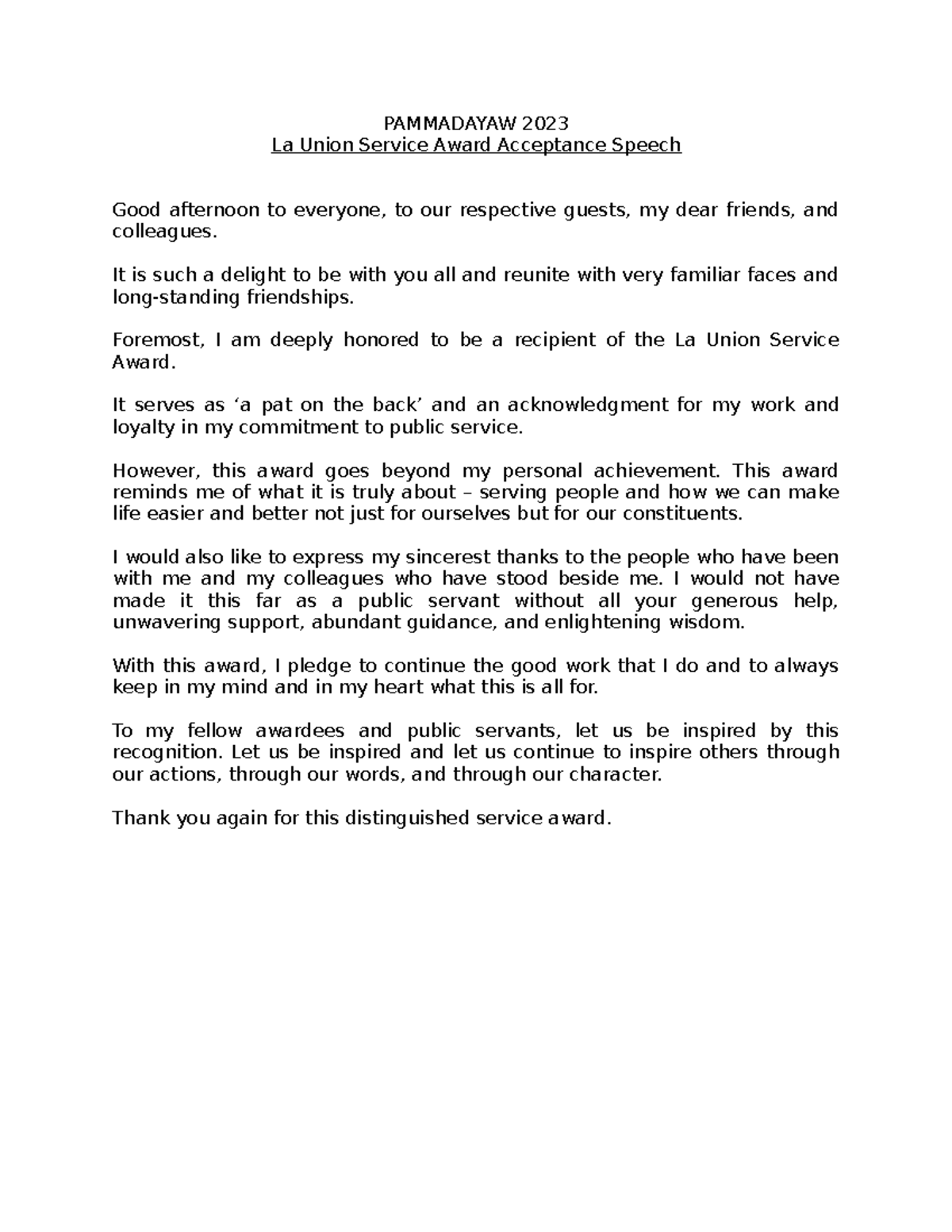
"Thank you so much to the Executive Committee and the Board for this incredible honor. Standing here among such talented nominees—many of whom I’ve had the privilege of collaborating with this year—is truly humbling.
When we started the 'Project Nexus' initiative last January, we didn't do it for the accolades; we did it because we saw a gap in how we serve our clients. There were nights at 2:00 AM when the data didn't make sense and the path forward was unclear. But it was the resilience of the Strategy Team—specifically Sarah Jenkins and Marcus Thorne—that kept us moving.
This award belongs to the entire department. It’s a testament to what happens when we stop working in silos and start working as a unified front. I am more energized than ever to see where we take our 2027 initiatives. Thank you for this recognition and for your continued trust."
Example 2: Community Service or Volunteer Award
Context: Receiving recognition for non-profit work or community leadership.
"I am deeply moved to receive the Community Beacon Award tonight. To the [Organization Name], thank you for providing the platform that allows us to do this vital work.
I’m often asked why I spend my weekends at the community garden or the youth center. The truth is, I do it because I’ve seen the impact firsthand. Last month, a young student named Leo told me that having a safe place to study after school changed his entire outlook on his future. That is the real award.
I want to thank my family for supporting the long hours, and my fellow volunteers who are the hands and feet of this mission. This trophy will sit in our center as a reminder that every small action contributes to a larger change. Let’s keep building together. Thank you."
Example 3: Creative or Academic Achievement Award
Context: Receiving an award for a publication, research paper, or artistic work.
"It is a profound honor to be recognized by the [Association Name]. Writing [Title of Work] was a five-year journey of discovery, frustration, and ultimately, joy.
I want to thank my editor, Elena, for her relentless pursuit of clarity, and the University for the grant that made this research possible. We often think of writing or research as a solitary act, but it is actually a conversation between the past and the future.
I hope this work sparks further dialogue in our field and encourages the next generation of researchers to ask the difficult questions. Thank you for valuing this contribution and for this wonderful evening."
Common Pitfalls to Avoid During an Award Reception
Even seasoned speakers can make mistakes when the adrenaline of a win hits. Awareness of these common errors will help you maintain your professional reputation.
- The "Shopping List" Gratitude: Avoid listing 20 people by name. The audience will tune out by name five. Group them by category (e.g., "The marketing team," "my extended family").
- Excessive Humility: Constantly saying "I don't deserve this" can inadvertently insult the judges who decided you did deserve it. Accept the award with a simple "I am honored" or "I am grateful."
- Inside Jokes: Avoid jokes that only three people in the front row will understand. If the 300 other people in the room don't get the punchline, you create a sense of exclusion.
- Political or Social Soapboxing: Unless the award is specifically for activism, be cautious about using your 90 seconds to pivot to a controversial topic. While you have the platform, alienating half the room can overshadow your achievement.
- Checking the Time: Never look at your watch while on stage. It signals to the audience that you’d rather be somewhere else. Trust your preparation to keep you within the time limit.
Refining Your Presence and Delivery
Beyond the words on the page, your physical presence dictates how the speech is received. In the 2026 professional environment, "presence" is defined by groundedness and clarity. When your name is called, take a moment to breathe before you stand up. Walk to the stage at a measured pace; there is no need to sprint.
Once at the podium, set the award down if it is heavy. This frees up your hands for natural gesturing. Adjust the microphone if necessary—nothing ruins a great speech like the audience only hearing every third word. Speak slightly slower than you think you need to. The acoustics of large halls often create an echo, and speaking quickly will make your words muddy.
If you are using a teleprompter or notes, keep your chin up. Looking down for extended periods can muffle your voice and break the connection with the audience. Finally, remember to smile. An award is a celebration, and your facial expressions should reflect the joy of the occasion.
How do I handle a surprise win if I haven't prepared a speech?
Stay calm and stick to a three-part "Emergency Structure": First, express genuine surprise and thanks to the organization. Second, acknowledge the team or people you work with daily. Third, state what the honor means to you personally in one sentence. Keep it under 60 seconds. A short, sincere "unprepared" speech is always better than a long, rambling one.
Is it okay to use humor in an acceptance speech?
Yes, humor is an excellent way to break the ice and make you more relatable. Self-deprecating humor (making fun of yourself) is generally the safest and most effective. However, avoid "punching down" or making jokes at the expense of others, even in jest. If you aren't naturally funny, don't force it; a sincere, heartfelt speech is more valuable than a failed comedy routine.
Who should I thank first?
The standard protocol is to thank the awarding body or the person who presented the award first. This establishes the context for why you are on stage. Following that, thank your primary supporters (employers, mentors, or partners) and finish with a brief nod to your family if appropriate for the setting.
What should I do if I forget someone important?
If you realize you missed a key person immediately after leaving the stage, don't panic. You can acknowledge them privately later, or if there is a social media follow-up or an "acceptance photo" posted online, use that opportunity to tag them and express your gratitude publicly. In the moment, the audience won't know you missed someone, so don't call attention to the mistake while on the mic.
Strategic Next Steps for Award Recipients
Once the ceremony is over, your responsibilities as a recipient continue. In the days following the event, send personalized thank-you notes (handwritten or formal email) to the individuals you mentioned in your speech. This reinforces the relationships and shows that your gratitude wasn't just for show.
Additionally, update your professional profiles—such as LinkedIn or your corporate bio—to reflect the new honor. Sharing a short clip of your speech or a photo of the ceremony on professional networks is a standard way to leverage the award for career growth in 2026. Use the momentum from the win to kickstart your next project or to mentor someone else in your field, paying the honor forward.