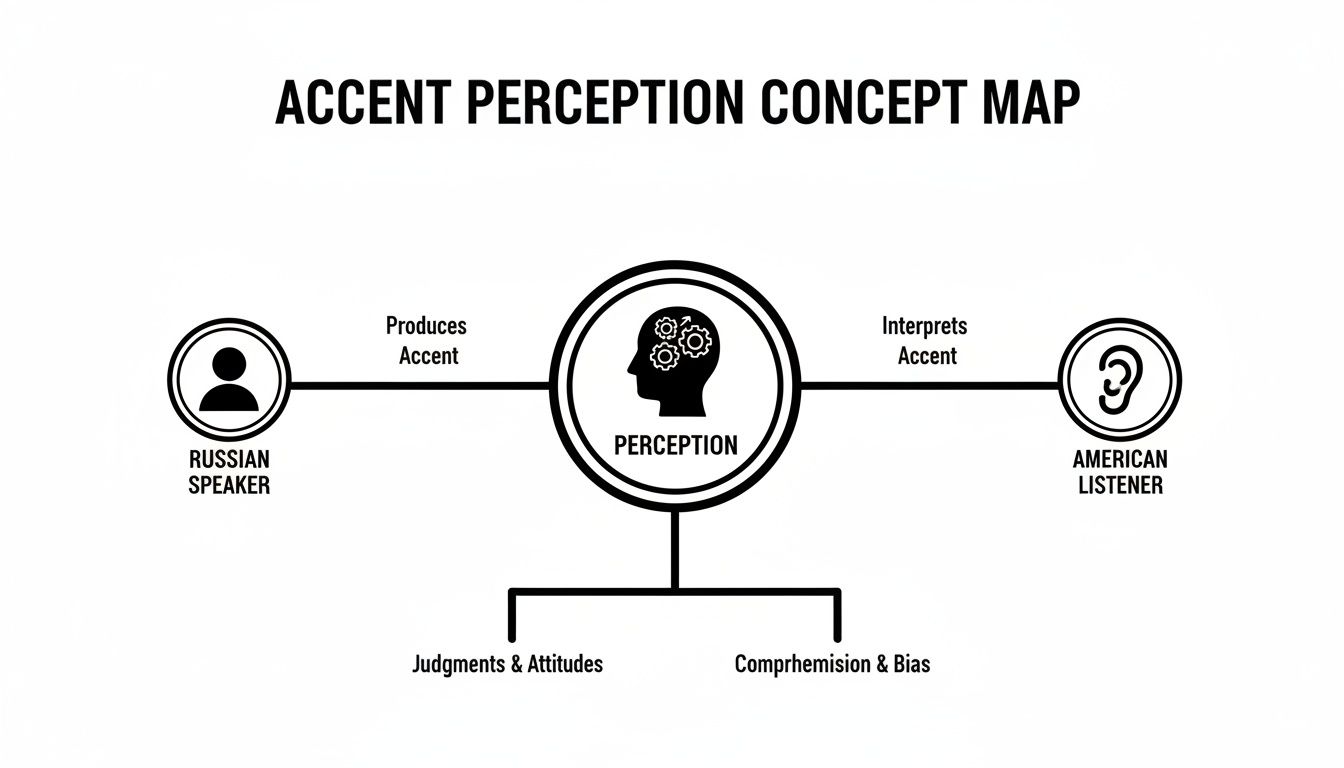
Accent perception is the cognitive and social process by which listeners categorize speech patterns based on phonetic variations. It involves identifying a speaker’s geographic or social origin while simultaneously evaluating their intelligibility. This process is heavily influenced by the listener's own linguistic background, expectations, and implicit biases regarding specific groups.
The Cognitive Architecture of Accent Perception
To understand how we perceive accents, we must distinguish between the physical signal of speech and the mental representation formed by the listener. Accent perception is not a passive recording of sound; it is an active, constructive process. When a person speaks, the listener's brain performs two simultaneous tasks: decoding the linguistic content (what is being said) and processing the indexical information (who is saying it).
The brain relies on a combination of bottom-up and top-down processing. Bottom-up processing involves the acoustic analysis of phonemes—the smallest units of sound. In 2026, neurological research continues to affirm that listeners who are frequently exposed to diverse phonetic patterns develop more flexible "phonetic categories." This allows them to map unfamiliar pronunciations onto known words more efficiently. Conversely, top-down processing involves the listener’s expectations. If a listener expects a speaker to have a certain accent based on their appearance or name, their brain may actually "hear" that accent, even if it is not present. This phenomenon, known as "reverse linguistic stereotyping," demonstrates that accent perception is often as much about the listener’s mind as it is about the speaker’s voice.
Intelligibility, Comprehensibility, and Accentedness
In the field of sociolinguistics, researchers categorize accent perception into three distinct dimensions. Understanding the difference between these is crucial for educators, employers, and communication specialists.
- Intelligibility: This refers to the actual degree to which a listener understands the words being spoken. It is often measured through transcription tasks where a listener writes down what they hear.
- Comprehensibility: This is the listener’s perception of how difficult or easy it is to understand the speaker. A speaker might be 100% intelligible (the listener gets every word) but have low comprehensibility (the listener feels they have to work very hard to understand).
- Accentedness: This is a purely subjective judgment of how different a speaker’s accent sounds compared to the listener’s own speech or a perceived "standard."
It is a common misconception that high accentedness automatically leads to low intelligibility. Research consistently shows that listeners can understand highly accented speech perfectly well, provided they are motivated to listen and have some level of familiarity with the phonetic variations.
The Social Weight of Linguistic Profiling
Accent perception is rarely a neutral act. Because accents are tied to identity, they often trigger social categorization and prejudice. This is referred to as linguistic profiling. In social psychology, the "standard language ideology" suggests that certain accents (usually those associated with power, wealth, or the capital city) are perceived as "accentless" or "correct," while others are seen as "deviant" or "uneducated."
By 2026, the global workforce has become increasingly interconnected, yet accent-based discrimination remains a documented challenge. Studies in workplace dynamics show that "prestige" accents—such as Received Pronunciation in the UK or General American in the US—are often unfairly correlated with higher levels of competence and leadership potential. Meanwhile, regional or non-native accents may be associated with lower status, regardless of the speaker’s actual qualifications. This bias is often unconscious; listeners may not realize that their perception of a speaker's intelligence is being filtered through a phonetic lens.
Factors Influencing How We Perceive Speech
Several variables dictate how an accent is received in any given interaction. These factors can either bridge the gap of understanding or widen the divide of bias.
Listener Familiarity and Exposure
The "Interlanguage Speech Intelligibility Benefit" suggests that non-native listeners often find it easier to understand other non-native speakers who share their first language than they do native speakers. For native speakers, exposure is the most powerful tool for improving perception. Those who live in multicultural hubs or work in international environments develop a higher "perceptual flexibility," allowing them to decode various accents with minimal cognitive load.
Visual Cues and Social Expectancy
As mentioned previously, what we see influences what we hear. In a famous experiment, listeners were played a recording of a standard English accent while being shown a photo of a person from a different ethnic background. Many listeners reported hearing a foreign accent and scored lower on comprehension tests, despite the audio being perfectly standard. This highlights that accent perception is a multimodal experience involving both auditory and visual inputs.
The Role of "Listener Effort"
Accent perception is also a matter of psychological will. If a listener feels "linguistic insecurity" or is prejudiced against a speaker’s group, they may subconsciously withdraw the effort required to process the speech. This results in a self-fulfilling prophecy where the listener claims they "cannot understand" the speaker, when in reality, they have stopped trying to engage with the phonetic variations.
Accent Perception in the Age of Artificial Intelligence
As of 2026, the intersection of human accent perception and machine learning has reached a critical juncture. Voice-activated systems, transcription AI, and real-time translation tools must navigate the same phonetic complexities that humans do.
Early iterations of AI often struggled with "non-standard" accents, leading to what technologists call "algorithmic bias." If an AI is trained primarily on "standard" voices, it fails to perceive the nuances of regional or non-native speech. Current 2026 standards in AI development prioritize "dialectal robustness," ensuring that speech recognition software is trained on diverse datasets. However, there is a secondary effect: as humans interact more with AI voices, our own perception of what sounds "natural" or "authoritative" is shifting. We are beginning to perceive "AI-neutral" speech as a new kind of standard, which may further marginalize unique regional accents.
Comparing Perceptual Dimensions
The following table summarizes the key differences in how we evaluate and categorize speech patterns during the perception process.
| Dimension | Definition | Measurement Method | Subjectivity Level |
|---|---|---|---|
| Intelligibility | Actual understanding of the message. | Transcription accuracy. | Low (Objective) |
| Comprehensibility | Perceived ease of understanding. | Likert scales (1-9 rating). | Moderate |
| Accentedness | Perceived distance from the norm. | Comparative judgment. | High |
| Social Prestige | Perceived status of the speaker. | Implicit Association Tests (IAT). | Very High |
| Indexicality | Identification of speaker traits (age, origin). | Categorization tasks. | Variable |
Mitigating Bias in Professional and Educational Settings
Given the deep-seated nature of accent perception, organizations in 2026 are moving toward "linguistic inclusion" strategies. Rather than focusing on "accent reduction" (which places the burden on the speaker), the focus has shifted to "ear training" for the listener.
- Implicit Bias Training: Recognizing that we all categorize people based on their speech is the first step. Awareness programs help recruiters and managers decouple "fluency" from "competency."
- Shared Responsibility: Communication is a two-way street. In professional settings, the burden of being understood should not rest solely on the non-native or regional speaker. Listeners are encouraged to practice active listening and ask clarifying questions rather than dismissing speech as "incomprehensible."
- Standardizing Evaluations: In interviews, using structured rubrics that focus on specific content and outcomes—rather than "communication style"—can help filter out phonetic prejudice.
Frequently Asked Questions
Can you "unlearn" a negative perception of an accent?
Yes. Negative perceptions are typically based on stereotypes rather than the sounds themselves. Increased positive social interaction with speakers of a particular accent, combined with conscious effort to recognize bias, can significantly alter how that accent is perceived over time. Neuroplasticity allows the brain to update its social and phonetic maps well into adulthood.
Does a strong accent always mean a speaker is less fluent?
Not at all. Fluency refers to the flow, vocabulary, and grammatical correctness of speech, while accent refers to the phonetic delivery. A person can be highly fluent, possessing a massive vocabulary and perfect syntax, while still maintaining the phonetic markers of their first language or home region. Confusion between the two is a common perceptual error.
Why do some accents sound "musical" while others sound "harsh"?
These judgments are purely aesthetic and socially constructed. There is no biological or linguistic basis for an accent being inherently "harsh" or "musical." These perceptions usually stem from the listener's cultural associations. For example, if a culture associates a specific region with classical music or romance, its accent is often perceived as "melodic."
How does "accent mimicry" affect perception?
Subconscious mimicry, or the "chameleon effect," often occurs when a listener likes a speaker and wants to build rapport. When we subconsciously align our speech patterns with another person, it typically improves the speaker's perception of us, as it signals empathy and social cohesion. However, intentional or poorly executed mimicry can be perceived as mocking or offensive.
Is there such a thing as a "neutral" accent?
Linguistically, no. Every human being who speaks has an accent. What is commonly called a "neutral" accent is simply the accent of the group that holds the most social, media, or political power in a given region. Because it is the "norm" for that environment, it becomes invisible to the people who live there.
Towards a More Inclusive Linguistic Future
As we navigate 2026, the focus on accent perception must move toward empathy and cognitive flexibility. Understanding that our ears are filtered by our histories, biases, and expectations allows us to communicate more effectively in a globalized world. The goal is not to eliminate accents—which are rich markers of human heritage—but to eliminate the barriers of prejudice that often accompany them.
For individuals looking to improve their own perception, the best action is diversified exposure. Listening to international news, engaging with diverse media, and participating in cross-cultural dialogues trains the brain to handle phonetic variety with ease. For organizations, the path forward involves structural changes that recognize linguistic diversity as an asset rather than a hurdle. By prioritizing intelligibility over "standard" pronunciation, we create a society where what is said is finally given more weight than the phonetic melody used to say it.