Academic libraries serve as the intellectual hubs of colleges, universities, and research institutes, providing specialized collections, expert research consultation, and collaborative spaces. Rather than functioning simply as book repositories, modern academic libraries anchor higher education by stewarding research data, negotiating scholarly publishing agreements, preserving cultural heritage, and teaching information literacy across undergraduate, graduate, and faculty levels.
Core Functions and Structural Evolution
The mandate of an academic library centers on advancing the teaching, learning, and research missions of its parent institution. While early university libraries focused primarily on accumulating and safeguarding rare physical manuscripts and print volumes, contemporary facilities operate as hybrid institutions. They balance physical monographs, special collections, and extensive archives with petabytes of licensed digital journals, streaming media, institutional repositories, and advanced computational datasets.
The governance structure of an academic library typically places it under the academic affairs division of a university, led by a Dean of Libraries, University Librarian, or Director of Library Services. Professional librarians within these systems frequently hold faculty status or specialized academic professional appointments, possessing Master of Library and Information Science (MLIS) degrees alongside disciplinary doctorates or subject-area master's degrees. This specialized expertise allows librarians to collaborate directly with teaching departments, sit on curriculum committees, and partner on externally funded research grants.
Budgetary allocations reflect this operational shift. Print collection expenditures have steadily declined as a percentage of total acquisition spending across higher education, replaced by recurring subscription licenses for multidisciplinary research databases (such as Scopus, Web of Science, and PubMed), publisher packages, and open-access funding models. Concurrently, operational investments increasingly fund specialized personnel, including data visualization consultants, copyright specialists, digital humanities coordinators, and metadata systems engineers.
Key Services: From Information Literacy to Research Data Management
Academic libraries provide specialized programming and technical infrastructure designed to support every phase of the scholarship lifecycle. Rather than offering passive reference desks, modern academic libraries deliver targeted research intervention services.
Information Literacy and Curricular Integration
Information literacy instruction represents one of the most critical instructional functions in post-secondary education. Librarians teach credit-bearing courses, lead course-integrated workshops, and embed directly into digital learning management systems (LMS) such as Canvas, Blackboard, or Moodle. Following frameworks such as the Association of College and Research Libraries (ACRL) Framework for Information Literacy for Higher Education, this instruction moves beyond basic keyword searching. It trains students to:
- Evaluate algorithmic bias, source credibility, and disciplinary peer review standards.
- Navigate paywalls through legal library-provided pathways and open-access repositories.
- Synthesize primary historical sources with secondary and tertiary scholarly commentary.
- Master citation ethics, bibliographic management tools (like Zotero, EndNote, and Mendeley), and academic integrity standards.
Research Data Management (RDM) and Open Scholarship
Major federal and private granting agencies—including the U.S. National Science Foundation (NSF), the National Institutes of Health (NIH), and European Horizon frameworks—mandate transparent data availability and strict public access plans. Academic libraries have stepped in to build the infrastructure and consultation services needed to satisfy these compliance standards.
Subject and data librarians assist researchers with developing Data Management and Sharing Plans (DMSPs) prior to grant submission. They advise on file naming standards, non-proprietary file formats, FAIR principles (Findable, Accessible, Interoperable, and Reusable), and disciplinary data repositories. Post-publication, library platforms ensure research datasets receive persistent identifiers, such as Digital Object Identifiers (DOIs), enabling long-term citation, attribution, and algorithmic discovery.
Digital Preservation and Institutional Repositories
Institutional repositories (IRs) managed by academic libraries collect, preserve, and showcase the scholarly output of a university. Built on platforms such as DSpace, Digital Commons, or Samvera, these repositories store:
- Electronic theses and dissertations (ETDs).
- Open-access preprints and post-prints of faculty journal articles.
- Grey literature, conference proceedings, and working technical papers.
- Digitized campus archives, oral histories, and institutional records.
By cataloging this output with standardized schema (such as Dublin Core and MARC21), the library makes university research freely accessible to global scholars who lack commercial database subscriptions, dramatically expanding institutional citation rates and prestige.
Comparative Matrix: Library Types and Institutional Roles
Understanding how academic libraries operate requires contrasting their institutional scope, funding mechanisms, and user bases with those of public, special, and national libraries.
| Feature / Dimension | Academic Library | Public Library | Special / Corporate Library | National Library |
|---|---|---|---|---|
| Primary Mission | Support higher education curricula, faculty research, and institutional scholarship. | Support lifelong learning, community literacy, and civic engagement. | Support targeted strategic goals of a private firm, NGO, hospital, or law practice. | Preserve national heritage, comprehensive legal deposit, and national bibliography. |
| Primary User Base | Enrolled undergraduate and graduate students, faculty, and affiliated researchers. | General public, families, local residents, and community organizations. | Employees, corporate researchers, attorneys, or clinical medical staff. | Scholars, government agencies, and the global public. |
| Collection Profile | Highly specialized scholarly journals, academic monographs, datasets, and archives. | Popular fiction, nonfiction, community resources, youth literature, and basic media. | Proprietary reports, specialized trade publications, regulatory filings, and patents. | Exhaustive national copyright deposits, historical archives, and cultural artifacts. |
| Funding Structure | University tuition revenue, state appropriations, endowments, and indirect research costs. | Local municipal property taxes, state aid, and civic donor foundations. | Corporate operating budgets, billable department charge-backs, or firm revenues. | Direct federal government tax revenue and legislative appropriations. |
| Instructional Focus | Disciplinary research methods, citation mechanics, and information literacy frameworks. | Early childhood literacy, digital basics, ESL classes, and job-search assistance. | Specialized competitive intelligence, business research, and compliance reporting. | High-level bibliographic standards, rare document handling, and curation workshops. |
Scholarly Communication and Collection Economics
The economic landscape of academic publishing has undergone intense friction over subscription pricing, access rights, and intellectual property. The rising price of commercial journal bundles—often termed the "serials crisis"—prompted academic libraries to adopt assertive, innovative collection strategies.
Transformative Agreements and Open Access
Rather than paying solely for paywalled "read" access to scholarly journals, academic library consortia increasingly negotiate transformative agreements (often called "Read and Publish" agreements). Under these contracts:
- The institution pays a single combined fee that covers campus-wide journal reading access.
- The agreement waives or offsets Article Processing Charges (APCs) for affiliated faculty and graduate students publishing open-access articles in those journals.
This model transitions institutional funds away from maintaining paywalls and toward subsidizing universal open dissemination. Academic libraries also advocate for "Green Open Access" by educating researchers on their rights under institutional open-access policies, allowing authors to deposit accepted manuscripts into local repositories regardless of commercial publisher copyright transfers.
Demand-Driven and Evidence-Based Acquisition
To optimize acquisition budgets, libraries employ algorithmic collection models alongside traditional subject-selector curation:
- Demand-Driven Acquisition (DDA): Digital monograph records are loaded into the library catalog. A purchase triggers automatically only after users access a title a specific number of times or browse beyond a set page threshold.
- Evidence-Based Acquisition (EBA): The library pays an upfront fee for access to a vast publisher catalog over a specified period. At the end of the term, librarians analyze granular usage analytics to determine which titles are permanently acquired using the committed funds.
Physical Architecture: Blended Learning and Computational Spaces
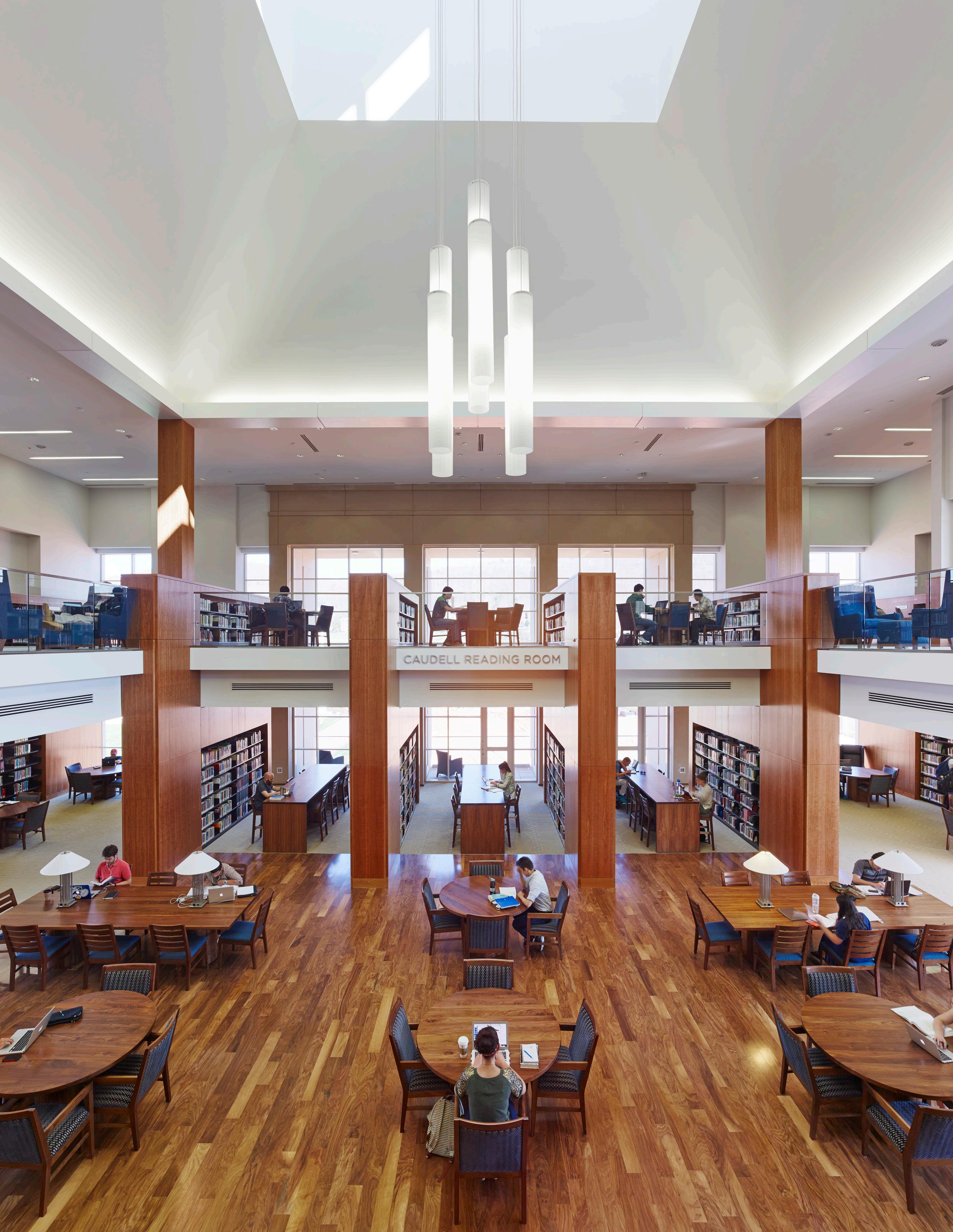
The transformation of research methods has reshaped the physical floor plans of university libraries. While high-density off-site storage facilities and compact mobile shelving house less frequently consulted print volumes, primary campus library footprints have been reimagined to support active learning.
Modern academic library spaces balance distinct environmental zones:
Collaborative and Technology-Enhanced Hubs
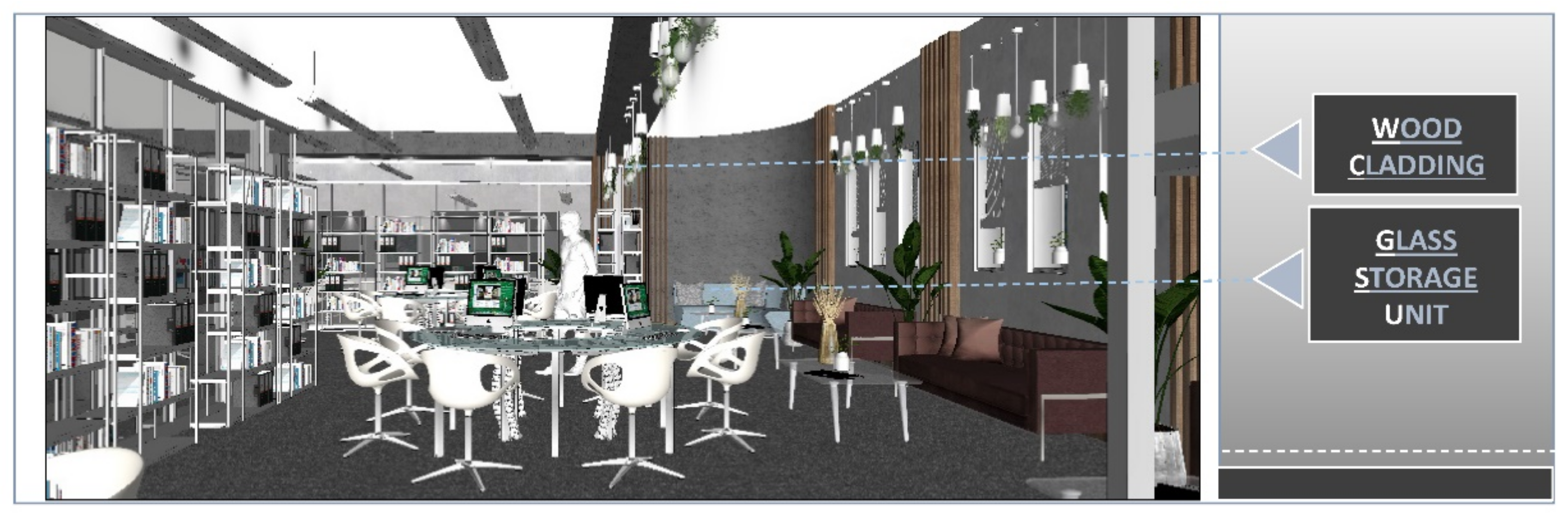
These active areas provide reconfigurable furniture, interactive digital displays, and collaborative software suites. They frequently co-locate academic support services—such as writing centers, tutoring desks, and career advisory stations—creating an integrated student success commons. Specialized computational spaces include:
- Makerspaces and FabLabs: Equipped with 3D printers, laser cutters, microcontrollers, and virtual reality gear to support multidisciplinary prototyping.
- Data Visualization Labs: High-resolution digital video walls and analytical workstations configured for geographic information systems (GIS), big data modeling, and qualitative coding software (such as NVivo and ATLAS.ti).
- Multimedia Production Studios: Acoustic isolation booths and studios for student and faculty podcasting, lecture recording, and video editing.
Quiet and Archival Research Environments
Despite the rise of collaborative zones, the demand for silent, distraction-free study remains constant. Academic libraries maintain dedicated quiet reading rooms, private carrels for doctoral candidates writing dissertations, and controlled-environment reading rooms for Special Collections and University Archives. In archival spaces, rare books, personal manuscripts, and institutional records are consulted under strict environmental controls (typically 65–70°F and 30–50% relative humidity) with specialized supervision.
Navigating Academic Library Resources: Step-by-Step Research Workflow
Extracting maximum value from an academic library requires a deliberate methodological approach. University library systems operate discovery layers (such as Primo, Summon, or EDS) that index both local and remote collections.
- Institutional Single Sign-On / Campus Network
- Unified Library Discovery Layer Search
- Physical Items (Catalog Calls)
- Stacks / Reserves
- Licensed Digital Subscriptions (Full-Text Article Databases)
- Direct Full-Text Access
- (If paywalled or unavailable) Interlibrary Loan (ILL / Tipasa)
- Delivered via Secure PDF
- (If paywalled or unavailable) Interlibrary Loan (ILL / Tipasa)
- Direct Full-Text Access
- Physical Items (Catalog Calls)
Phase 1: Authentication and Catalog Discovery
- Access via Institutional Proxy or VPN: Begin research through the library's portal or with an active institutional Single Sign-On (SSO) session. Commercial databases identify the user's university IP range to unlock institutional subscriptions.
- Execute Controlled Vocabulary Searches: While standard keyword queries provide broad overviews, using Library of Congress Subject Headings (LCSH) or Medical Subject Headings (MeSH) prevents ambiguous search results and ensures systematic retrieval of all cataloged works on a discipline.
Phase 2: Disciplinary Database Exploration
Unified discovery bars search across millions of items, but they often obscure specialized search functions. Researchers should transition from the main search bar to subject-specific abstracting and indexing (A&I) databases:
- Humanities: JSTOR, Project MUSE, MLA International Bibliography.
- Sciences & Engineering: IEEE Xplore, Inspec, SciFinder-n.
- Social Sciences & Education: ERIC, PsycINFO, SSRN.
Phase 3: Utilizing Resource Sharing and Interlibrary Loan (ILL)
No single academic library can purchase every published volume or journal issue. When a needed resource is not directly accessible:
- Locate the document's complete bibliographic metadata (author, title, ISBN/ISSN, DOI).
- Submit a request through the library’s Interlibrary Loan (ILL) system (commonly powered by platforms like ILLiad or Tipasa).
- The host library leverages global consortial partnerships (such as the Big Ten Academic Alliance, Orbis Cascade, or OCLC's WorldShare) to obtain digital copies—typically delivered within 24 to 72 hours—or physical books shipped across institutions at zero or minimal direct cost to the user.
Frequently Asked Questions
What is the difference between an academic library and a public library?
An academic library exists primarily to advance higher education instruction, student coursework, and academic research at an affiliated institution. Its collections focus on peer-reviewed monographs, specialized datasets, scientific journals, and historical archives. A public library is funded by local tax dollars to serve a municipal or county community, focusing on literacy development, recreational reading, popular media, civic services, and general reference.
Can individuals not enrolled at a university access its academic library?
Access policies vary by institution and funding structure. Publicly funded state universities typically grant open physical access to community members, allowing on-site reading of print volumes and public workstation use for database research. Private universities often restrict physical entry to card-carrying students, staff, faculty, and authorized visiting researchers. Remote off-campus access to licensed online journals is almost universally restricted to current affiliates due to publisher licensing agreements.
How do librarians decide what materials to purchase for an academic library?
Collection development combines data analytics and academic consultation. Subject specialist librarians assess university course offerings, new degree programs, and ongoing faculty research projects. They analyze digital usage statistics, cost-per-use metrics, and student ILL requests, while employing evidence-based acquisitions (EBA) and demand-driven acquisitions (DDA) to systematically purchase items that demonstrate clear campus demand.
What is an institutional repository, and why is it important?
An institutional repository (IR) is an open-access digital archive managed by an academic library to curate, preserve, and distribute the scholarly output of its university. Repositories host journal post-prints, conference presentations, master's theses, doctoral dissertations, datasets, and institutional historical files. They ensure scholarship is permanently accessible to global researchers without financial paywalls, increasing citation visibility and institutional impact.
How does Interlibrary Loan (ILL) work?
Interlibrary Loan is a cooperative resource-sharing network through which libraries lend materials to one another. If a researcher requires a book chapter, article, or print volume not owned by their institution, the local library places an electronic request with partner libraries worldwide. The lending library scans the document or ships the volume to the requesting library, which delivers the file or book to the researcher.
Optimizing Institutional Research: Strategic Actions for Scholars
To make the most of academic library resources, students, faculty, and independent scholars should integrate professional library services into their regular workflows rather than treating the library as an occasional study space or simple search box.
Begin by identifying your Subject Specialist Librarian. Academic libraries assign liaison librarians to specific academic departments (such as Chemistry, History, or Business). These specialists provide customized literature review strategies, advise on data management plans for grant proposals, recommend suitable publication venues, and coordinate collection acquisitions tailored to your thesis or research lab.
Second, schedule an annual audit of your research footprint. Partner with library scholarly communication teams to review your profiles on platforms like ORCID, Google Scholar, and your institutional repository. Ensuring your publications, datasets, and preprints are correctly linked to your persistent identifiers expands the discoverability, citation reliability, and open-access compliance of your academic work.